






evangelický kostel v Třebíči Church
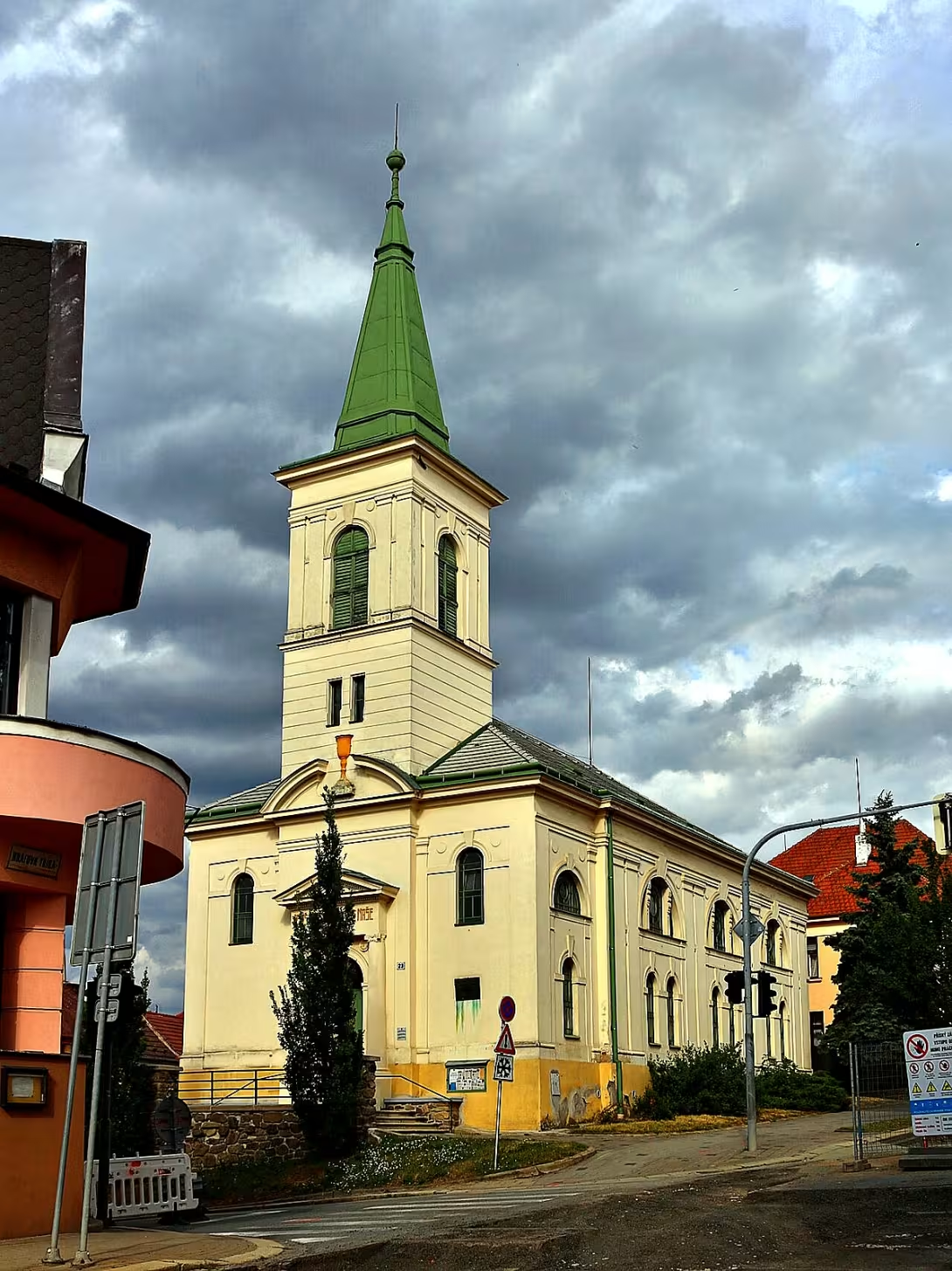
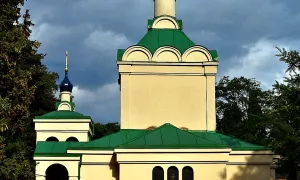
Church of Evangelists in Třebíči stands on Brother's class and belongs to the Choir of the Czech Brotherhood Church Evangelical. Its creation follows a long tradition of Protestantism in the region. In 1897, a Brotherhood Unity was founded in Třebíči; Five years later, the city of Třebíč sold land for the construction of a brotherly prayer house. The original intention was to set up the collection house according to the design of architect Jurkovic, but later decided to build the temple. The construction permit was extended from 1903 and a plan was selected for construction from the Viennese architect Zlatohlavka. The builder was the local company Kosik.
The construction of the church lasted from September 1909 to 1910, when the temple was completed and on 12th August it collapsed. The internal equipment was provided by the Brno company K. Pears and also installed electrical wiring, which was still exceptional in such an early period. On 15 August 1910 the ceremonial opening and sanctification of the church took place; ceremony present superintendent Ferdinand Císař and ceremonial sermon led by Josef Dobeš from New Town. Apart from the church itself, there was also a neighboring choir house with a parish. It started in the spring of 1928 and until the last day of the year of the same year it was collaborated; It contained a church and parish apartment, a room for biblical education, and the so-called Tardy Hall for a larger gathering.
The war and postwar periods have resulted in considerable interference with the construction. During the First World War, organ whistles and brass mound were seized; The rest of the precious metals were protected by the congregation by laying in the garden of the rectory. In November 1919 he initiated the formation of his separate congregation which was approved at the end of March 1920. A memorial plaque dedicated to three centuries since the gospels' departure into exile was revealed on 13 October 1929; during World War II, it was covered and the building marked with honorary and German inscriptions. The record was rediscovered in early 1946.
The second half of the 20th century brought a long series of renovations. Since 1947 there have been extensive repairs of the facade, the organ has been restored in the following years, the electrical network has been modified (220 volts have been transferred to summer 1949), and building status has been gradually improved including interior painting. The complex reconstruction of the organ took place in 1983, when a historical tool from 1849 was introduced. In the summer of 1988, the choir house obtained gas treatment.
Church architecture reflects the evangelical tradition of modesty. The tower without bells rises from the west front above the main entrance. The interior consists of a single ship with three rows of altar-oriented benches and a pulpit. The decoration remains evangelically simple. On the wall next to the entrance, the commemorative plate from 1915 commemorates the fifth anniversary of the burning of Master Jan Hus. Part of the church is a commemorative plaque dedicated to three centuries since the mass departure of Czech brothers from Třebíč to exile.
The visitor in the church will find authentic evidence of the restoration of the Czech Protestant community in the 20th century - from its founding in the epoch of national awakening to the war trials to the carefully guarded restoration in the hands of the religious congregation.
Then and now
Drag the slider to compare how the landmark may have looked when it was built with the view today.
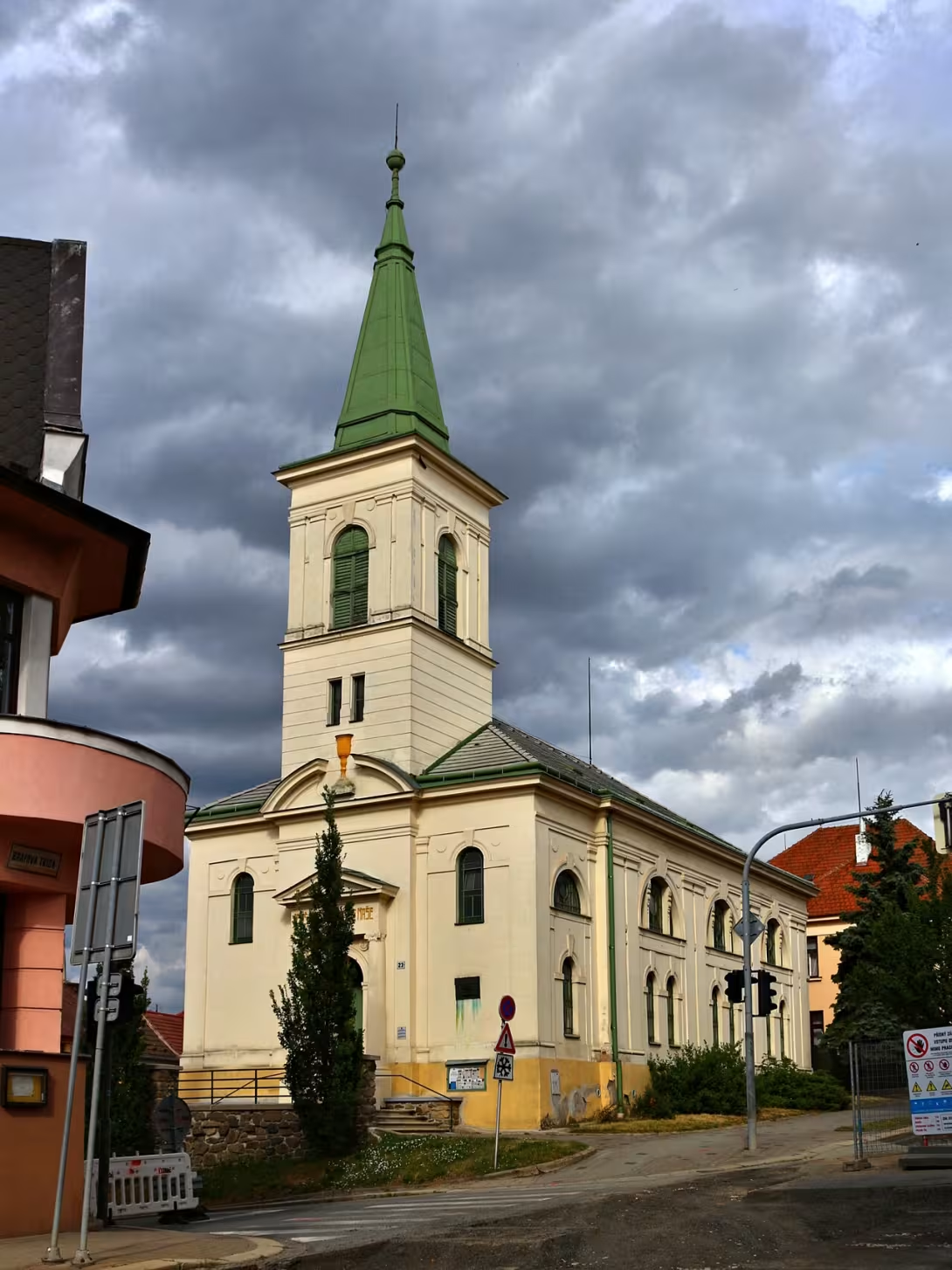

The historical appearance on the left is an AI-generated visualisation and serves as inspiration only.
Historical milestones
- 1897
- Establishing a fraternity in Třebíči.
- 1909
- The beginning of the construction of the church according to the design of architect Zlatohlavka.
- 1910
- Completion and approval of the church, opening ceremony on 15th August.
- 1919
- Application for the establishment of a separate body, approved in March 1920.
- 1928
- Completion of the building of the choir house (rectory).
- 1946
- Unveiling the memorial plate
Architectural development
The church was built according to the design of the Viennese architect Zlatohlavík in 1909-1910. It is a single-boat building with a tower above the west front, without bells. The internal equipment and organ dates back to the period after 1910, when they were installed by the Brno company K. Pears. In the 1950s, extensive reconstruction of the interior and facade took place, further repairs were carried out in the 1970s and 1980s, including reconstruction of the organ and facade.
Historical events
- 1910
- The ceremonial opening and sanctification of the church with the participation of Superintendent Ferdinand the Emperor.
- 1919
- Establishing a separate evangelical choir in Třebíči.
- 1942
- The church was marked by German and Czech inscription during World War II and the commemorative plate from 1929 was covered.
Owners
Choir of the Czech Brotherhood Church Evangelical in Třebíči.
Points of interest
- The church was built in the years 1909-1910 according to the plan of the Viennese architect Zlatohlavák, with the construction provided by the local company Kosík.
- In the interior there is a commemorative plaque from 1915 commemorating the 500 anniversary of the burning of Master Jan Hus.
- During World War I, the church was seized by organ whistles and brass pointer, remaining valuable objects hidden in the garden of the rectory.
Guide
This guide is narrated by a synthetic voice generated by artificial intelligence.
Show guide text
This text was created by artificial intelligence and has not been editorially reviewed. It may contain inaccuracies.
Welcome to this quiet but deeply symbolic place - the evangelical church in Třebíči at Brat's class. You are facing a simple but distinctive sacral structure that reflects the spirit and tradition of Czech Protestantism. Its simple shapes and modest architecture are not random - every detail here talks about faith, determination and the history of people who have found a spiritual home. Let's go together and see what this monument can tell us.
The first impression that will fill you here is a sense of peace and focus. In front of you is a single-boat church built in the years nineteen hundred nine to ten. Its creation is closely linked to the history of the Brotherly Unity, which established its association here in 18 hundred and ninety-seven. It was a time when the Czech Protestant religion was awakened again after centuries of persecution, and the Three-Bik believers wanted to have their own place where they could freely confess their faith. The church became not only a place of worship, but also a symbol of freedom and resistance to oppression.
Look at the front of the church. Its simple lines and absence of decorated facades reflect a Protestant tradition that emphasizes modesty and directness. The construction was designed by the Viennese architect Zlatohlavek, but was realized by the local company Kosík. The church was completed in nineteen hundred and ten and ceremonially opened on the 15th of August of that year. Its interior is as simple as the exterior - without demanding decorations, but with an atmosphere that encourages thought. Notice how light penetrates glass windows and reflects from smooth walls. This space was designed so that no one distracted attention from the most important: the words of God and the common prayer.
Now pay attention to some of the key moments that have taken place here. In nineteen hundred and nineteen local believers submitted a request to establish a separate congregation, which was only approved in March of the following year. This was an important step to enable the Three-Bik Gospels to fully live their faith without foreign supervision. Later, in nineteen hundred twenty-eight, the building of the choir house was completed, which served as a parish and a place for meeting the community.
The personalities associated with this church include Ferdinand Císař, Josef Dobeš or Jiří Zejfart - people who have earned the development of the local choir and its spiritual life. Their names remind us that the church was never just a stone building, but a living place where people met with different fates, but shared faith.
Now let's look at one of the most interesting things you can see here. In the interior of the church there is a commemorative plaque from the year nineteen hundred and fifteen, which commemorates the 500 anniversary of the burning of Master Jan Hus. This gestus was very important to local evangelists - reminding them that their faith had its roots in the dedication and bravery of the ancestors who, even in difficult times, were not going to turn away from their truth. Unfortunately, during World War I, the organ was confiscated from the church, which was another heavy blow to the community. But after the war, the believers continued to rebuild and the life of the church continued.
Take another look before leaving. The church is located in a part of the city called Horka-Domky, where the calm of the city building is mixed with the feeling of history. Its simplicity and modesty may remind you that the true power of religion lies in its content, not in external manifestations. If you have time, you can also look at the nearby choir house, where there are today other monuments and documents that tell other chapters of this fascinating history.
Thank you for taking the time to stop by. This church is not only a monument to stones, but a living place where the past and present meet. Whether you're religious or just a curious visitor, we hope you've taken away at least a little of what makes this building so special. If you liked what you discovered here, you can go back or continue to explore other parts of this beautiful city. May the peace and inspiration this church offers accompany you along the way. Goodbye.
Tips for visitors
{'text': 'Best time to visit the Evangelical Church in Třebíči is in the morning when the interior is lit with natural light and there is a quieter atmosphere. The ideal is also a visit in the summer months when windows are opened and the church is driven by pleasant air. In the winter months, the indoor temperature is pleasant, but a visit in the Advent or Easter period can be emotionally richer for some visitors.'}
{'text': 'The church is available by car, parking is possible in nearby parking lots in the centre of Třebíče. It is recommended to use public transport, such as bus connections that stop near the church. The current connection and departure times are always good to check in the traffic search engine. If you arrive by car, you can use the parking lot at St. Prokop's Church, which is just a few minutes' walk away. '}
{'text': 'When visiting the church, wear comfortable clothes and shoes, as you often move in the interior on tiles with different levels. It is also appropriate to take a small laptop or mobile phone so that you can write notes or photos. If you plan a longer stay, you can bring a light snack, but you can't eat or drink in the church.'}
{'text': 'Photography is allowed in the church, but it is good to take care of respect for other visitors. The best places for photos are spacious spaces of the ship where there is enough light and space for composition. It is convenient to photograph in the natural light, for example in the morning or in the afternoon when the light is softer. In the interior, it is advisable to use lower ISO and longer exposure to minimise noise in photographs.'}
{'text': 'Around the church is worth visiting the church of St. Prokop, which is about 1.5 kilometers away. This Gothic church from the 13th century is dominated by Třebíče and offers a fascinating view of the history of the city. Another interesting thing is the Třebíč monastery complex, located about two kilometres from the church. It includes the pilgrimage church of the Assumption of the Virgin Mary and the monastery, which are ideal for those who are interested in medieval architecture and history.'}
{'text': 'For families with children, the visit to the church is particularly interesting thanks to the possibility of getting to know history and architecture in accessible form. Children can see the spacious church ship and learn more about the evangelical religion. In the vicinity of the church it is also possible to visit the church of St. Prokopa, where there are often interesting tours or workshops for children. It is also recommended to visit the Třebíč Monasteries where children can see unique frescos and historical monuments.'}
Frequently asked questions
Is evangelický kostel v Třebíči open to the public?
Yes, the church is open to the public. The opening hours are 9: 00 to 5: 00.
How do I get to the place by car / public transport?
The church is located in the center of Třebíče, so it is available by foot or bus public transport. Parking is possible on the surrounding parking areas.
How much is the entrance fee and is it paid on the spot?
Payment is made at the register of the church.
Is the tour suitable for children and seniors?
Yes, a church tour is also suitable for families with children or seniors. The church has an accessible staircase and can be adapted according to the age and ability of visitors.
How long does the tour take?
The church tour takes approximately 30-45 minutes, but visitors can spend more time around the church or have fun in the courtyard.
What are the opening times and booking is required?
The church is open from 9: 00 to 17: 00, except Tuesday days. Reservation is not necessary, but a contact message is recommended for groups over 10 persons.
What's interesting in the immediate vicinity?
In the immediate vicinity of the church is located the historical centre Třebíče, including other monuments such as the chateau or museum. There are also restaurants and cafés nearby.
For kids
Imagine going back 117 years and finding yourself in a small village called Třebíč. At that time there was a beautiful evangelical church built in 1909.
If you'd gone there, you'd have seen how the locals lived and worked in their fields. The village was completely different then. There were fields, forests and rivers all around. Local people have been farming and trading. The church was their most sacred place where weddings, funerals and prayer services were held.
Businesses nearby
Do you run a restaurant, accommodation, shop, museum, rental, wellness or other visitor service near this monument? Show yourself directly to the people heading to it — this is how they will see you in the app and on the web:
Nearby
{'memories': [{\ 'nazen': 'Church', 'type': 'church', 'distance': 'cca 1,5 km', 'description': 'Gothic church from the 13th century, a dominant monument of Třebíče.'}, {'Nazen': 'Třebíč monastery', 'type': 'monastery', 'distance': 'Park at Třebíče Chateau': 'pilgrimage church of the Assumption of the Virgin Mary': 'cca 3 km', 'description': 'Green space with historical trees': [{'nazen': 'Park at the TřebíčXXcastle', 'distance': 'cca 3 km', 'description': 'Green space with the historical trees'. '
Accommodation nearby
Themed route
Thematic cruise route from Třebíče
1. Evangelical Church in Třebíči Type: Church Why is it worth visiting: The Evangelical Church is one of the oldest evangelical sacral buildings in Moravia. Its Gothic elements and history, dating back to the 13th century, make this church an important cultural heritage.
2. Church of St. Prokop Type: Church Distance: approx. 1.5 km Why is it worth a visit: This Gothic church is the dominant element of the city panorama Třebíče. Its tall tower and rich history from the 13th century offer a view of the development of the city and its architectural past.
3. Třebíč Monasteries Type: Monastery Distance: approx. 2 km Why is it worth a visit: Třebíč Monasteries are an excellent example of premonstrator monastic life from the 13th century. The pilgrimage church of the Assumption of the Virgin Mary and the monastery itself offer a view of the rich spiritual tradition and history of this area.
4. Park at Třebíč Castle Type: Park Why is it worth a visit: This park offers a quiet space for relaxation and beautiful walks in nature. It is an ideal place to relax after exploring the historical monuments Třebíče.
This route allows you to become aware of the rich cultural and spiritual history of Třebíče, while offering the opportunity to enjoy the beautiful natural landscape of the surroundings.
Seasonal recommendations
Spring: In spring the church in Třebíči appears in its most beautiful radiation when the sun's rays illuminate its architectural details and the trees around it begin to bloom. The atmosphere is full of recovery and hope, which attracts many visitors looking for a beautiful garden path. This season we recommend visiting the memory early in the morning or late in the afternoon to avoid increasing crowds. Dress according to temperature - in spring days there may be cold wounds and heat of the afternoon sun.
Summer: For years the church is surrounded by living greenery, which gives the landscape a special peace. Long days allow you to explore the memory even in the prehistoric hours when the temperature is lighter and the crowds are less. This season we recommend to wear light clothes and protective sunglasses so that it is safe to relax while walking around the church or in the surrounding area. In the main summer season it is advisable to visit the memory earlier in the day to enjoy a lighter atmosphere.
Autumn: Autumn brings church in Třebíči golden and red palette of colors, where tree leaves form views full of peace and beauty. The atmosphere is slightly cold with fewer visitors compared to the winter period, which allows for more intimate exploration of the monument. This season it is advisable to wear top clothes and hat against cool winds, especially in late autumn. Visit the church in the morning for the best light.
Winter: Winter Třebíč offers the church a unique atmosphere with covered snow trees and calm that is present during this period. The lighting changes by daylight, giving the church a romantic view. This season we recommend wearing warm clothes and shoes with helmets to enjoy a visit without inconvenience. The monument can be visited in the morning or late afternoon hours when the temperature is lighter and the crowds are less.
Visualizations and artistic views


The visualisations are generated by artificial intelligence and serve as inspiration.
Photos from the area
Real photos taken near the monument


Zdroj a licence jsou uvedeny u každého snímku.
Atmosphere of the place
This atmospheric visualisation of the place and period was generated by artificial intelligence. It is not real footage of the location.
Tips from visitors
No tips yet. Be the first!
Log in and add your tip.
Sources and literature
Fotografie: VitVit / CC BY-SA 4.0 — Wikimedia Commons. The author and licence also appear when you hover over the image.
Faktickým podkladem tohoto textu byl článek na Wikipedii, jehož autory jsou přispěvatelé Wikipedie. Článek je dostupný pod licencí CC BY-SA 4.0.
Location on the map

Příběhy a pověsti
Legendy, pověsti a příběhy spjaté s touto památkou
Fotografie návštěvníků
Zatím žádné fotografie. Buďte první, kdo přidá fotografii z návštěvy!
Přihlaste se a přidejte svou fotografii nebo hodnoťte.
Za ověřenou návštěvu v aplikaci získáte víc bodů — poznáme podle GPS, že jste na místě.
Reviews and comments