



fara Malonty Parish house
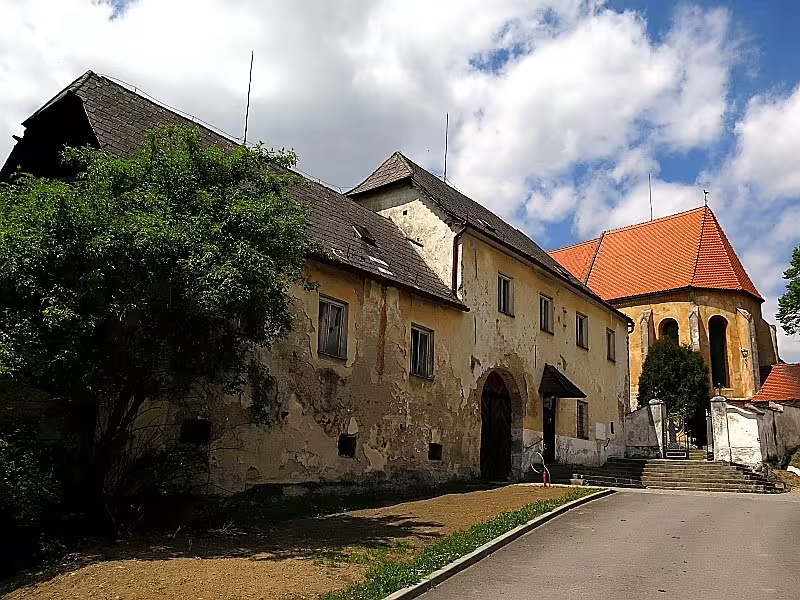
The parish of Malonty is a protected heritage complex in the district of Český Krumlov in the South Bohemian Region. The core of the complex consists of a baroque multi‑storey building, complemented by 19th‑century farm structures. This significant building is closely linked to the spiritual administration of the region and demonstrates the architectural development in the foothills of the Novohradské Mountains.
The first written mention of the Malonty parish dates from 1364, and in 1541 it is recorded in the provincial registers. During the baroque reconstruction at the beginning of the 18th century, the Czech lands were part of the Habsburg monarchy, which was recovering from wartime conflicts. In this period, baroque culture reached its height in Europe, profoundly influencing both sacred and secular architecture.
The architectural core of the site is a multi‑storey baroque building that underwent a major reconstruction between 1709 and 1710. At the end of the 19th century, specifically between 1894 and 1898, the structure was thoroughly renovated. The works also included the addition of a chapel, which, however, collapsed in 1941. The farm buildings that complete the complex mainly date from the 19th century.
The history of the parish is intertwined with a series of events that have shaped village life. In 1933 the parish, together with the church and the whole village, was electrified. In May 1945 the building was used to house members of the Red Army. Among the clergy who served at the parish from 1956 was also the Vyšebrod Cistercian Xaver Švanda.
The present‑day appearance of the complex in Malonty reflects the long‑term evolution of parish administration near the Austrian border. A visit to this site offers the opportunity to discover the region’s architectural heritage and the history that has shaped this cultural monument over the centuries.
Historical milestones
- 1364
- First written mention of the parish.
- 1710
- Completion of the baroque reconstruction of the church.
- 1898
- Completion of a thorough renovation of the building.
- 1941
- Demolition of the chapel annex built in the 19th century.
Architectural development
The original Baroque building was fundamentally rebuilt between the years 1709 and 1710. At the end of the 19th century, a thorough renovation took place, which included the addition of a small chapel; however, this chapel collapsed in the year 1941.
Historical events
The first written mention of the parish dates back to 1364. In May 1945, the rectory was used to accommodate Red Army personnel.
Points of interest
– The core of the complex is a Baroque multi-story building, complemented by 19th-century farm buildings. – The first written mention of the parish dates back to 1364, and it was recorded in the land registers in 1541. – The main building underwent a major reconstruction between 1709 and 1710 and was thoroughly renovated at the end of the 19th century. – The modifications included the addition of a chapel, which collapsed in 1941. – In 1933, the rectory was electrified, and in May 1945, it was used to accommodate soldiers.
Guide
Show guide text
This text was created by artificial intelligence and has not been editorially reviewed. It may contain inaccuracies.
Welcome to Malonty. You are standing at a place that is much more than just a collection of old buildings. It is a living witness to history, which has endured for centuries and observed how the world around it changes, generations come and go, and the landscape itself transforms. When you now look around, you will see an ensemble that carries traces from many different eras. The main point that will capture your attention is the imposing two-story building that dominates the entire area. Its presence here exudes calmness and dignity at the same time. Feel the atmosphere of peace that is deeply rooted in this place.
Let us now journey back into the past together to understand why this place is so important. The history of this parish is not short. If we wanted to find its earliest trace, we would have to go as far back as the fourteenth century. The first written mention that there was a parish here dates from 1364. Imagine the world at that time, the medieval era, when faith and spiritual care were fundamental pillars of every community. This building and its predecessors were the heart of the community, a place where people gathered in both the hardest and happiest moments of their lives. The importance of this site was confirmed later as well, for example, in 1541, when the parish was officially recorded in the land registers. This tells us that this place had a firm legal and social position in the entire region for centuries.
Now pay attention to the shape of the building you have right before your eyes. Although you see an ensemble that appears very harmonious, its face has changed many times over time. What you now observe as the main two-story building is the result of a major renovation that took place during the Baroque period, specifically around 1710. It was then that the building acquired its current majestic character. The Baroque style not only dominated architecture at that time but also the entire concept of beauty and spiritual expression. When you now look at the walls and overall structure of this object, you can feel in its lines the effort to express stability and dignity demanded by the Baroque era.
However, the main building is not just connected with spiritual aspects. The area consists of other objects that you have probably noticed. They are primarily economic buildings that mostly date from the nineteenth century. These structures tell us a different story, the story of everyday life, work, and farming. They show us that the parish was not only a place of prayer but also a place where survival had to be ensured and where the real, practical lives of people in this region took place. This contrast between the majestic two-story building and these utilitarian economic buildings creates exactly the unique atmosphere you now feel here.
We also know that the building was not abandoned or forgotten in more recent times. At the end of the nineteenth century, precisely in 1898, the entire building underwent a very thorough and extensive renovation. It was a time when the world was changing rapidly, modernization was coming, and this renovation was a way for the monument to adapt to new demands without losing its historical soul.
But to understand the human dimension of this place, we must reflect on those who worked here. Although the names of many builders remain unknown in history, records mention personalities who were key to this area. One such person was Xaver Švanda. Even if you do not know everything about him, his name is firmly linked with the history of this site and reminds us that behind every wall and stone stand specific people, their decisions, and their efforts to serve both people and God.
Now I would like to take you to something that might be a bit sadder but also very interesting. If you look around, you may wonder whether there were other buildings here that complemented this ensemble. In the nineteenth century, a small chapel was added to the main building. It was a beautiful part of the area that gave it even greater spiritual depth. Unfortunately, history brought us difficult times as well. In 1941, the chapel collapsed. This event left an indelible mark on the area and adds a certain melancholy to this place. It is a reminder of how fragile human creations can be and how much time and sudden events can change the face even of the most solid monuments.
When you look at the entire area in Malonty, realize how much this object is linked with the spiritual care of the entire region. It is not just a building; it is a symbol of continuity. From 1364 to the present day, this place has served as a focal point around which village life revolved. Every renovation, every restoration, and every change you have just heard about was a response to the needs of people who lived here.
I will not hold you back from further exploration. I recommend that you slowly walk around these buildings and try to find traces of the centuries they have spent here in each corner of the area. Notice the differences between the Baroque core and the economic structures from the nineteenth century. Try to imagine how this place looked when it was first mentioned in writing, or how it appeared at its greatest flourishing after the renovation at the end of the nineteenth century.
Thank you for spending this time with us and showing interest in the history of this site. We hope that this view of the parish in Malonty has helped you better understand its significance and beauty. We wish you an enjoyable stroll and further interesting experiences while discovering our monuments. Goodbye.
Tips for visitors
We recommend visiting Malont in late spring or early autumn when the weather in the foothills of the Novohradské Mountains is most pleasant for walks around the historic fara Malonty.
You can conveniently reach the village by car.
Take sturdy footwear suitable for moving through terrain. For photographing the baroque architecture of the fara, morning light is most suitable as it highlights the details of the facade and farm buildings.
In the vicinity, you can explore the picturesque landscape of the Novohradské Mountains. The location is ideal for families with children as a starting point for easy nature walks where children can safely discover the countryside.
Frequently asked questions
Can the monument be visited?
This is a residential or farm building, not a museum with opening hours. Please view it from public space and respect the owners' privacy. We have no information about access to the interior.
Where is the monument?
Location: Malonty. The map on this page shows the exact spot.
Why is the monument protected?
It is listed in the Central List of Cultural Monuments of the Czech Republic as a cultural monument (register no. 1000129552).
Businesses nearby
Do you run a restaurant, accommodation, shop, museum, rental, wellness or other visitor service near this monument? Show yourself directly to the people heading to it — this is how they will see you in the app and on the web:
Nearby
Obec Malonty se nachází v podhůří Novohradských hor, v blízkosti hranic s Rakouskem.
Accommodation nearby
Trips and activities nearby
Guided tours, tickets and activities nearby from GetYourGuide
Affiliate link: if you buy from the partner, we may receive a commission. The price for you does not change.
Search tours and activities →Themed route
Thematic excursion route from Malonty
1. fara Malonty (others)
Type: Historical building
Why it's worth visiting: The fara Malonty is an architectural gem with a rich history, attracting visitors with its Neoclassical design and impressive interiors. It is a starting point for discovering the local culture.
2. Church of Saint John the Baptist
Type: Religious monument
Why it's worth visiting: This church is known for its historical significance and beautiful setting in the surrounding landscape. Its architecture and interior offer a glimpse into the village's past.
3. Forest paths around Malonty
Type: Nature walk
Why it's worth visiting: Beautiful forest paths offer a peaceful walk in nature, where you can enjoy the fresh air and views of the Novohradské Mountains. It is an ideal way to immerse yourself in the area.
4. Local traditional shop
Type: Cultural experience
Why it's worth visiting: Visit the local shop to discover traditional products and experience local life. Here you will find authentic food and products that represent the region.
5. Malonty Cultural Center
Type: Cultural institution
Why it's worth visiting: The center offers a diverse program, including exhibitions and cultural events. It is a place to meet local artists and understand the culture of the area.
This route provides a comprehensive view of Malonty, combining historical, cultural, and natural elements.
Seasonal recommendations
In spring, fara Malonty glows with new greenery and blooming gardens. The soft spring light beautifully highlights the details of the historic building and creates a fresh atmosphere. We recommend dressing in layers, as the weather can be unpredictable during this period. The best time to visit is in the morning hours, when the air is freshest.
The summer season brings scorching sun and dense shade from the trees surrounding the monument. The environment is full of color and life. Due to the peak summer season, we recommend arriving early in the morning to avoid the largest crowds and the heat. Don't forget light, breathable clothing and plenty of fluids.
In autumn, the surroundings of fara Malonty turn golden and red, creating a melancholic mood. Morning mists add a sense of mystery and tranquility to the place. A waterproof coat is recommended, and it is ideal to visit the monument in the afternoon, when the sun hits at a low angle and beautifully illuminates the facade.
In winter, the monument feels hushed, especially when covered in snow. The light is cooler and the days are short, giving the place a stark yet cozy character. It is essential to wear very warm clothing and sturdy footwear.
Visualizations and artistic views

The visualisations are generated by artificial intelligence and serve as inspiration.
Photos from the area
Real photos taken near the monument


Zdroj a licence jsou uvedeny u každého snímku.
Tips from visitors
No tips yet. Be the first!
Log in and add your tip.
Sources and literature
Photos: Sovicka169 / CC BY-SA 4.0 — Wikimedia Commons. The author and licence also appear when you hover over the image.
Faktickým podkladem tohoto textu byl článek na Wikipedii, jehož autory jsou přispěvatelé Wikipedie. Článek je dostupný pod licencí CC BY-SA 4.0.
Location on the map




Příběhy a pověsti
Legendy, pověsti a příběhy spjaté s touto památkou
Fotografie návštěvníků
Zatím žádné fotografie. Buďte první, kdo přidá fotografii z návštěvy!
Log in a přidejte svou fotografii nebo hodnoťte.
Za ověřenou návštěvu v aplikaci získáte víc bodů — poznáme podle GPS, že jste na místě.
Reviews and comments