



fara s kaplankou Parish house
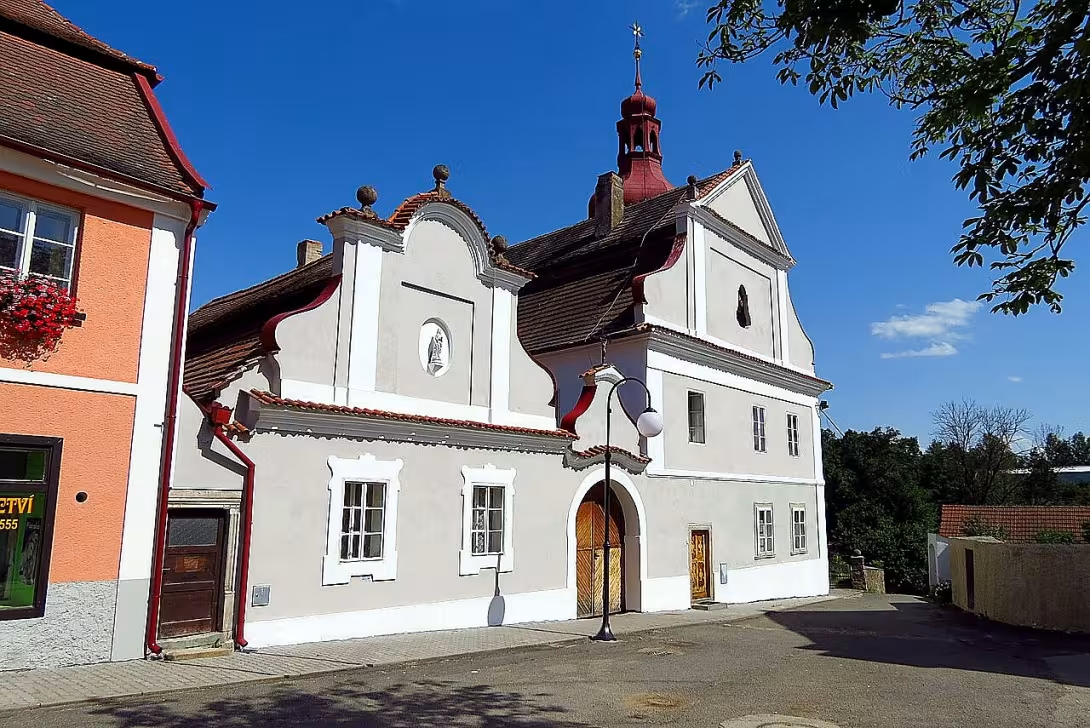
Fara with a capla in Red Greece in the district of Pelhrimov in the region Vysočina is a remarkable Baroque twin standing in the southeast corner of the square at the church of St. Mary Magdalena. This complex represents a protected complex of buildings with high baroque shields, which reflects the building development after the great fire of the city in the 18th century. The monument is listed in the Central List of Cultural Monuments of the Czech Republic and forms part of the urban monument zone announced in 2003.
The orchard called Greece was established southwest of the right bank of the meandroving stream of the Trnava river or Trnavka river at the end of the 12th century in connection with the colonization of the landscape of the Geluvian monastery. The first written references to the village dates from 1279 to 1290 and the plebania is already documented here in 1280. The local parish church of St. Mary Magdalena existed already in the 13th century before 1283, when the Bishop of Prague Tobiáš z Bechyně had it fortified in the event of the raid of Ota Braniborsky's troops. Since 1352, the municipality has been the seat of the Dean. The local water castle or the castle belonged to the Prague bishops and in 1392 the general vicar Jan z Pomuku, later known as St. John Nepomucký, lived here. Between 1420 and 1619 the sanctuary was managed by Utraquist priests, they were replaced by Catholics in 1619, and from 1623 it belonged again to the Prague Archbishop, who also owned the rectory. In 1680, the parish was promoted to dean. The period of construction of the original rectory and chapel is not mentioned in the documents, the sources refer only to the Renaissance buildings before the great fire of the city of 11 September 1732.
Originally Renaissance buildings of the rectory and chaplains were built from a quarry wall and equipped with plaster. After a devastating fire in 1732, a full Baroque reconstruction took place. At that time, both buildings acquired new facades facing the square, ending with high baroque shields with volute wings. The closest to the church is a storey farm building covered with a Mansard roof. Its facade is broken down by pilasters, ending with a triangular front and in the middle it has a casual opening. In the interior of the rectory there are arched ceilings, on the floor there are flat ceilings with stucco mirrors. The chaplain standing closer to the town hall is only ground floor with two window axes. It has a Mansard roof and a baroque shield with volute wings and pilasters. In the middle of the chaplain, there is an oval deepening, in which there is a statue of the Virgin Mary. Between the two objects stands a brick entrance to the yard with a semi-circle arched entrance. The gate has a corrugated ledge covered with overalls and a baroque volute shield ended with a low triangular attachment and a peak cross.
The parish was owned by the Archbishop of Prague. Among the historical events of the complex is the great fire from September 11, 1732, which destroyed the original parish, church, town hall and school, followed by the Baroque restoration. In 2003, the whole set of buildings became part of a newly announced urban monument zone.
A self-protected object in the complex is a statue of St. John Nepomuk. It stands about four meters south of the rectory wall towards the church entrance. The sculpture on the high prism pedestal shows a saint with a biret on his head and a stone cross in his arms. On the back of the pedestal is 1722, which means that by ten years she survived the great fire of the city.
The whole Baroque area of the rectory with a chaplains and adjacent statue of St. John Nepomuk is located in the immediate vicinity of the church of St. Mary Magdalena on the square in Red Greece and forms an integral part of the town monument zone. Visiting this place offers a view of the preserved rural ecclesiastical architecture of the peak Baroque period in Czech countries.
Historical milestones
- 1280
- Plebania is already documented in Greece this year.
- 1732
- In the great fire of the city, the original parish, church, town hall and school burned down.
- 2003
- The area of the rectory became part of the newly announced urban monument zone Červená Řečice.
Architectural development
Originally Renaissance buildings of the rectory and chaplains were built from a quarry wall. After a devastating fire in 1732, a full baroque renewal took place, including new facade with volute shields. The rectory is covered with a Mansard roof and in the interior it hides arched ceilings.
Historical events
At the end of the 12th century, the village of Greece was founded. In 1283, Prague Bishop Tobiáš z Bechyně had the local church fortified. On 11 September 1732 the city was hit by a big fire that destroyed the original rectory.
Owners
prague archbishop
Points of interest
- The rectory rectory in Red Greece is a remarkable baroque twin standing in the southeast corner of the square at the church of St. Mary Magdalena. - Originally Renaissance buildings from the quarry wall were completely restored in the Baroque after the devastating fire of the town of the eleventh September of 1732. - The storey building of the rectory has a mansard roof, a facade divided by pilasters, a triangular front and arched ceilings in the interior. - The ground chaplain with two window axes has an oval depth in the shield with a statue of the Virgin Mary. - Between the two objects stands a brick entrance gate to the yard with a baroque volute shield, which ends with a low triangular attachment and a top cross.
Guide
Show guide text
This text was created by artificial intelligence and has not been editorially reviewed. It may contain inaccuracies.
Welcome to Red Speech. Right now, you're standing on the southeast corner of the town square, right at St. Mary Magdalena's Church, and before your eyes, stands the remarkable baroque twins that make up fara s kaplankou. When you look ahead, you see a unique historical structure whose facade speaks to you through centuries. Take some time, take a breath in the atmosphere of this place and let the ancient walls that remember the joys and tragedies of the local people.
Let's look deeper into the past to understand how this monument came to be. The spiritual administration, the so-called plebania, is already documented in Greece in the year twelve hundred and eighty. This means that spiritual life here has roots deep in the Middle Ages. Originally, it was renaissance buildings built from a quarry wall that served their purpose, but history was not always merciful to them. On the 11th of September in the year seventeen hundred thirty-two the city was struck by great misfortune. That was when a devastating fire broke out, in which not only the original parish burned down, but also the church, town hall and school. The whole town suffered huge damage at the time, but people didn't give up. Residents were able to restore their homes and church buildings. The cremated Renaissance buildings received a new face and were generally repaired baroque. Thanks to this, we can now admire the form that came from this great renewal. For many centuries it formed the character of the whole complex and in the year two thousand and three this valuable part became a solid part of the newly announced urban monument zone Červená Řečice.
Now pay attention to the architecture itself. The names of the creators who planned and carried out this renewal remained unknown in history, but their work speaks for itself. You're standing in front of a double house where a storey farm building and a ground chaplain are bound. Both of these parts are facing the square and will capture your view with high baroque shields. These shields are decorated with volute wings, an element that gives the entire facade elegance and grandeur. A brick entrance gate is also part of this monument protected area you are now looking at. When you look carefully at the details of the construction, you will see the precise work of our ancestors, who were able to create a harmonious whole from the ordinary quarry wall.
When you walk around this square and feel the surrounding houses, history associated with significant personalities breathes upon you. Names like Tobiáš z Bechyně, Jan z Pomuku or Ota Braniborský are associated with this region and its ecclesiastical life. These men wrote the history of our countries in times when the limits of power, religious order and sovereign court were formed. Imagine what it must have been like when people walked through here in period clothes, when the fate of the parish was decided in these places, and when the walls at your fingertips witnessed daily prayers and heavy trials in building the city after the fires.
The interesting thing about this place is the fact that fara s kaplankou in the Red Speaker is not just an ordinary building, but shows the incredible resilience of local people. Although the city was hit by a huge disaster in the form of a fire that destroyed the heart of the village, people were able to rise from the ashes. The way they connected the original older building elements with the new Baroque style shows an enormous sense of beauty and order. The two standing on the southeast corner of the square today is a silent but very eloquent witness to the power of the human spirit and dedication.
We hope you enjoyed this stop. We now invite you to further explore. Take a peaceful walk around the church of St. Mary Magdalena, explore the next corner of the town's monument zone and let yourself breathe the calm atmosphere of Red Greece. Thank you for listening to our guide, we wish you a beautiful rest of the day and see you at other sights.
Tips for visitors
A tour of the historical rectory with the chapel in Red The talk is best enjoyed during the morning or morning sun, which radiates the Baroque front of the house in the southeast corner of the square. During spring and summer months you can admire the blooming historical core of the city and surrounding nature without large crowds of tourists. Take comfortable shoes for walking on historic paving, camera to capture architectural details and bottle of drinking water. The best pictures of the entire double house are taken from the centre of the square, from where its construction will stand out in full width. The nearby church of Saint Mary Magdalena, a majestic water castle or the castle and picturesque banks of the river Trnava, is also worth visiting.
Frequently asked questions
Can the monument be visited?
This is a residential or farm building, not a museum with opening hours. Please view it from public space and respect the owners' privacy. We have no information about access to the interior.
Where is the monument?
Location: Červená Řečice. The map on this page shows the exact spot.
Why is the monument protected?
It is listed in the Central List of Cultural Monuments of the Czech Republic as a cultural monument (register no. 1000148342).
Businesses nearby
Do you run a restaurant, accommodation, shop, museum, rental, wellness or other visitor service near this monument? Show yourself directly to the people heading to it — this is how they will see you in the app and on the web:
Nearby
Městská památková zóna Červená Řečice, kostel svaté Maří Magdaleny, vodní hrad neboli zámek v Červené Řečici, řeka Trnava neboli Trnávka.
Accommodation nearby
Themed route
1. the church of St. Mary Magdalena, a religious place, offers visitors peace and a view of the old building. 2. fara s kaplankou, the main objective, represents an interesting house with religious significance. 3. City Monument Zone Červená Řečice, historical territory, allows you to walk between older buildings. 4. water castle or castle in Red Greece, a significant building, stands by the water and dominates the surrounding area. 5. the Trnava River, or Trnavka River, water flow, flows through the city and creates a pleasant environment.
Seasonal recommendations
Spring in Red The talk brings about the awakening nature, when the surrounding trees begin to bloom and the morning mist shrouds the historical building of the old rectory with its adjacent caplar into a mysterious haze. The sun's rays penetrate through the still slightly squeaky branches and create a fine shadow game on the old facades, ideal for lovers of peaceful observation of architecture in the open air. Due to the occasional spring rain and colder wind blowing from adjacent fields, it is worth wearing fixed waterproof shoes and a warmer windbreaker, the best light for silent admiration of exteriors and taking pictures comes in the morning when the sun lights up the front of buildings.
Summer in this place is ruled by lush greenery and long days, during which dense tree crowns partially shade the outer walls of the monuments and create a pleasant refuge from the afternoon heat. The surrounding area is a song of birds and a summer buzz, while the warm air underlines the rural calm of the whole area around the residential building. For a summer tour around the building, choose light breathable clothes, headgear against sharp sun and plenty of fluids in the backpack, because the shadow at the walls may not be everywhere enough; The best time to visit is either early in the morning or in the evening when the temperature falls and the setting sun paints bricks and plaster into golden shades.
Autumn transforms the scenery around the rectory into a palette of warm colors, where leaves in the surroundings play yellow, orange and brown tones, and the falling fog gives the whole rural estate a melancholy atmosphere of ancient times. The low autumn sun creates extended shadows and specific scattered lighting, which makes the structure of outer walls and architectural details of both buildings stand out. Since the soil is usually wet and the cold wind blows, it is necessary to take your solid shoes into the mud and warm coat with scarf, while the ideal time for walking around the monument is around noon when the best chance is outside for at least a partially famous sky.
Winter shrouds the Red Speaker into a snow blanket that dampens sounds and turns a quiet area into a quiet winter landscape with frosty air and glitter freezes on the roofs. The white background strongly reflects light, creating a sharp contrast to the dark outlines of the old rectory and chaplains, whose perimeter walls operate especially strenuous and majestic in January frost. For an external stay during this period you need high-quality winter hippos with anti-slip soles, strong gloves, hat and several layers of warm clothing, the most suitable is to set off in the early afternoon when the short day provides a single daylight and temperatures reach their daily maximum.
Visualizations and artistic views

The visualisations are generated by artificial intelligence and serve as inspiration.
Photos from the area
Real photos taken near the monument


Zdroj a licence jsou uvedeny u každého snímku.
Tips from visitors
No tips yet. Be the first!
Log in and add your tip.
Sources and literature
Photos: Flipper77 / CC BY-SA 3.0 — Wikimedia Commons. The author and licence also appear when you hover over the image.
Faktickým podkladem tohoto textu byl článek na Wikipedii, jehož autory jsou přispěvatelé Wikipedie. Článek je dostupný pod licencí CC BY-SA 4.0.
Location on the map

Příběhy a pověsti
Legendy, pověsti a příběhy spjaté s touto památkou
Fotografie návštěvníků
Zatím žádné fotografie. Buďte první, kdo přidá fotografii z návštěvy!
Log in a přidejte svou fotografii nebo hodnoťte.
Za ověřenou návštěvu v aplikaci získáte víc bodů — poznáme podle GPS, že jste na místě.
Reviews and comments