



Farní škola u sv. Jindřicha a sv. Kunhuty School building
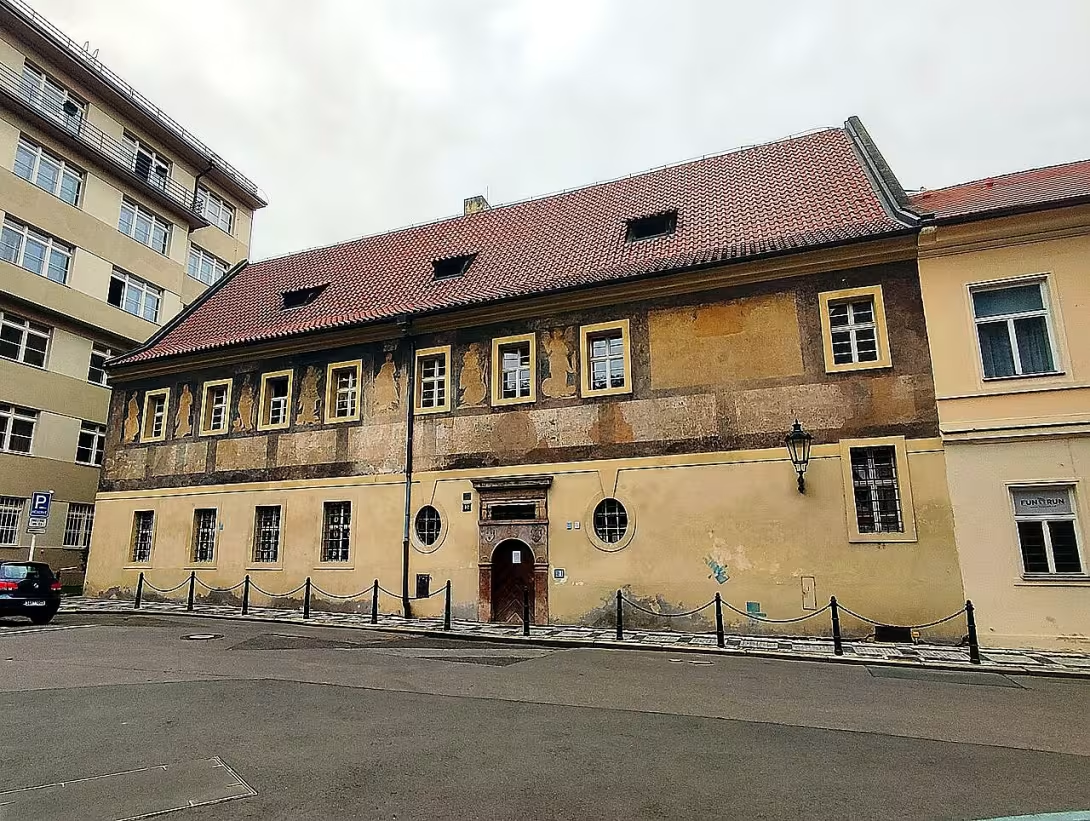
The former St. Jindřiš parish school at the address of Jindřišská 974 / 32 in Prague's New Town is a valuable Renaissance building in close proximity to the church of St. Henry and St. Kunhuta. The building excels with preserved historical vaults, Renaissance roof and portal with carved date 1358, which recalls the original Gothic foundation. It is also remarkable in its history of the beginnings of modern politics and the remains of historical gardens dating back to the former Horse Market.
The creation of this school facility in 1358 is directly linked to the promotion of the newly built crucifying church of St. Henry and St. Kunhuta to the parish. It happened during the reign of the Czech king and Roman Emperor Charles IV. In this period of the High Middle Ages, the development of the New Town of Prague and the creation of new urban institutions and educational centres was spectacular. Although the original parish school was one of the seven parish schools in Prague's New Town, a new Renaissance building between the church and the parish later grew up. It is located at the intersection of today's streets of Rosé and Henry. In its days of operation, it was used to teach basic teachings at the time, where it included reading, writing, numbers, basic Latin and ecclesiastical singing.
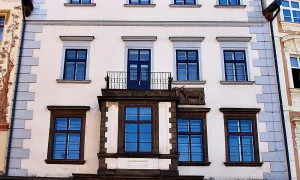
The building represents a Renaissance building, the current form of which came from the reconstruction of an earlier Gothic building from the 14th century. In the course of the following years she also went through classical modifications. On the portal of the building there is a date 1358 drawn referring to the original Gothic foundation. In the interior are preserved original vaults and Renaissance crows. The architectural details include the sgraffiti on the facade, which was professionally restored during reconstruction in the twentieth century. The grounds include a garden, which is connected to the garden in the past. Both of these areas are the remains of extensive gardens ranging from the mid-14th century to the Horse Market. They were previously followed by the garden of the Royal pharmacist Angela from Florence, now fully built by the Main Post Office.
Over the centuries, the building served in addition to its original spiritual and educational functions also for other purposes. An important episode in the modern history of the building was the period 1897 to 1898. Back then, after the founding of the Czech Social Party, its first secretariat was based here, led by Secretary Josef Klečák. In the 1970s, the building underwent a landmark reconstruction, supervised by the Prague Centre of State Heritage and Nature Protection. Part of these works was the restoration of sgraffiti on the facade, as well as an archaeological survey of the courtyard of the building, which was carried out by the archaeological department of historical care.
Today, this historic building is located in the dense building of the city area Praha 1 in close proximity to the church of St. Henry and St. Kunhuta with Gothic bell tower and Senovážné Square. Visiting this place offers a unique opportunity to see material documents of building development from the 14th century to the Renaissance period in the very center of the metropolis. Discover this remarkable monument and let yourself breathe history associated with the development of Prague's education and political history with your own eyes.
Historical milestones
- 1358
- The formation of the parish school associated with the promotion of St. Henry and St. Kunhuta to the parish.
- 1897
- The first Secretariat of the newly founded Czech Party of National Social under the direction of Josef Kleják was established in the building.
Architectural development
The original Gothic building from the 14th century was later rebuilt into the contemporary Renaissance form and during the following years it also underwent classical modifications. The interior has preserved historical vaults and original Renaissance crows. During the reconstruction in the twentieth century, historical sgraffiti was professionally restored on the facade.
Historical events
In 1358, the parish school was founded in connection with the promotion of St. Henry's Church to parish. From 1897 to 1898 the first secretariat of the newly founded Czech Social Party was located in the building. A reconstruction of the building and archaeological survey of the yard took place under the supervision of the monuments in the 1970s.
Points of interest
- A valuable Renaissance building is located in the immediate vicinity of the church of St. Henry and St. Kunhuta in Prague's New Town and stands out with preserved historical vaults, Renaissance roof and portal with carved date 1358. - The formation of the school establishment in 1358 is connected with the promotion of the crucifixion church to the parish under Charles IV's rule and, in the days of operation, the school was used to teach reading, writing, calculus, basic Latin and ecclesiastical singing. - On the facade of the building there are sgraffiti, which was professionally restored during the reconstruction in the twentieth century, and the area includes a garden as a remnant of extensive gardens that reach the Horse Market. - From 1897 to 1898, after the founding of the Czech Social Party, its first secretariat was based here, which was led by Secretary Josef Klečák. - In the 1970s, the building underwent a landmark reconstruction, including the restoration of sgraffiti and archaeological survey of the yard.
Guide
Show guide text
This text was created by artificial intelligence and has not been editorially reviewed. It may contain inaccuracies.
Welcome to one of the very valuable monuments in Prague's New Town. Right now, you're standing in front of a former St. Henry's parish school located in the immediate vicinity of St. Henry's and St. Kunhuta's. If you look in front of you, you see a Renaissance building with a rich history that remembers many centuries of our capital development. You can look at her facade in peace, perceive the atmosphere of an ancient place and let the ancient times take hold of you when the important events of our history took place here.
Let us now return in time to the past to understand how and why this place was created. The full beginnings of this school building range back to 135,508. The establishment of this facility was closely linked to the promotion of the neighbouring crucifying church to the parish church. The place where we are now began to serve our purpose, and the pupils came here for education. Here they learned the basic lessons of the time, among which there was no Latin language and singing. Imagine these young people sitting in benches hundreds of years ago absorbing the knowledge that was crucial to the life of the city at that time.
Now pay attention to the construction itself and its architectural details, which are right in front of you. The current form of this building comes from the Renaissance period and hides a number of remarkable elements. When you look carefully, you can see an extremely valuable portal with a carved date of 131,558, which still reminds us of the year of school. Inside the building there are also preserved historical vaults and original Renaissance crows, which testify to the great building art of our ancestors. Unfortunately, the names of the creators, the architects, have not been preserved until today, but their work speaks for them and has lasted centuries.
There are also very interesting historical figures and stories associated with this building. Important figures associated with this place include Angel z Florencie, whose name bears part of our history, and also Josef Klečák. It was Josef Klečák who led the events of eighteen hundred and ninety-seven when the first secretariat of the newly founded Czech Party of National Social began to reside in this building. The place that previously served Latin teaching and singing became an important centre of political activity and the formation of modern Czech society at the end of the nineteenth century.
When you think about it, it's fascinating how one building can connect such different periods. On the one hand stands the medieval and Renaissance foundations associated with the church and education of children, on the other hand modern political history and the pursuit of national self-determination. The date carved on the portal that has been standing here for centuries is a silent witness to all these changes.
We hope you enjoyed our stop today and that you are taking away a nice experience. Now you can continue to discover the other beauty of Prague's New Town, see the neighboring church or explore the adjacent alleys. We thank you for your attention and wish you a wonderful rest of the day.
Tips for visitors
A tour of the exterior of the former parish school near St. Henry and St. Kunhuta is most suitable in the early morning, when the sunlight ideally illuminates the historical Renaissance façade of the building and adjacent Gothic bell tower.
Traffic availability to this Prague location is possible by public transport and by car; We recommend to verify the exact connections and stand options in the respective online maps before travelling.
Take a walk with you with comfortable shoes for walking on historic tiles, camera to capture details of ancient architecture and in colder months of the year also warmer clothes.
In the immediate surroundings, you can admire the mentioned church with Gothic bell tower, Senováný Square or nearby Main Post building, which stands on the site of historic gardens.
Frequently asked questions
Can the monument be visited?
The building is in use (offices, a school, shops and the like). The interior is generally accessible only during operating hours and tours are not usually offered; we have not verified the details. You can see the exterior from the street.
Where is the monument?
Location: Praha 1. The map on this page shows the exact spot.
Why is the monument protected?
It is listed in the Central List of Cultural Monuments of the Czech Republic as a cultural monument (register no. 1000156924).
Businesses nearby
Do you run a restaurant, accommodation, shop, museum, rental, wellness or other visitor service near this monument? Show yourself directly to the people heading to it — this is how they will see you in the app and on the web:
Events nearby

Zdroj akcí: otevřená data měst a obcí ČR (Národní katalog otevřených dat) a kalendář akcí Národního památkového ústavu.
Nearby
V těsné blízkosti se nachází kostel svatého Jindřicha a svaté Kunhuty s gotickou zvonicí, Senovážné náměstí a nedaleko leží také budova Hlavní pošty vystavěná na místě historických zahrad.
Accommodation nearby
Trips and activities nearby
Guided tours, tickets and activities nearby from GetYourGuide
Affiliate link: if you buy from the partner, we may receive a commission. The price for you does not change.
Search tours and activities →Themed route
Thematic cruise route in the village Praha 1:
1. Parish school at St. Henry and St. Kunhuta (others) This main objective represents an interesting historical structure associated with spiritual and social life in the past. It is worth visiting for its unique location in the historical core of the metropolis.
2. Church of St. Henry and St. Kunhuta with Gothic bell tower (monument) In close proximity to the main target is this sacral building with an unseen ancient tower. It is worth visiting for its preserved medieval architecture and atmosphere.
3. Sensational Square (Space) A few steps away from the previous stops, this busy area is unfolding. It is worth a visit as a demonstration of a significant urban space in the wider city centre.
4. Main Post Building (historical building) Not far from here lies this magnificent building that was built on the site of historic gardens. It is worth a visit thanks to its impressive construction design and interesting historical basis.
Seasonal recommendations
Spring: During the spring season, the surroundings of the rectory at St. Henry and Kunhuta are particularly flowering when various types of flowers develop in the parks. The sun rays illuminate the architectural details of the building with their warm radiation, which contributes to a comfortable atmosphere for walking around the monument. Due to the emergence of new life cycles, it is advisable to visit this place in the early afternoon to avoid excessive temperatures and possible long fronts for more popular attractions. It is recommended to wear light clothes with hood to protect against sunlight.
Summer: During the summer period, the area around the rectory is full of life when different kinds of birds appear in parks and gardens. The sun illuminates the building with long rays, highlighting its historical architectural elements. The best time to visit is early morning or late afternoon, avoiding extreme temperatures and other people. It is recommended to wear light clothes with a sun protective tie.
Autumn: In autumn, the surroundings of the rectory near St. Henry's and Kunhuta are coloured with coloured tree leaves, creating a comfortable environment for relaxation on the outside. Sun rays illuminate the building through the red and yellow colour of leaves, which contributes to a mild atmosphere. The best time to visit is in the early afternoon to avoid cold evenings and possible rain. It is recommended to wear clothes with multiple layers for any change in weather.
Winter: During the winter season the area of the rectory is covered with snow, creating a quiet and quiet environment. Sun rays illuminate the building with their warm radiation, which contributes to a comfortable atmosphere for walking around the monument. The best time to visit is at noon, when the sun lights the building with long rays and increases temperature. It is recommended to wear warm-up clothes with protection against cold and snow.
Visualizations and artistic views

The visualisations are generated by artificial intelligence and serve as inspiration.
Photos from the area
Real photos taken near the monument

Zdroj a licence jsou uvedeny u každého snímku.
Tips from visitors
No tips yet. Be the first!
Log in and add your tip.
Sources and literature
Photos: Palickap / CC BY-SA 4.0 — Wikimedia Commons. The author and licence also appear when you hover over the image.
Faktickým podkladem tohoto textu byl článek na Wikipedii, jehož autory jsou přispěvatelé Wikipedie. Článek je dostupný pod licencí CC BY-SA 4.0.
Location on the map
Příběhy a pověsti
Legendy, pověsti a příběhy spjaté s touto památkou
Fotografie návštěvníků
Zatím žádné fotografie. Buďte první, kdo přidá fotografii z návštěvy!
Log in a přidejte svou fotografii nebo hodnoťte.
Za ověřenou návštěvu v aplikaci získáte víc bodů — poznáme podle GPS, že jste na místě.
Reviews and comments