






Fort Galgenberg Fortress
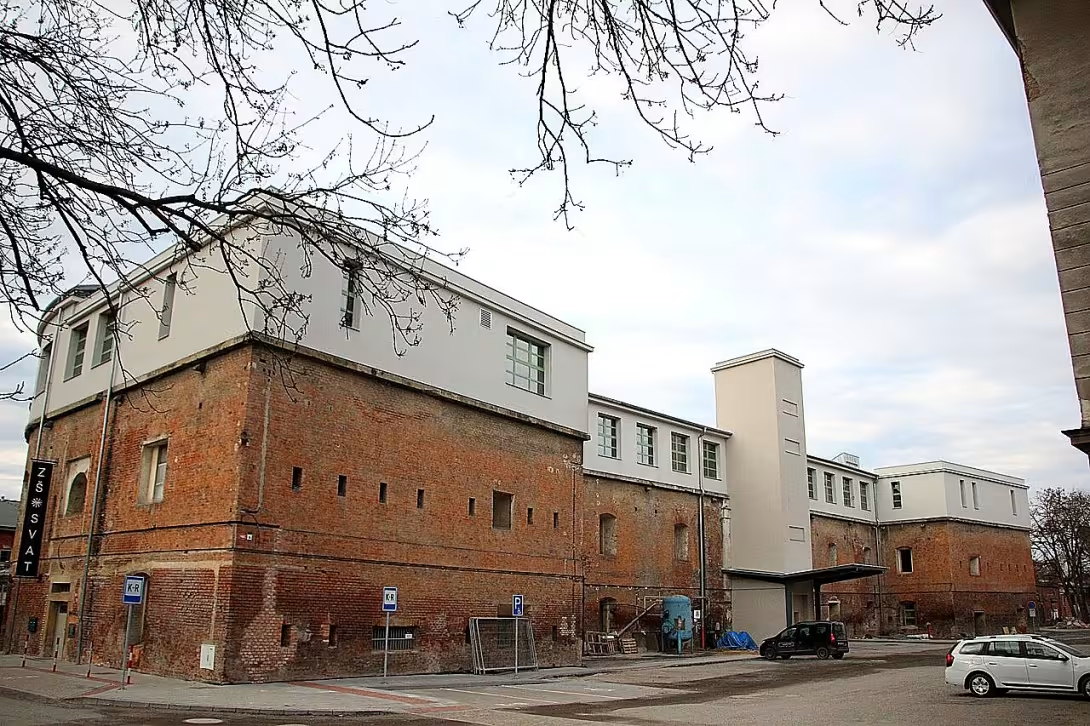
Fort Šibeniční vrch, also known as Fort Galgenberg, is a former fortress in the Olomouc district of Nová Ulice. This technical and military monument of European significance was created in the first half of the 19th century as part of the city's fortifications and today represents a unique testament to fortification architecture.
The construction of the fort was part of the modernization of the Austrian monarchy's defense system, which responded to changing military strategies and the threat of conflict in Europe. The first design was submitted by architect Camillo Vacani in 1834. The implementation itself took place between 1839 and 1845, during which the construction was accompanied by complications caused by unsuitable clay subsoil. Due to necessary repairs and technical difficulties, the cost rose to 850,000 gold coins, and the structure was not definitively completed until 1851.
Architecturally, it is a polygonal redoubt fort, with a floor plan identical to the fort on Tabulový vrch. The construction had to account for the site's demanding geological conditions. Between 1927 and 1928, the redoubt building underwent significant modification; it was raised by one floor to accommodate aviation workshops, and a prismatic elevator vestibule was added at the main entrance. During the Second World War, the structure was supplemented with a system of concrete shelters connected to the original underground mine galleries.
The fortress originally served as barracks and a warehouse for weapons and materials, with a permanent garrison of 500 men. During the Austro-Prussian War, the facility's capacity increased to 1,150 men, and the fort possessed a firepower of 24 guns. After the city's fortress status was abolished in 1886, the area served as a cavalry school and, during the First World War, as barracks for heavy artillery. From 1919 to 1948, the manufacturing workshops of the Letov plant were located here, and from 1949 until the 1990s, the facility was used by a military automotive repair plant.
A key moment in its modern history was the years 1944 to 1945, when the German occupation administration implemented a project to connect the underground mine galleries with concrete shelters, including a connection to the mine gallery designated as "O". Currently, the property is in the private hands of the company RP Nemovit and, after a long period of neglect, is undergoing gradual restoration. Since 2024, a private primary school has been located within the renovated redoubt area.
Fort Šibeniční vrch represents a significant testament to 19th-century engineering. Due to its connection to the fort on Tabulový vrch, it forms an integral part of European military heritage. A visit to this site offers an opportunity to glimpse the history of fortification systems and witness the restoration process of a monument that is gradually being reintegrated into the life of the city.
Historical milestones
- 1834
- Submission of the first design for the fort by Camillo Vacani.
- 1851
- Completion of the fort's construction.
- 1927
- Commencement of reconstruction into aviation workshops for the Letov plant.
- 2024
- Opening of a private primary school within the renovated complex.
Architectural development
It is a polygonal redoubt fort, whose construction was influenced by the challenging clay subsoil. In 1927–1928, the redoubt building was raised by one story to accommodate aviation workshops, and an elevator was added. During the Second World War, the facility was supplemented with a system of concrete shelters connected to the original mine galleries.
Historical events
1839–1845: Main construction phase of the fort. 1886: Abolition of the fortress status of the city of Olomouc. 1944–1945: Implementation of an air-raid shelter system in the underground passages.
Owners
Austro-Hungarian army, Czechoslovak state, RP Nemovit company.
Points of interest
– Construction was complicated by unsuitable clayey substrate, which drove the cost up to 850,000 gold pieces. – Between 1927 and 1928, the building was raised by one floor to accommodate aviation workshops, and a rectangular elevator shaft was added at the main entrance. – During the Second World War, the facility was supplemented with a system of concrete shelters connected to the original underground mine tunnels. – The fortress originally served as barracks and a warehouse, with a permanent garrison of 500 men, but during the Austro-Prussian War, its capacity increased to 1,150 men. – Since 2024, a private primary school has been located in the renovated fort area.
Guide
Show guide text
This text was created by artificial intelligence and has not been editorially reviewed. It may contain inaccuracies.
Welcome to Fort Galgenberg. You are standing in a place that bears deep traces of the past and immediately captures your attention with its massiveness. Look around you and feel the atmosphere of this place. Before you rises a structure that was not built merely as an ordinary building, but as a strong point in the entire city's defense system. Can you feel the weight of history hidden within these walls? This fortress, located in the Nová Ulice part of Olomouc, stands as a witness to many years of change. It is a place where military power, industrial activity, and modern daily life converge.
Let us now journey back deep into the past to understand why this structure was created in the first place. Imagine the first half of the nineteenth century. The city needed to ensure its security and create a fortification system capable of resisting potential threats. This entire ambitious project began as early as 1834, when the first proposal was submitted. The driving force behind this vision and its realization was a prominent architect named Camillo Vacani. It was he who had to devise how to integrate this fortress into a larger whole and how to build it so that it would be both resilient and functional. The construction itself, however, was not as swift as it might have seemed. It lasted many years, specifically from 1839 until 1851.
Now, as you look at these walls, you might think the structure looks very solid and stable. But the truth is that its creation was accompanied by immense effort and constant obstacles. Notice how this building is anchored in the ground. During construction, workers and engineers had to face enormous technical complications. The reason was not a lack of materials or bad weather, but the very ground beneath them. The substrate upon which the fort stands is composed of unsuitable clay. This soft and problematic material made every step of the construction a major challenge. Work on this project was so demanding and the constant resolution of foundation issues so costly that the total price for completing the building eventually climbed to an incredible 850,000 gold pieces. It is a fascinating thought to consider the great price this fortress had to pay to stand firmly in this location.
If you look at the architecture of the building itself, you can see traces of different eras. The fortress was not static; its appearance changed over time according to the evolving needs of the people. It originally served as barracks and an armory. Imagine those times, when soldiers moved through here and important military supplies were stored. It was a place of discipline and readiness. But time brought new needs. In 1927, a major turning point occurred. The building became part of the industrial world. It was repurposed for the needs of the Letov aircraft workshops. To make the best use of these new spaces, architects had to make fundamental decisions. Between 1927 and 1928, the building was raised by an entire story. If you look toward the main entrance now, you can spot another important detail. A rectangular annex was added to serve as an elevator space. This element was added precisely then, to adapt the building to modern technologies and the needs of the aircraft workshops.
It is fascinating to watch how this place is constantly transforming. From a military fortress meant to defend the city, it became a workshop where machines for air travel were prepared. Each of these phases has left its mark on the architecture, which you can observe today as you walk around the site. Stop for a moment and feel how these different layers of history intertwine.
And what is happening today? History did not stop in the last century. Even in recent history, we see how this site has been revitalized once again. In 2004, the operation of a new institution began in these renovated spaces. Today, a private primary school is located here. It is an incredible transition. A place where weapons once stood and where aircraft machines were worked on is now a space for education, learning, and the growth of young people. This transformation from a military object to a place for children and students is one of the most beautiful stories this fort tells.
As you continue your exploration, try to perceive these contrasting worlds. Feel the strength of the original construction that had to battle the clay, while simultaneously experiencing the modern life unfolding here. Every detail, from the rectangular annex to the height of the buildings, tells us about the people who worked here, the architects who designed it, and the changes brought by new eras.
Thank you for spending this moment with us and for choosing to explore this historical story. Please continue your tour of the surroundings and enjoy the atmosphere of this exceptional place. There are many more interesting things ahead waiting for you to discover. Goodbye.
Tips for visitors
The best time to visit is on sunny days during the spring or autumn months, when the vegetation is lower and the structure is more visible. Due to ongoing restoration work, access within the grounds is limited; we therefore recommend checking for the latest accessibility updates.
The site is accessible by car and public transport. Parking is available in the streets surrounding the University Hospital Olomouc, from which it is a short walk to the fort. Please check an online search engine for current public transport connections.
For your visit, please wear sturdy footwear suitable for the terrain and clothing that you don't mind getting dirty, as the site is currently undergoing repairs. Don't forget a charged phone or camera to capture the historical features of the fortifications.
The best time for photography is in the afternoon, when the sun illuminates the fort's front walls. Focus on the masonry details and wide exterior shots that showcase the imposing scale of nineteenth-century military architecture.
Nearby, you can visit the Tabulový vrch fort, explore the grounds of the University Hospital Olomouc, or head to the historic center of Olomouc, which offers a wealth of cultural activities for the whole family.
Businesses nearby
Do you run a restaurant, accommodation, shop, museum, rental, wellness or other visitor service near this monument? Show yourself directly to the people heading to it — this is how they will see you in the app and on the web:
Nearby
Fakultní nemocnice Olomouc, fort Tabulový vrch, historické centrum města Olomouce.
Accommodation nearby
Trips and activities nearby
Guided tours, tickets and activities nearby from GetYourGuide
Affiliate link: if you buy from the partner, we may receive a commission. The price for you does not change.
Search tours and activities →Themed route
Thematic excursion route from Nová Ulice
1. Fort Galgenberg (other) - Type: Historical military structure - Why it's worth visiting: This fortress is an important historic monument that recalls the period of Austro-Hungarian military influence in the region. A visit offers insights into the architecture and the history of vulnerability.
2. Fakultní nemocnice Olomouc - Type: Modern medical complex - Why it's worth visiting: Although it primarily serves as a healthcare facility, it is interesting for its modern architectural design and its significant role in training future doctors. A visit can be especially relevant for medical students or visitors interested in contemporary architecture.
3. Fort Tabulový vrch - Type: Historical military fortress - Why it's worth visiting: This fortress is part of the defense system that protected Olomouc in the past. It offers fascinating information about historical military strategies and architecture from the Austro-Hungarian Empire era.
4. Historické centrum města Olomouce - Type: Historical part of the city - Why it's worth visiting: The centre of Olomouc is full of historic buildings, culture and life. It is an ideal place to explore ancient architecture, shopping streets and cultural institutions. Visitors here can appreciate the rich history and culture of the region.
This route offers a combination of historic monuments with a modern educational facility, making it ideal for people interested in both history and contemporary developments.
Seasonal recommendations
Spring: In spring, the area around the ramparts awakens. Trees begin to turn green and the sun shines more softly, creating a pleasant light for observing the ongoing repairs. The atmosphere is fresh, but due to construction work, you may encounter more dust. I recommend wearing several layers of clothing, as mornings can be chilly and afternoons may already be warm. It is an ideal time for a visit, as the largest crowds have not yet arrived.
Summer: During the summer months, it is very sunny here and the days are at their longest. Although the surroundings are full of lush greenery, the heat can be very intense near the stone walls. Due to the ongoing reconstruction, there may be more dust in the heat. It is best to arrive early in the morning to avoid the biggest crowds and the midday heat. Don't forget a hat and plenty of water.
Autumn: Autumn brings a sense of melancholy and beautiful golden foliage to this location. Morning mists around the historical structures create a mysterious mood. Paths can be slippery and damp due to rain, so please wear waterproof footwear. The best time for a walk is in the morning, when the light is most interesting. Clothing should be windproof.
Winter: In winter, it is quieter here and the surroundings feel stark. Without the leaves, the details of the historical buildings and the repaired sections are more visible, even though the sky is often grey. Given the cold and shorter days, I recommend visiting when the sun is at its highest. A very warm jacket, scarf, and gloves are essential. Also, please be aware of shorter opening hours, which often change during this period.
Visualizations and artistic views


The visualisations are generated by artificial intelligence and serve as inspiration.
Photos from the area
Real photos taken near the monument


Zdroj a licence jsou uvedeny u každého snímku.
Tips from visitors
No tips yet. Be the first!
Log in and add your tip.
Sources and literature
Photos: Transbedy / CC BY-SA 4.0 — Wikimedia Commons. The author and licence also appear when you hover over the image.
Faktickým podkladem tohoto textu byl článek na Wikipedii, jehož autory jsou přispěvatelé Wikipedie. Článek je dostupný pod licencí CC BY-SA 4.0.
Location on the map

Příběhy a pověsti
Legendy, pověsti a příběhy spjaté s touto památkou

Fotografie návštěvníků
Zatím žádné fotografie. Buďte první, kdo přidá fotografii z návštěvy!
Log in a přidejte svou fotografii nebo hodnoťte.
Za ověřenou návštěvu v aplikaci získáte víc bodů — poznáme podle GPS, že jste na místě.
Reviews and comments