



Frantův mlýn Water mill
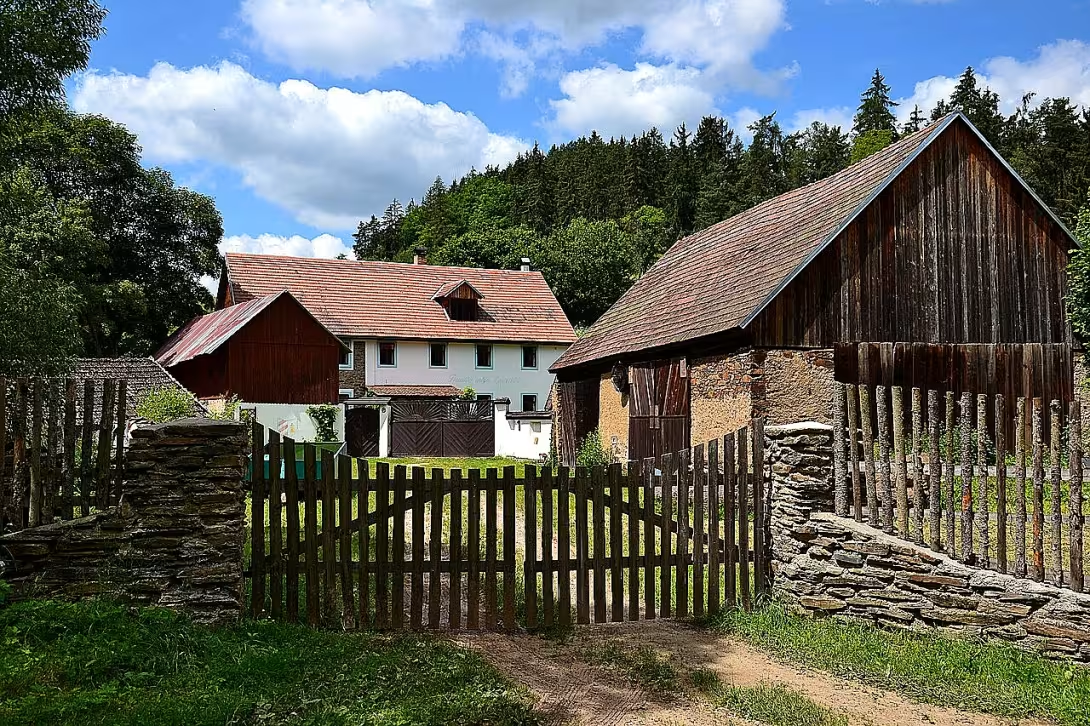
Frantův mlýn at Manětína on the Manětín stream in Brdy is a historic water mill with saw. It is protected as a cultural monument of the Czech Republic. Its long history and architectural modifications represent an interesting example of miller art. It is important not only technically, but also because of the stories of families and personalities associated with it.
The history of the mill dates back to the 17th century. In 1651, the miller Anna Frantová is mentioned here. In 1672 he bought the barren mill Karel Maxmilián Lažanský, which started a new chapter in the administration of this industrial building. In 1768 Jan Karásek sold it to Josef Dobiasch. These periods are indicative of the dynamics of the former milling industry and social structures.
It is architecturally excellent with the original stone block. After the flood in 1872, however, it was replaced by a provisional of willow and gravel. In 1937 they modernized the mill by installing Francis' turbine and introducing electric lighting. These changes reflect technological progress and the ability of construction to adapt to new needs.
The ownership of the mill has changed several times over time. After Karl Maximilian Lažanski took over Jan Karásek and subsequently Josef Dobiasch. In 1930 it is the owner of František Tobiáš, which introduced further improvements. After World War II, the mill was sold to Hec, which confirms constant changes in its administration and use.
Key events include flooding damage in 1840. This led to the debt of the miller and the construction of a temporary lake. During World War II, the mill served until 1943 for black activity, which was a dramatic change in its function. After the war the object was sold and only the saw remained in operation.
Today Frantův mlýn is a protected monument that attracts visitors with its history and architecture. The preserved 1937 Francis turbine is one of the main elements of the technological progress at the time. Thanks to the accessible location, the visit offers insight into the mill industry and architecture of the past century.
The mill is not only a monument to technology, but also to economic and social changes in the region. His fates reflect the development of miller craft, which makes the object attractive to visitors from all over the country. The walk through the mill allows you to familiarize yourself with the rich history and modifications that the monument has undergone over the centuries.
Historical milestones
- 1651
- introducing miller Anna Franto
- 1672
- Karel Maxmilián Lažanský bought the mill as desolate
- 1768
- sale of the mill to Josef Dobiasch
- 1840
- damage to nearby flooding
- 1937
- installation of Francis turbine and electrical lighting
- 1943
- ending black grinding during world war ii
Architectural development
The original eatery was built from stone blocks, but after the flood in 1872 it was replaced by a temporary construction of willow branch and gravel. In 1937 electricity was introduced and Francis turbine was installed. The saw has been modernized over time.
Historical events
1672: purchase of the mill by Karel Maximilian of Lažansky; 1768: sale of the mill to Josef Dobiasch; 1937: installation of Francis turbine; 1943: Completion of black grinding.
Owners
1672: Karel Maxmilián Lažanský; Jan Karásek and Josef Dobiasch; 1930: František Tobiáš; 1946: Hec.
Points of interest
- The history of the mill dates back to the 17th century when the miller Anna Frantová was mentioned in 1651. - The original stone block food was replaced after the flood in 1872 with a commission of willow and gravel. - In 1937 the mill underwent modernization, where the Francis turbine was installed and electrical lighting was introduced. - During World War II the mill served until 1943 for black activity. - After World War II, the object was sold and only the saw remained in operation.
Guide
Show guide text
This text was created by artificial intelligence and has not been editorially reviewed. It may contain inaccuracies.
Welcome to Frank's Mill. You are standing in a place where history meets the constant movement of water and where every splashing stream of Manětín creek in Brd tells a story from centuries ago. In front of your eyes is a historic building that was not just a simple box, but a heart of local production and an important point in the life of surrounding settlements. Feel this atmosphere, feel the calm that exists here, and at the same time remember how much this place has changed over time, even though the water in the stream still flows through the same rhythm.
Let's go back deep into the past together to understand how this mill came into being. The history of this place is not short, because it dates back to the seventeenth century. The first concrete clue that time has left us is in the year one thousand six hundred fifty-one. That's when Anna Franta's miller's name appears in our records. Imagine life at the time, hard work at the water and the role that the miller played in the community. However, the mill has not always gone through a period of prosperity. In the year one thousand six hundred seventy-two something crucial happened. Karel Maxmilián Lažanský, an important noble family, purchased this mill, but at that time it was no longer called a thriving business, but a desolate object. The mill was in ruins at the time, demanding repairs and a new future. Yet, thanks to the noble interest and subsequent owners, such as Josef Dobiasch, who took over it in the year of the thousand seven hundred and sixty-eight, it succeeded in reviving this place and returning it to its important function.
Now pay attention to the architecture itself and what you can see around you. Frantův mlýn is not just an ordinary water mill, it is a complex whole that carried a saw. Looking at the construction, you can realize how its existence was directly dependent on water power. Note how the object is incorporated into the landscape of the Manětín creek. Although the building changed over the centuries, its basic character remains preserved. If you look towards the water surface, you can imagine what the original food looked like. It was once built from massive stone blocks, which witnessed the strength and stability of the day. But sometimes nature takes its toll. After the devastating flood in the year one thousand eight hundred seventy two, this stone eatery was destroyed and had to be replaced by a provisional solution from willow wicker and gravel. This change in the construction of the lake is a fascinating proof of how the miller constantly had to fight the variable power of water and how they had to be able to react quickly to unexpected natural disasters.
In the history of this place, the fates of many important personalities intersect. You can feel traces of the miller families who lived here, worked and built their livelihoods. Next to Anna Franta's miller, names like Jan Karásek or František Tobiáš appear in history. Each of these names represents one chapter in the long chronicle of this mill. The mill was a place where people met, where work and trade took place, and where the interests of simple miners and the interests of noble families were mixed. This dynamic between the various social layers was absolutely crucial for living around Manětína.
If we move to a period much closer to our current knowledge, we will encounter a period of great modernization. The year one thousand nine hundred thirty-seven was a milestone for Frantův mlýn. This year, there was a major technical change that moved the mill into a new era. A modern Francis turbine was installed and electrical lighting was introduced into the building. Imagine the contrast between the old, traditional grinding and the new electricity that started filling these spaces. This modernization was a symbol of the progress that hit even the farthest corners of our country in the first third of the twentieth century.
However, this progress has also been interrupted. If you look at the mill, you can feel the shadow of darker times. In the year one thousand nine hundred forty-three, in the middle of World War II, there was something that meant the end of an era for miller. The grinding was complete then. The mill, which has been beating in the rhythm of water and grain for centuries, has suddenly died down. This silence that took place during the war must have been very difficult and tiring for this place. It was a period when not only the movement of machines stopped, but also the very rhythm of life that this mill defined for centuries.
You now have the opportunity to stop and see the surroundings. You might be interested in one strange thing, one little mystery that hides in the details. Think about how many generations of people have stood here in the same places, how many faces have lost in this mill over time, and how many secrets these old walls and stone shapes still keep inside of them. It is fascinating that despite all the floods, changes in owners and political upheavals, this object still stands and reminds us of our own history.
I now allow you to continue your tour of this beautiful place. Walk along the stream, feel the scent of water and leaves and let yourself be carried by the atmosphere created here by the combination of history and nature. Frantův mlýn has many things to say if you want to listen to his silent noise. Thank you for spending this moment with us. We will brighten you a pleasant walk around Manětína.
Tips for visitors
For the best experience we recommend a visit in the morning or in the late afternoon when the light is softer and better highlight the details of the historical building. You can reach the mill by car or public transport; Please check the current traffic connections in the search engine.
It is advisable to wear comfortable shoes suitable for walking in nature and possibly repellent. For families with children, the visit is ideal as a short walk in the countryside, while being careful with water.
If you are interested in photography, the best places for images are near the Manětín creek, where you can capture the mill in combination with water and natural environment.
Within a short walk you can explore the surroundings of the village Take it easy or take the banks of the Manětín creek. It is advisable for visitors to carry their own refreshments and water, as there may be no service in the immediate vicinity of the monument.
Frequently asked questions
Can the monument be visited?
This is a technical monument. Some are open as exhibitions, others are out of use or on private land. We have not verified whether this one is accessible.
What are the opening hours and admission?
We have not verified the opening hours or admission. Current information is published by the operator.
Where is the monument?
Location: Manětín, Plzeňský kraj. The map on this page shows the exact spot.
Why is the monument protected?
It is listed in the Central List of Cultural Monuments of the Czech Republic as a cultural monument (register no. 1181244515).
Businesses nearby
Do you run a restaurant, accommodation, shop, museum, rental, wellness or other visitor service near this monument? Show yourself directly to the people heading to it — this is how they will see you in the app and on the web:
Nearby
Manětín brook, village Brdo.
Accommodation nearby
Trips and activities nearby
Guided tours, tickets and activities nearby from GetYourGuide
Affiliate link: if you buy from the partner, we may receive a commission. The price for you does not change.
Search tours and activities →Themed route
Thematic cruise route around Frantův mlýn
1. Frantův mlýn (mill) * Why is it worth visiting: * This historic mill is a unique example of the tradition of recovery and sustainable use of resources. It offers an interesting opportunity to explore the technique of old miller machines and to understand how energy was used before.
2. Manětín stream * Why is worth a visit: * This stream is not only a life-giving artery for Frantův mlýn, but also provides a pleasant surroundings for short walks. Its peaceful waters and green shores are ideal for relaxing and enjoying nature.
3. Municipality of Brdo * Why is it worth a visit: * Shortly after exploring Frantův mlýn take a look to the village of Brdo where you can discover local architecture and perhaps some cultural events. It's a place full of history and traditions that add another layer of understanding to the region.
4. Manětín stream (when walking from Frantův mlýn to Brdo) * Why is it worth visiting: * By extending the road along You can enjoy the views of the natural landscape and perhaps even a random encounter with local animals. This part of the route is ideal for relaxation and relaxation after exploring historical sites.
5. Return to Frantův mlýn * Why is it worth a visit: * After walking through the villages and natural surroundings we will return to Frantův mlýn so that we can enjoy its atmosphere again or look at some new details that we might miss on our first tour.
Seasonal recommendations
In spring, the surroundings of the mill awaken to life, and the colours gradually begin to give way to grey shades. The light is soft in this period and very pleasant for photography, while the surrounding vegetation begins to bloom. We recommend taking layered clothes because the morning cold at the water can still be felt. The ideal is to visit the morning when nature is the most lively and air fresh.
Summer period brings to Manětína full of sun and intense green color leaves. The atmosphere by the water is very lively and warm, which attracts long walks. It is better to arrive early in the morning because of the higher attendance in the high summer season, so that you enjoy your peace. Don't forget the headgear and plenty of fluids, because the heat can be considerable in open spaces.
Autumn turns the surroundings of the mill into a varied palette of gold and brown shades. The morning mist above the water creates a mysterious and melancholy atmosphere that is ideal for this historical object. Wet shoes and warmer clothing are essential for comfortable movement in the wet landscape. The best time to visit is in the afternoon, when the sun at a lower angle beautifully highlights the colour of leaves.
Zimą The area around the mill is covered in silence and often also in snow sheets. The lighting is weak in this period and the days are short, which gives the monument a raw but fascinating look. It is necessary to prepare for the frost and choose a very warm and breathable garment. Due to limited availability, we recommend planning a visit on bright, sunny days around noon.
Visualizations and artistic views


The visualisations are generated by artificial intelligence and serve as inspiration.
Photos from the area
Real photos taken near the monument


Zdroj a licence jsou uvedeny u každého snímku.
Tips from visitors
No tips yet. Be the first!
Log in and add your tip.
Sources and literature
Photos: Petr Kinšt / CC BY-SA 3.0 — Wikimedia Commons. The author and licence also appear when you hover over the image.
Faktickým podkladem tohoto textu byl článek na Wikipedii, jehož autory jsou přispěvatelé Wikipedie. Článek je dostupný pod licencí CC BY-SA 4.0.
Location on the map


Příběhy a pověsti
Legendy, pověsti a příběhy spjaté s touto památkou

Fotografie návštěvníků
Zatím žádné fotografie. Buďte první, kdo přidá fotografii z návštěvy!
Log in a přidejte svou fotografii nebo hodnoťte.
Za ověřenou návštěvu v aplikaci získáte víc bodů — poznáme podle GPS, že jste na místě.
Reviews and comments