



Frühweinovský dům Building
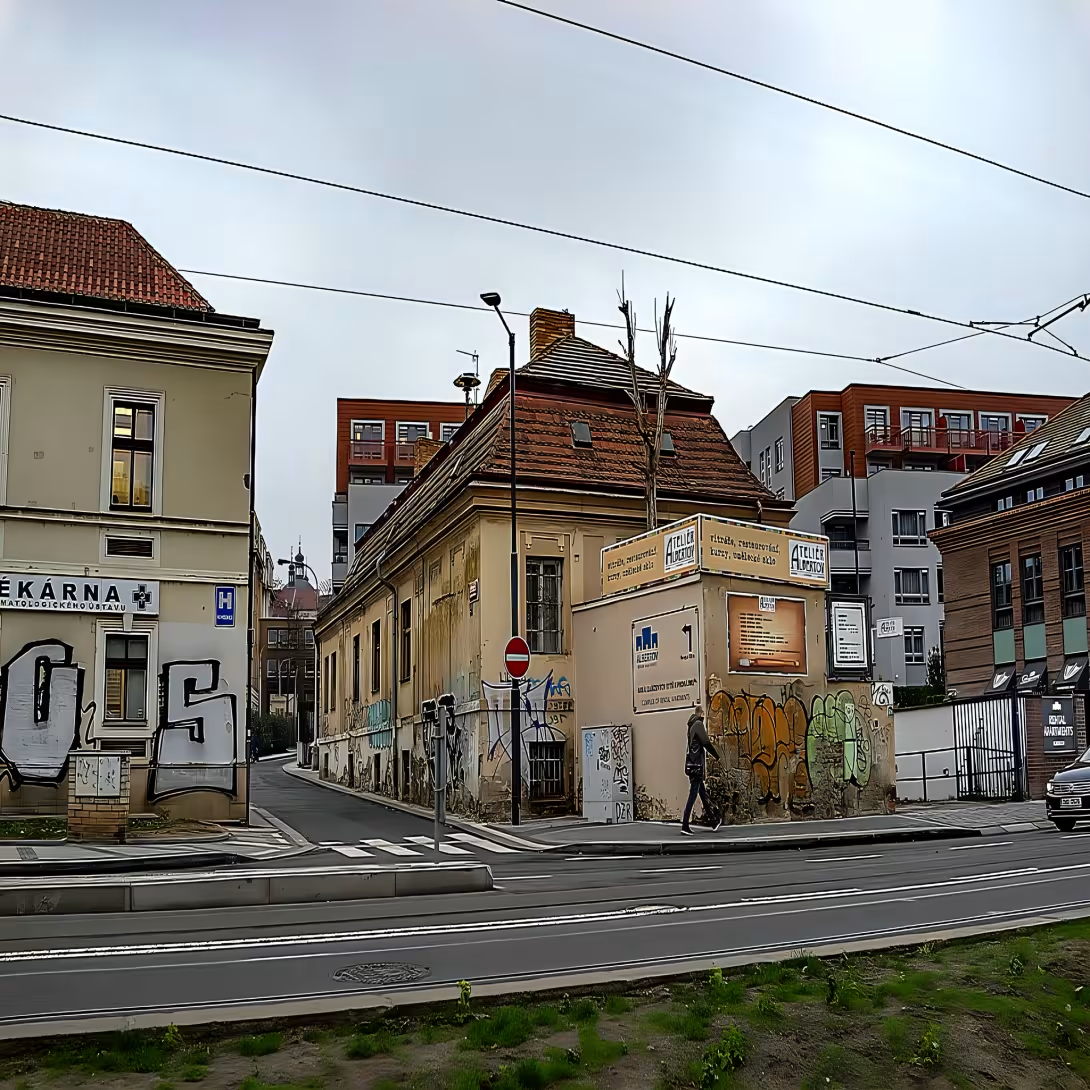
Frühweinovský dům is a late baroque townhouse with classical style. Located in Prague 2 in New Town in Na Slupi 2a. The building is an important example of the classical building of this part of the city. Due to its historical character, it was declared a cultural monument in 2022. It is also part of the Prague Monument Reserve, listed in the UNESCO World Heritage List.
The oldest parts of the building come from the second half of the 18th century. By 1802, the existence of the house was reliably documented as a classicist one-story building. At the time, she had a vaulted stable and a road station. The building was created during the transition from Baroque to Classicism. At the time, the construction of New Town was developed in Prague, for which the combination of residential and economic use was typical.
The object has an elongated rectangular plan. It stands on an irregularly shaped, surrounded plot to cross the streets of Na Slupi and Mountain. The main part of the facade is heading for Mountain Street. The street Na Slupi is oriented only by a shorter side facade, which is partly covered by a low extension in fencing. Under the whole house there are stone cellars with vaulted vaults.
The architectural look developed over time. At the beginning of the 19th century the house was extended to the western part, the second floor and the Mansard roof. In 1846 an eastern extension with a saddle roof was established. This represents the last remnant of the former tannery building. Other building modifications took place in the 1960s.
The house bears its name according to owners or tenants from the Frühwein family of Prague. Historically, it served for living and craft purposes, as evidenced by the tannery and the road industry.
At present Frühweinovský dům is used for housing after being converted into flats in 2020. The building remains a valuable urban element of the historical centre of Prague.
This monument offers a view of the layered history of Prague's township and craft tradition. It is advisable to visit her as part of a walk in New Town, where she serves as an authentic witness to the transformation of urban architecture.
Historical milestones
- 1802
- The existence of the house as a classicist one-storey building with arched stables and a road house is reliably documented.
- 1846
- An eastern extension with a saddle roof.
- 2022
- The house was declared a cultural monument.
Architectural development
The oldest part dates back to the second half of the 18th century, then the building was modified in a classical style. At the beginning of the 19th century there was an extension to the second floor and a Mansard roof, in 1846 the eastern part with a saddle roof was added. In 2020, housing was converted.
Historical events
2022: Declaration of the object for a cultural monument.
Owners
Frühwein family
Points of interest
- It's a late Baroque townhouse with a classic design, which was declared a cultural monument in 2022. - The building is part of the Prague Monument Reserve included in the World Heritage List. - As of 1802, it is documented as a single-storey building, which had a vaulted stable and a road yard. - The eastern extension of 1846 is the last remnant of the former tannery building. The house bears its name according to owners or tenants of the Frühwein family of Prague.
Guide
Show guide text
This text was created by artificial intelligence and has not been editorially reviewed. It may contain inaccuracies.
Welcome to Prague, the heart of New Town. You're standing in front of a building with the name Frühweinovský dům. If you look at it now, you will see a typical townhouse, which in its form tells the story of changes in time and tastes of different epoch. The building is located at the intersection of the streets Na Slupi and the mountain and its most distinctive feature is an elongated rectangular shape, which you see right at first sight. It's a place where history meets the everyday life of a modern city, yet it retains its dignity and peace.
Now let's look together at how this house was born and how it evolved. In front of you is a building that comes from the late Baroque age, but later underwent a significant adjustment in the spirit of classicism. Classicism has brought order, purity and balance to architecture, which you can see in the overall engraving of the building. Historical records tell us that already in the year one thousand eight hundred and two the house was reliably documented as a one-story building. At the time, however, it was not just an ordinary house. Imagine that there was once a arched stable and a roadhouse in areas where you might hear traffic noise. It was a space full of motion, horses and cars that were the only transport at the time. Later, in the year one thousand eight hundred forty-six, the house further grew by an eastern extension with a saddle roof, which gave the building its current scope.
Now pay attention to the architecture itself and to what you see right in front of you. Notice how the building combines a baroque base with a classical face. Even if we don't know the names of the particular builders, their work can be seen in the harmony of the whole. Look at the line of the house and its decomposition. It's fascinating to think that under your feet there are stone cellars with precious vaults. These spatial elements are a testament to the old craftsmanship as well as the practices of ancient times when cellars used to store supplies or craft activities. It is this connection of the residential part with workshops and stables that shows that the house was in the past a living centre of work and craft.
When we think about the people who lived and worked here, we must realise that this house witnessed the daily efforts of Prague craftsmen. Even though the records don't include famous personalities with big names, it was these unknown people who made up the city's tissue. Imagine the morning rush in the road, the smell of horses from stables and the sound of hammers from craft workshops. This house was not only a monument, but a functional space that served its owners and residents to live and live. It is a monument to ordinary but important urban life, which formed the basis of Prague.
Now I'm going to lead you to one interesting thing that gives this place special weight. You may be surprised that even if the house is quiet, it is part of the Prague Heritage Reserve. This means that it is included in the UNESCO World Heritage List. It is a recognition that even townspeople 'houses are essential components of the overall image of our city. Another important milestone was the year two thousand twenty-two, when the house was officially declared a cultural monument. This step has given a clear signal that its historical value is irreplaceable and must be protected for future generations. It's fascinating how a building that once served as a stable and a roadhouse became a protected jewel of urban architecture.
Stop for a moment and feel the atmosphere of this New Town corner. Imagine how centuries have changed here, how fashion has changed in clothes, how cars have disappeared and cars have come, and yet this house is still standing watching everything around it. He is a silent witness to history which reminds us that beauty may not always be in monumental cathedrals, but also in a simple, honest townhouse that has survived for centuries.
Now that you've met the Frühwein house, I suggest you go around it again slowly and observe its elongated plan and roof from different angles. Observe the details of the Baroque and Classicism. Then you can continue to explore other hidden treasures of Prague that are still waiting for you around.
Thank you for taking a walk at this monument. I hope you have felt the spirit of old Prague in this inconspicuous but valuable place. I wish you a pleasant continuation in discovering the beauty of our city. Goodbye.
Tips for visitors
The best time to visit is in the morning or late afternoon when the sun hits the facade of the house and highlights the details of the Baroque and Classicist style. The building is located in the heart of the city, so it is best to use public transport or walk; Check the current connection in the search engine.
We recommend taking shoes suitable for walking through the historical centre. Since it is a building in operation, we recommend to be discreet when photographing and respect people who work in the house.
For the best photos, focus your lens on crossing the streets of Na Slupi and Mountain, where the building is most visible. The ideal light to capture the facade details is during the golden hour before sunset.
Around the house you can explore the historical centre of Prague and Nové Město, located in the immediate vicinity. Families with children will appreciate a walk on the surrounding streets where children can observe the old architecture of the city.
Frequently asked questions
Can the monument be visited?
The building is in use (offices, a school, shops and the like). The interior is generally accessible only during operating hours and tours are not usually offered; we have not verified the details. You can see the exterior from the street.
Where is the monument?
Location: Praha 2. The map on this page shows the exact spot.
Why is the monument protected?
It is listed in the Central List of Cultural Monuments of the Czech Republic as a cultural monument (register no. 1999996507).
Businesses nearby
Do you run a restaurant, accommodation, shop, museum, rental, wellness or other visitor service near this monument? Show yourself directly to the people heading to it — this is how they will see you in the app and on the web:
Events nearby

Zdroj akcí: otevřená data měst a obcí ČR (Národní katalog otevřených dat) a kalendář akcí Národního památkového ústavu.
Nearby
Historické centrum Prahy, Nové Město.
Accommodation nearby
Trips and activities nearby
Guided tours, tickets and activities nearby from GetYourGuide
Affiliate link: if you buy from the partner, we may receive a commission. The price for you does not change.
Search tours and activities →Themed route
Here is the design of the thematic route:
1. Historical centre of Prague (area) - The starting point of the trip where you can admire the ancient architecture and atmosphere of the old town. 2. New Town (area) - Walk a more modern part of the centre that connects the main points of the route. 3. Frühweinovský dům (building) - The main destination of the visit where you can focus on the details of this particular monument.
Seasonal recommendations
In the spring, the surroundings of the building awaken to life, and the first green leaves on the trees in the streets give the place freshness. The light is fine in the morning, which is ideal for observing the facade details. We recommend light spring coats and shoes suitable for walking in the old town.
In the summer months, it dominates the atmosphere of hot days and bright, sharp sun, which highlights the colors of historical walls. It is best to visit the surroundings in the early morning or late evening hours when the air is colder. It is advisable to choose light, breathable clothes and not forget the hat against the sun.
Autumn brings the golden colour of leaves and a specific fog to the district, which gives the memory a mysterious touch. The light is golden and less intense in this period. Visitors are suitable for layered clothes and waterproof shoes, because the streets are more frequent in moisture.
Zimą works in contrast to freezing air and grey sky, while in advent time the surrounding lighting creates a cozy mood. We recommend warm winter clothes, gloves and a hat.
Visualizations and artistic views

The visualisations are generated by artificial intelligence and serve as inspiration.
Photos from the area
Real photos taken near the monument


Zdroj a licence jsou uvedeny u každého snímku.
Tips from visitors
No tips yet. Be the first!
Log in and add your tip.
Sources and literature
Photos: The photonaut / CC BY-SA 4.0, rozlišení zvýšeno umělou inteligencí — Wikimedia Commons. The author and licence also appear when you hover over the image.
Faktickým podkladem tohoto textu byl článek na Wikipedii, jehož autory jsou přispěvatelé Wikipedie. Článek je dostupný pod licencí CC BY-SA 4.0.
Location on the map
Příběhy a pověsti
Legendy, pověsti a příběhy spjaté s touto památkou
Fotografie návštěvníků
Zatím žádné fotografie. Buďte první, kdo přidá fotografii z návštěvy!
Log in a přidejte svou fotografii nebo hodnoťte.
Za ověřenou návštěvu v aplikaci získáte víc bodů — poznáme podle GPS, že jste na místě.
Reviews and comments