



Fürstenberská huť Hammer mill
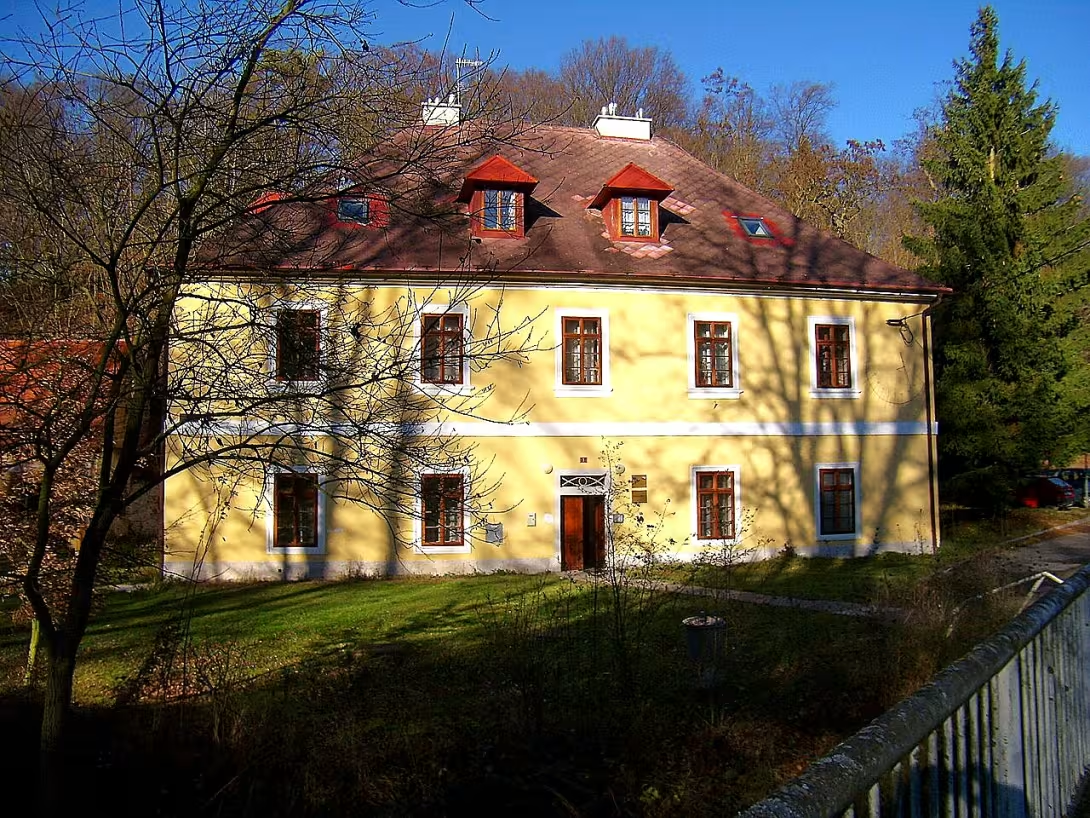
Fürstenberská huť is a historical industrial complex located on the cadastral territory of Nové Jáchymov in the district of Beroun, Central Bohemia. This monument was built as a hardware company between 1810 and 1818, making it one of the most modern and largest ironworks of its time in Europe. Its historical value is that it reflects the expansion of the industrial revolution and brings innovative technologies like steam engines to drive blowers.
The formation of the Fürstenberg Huti is closely linked to the proximity of the ferrous ore deposits in Krušný Hora and the expansion of mining even from greater depths. The founder of this company was Prince Jáchym Egon z Fürstenbergu, administrator of the Křivoklat estate. The design for construction was developed by František Gerstner, Director of Prague Polytechnics, and František Nittinger, Director of the Fürstenberg Huti in Nižbor. The construction took place in 1810-1818 and 320 thousand gold were spent on it.
The architecture of the Fürstenberg Huti is characteristic of the era of feudal wood metallurgy. The blast furnaces, built in a common obituary to reduce heat losses, were 12,5 metres tall and had the names Karl and Amalia. The furnace was driven by a blowtorch which in 1833 was converted into a common double-cross with a wind pressure regulator. In the mid-1930s, experiments were carried out with a cylindrical cast iron fan with steam drive.
The ownership and administration of the Fürstenberg Huti has changed over time. After its founding, it was led by Prince Jáchym Egon z Fürstenbergu, but specific information about other owners is not provided. Key events in the history of the smelter include the first use of a steam engine to drive blowers in 1832 and experiments with wind heating blown into blast furnaces in 1835. In 1872, a large flood hit the iron plant, resulting in economic problems and the subsequent lifting of blast furnaces in 1877-1878.
Today only the remains of the foundations of tiered buildings, the water channel with brick bridging, administrative building no. 1, blacksmith no. 68, slag piles and three ponds are preserved from the original iron factory. Before entering the ore mine, there is a ground floor building with a locked entrance, rooms and a chapel.
Fürstenberská huť is today a monument to the Industrial Revolution and its visit offers a unique view of the history of the hardware store. Maintaining it makes it possible to understand technological innovation at the time and the importance of industrial change for the region. For those interested in history and industry, a visit to the Fürstenberg plant is not only a learning experience, but also a reminder of an important period in Czech history.
Historical milestones
- 1835
- Attempts were made to heat the wind blown into the blast furnace.
- 1872
- The Great Flood has hit the ironworks.
Architectural development
The construction took place between 1810-1818 with designs by František Gerstner and František Nittinger. Originally, the blast furnaces were built in a common obese to reduce heat losses, which was typical of the technology at the time.
Historical events
- 1810
- The construction of the Fürstenber plant has begun.
- 1832
- For the first time, a steam engine was used to drive the blowers.
- 1878
- Cancellation of blast furnaces due to economic problems and flooding.
Owners
The founder was Prince Jáchym Egon z Fürstenbergu, administrator of the Křivoclat estate. Details of other owners are not provided.
Points of interest
- Fürstenberská huť is a historical industrial complex located in the cadastral territory of New Jáchymov. - This monument was built as a hardware company between 1810 and 1818, making it one of the most modern and largest ironworks of its time in Europe. - Its historical value is that it reflects the expansion of the industrial revolution and brings innovative technologies like steam engines to drive blowers. - The ownership and administration of the Fürstenberg Huti changed over time, and was led by Prince Jáchym Egon z Fürstenbergu after its creation. - Today only the remains of the foundations of tiered buildings, water channel with brick bridge, administrative building No. 1, blacksmith No. 68, slag piles and three ponds are preserved.
Guide
Show guide text
This text was created by artificial intelligence and has not been editorially reviewed. It may contain inaccuracies.
Welcome, you stand before a unique place where the power of nature and human ingenuity met in the last century. In front of you is a vast complex of old stone structures, whose massive walls and high chimneys tell the story of the time when the industrial revolution in Europe burned down. The air here carries the light odour of metal and old wooden beams, reminiscent of the noise of ancient machines and the rumbling of kilns that once sparked this landscape. Look at the wide open areas, where huge iron production was once decomposed, and perceive the atmosphere of a place that was once the heart of technological progress.
Let's move on to the beginning of this place. Fürstenberská huť was founded between 1810 and 1818 as a hardware company based on the initiative of the nobleman Jáchym Egon of the family of Stephen, also known as Jáchym Egon z Fürstenbergu. At that time, Europe was changing rapidly, coming up with a new era of machines and new production methods. The emergence of this smelter was a response to the growing demand for high-quality iron, which needed not only railway lines, but also emerging factories and machinery. The project was entrusted to two important builders - František Gerstner and František Nittinger - whose experience and innovative approach ensured that the smelters were among the most modern and biggest ironworks of their time throughout Europe. Since their inception, the latest technologies, such as steam machines, have been applied here, which have driven blowers and have enabled continuous air flow to the blast furnaces.
Now pay attention to the architecture that stretches before you. The main buildings are built of heavy stone, whose massive walls are firmly connected and form an impressive facade that resists time. Notice the large windows that once let light into the working halls and the high chimneys that were used to draw smoke from the furnaces. The architectural solution reflects the functionality and aesthetics of the industrial period - simple lines, robust shapes and practical layout of the premises. If you look closer to one of the furnaces, you will see its characteristic shape, resembling a huge metal cauldron, in which iron ores and coal were inserted. These furnaces were driven by steam engines that provided a steady flow of air, thanks to the blowers that were then considered a technological miracle.
The key stories associated with this place include experiments that took place in 1835. At that time, engineers tried to heat the wind that was sucked into the blast furnaces, thereby increasing melting efficiency. This experiment was one of the first attempts to optimize processes through heat preheating, which shows how far the technical imagination of the people who worked here went. Another important event was a large flood in 1872, which hit the whole area and caused considerable damage. Although the flood has left traces of construction, the smelter has recovered and continued to operate, suggesting the resilience and importance of this industrial centre.
We cannot ignore the personalities who shaped the fate of this smelter. Jáchym Egon z Fürstenbergu, founder and chief patron, was a visionary who recognized the potential of the hardware store for the development of the region. His commitment and investment brought not only the economic boom, but also technological innovation that spread on. František Gerstner, one of the architects, was known for its projects in the field of railway transport and industrial construction; its contribution to the design and implementation of the smelter was crucial. František Nittinger, the second architect, has contributed his knowledge of construction techniques and materials, allowing to build such a robust and long-lasting complex. Together they created a place that became a symbol of the progress and strength of the human mind.
The interesting fact that Fürstenberská huť is located in the cadastral territory of Nové Jáchymov and represents one of the few preserved industrial sites from the early 19th century in this part of the country. Its historical value lies not only in architectural design, but also in the fact that the latest technologies of its time have been tested and applied here. For example, steam machines that powered blowers at that time were a relatively new invention and their deployment in this plant showed how fast modern technology spread to different industries. In addition, experiments with wind heating in 1835 are an early example of energy saving and efficiency gains, which are also topical at present.
Now that you've become acquainted with history, architecture and the stories associated with this place, you can look around and see how the past intertwines with the present. Notice how the stone walls still hold their majestic appearance, and imagine how loud and noisy it used to be when iron and steam machines were melting in the furnaces. Think about the people who worked here - craftsmen, engineers, supervisors who have contributed every day to the development of this enterprise. Every detail, whether it's an old window frame or a worn-out stone threshold, carries traces of time and reminds that there was once a life of hard work and innovation.
In conclusion, I invite you to continue to immerse yourselves in the atmosphere of this place and explore its surroundings. Walk around the premises, listen to the whisper of the wind between the stone walls and imagine what the sound of steam machines was when they started. Let yourself be inspired by the courage and visions of people who have created something here that has survived for hundreds of years and still resembles the power of the human spirit. Thank you for joining this audio guide, and I wish you another pleasant trip along the historic paths of New Jáchymov. Say goodbye to this place with a sense of respect for the past and knowing that even today you can find inspiration for the bold steps taken here.
Tips for visitors
The best time to visit the Fürstenberg Huti is in the summer months when the weather is favourable and the tree offers a cosy shadow. This historical industrial ensemble offers a view of the remains of old buildings in harmony with natural surroundings, which is ideal for lovers of history and nature.
Public transport is suitable for access to Nové Jáchymov, while you can continue by foot or car to the Fürstenberg Huti.
What to take with you: We recommend not sleeping on your feet, sun protection and water for drinking. Moreover, it is a good idea to bring a map or use GPS navigation to better orient the surroundings.
Photography: The best places for photos include the area around the administrative building No. 1 and the forge No. 68, where it is possible to capture the charm of old remains in natural light. Preferably take pictures during early morning or evening when light is less intense and shading favorable.
What to visit nearby: Near the Fürstenberg Huti there are three ponds that are ideal for relaxation or a short walk. These places offer a calm atmosphere and an opportunity to enjoy the natural environment.
Frequently asked questions
Can the monument be visited?
We have not verified whether this monument is accessible. Please ask the owner or operator, or the local municipal office.
Where is the monument?
Location: Středočeský kraj. The map on this page shows the exact spot.
Why is the monument protected?
It is listed in the Central List of Cultural Monuments of the Czech Republic as a cultural monument (register no. 1000143083).
Businesses nearby
Do you run a restaurant, accommodation, shop, museum, rental, wellness or other visitor service near this monument? Show yourself directly to the people heading to it — this is how they will see you in the app and on the web:
Events nearby

Zdroj akcí: otevřená data měst a obcí ČR (Národní katalog otevřených dat) a kalendář akcí Národního památkového ústavu.
Nearby
Areál se nachází v údolí podél Habrovského potoka, s třemi rybníky a zbytky správní budovy čp. 1 a kovárny čp. 68.
Accommodation nearby
Themed route
Thematic cruise route: Fürstenberská huť
1.Fürstenberská huť (hamr) - Type: historical monument - Why is it worth a visit: This ancient blacksmith factory is one of the oldest industrial plants in Bohemia. Visit her to see the history of hardware and to see how the forging was done in the 19th century.
2. Pond - Type: natural tour site - Why is it worth a visit: Three ponds in the valley of Habrovsky creek offer a quiet atmosphere and beautiful landscapes. They are an ideal place to relax after exploring historical buildings.
3. Administrative Building No. 1 - Type: architectural monument - Why is it worth a visit: The remains of this building testify to the past and organization of industrial operations in the area. It's an interesting example of architecture from when it was active.
4. Blacksmith No. 68 - Type: historical building - Why is worth a visit: This forge is an important part of the industrial complex and provides insight into the techniques and processes used here. It's an ideal place to understand historical forging methods.
5. Habit stream - Type: natural element - Why is it worth a visit: The stream that flows through the whole location adds a lively atmosphere to the area and is a beautiful place for relaxation or short walks. Its sounds help to relax the mind after visiting historical buildings.
This route will offer you a combination of history and nature, which will allow a deeper understanding of the past and the beauty of the surrounding environment.
Seasonal recommendations
Spring: During the spring season, the Fürstenberg Huta has a vibrant greenness where nature begins to come to life and the surrounding forests are drawn into brighter shades. The sunny days bring a warm ray of light that illuminates the remains of the foundations and building, creating an unforgettable atmosphere. It is recommended to visit the spring sun when the temperature is pleasant and the presence of crowds is minimal. A good idea is to bring light clothes to protect from sunlight.
Summer: In summer Fürstenberská huť is a popular place thanks to warm sun and long days that allow you to explore historical remains in peace. The forest areas around the hut offer beautiful views and opportunities for picnicking. Summer is the most visited time, so it is recommended to come early in the morning to be able to explore the memory without greater crowd pressure. Remember to protect against the sun - the hat and the protective scaffolding are necessary.
Autumn: In the autumn period Fürstenberská huť gains melancholic charm when the forests turn into different shades and the falling leaves give the atmosphere quiet and calm. Sunshine days are still common, but long nights bring colder air. This is the perfect time for those who are looking for a place without big crowds. It is recommended to wear several layers of clothing and consider a warm shirt or raincoat. Due to the reduced number of visitors it is possible to explore the memory in peace.
Winter: Winter Fürstenberská huť offers a completely different view when snow sheets and ice shapes add beautiful beauty to the place. The sunny days are shorter, but the sun creates a breathtaking effect on the shady sides of the remains of the buildings. We recommend that you wear warm clothes, including leather gloves and shoe cover to be paralyzed from freezing temperatures. Winter visit is ideal for those who love the peace and sight of the memory in ice and snow.
Visualizations and artistic views


The visualisations are generated by artificial intelligence and serve as inspiration.
Photos from the area
Real photos taken near the monument


Zdroj a licence jsou uvedeny u každého snímku.
Tips from visitors
No tips yet. Be the first!
Log in and add your tip.
Sources and literature
Photos: Krabat77 / CC BY-SA 3.0 — Wikimedia Commons. The author and licence also appear when you hover over the image.
Faktickým podkladem tohoto textu byl článek na Wikipedii, jehož autory jsou přispěvatelé Wikipedie. Článek je dostupný pod licencí CC BY-SA 4.0.
Location on the map
More monuments – Středočeský kraj
Show all in the region




Příběhy a pověsti
Legendy, pověsti a příběhy spjaté s touto památkou

Fotografie návštěvníků
Zatím žádné fotografie. Buďte první, kdo přidá fotografii z návštěvy!
Log in a přidejte svou fotografii nebo hodnoťte.
Za ověřenou návštěvu v aplikaci získáte víc bodů — poznáme podle GPS, že jste na místě.
Reviews and comments