



Harrachovská hrobka v Horní Branné Tomb
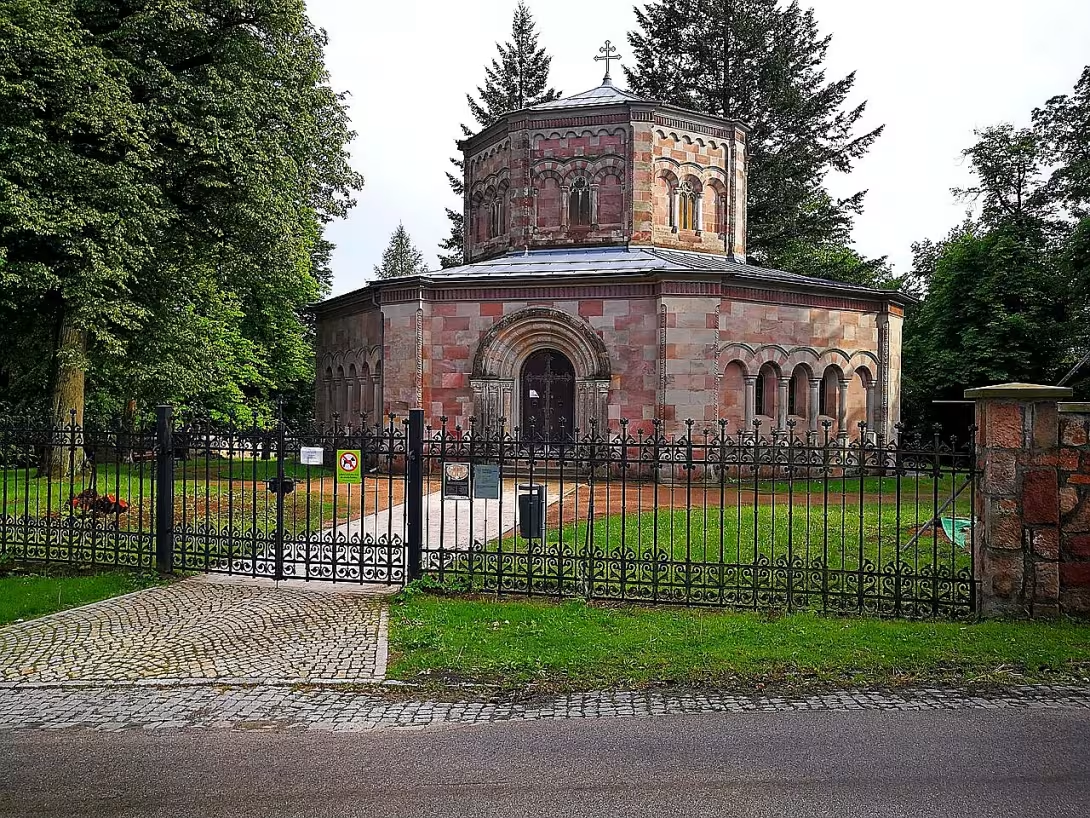
Harrachovská hrobka v Horní Branné (Semily County, Liberec Region) is a pseudo-Romanesque funeral chapel of the Holy Cross, built in 1840-1870. The work excels in architectural design and serves as the final resting place of members of the House of Harrach. The chapel was created thanks to the initiative of František Arnošt of Harrach.
The architectural solution is unique in northern Bohemia. The shape of the tomb comes from two focused octagonal. The facade consists of alternating blocks of red and white sandstone from nearby quarry. The entrance portal is richly decorated with knitting belts and palm trees. The inner walls are lined with black marble plates on which the name and titles of the buried members of the genus are carved in gold.
There's a crypt under the chapel. The remains of the Harrachs were moved here on March 4, 1875 from the chapel of St. Alois in the neighbouring hospital. Among the local personalities are, for example, enlightened nobleman Jan Nepomuk hrabě Harrach, who lived between 1828 and 1909.
The history of the tomb recorded two attempts at robbery. The first took place on the night of the 15th to 16th May 1925, when the perpetrators stole three brass candlesticks and chandelier. But later, these objects were dumped in the sandpit in the forest of Brabenec, where children were found playing. The second attempted break-in took place on the night of August 4th to August 5th, 1934, but the robbers didn't get into the gallery and left with the missing.
The first reconstruction took place in 1975 at the expense of the local organisation Svazarm. From 2009 to 2011, extensive repairs were carried out to restore the historical centre of the village, including the castle, church and hospital. The academic sculptor Jiří Kašpar performed a total of CZK 3.5 million. The funding was provided by the municipality Horní Branná, EU subsidy, Ministry of Culture and the Liberecký Region Cultural Heritage Fund. The reconstruction focused on the external facade (pairing, removing moss and replacing small decorative elements) and the surrounding park.
Today, the chapel serves as a ceremonial hall for the interpretation of funerals. It is surrounded by a publicly accessible park with grown trees and benches. The Harrachov tomb represents a rare example of pseudo-Romanesque architecture and silent testimony about the history of the noble family. Her visit allows you to know the historical centre of the village Horní Branná.
Then and now
Drag the slider to compare how the landmark may have looked when it was built with the view today.
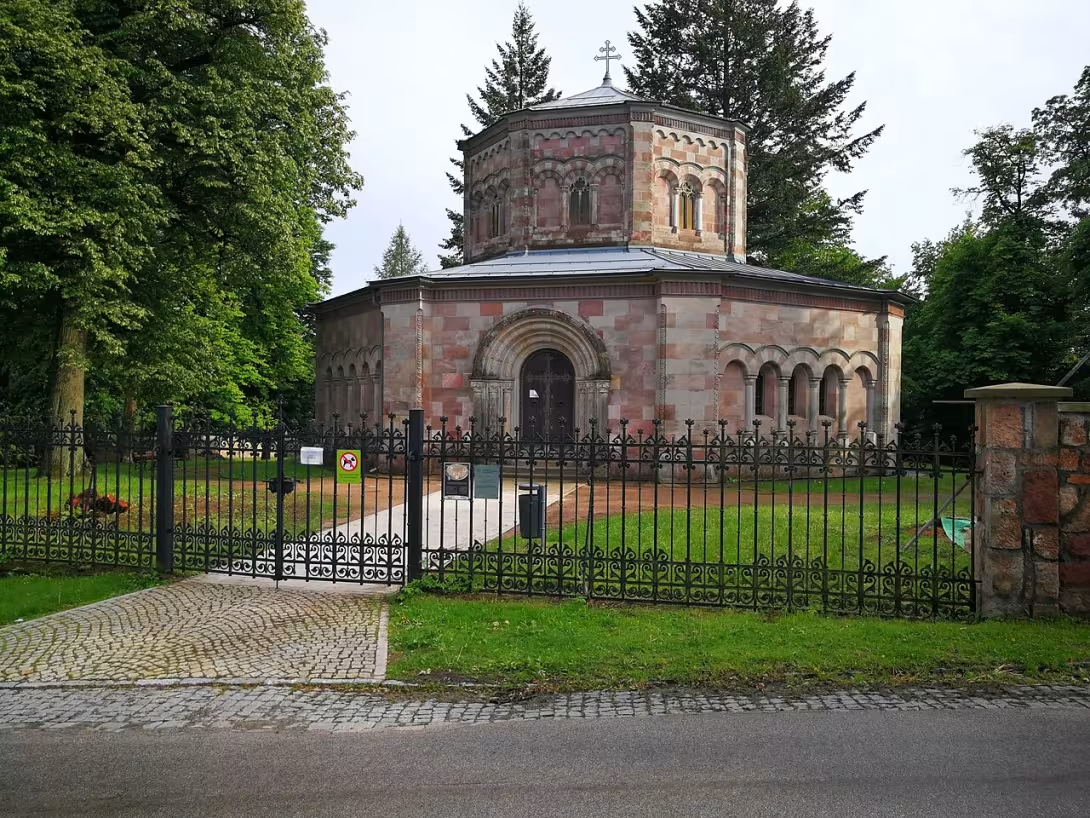

The historical appearance on the left is an AI-generated visualisation and serves as inspiration only.
Historical milestones
- 1840
- Start of the chapel construction
- 1870
- Completion of chapel construction
- 1875
- Movement of the remains of members of the House of Harracha from the chapel of St. Alois
- 1925
- First tomb robbery
- 1934
- Second attempted robbery
- 1975
- First reconstruction at the cost of Svazarm
- 2009
- Start of extensive reconstruction of the building
Architectural development
The construction was realized in pseudo-Romanesque style of red and white sandstone. The first reconstruction took place in 1975 and in 2009-2011 a complex reconstruction of the facade and surrounding park was carried out.
Historical events
The chapel was built in 1840-1870. In 1875, the remains of the Harracha family were moved into the crypt from a nearby hospital. In the years 2009- 2011 a extensive reconstruction of the building and surrounding park took place.
Owners
House of Harrachs
Points of interest
- The architectural solution in the shape of two concentrated octagonal is unique in northern Bohemia. The facade consists of alternating blocks of red and white sandstone. - The inner walls are covered with black marble plates with gold letters. In 1925, the robbers stole three brass candlesticks and a chandelier. The objects later found children playing in the sand pit in the forest of Brabenec. On the night of August 4 to 5, 1934, there was another attempted break-in that was unsuccessful. - The chapel is now serving as a ceremonial hall for the interpretation of funerals.
Guide
Show guide text
This text was created by artificial intelligence and has not been editorially reviewed. It may contain inaccuracies.
Welcome to Upper Branne. You are now facing one of the most important and most precious building units in the entire region. Before you go any further, stop for a moment and feel the atmosphere of this place. Before your eyes is the chapel of the Holy Cross, which serves as the tomb of the great nobleman House of Harrachs. At first sight, you must be interested in its unusual appearance and colors, which are so harmonious and at the same time noble. Feel the beauty that comes from a combination of materials used here. The facade of the chapel is not monotonous, but it consists of alternating blocks of red and white sandstone. This color contrast creates a rhythm that leads your view across the entire area of the building and gives it dynamics, even if it is a place for quiet rest and memories.
Let us now look together deeper into the history that shaped this place. This chapel is not just a random stellar work, but a result of long-term efforts and visions of one particular family. The whole construction started in 1840 and lasted several decades until it was completed in 1870. The main initiator of this magnificent project was František Arnošt z Harrachu. His intention was to create a dignified place that would forever preserve the memory of his family. The whole construction process was accompanied by an effort for perfection, which is also evident from how long the implementation lasted. Later, in 1875, there was another important event, when the remains of members of the House of Harrach were moved to this tomb from the former chapel of St. Alois. This definitely became the heart of family memory.
Now pay attention to the architecture itself, because what you see is absolutely exceptional. The chapel was built in a pseudo-Romanesque style, which means that its appearance refers to ancient, solid and spiritual shapes that give us a sense of stability and eternity. The architect of the whole work was Jiří Kašpar, a man who was able to combine the demanding demands of the noble family with artistic elegance. If you look at the overall geometry of the building now, you may not realize its greatest mystery. This chapel has a unique shape of two concentrated octagonal. This architectural element is unique throughout the northern Bohemia. Imagine the mathematical precision and harmony where one octagonal is inserted into another, creating a space that acts as the center of the universe or a place where the earthly world meets the celestial one.
When you decide to enter, prepare yourself for an experience that completely distinguishes you from the outside. While the sandstone dominated outside, the inner space is brought forth with immense wealth. Notice the walls that are lined with black marble plates. This dark, deep material creates a strong contrast to what you see in them. Because these plates are decorated in gold. This contrast of black and gold is not random; It is meant to create a sense of grandeur and to remind you of the unshakable value of human life and family tradition. The inner space of the chapel is not just an ordinary room, but a ceremonial hall which is intended for the most serious moments.
But the history of this place is not just a story about architecture and nobility. It's also a story about human weaknesses and drama that took place in the silence of these walls. Even such a sacred and protected place was not immune to crimes. In 1925, the chapel was the target of the first robbery. At that time, the robbers woke up inside the tomb and stole three brass candlesticks and chandeliers, which at that time represented a great loss not only material but also spiritual. This event left a shadow in the memory of the place. Unfortunately, human greed has not given way. In 1934, the robbers tried to rob again, which shows how much this place lured its treasures. These events add some dark mystery to the tomb and remind us that history is composed not only of light but also of shadows.
Even after these difficult times, the chapel has come to terms with time and fate. After a period of uncertain years, the first major reconstruction took place in 1975, which was secured at the expense of Svazarm. This renewal helped preserve this precious monument for future generations and ensured that its architecture and details would not be lost in the dust of oblivion. Thanks to this, we can look forward to seeing the same shapes and colors that people saw over a century ago.
When you look at the chapel, try to perceive not only what you can see at first sight, but also what is hidden in the details. Feel the weight of history that radiates from every stone. Imagine the moments when the rites took place here in silence, and the moments when the robbers moved here at night. This tomb is a living witness to ups and downs, human faith and human greed. It's where the mathematics of the octagonal meets the emotions of the human heart.
I hope that this short journey through the history of Harracha and their tombs has moved you and helped you better understand the importance of this place. Let yourself be inspired by the beauty of Upper Branné and continue to explore the surroundings. Every stone in this city has a story, but this Holy Cross story is one of the most important. Thank you for your attention and we will wait you out on the next trip through history. Goodbye.
Tips for visitors
The best time to visit the Harrachov tomb is in the spring months when the green and flowering surrounding parks are the most charming. The sunny days provide ideal conditions for a tour of the chapel and its beautiful environment.
When visiting, bring protective clothing, especially in colder months. Photography is suitable in the early afternoon or in the evening when light is lighter and shading is better for capturing the details of architecture.
In the vicinity of the Harrachov tomb there is a local castle that offers interesting history and beautiful gardens. The church and hospital are other attractions that can be explored during the visit.
For families with children the surrounding park is an ideal place to relax or have a picnic. Children can look forward to walking between trees and perhaps playing in nature.
Frequently asked questions
Can the monument be visited?
Cemeteries and graves are usually accessible; please respect the dignity of the place. We have not verified the opening hours of this cemetery.
Where is the monument?
Location: Horní Branná, Liberecký kraj. The map on this page shows the exact spot.
Why is the monument protected?
It is listed in the Central List of Cultural Monuments of the Czech Republic as a cultural monument (register no. 1000128821).
Businesses nearby
Do you run a restaurant, accommodation, shop, museum, rental, wellness or other visitor service near this monument? Show yourself directly to the people heading to it — this is how they will see you in the app and on the web:
Nearby
Public accessible park with grown trees, local castle, church and hospital.
Accommodation nearby
Themed route
1. Local castle (castle) - Historical center of the village, which serves as an ideal entry point for walks. 2. Church (church) - An architectural element with a spiritual atmosphere close to the centre. 3. An interesting building resembling old care for the health of local people. 4. Public park (park) - An oasis of peace with grown trees that leads the way to the main destination. 5. Harrachov tomb (chapel) - Top of the route and a significant family tomb in the form of a chapel.
Seasonal recommendations
Spring: Harrachovská hrobka v Horní Branné offers an unforgettable impression in the spring due to the blooming nature that revives the surrounding countryside. Sunny days and mild temperatures provide ideal conditions for walking around the chapel. At this time the lighting is gentle and golden, which gives the historical state of the tomb a romantic atmosphere. It is recommended to visit early afternoon time when crowds are still mild and nature offers the most beautiful experiences. The important thing is to bring clothes suitable for mild temperatures, perhaps even umbrella in case of sudden spring rainfall.
Summer: In summer, the Harrachov tomb is gaining its life thanks to the long dawn and warm meridians. The sun illuminates the chapel in full beauty, which increases the visual attraction of the monument. This season it is advisable to visit the tomb early or late in the afternoon to avoid the biggest crowds. Hot clothes and sun protection (kaktaus, hats) are necessary for a comfortable stay. Nature around is in full power, making the surrounding walking or picnics an ideal complement to the visit.
Autumn: Autumn brings the Harrachov tomb to a special atmosphere with changing colour speculations of leaves and colder temperatures. Sunshine days are still beautiful, but the length of dawn is falling, which means it is advisable to visit the memory early in the day. The atmosphere becomes quieter and less demanding on the sun, which attracts lovers of peaceful walking. Clothes should be mild with the possibility to add a layer in case of colder days or evenings.
Winter: Winter visit to the Harrachov tomb offers unique experiences where the chapel stands still and covered with snow. Light is colder and less intense, which gives the memory a mystical character. This season the opening time is shorter, so it is advisable to visit it in time. Hot clothes with protection against the whirlwind and snow are essential for a comfortable stay. Winter offers a quieter visit without large crowds, which allows you to enjoy a historical memory in a quiet atmosphere.
Visualizations and artistic views


The visualisations are generated by artificial intelligence and serve as inspiration.
Photos from the area
Real photos taken near the monument


Zdroj a licence jsou uvedeny u každého snímku.
Tips from visitors
No tips yet. Be the first!
Log in and add your tip.
Sources and literature
Photos: Al.trcka / CC BY-SA 4.0 — Wikimedia Commons. The author and licence also appear when you hover over the image.
Faktickým podkladem tohoto textu byl článek na Wikipedii, jehož autory jsou přispěvatelé Wikipedie. Článek je dostupný pod licencí CC BY-SA 4.0.
Location on the map
Příběhy a pověsti
Legendy, pověsti a příběhy spjaté s touto památkou
Fotografie návštěvníků
Zatím žádné fotografie. Buďte první, kdo přidá fotografii z návštěvy!
Log in a přidejte svou fotografii nebo hodnoťte.
Za ověřenou návštěvu v aplikaci získáte víc bodů — poznáme podle GPS, že jste na místě.
Reviews and comments