






Hloubětín Chateau
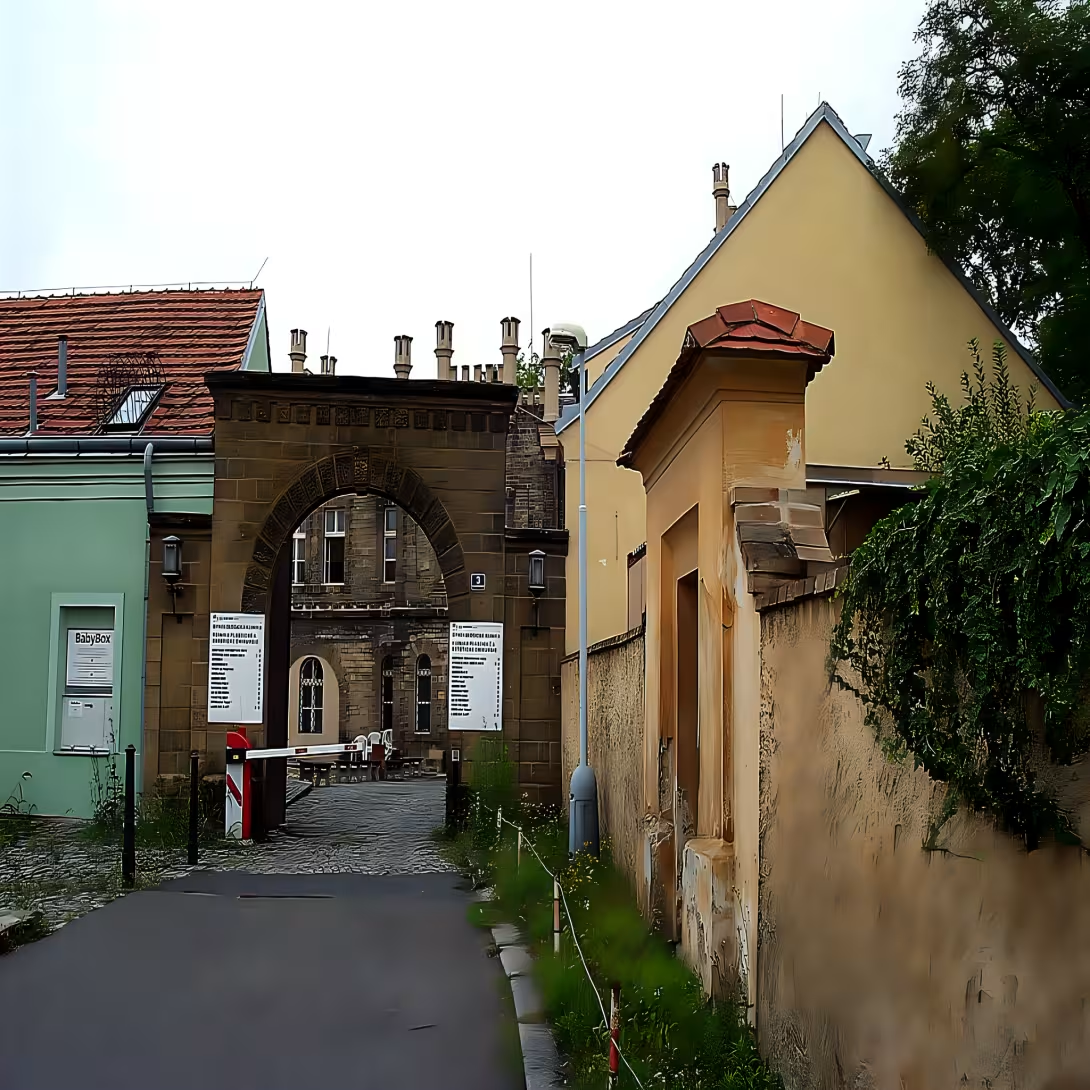
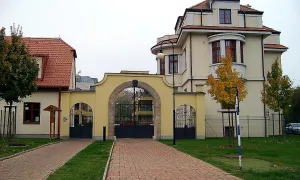
The Hloubětín Chateau in Prague 9 is a neo-gothic architectural monument consisting of a single-storey building with a distinctive three-storey tower. Although it comes from the second half of the 19th century, it is assumed that the very core of the construction could have been of much older origin. The chateau is listed on the list of cultural monuments of the Czech Republic.
The history of the site dates back to the Middle Ages. In the place of today's chateau there was a fortress which was fired by the Swedes in 1648. The modern form was acquired only in the 1970s, when the land was purchased by the land attorney JUDr. Václav Linhart. He built a Neo-Baroque villa here designated as his family's mansion, but soon sold it. One of the most important later owners was JUDr. František Sedláček, who began to transform the building into a neo-gothic chateau. An interesting figure among the owners was the Karlin landowner Vladimír Židlický, who had the facade decorated by his own made-up coat of arms and made a sound on the corner with a boundary wall equipped with a battlements.
Before World War II, the chateau belonged to a Jewish village. He was expropriated during the German occupation. After the war, the building served as a carpentry shop and warehouse. From 1945 to 1959 it had the headquarters of the village theatre, which subsequently worked under the name State Tours Theatre until 1962. Since 1969, the building has served as a house of pioneers.
A new chapter in its history brought back the Jewish village in 1990. The municipality rented the building to a private gynecology and assisted reproduction health facility. This step led to an important initiative - the launch of the first Babybox in the Czech Republic on 1 June 2005. Babybox has become a place of salvation for mothers in crisis. During nearly 15 years of its operation in Hloubětín 28 children were saved. Families with children born after successful artificial insemination used to meet each year at the chateau. With the transfer of the medical facility GynCentrum to Libna, Babybox also moved; since 5 December 2019 works at the Royal Vinohrady University Hospital.
The chateau became famous in cinema. He appeared in the film Pastik (1968 / 1990) and later in television series - in the 47th episode of Life in the Chateau, in the 6th episode of the Cop, in the 15th episode of the Criminals of the Angel, and in particular in the 13th episode of the Cop and the infant, who devoted herself to stories about the Babybox.
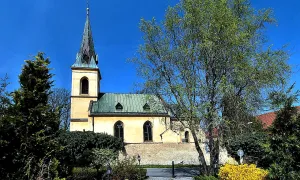
In the immediate neighbourhood of the chateau there is a crucifixion church in the northeast part of St. George with a former cemetery and a nearby crucifixion court, which adds another layer of historical depth to the site.
Then and now
Drag the slider to compare how the landmark may have looked when it was built with the view today.
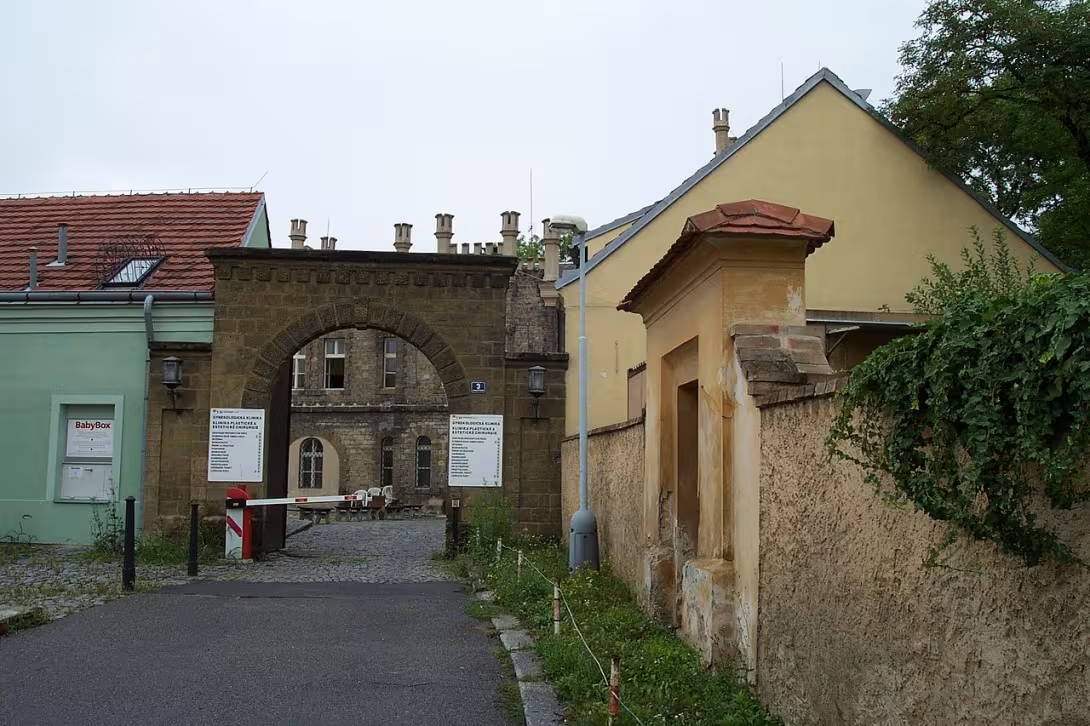

The historical appearance on the left is an AI-generated visualisation and serves as inspiration only.
Historical milestones
- 1648
- The original medieval fortress was burned by the Swedes.
- 1990
- The chateau was returned to the Jewish village.
- 2005
- The first Babybox in the Czech Republic was opened on 1st June.
- 2019
- The Hloubětín Babybox was moved to the Royal Vinohrad University Hospital after nearly 15 years of operation.
Architectural development
In the 1970s, the original medieval fortress, or the estate, was converted into a neo-Baroque villa. Later, a major reconstruction took place to a neo-gothic chateau under the direction of František Sedláček. There was also a three-storey tower, a sound and a fenced wall with a cimbura, and the facade was decorated with a fabricated coat of arms.
Historical events
1648: Burning the original medieval fortress of the Swede. 1945-1959: The effect of the village theatre in the building. 1 June 2005: The first Babybox in the Czech Republic.
Owners
JUDr. Václav Linhart (1970s), JUDr. František Sedláček, Karlinian landowner Vladimír Židlický, Jewish village (before World War II and again since 1990).
Points of interest
- The chateau in Hloubětín is a neo-gothic monument consisting of a single-storey building and a distinctive three-storey tower. The site of today's chateau was a medieval fortress that was fired by the Swedes in 1648. - Karlinian landowner Vladimír Židlický had the facade decorated with his own made-up coat of arms and made a sound on the corner with a border wall equipped with a battlements. - On 1 June 2005, the first Babybox in the Czech Republic was opened in Hloubětín, which saved 28 children in almost 15 years of operation. - The chateau appeared in the film Pimp and in TV series Life in the Chateau, the Cop, the Criminal Angel and the Cop and not to mention.
Guide
This guide is narrated by a synthetic voice generated by artificial intelligence.
Show guide text
This text was created by artificial intelligence and has not been editorially reviewed. It may contain inaccuracies.
Welcome to Hloubětín. You are standing right in front of one of the most interesting architectural pieces of this Prague district, which at first glance acts as from another century. In front of your eyes is a chateau whose neo-gothic form immediately captures anyone who stops by and raises their eyes. Feel the atmosphere of peace and history that has intertwined with every stone and every detail of this building over the centuries. Take a look at the structure, how it harmoniously fits into its surroundings, and at the same time it stands out in its specific, majestic form. There's something mysterious about it that makes you stop and think about what this place has been through.
But to really understand why this place looks what it looks like, we have to go back deep into the past together. What you see today is only one of the many faces of this place. A few centuries ago, there was no chateau, as you know, but a medieval fortress. Imagine the solid structure that was supposed to protect the surrounding settlement in times of uncertainty. But history can be cruel and unpredictable. In the year six hundred forty-eight, during the period of devastating wars, this fortress lost its glory when the Swedes burned it down. Imagine the fire and the chaos that took over this place. After this tragic dogaCalculation, there is likely to be an estate that served local generations for decades, until fate decided to transform this land completely.
Now pay attention to the architecture itself, which is right in front of you. Focus your view on the contrast between the main building and the dominant tower. The chateau is made up of a single-storey building that looks very elegant and sparingly, but what really dominates the whole view and what you should not miss is the tall, distinctive three-storey tower. It is the tower that gives the whole object the right neo-gothic touch and creates a sense of grandeur. Note the details on the facade. Although the building may seem quiet today, its facade bears traces of the ambitions of people who once lived here and wanted to leave their presence in permanent form.
Now let's move on to the stories of the people who shaped this chateau. This whole neo-gothic form that you admire today has its roots in the 1970s. That's when a man named Václav Linhart came in. He was a land lawyer who saw an opportunity in this part of Prague and decided to purchase the land to build a family residence. It was his decision that laid the foundations for making the original mansion a representative place. Later, however, the chateau became the property of other important personalities. One of them was, for example, the Karlín landowner Vladimír Židlický. He brought a piece of his own identity and pride into the building. If you look at the corners of the building and its facade, you can perceive its influence. The chair had the façade decorated with its own completely made-up coat of arms. It wasn't just about beauty, it was about expressing your own power and prestige through architecture. Other names such as František Sedláček appear in the history of this place, and each of these names has left its mark in the history of the chateau.
You might be surprised that this historical monument is also associated with a very modern and sensitive story that took place in the recent past. Chateau Hloubětín is not only a museum of the past, but a place that played an important social role in the New Testament. In the year two thousand and five, exactly the first of June, something absolutely extraordinary happened here. The first Babybox in our whole country was opened in the chateau. Imagine this - a new era of care for the smallest and most vulnerable beings was born in these historic walls. This facility worked here for nearly 15 years until in the year two thousand nineteen Babybox was moved to the Royal Vinohrady University Hospital. It's a fascinating combination of medieval roots, the nineteenth century and modern humanity that meets here in one place.
Look at the lock for a while and try to see all those layers of time. Since the fire of the year one thousand six hundred forty-eight, when the Swedes destroyed the fortress, and the ambitious entrepreneurs and lawyers who built the family houses here, to the modern social services that have worked here in recent years. Every brick and every tower floor tells its own unique story. It's a place where history keeps changing. I hope that this short journey through history has helped you better understand and perceive this extraordinary place. Continue to explore the surrounding area and enjoy the beauty of Hloubětína. Goodbye.
Tips for visitors
The best time to visit Hloubětína is in the morning during the working week, when there is a quieter atmosphere and you can enjoy the exterior of this neo-gothic monument from the nineteenth century. Transportation to the chateau is possible by car and by public transport, and you can best verify the specific connection in the online connection search engine. Take your comfortable shoes for walking around and possibly a camera to capture the historical details of the building. For photography it is best to use the morning side light, which will highlight neogothic architectural elements and adjacent historical buildings. In the immediate vicinity of the chateau is worth visiting the crucifixion church of St. George with a former cemetery and nearby crucifixion courtyard located in the northeast part just next to the building. Families with children will appreciate a modest walk around the monument, where they can see the historical places associated with the medieval history of this Prague district.
Frequently asked questions
Is Hloubětín open to the public?
Yes, the chateau is open to the public from April to October.
How do I get to the place by car / public transport?
Parking is possible near the chateau, but we recommend using public transport from nearby station. The journey takes about 10 minutes.
How much is the entrance fee and is it paid on the spot?
Payment shall be made on the spot.
Is the tour suitable for children and seniors?
Yes, the chateau is a suitable tour for families with children, but we recommend bringing tables and chairs so that children can relax during the tour.
How long does the tour take?
The tour takes about 1-2 hours, depending on how long you will be interested in the history of the chateau.
What are the opening times and booking is required?
The chateau is open all year round, but the best time to visit is from April to October. Opening hours are from 9: 00 to 15: 00, booking is not required.
What's interesting in the immediate vicinity?
In the immediate surroundings you will find other historical monuments such as churches and forts. Near there are also woods where you can make a pleasant walk.
For kids
Imagine going back to the past, until the Hloubětín was the chateau of the lords of the Deep. It was like a game where you were a hero and you could discover hidden treasures.
How did it look here? Who lived here? What happened here? Hloubětín stood in a strategic place in the Vltava Valley, as king on the throne. The gentlemen of Hlubětín had a seat here and checked the area. The city was full of life, people lived, traded and kissed.
Businesses nearby
Do you run a restaurant, accommodation, shop, museum, rental, wellness or other visitor service near this monument? Show yourself directly to the people heading to it — this is how they will see you in the app and on the web:
Events nearby

Zdroj akcí: otevřená data měst a obcí ČR (Národní katalog otevřených dat) a kalendář akcí Národního památkového ústavu.
Nearby
In the northeast part of the chateau is close to the crucifixion church of St. George with a former cemetery and a nearby crucifixion court.
Accommodation nearby
Trips and activities nearby
Guided tours, tickets and activities nearby from GetYourGuide
Affiliate link: if you buy from the partner, we may receive a commission. The price for you does not change.
Search tours and activities →Themed route
Thematic cruise route around the chateau Hloubětín
1. Chateau Hloubětín - * Type: * Historical chateau - * Why is it worth visiting: * Chateau Hloubětín is a unique architectural monument with a rich history. Its classical building and beautiful garden spaces offer a view of the past that everyone can enjoy.
2. St. George's Cross Church - * Type: * Church - * Why is it worth visiting: * This church is an example of Baroque architecture and has an important historical value for the area. Its location beside the chateau adds harmony and cultural depth to the entire area.
3. Former cemetery - * Type: * Historical cemetery - * Why is it worth visiting: * Despite its peaceful character, the former cemetery is an interesting place that reflects the history and tradition of the village. His ancient tombstones are evidence of a rich past.
4. Crossyard - * Type: * Historical building - * Why is it worth visiting: * The Crossroads Court, located near the church and cemetery, is another important historical element. Its architecture and functions in the past contribute to understanding life in this area.
This route offers visitors the opportunity to explore historical monuments around the chateau Hloubětín and appreciate their cultural importance.
Seasonal recommendations
Spring in the deep chateau area brings awakening nature, where the surrounding greenery and blooming park provide a fresh feel for historical facades. Low afternoon sun creates fine light transitions ideal for shooting details of exterior. During this period, you will meet only a few visitors, so you will enjoy the tour in complete peace. I recommend fixed waterproof shoes because the roads after winter may be wet, and the best time for visiting is in the morning when the morning fog rises above the adjacent stream.
Summer offers a lush vegetation of a fully foliated chateau park, which provides a pleasant shade and a cool atmosphere during sunny days. Sunshine penetrates the treetops and creates an interesting game of lights and shadows in the courtyard. As this is the main tourist season, you can count on higher attendance especially on weekends. Put on light breathable clothes and don't forget your headgear and liquid supply. The best time to arrive is early morning after opening to avoid afternoon temperature peaks and the biggest crowds.
Autumn turns the chateau park into a palette of warm shades from yellow to dark red, which gives the historical architecture a melancholy and romantic character. The low sun extends the shadows, and the morning mist covering the whole building creates a mysterious atmosphere. The crowds of tourists are falling apart at this time, which records peaceful walks. Due to the variable weather and colder winds, layered clothing, wind-resistant jacket and warmer shoes are needed. The ideal time for a visit is around noon, when outside is the best chance for warm sunlight.
Winter covers a deep chateau in silence, which sometimes only breaks the snow under its feet in a snowy park. Early dimming and artificial lighting of facades in advent time create a festive and intimate mood. Visiting is the lowest in the winter months of the year. The walk requires really warm winter clothes, a hat, gloves and firm non-slippery shoes due to frozen roads. The best thing to do is schedule a visit early in the afternoon so you can get through the campus in broad daylight before it gets dark and the gates close.
Visualizations and artistic views


The visualisations are generated by artificial intelligence and serve as inspiration.
Photos from the area
Real photos taken near the monument


Zdroj a licence jsou uvedeny u každého snímku.
Atmosphere of the place
This atmospheric visualisation of the place and period was generated by artificial intelligence. It is not real footage of the location.
Tips from visitors
No tips yet. Be the first!
Log in and add your tip.
Sources and literature
Fotografie: I would appreciate being notified if you use my work outside Wikimedia. More of my work can be found in my personal gall / CC BY-SA 3.0, rozlišení zvýšeno umělou inteligencí — Wikimedia Commons. The author and licence also appear when you hover over the image.
Faktickým podkladem tohoto textu byl článek na Wikipedii, jehož autory jsou přispěvatelé Wikipedie. Článek je dostupný pod licencí CC BY-SA 4.0.
Location on the map

Příběhy a pověsti
Legendy, pověsti a příběhy spjaté s touto památkou
Fotografie návštěvníků
Zatím žádné fotografie. Buďte první, kdo přidá fotografii z návštěvy!
Přihlaste se a přidejte svou fotografii nebo hodnoťte.
Za ověřenou návštěvu v aplikaci získáte víc bodů — poznáme podle GPS, že jste na místě.
Reviews and comments