






zájezdní hostinec v Hloubětíně Inn
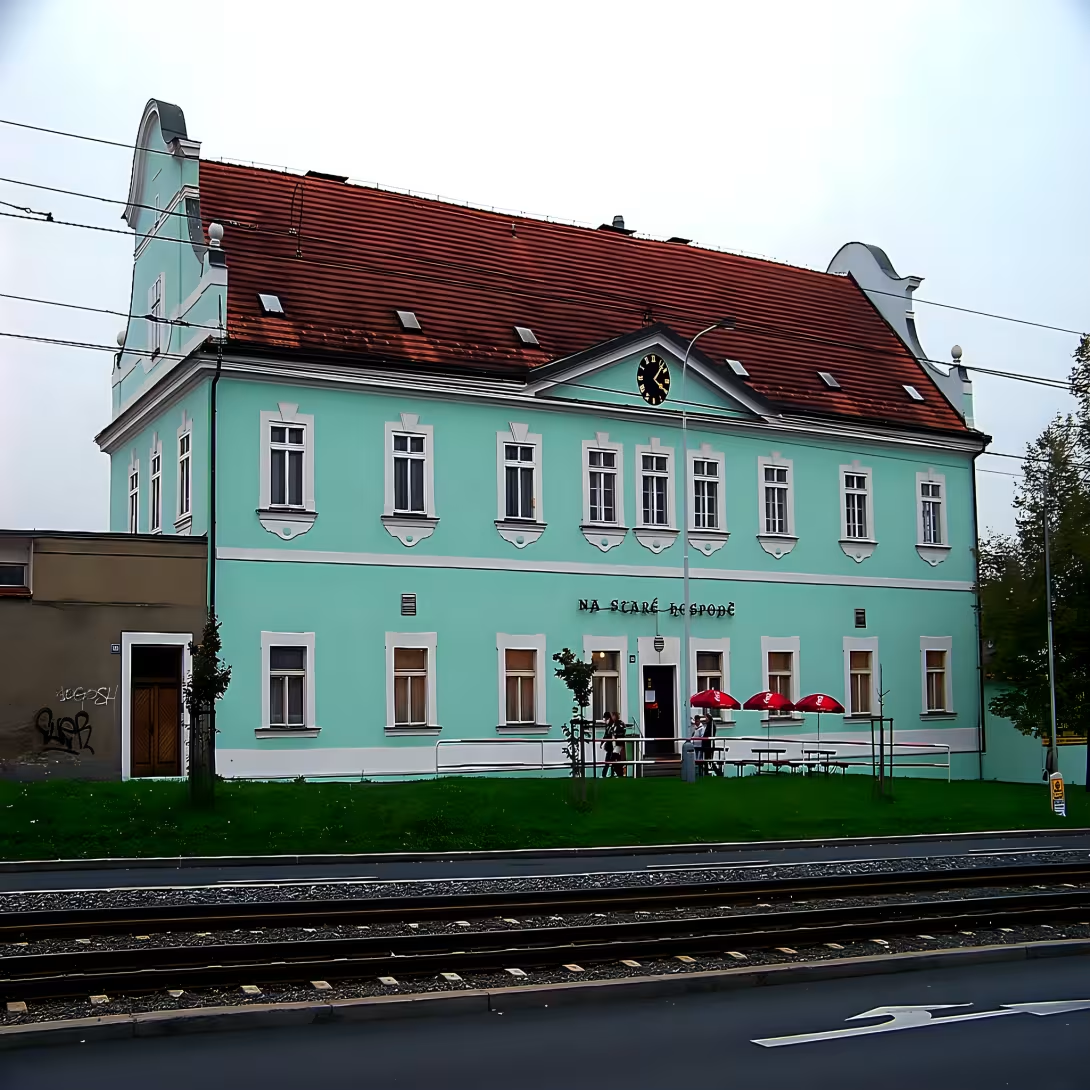
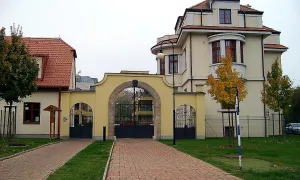
The Old Inn in Hloubětín is a baroque coaching inn situated in the Old Hloubětín, a part of Prague 14, at Poděbradská 1/110. This historic building has been a protected monument since 1958 and still houses a restaurant on its ground floor. The inn is notable for its unique baroque roof with a saddle-shaped roof and ornate gables, as well as its gate with pinecone decorations.
The original inn was built in 1711, but its facade was rebuilt in the late Baroque style in the late 18th century. The building has preserved its original walls and vaults from the first phase. The inn was built by the Cistercian Order, which owned the local land, and was initially used as a stop for travelers between Prague and Vienna. The inn was later privatized and was owned by private individuals until it was nationalized in 1961. After the fall of communism, the inn was returned to its private owners in 1990.
The inn has a rich history of hosting famous guests, including Emperor Charles VI, who stopped here on his way to coronation in 1723, and Emperor Francis I and his wife Maria Theresa, who visited in 1743. Emperor Joseph II, the son of Francis I and Maria Theresa, visited the inn several times between 1781 and 1784. A room in the inn still bears the name "Imperial Room" and features a fireplace with the date 1783.
The inn's complex includes the main building, a U-shaped farm building, a carriage shed, a gate with pinecone decorations, and an outer wall. The inn is located in a residential area, surrounded by other buildings.
Today, the Old Inn in Hloubětín is a unique example of a baroque coaching inn and a popular destination for those interested in history and architecture. Visitors can still dine in the inn's restaurant, which is located on the ground floor of the main building. The inn's rich history and unique architecture make it a must-visit destination for anyone interested in exploring Prague's cultural heritage.
Historical milestones
- 1711
- Built
- 1723
- Emperor Charles VI stopped here on his way to coronation
- 1743
- Emperor Francis I and his wife Maria Theresa stopped here
- 1781
- Emperor Joseph II visited the inn for the first time
- 1783
- Emperor Joseph II's visit
- 1784
- Emperor Joseph II's visit
- 1953
- Private owners were forcibly evicted
- 1958
- Protected monument
- 1961
- Nationalized
- 1990
- Restitution to private owners
Architectural development
The original inn was built in 1711, but the facade was rebuilt in the late Baroque style in the late 18th century. The building has preserved its original obverse walls and vaults from the first phase.
Historical events
In 1723, Emperor Charles VI stopped here on his way to coronation
In 1743, Emperor Francis I and his wife Maria Theresa stopped here
In 1781-1784, Emperor Joseph II visited the inn several times
Owners
Cistercian Order, private owners, state
Points of interest
– The Old Inn in Hloubětín is a baroque coaching inn situated in the Old Hloubětín, a part of Prague 14, at Poděbradská 1/110.
– The inn is notable for its unique baroque roof with a saddle-shaped roof and ornate gables, as well as its gate with pinecone decorations.
– The original inn was built in 1711, but its facade was rebuilt in the late Baroque style in the late 18th century.
– The inn has a rich history of hosting famous guests, including Emperor Charles VI, who stopped here on his way to coronation in 1723, and Emperor Francis I and his wife Maria Theresa, who visited in 1743.
– A room in the inn still bears the name "Imperial Room" and features a fireplace with the date 1783.
Guide
Show guide text
This text was created by artificial intelligence and has not been editorially reviewed. It may contain inaccuracies.
Welcome to the Old Hloubětín, a quiet and charming corner of Prague 14. You are standing right in front of one of the most historically significant buildings in this part of the city, a structure that has witnessed centuries of royal journeys and local life. Please take a moment to simply stand here and absorb the atmosphere. The air feels different in Old Hloubětín, doesn’t it? It carries a sense of history that is often overlooked by tourists who rush straight to the castle or the Old Town. But here, time seems to move a little slower, allowing you to appreciate the details that have survived for over three hundred years.
You are looking at the Old Inn, a magnificent example of baroque architecture. This building is not just a house; it is a protected monument, a status it has held since 1958. Its address, Poděbradská 1/110, marks it as a central point in the local history. As you look at the facade, you are seeing the result of a specific architectural vision from the early eighteenth century. The building was originally constructed in 1711, a time when the baroque style was reaching its peak of grandeur and ornamentation across Central Europe. It was built to serve as a coaching inn, a vital stop for travelers moving along the main roads of the kingdom. In those days, such inns were the hotels, restaurants, and social hubs of the era, providing rest for both the weary traveler and the horses that pulled their carriages.
Let us turn our attention to the architect who shaped this building. The design is attributed to Kryštof Dientzenhofer, a name that might not be as famous internationally as some of his contemporaries, but is highly respected in Czech architectural history. His work is characterized by a harmonious blend of structural solidity and decorative elegance. When you look at the roofline, you will notice the distinctive saddle-shaped roof. This is a classic feature of baroque coaching inns, designed to be both functional and visually striking. Above the roof, you can see the ornate gables that rise against the sky. These are not merely decorative; they are a testament to the craftsmanship of the period, showcasing the skill of the artisans who worked on this project.
Now, please look closely at the entrance area. One of the most unique features of this building is its gate. If you look carefully, you will notice the pinecone decorations integrated into the structure. In baroque symbolism, the pinecone often represents abundance, fertility, and the idea of a fruitful journey. It is a subtle but powerful detail that adds a layer of meaning to the building’s appearance. These details are what make this inn stand out from other structures in the neighborhood. They invite you to look closer, to appreciate the artistry that was embedded into the very fabric of the building.
The ground floor of the inn still houses a restaurant today. This continuity is remarkable. For over three centuries, people have sat in these rooms, eating, drinking, and telling stories. The walls have absorbed the conversations of merchants, nobles, and commoners alike. While you cannot enter the private areas of the building, the presence of the restaurant on the ground floor serves as a reminder that this place has always been a living space, not just a static monument. It is a place of hospitality, a concept that has remained central to its identity since its construction in 1711.
But perhaps the most fascinating aspect of the Old Inn is its connection to the highest echelons of power. This was not just a stop for ordinary travelers. It was a place where emperors paused on their journeys. Let us travel back in time to 1723. That year, Emperor Charles VI stopped here. He was on his way to his coronation, a moment of immense political and religious significance for the Habsburg Empire. To imagine the Emperor, dressed in his finest regalia, stepping out of his carriage to rest in this very spot is a powerful experience. It connects you directly to the events that shaped the history of Europe.
Just two decades later, in 1743, the inn welcomed another imperial couple. Emperor Francis I and his wife, Maria Theresa, stopped here during their travels. Maria Theresa is one of the most famous monarchs in history, known for her political acumen and her role in the Enlightenment. To think that she, too, rested her feet in this building adds a layer of prestige to the site. These visits were not just casual stops; they were part of official itineraries, carefully planned routes that highlighted the importance of the regions the emperors were passing through.
Then, in the late eighteenth century, the inn became a favorite stop for Emperor Joseph II. His visits were frequent and notable. He first visited in 1781, then again in 1783, and once more in 1784. Joseph II was a reformer, a monarch who sought to modernize the empire and improve the lives of his subjects. His repeated visits to this inn suggest that it was a place he trusted or perhaps enjoyed. It is a small detail, but it paints a picture of a monarch who was not just a distant figure, but a person who traveled, rested, and interacted with the world around him. These three emperors, Charles VI, Francis I, and Joseph II, all left their mark on this place, making it a site of immense historical weight.
There is a certain mystery to these visits. We know they happened, but we do not know exactly what they discussed, what they ate, or what they felt as they looked out from the windows of this inn. Did they notice the pinecone decorations on the gate? Did they appreciate the baroque elegance of the gables? These questions remain unanswered, adding to the charm of the place. It invites you to imagine the scenes, to fill in the gaps with your own creativity.
As you stand here, you are part of a long line of visitors who have paused to appreciate this building. The Old Inn is a bridge between the past and the present. It reminds us that history is not just something that happens in books or museums; it is something that happens in places, in the spaces where people live and work. The baroque style, with its emphasis on movement and emotion, is perfectly suited to this location. It reflects the energy of the eighteenth century, a time of change, reform, and imperial power.
I encourage you to take a few more moments to simply look at the building. Notice how the light hits the facade at this time of day. See how the colors of the paint and the stone interact with the sky. The Old Inn is a protected monument, a place that has been preserved for future generations. Its survival is a testament to the value we place on our heritage. It is a reminder that even in a modern city like Prague, there are places where the past is still very much alive.
As you prepare to move on with your day, I hope this brief visit has given you a new perspective on Old Hloubětín. This is not just a part of Prague 14; it is a piece of European history. The next time you pass by Poděbradská 1/110, you will know the story behind the walls. You will remember the emperors who stopped here, the architect who designed it, and the centuries of life that have flowed through its rooms.
Thank you for joining me for this short journey through time. I hope you enjoyed the experience of standing before this remarkable building. Please continue to explore the area around you. Old Hloubětín has many more stories to tell, and there is always something new to discover if you look closely. Take care, and enjoy the rest of your time in Prague.
Businesses nearby
Do you run a restaurant, accommodation, shop, museum, rental, wellness or other visitor service near this monument? Show yourself directly to the people heading to it — this is how they will see you in the app and on the web:
Events nearby

Zdroj akcí: otevřená data měst a obcí ČR (Národní katalog otevřených dat) a kalendář akcí Národního památkového ústavu.
Nearby
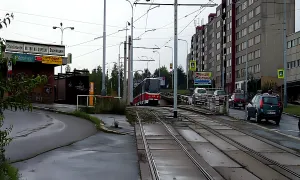
The inn is located in the Old Hloubětín, a part of Prague 14, surrounded by residential buildings.
Accommodation nearby
Trips and activities nearby
Guided tours, tickets and activities nearby from GetYourGuide
Affiliate link: if you buy from the partner, we may receive a commission. The price for you does not change.
Search tours and activities →Themed route
Route: "Old Hloubětín Delights"
Stop 1: Hloubětín's Historic Center Type: Neighborhood Why visit: Explore the charming streets of Old Hloubětín, a hidden gem in Prague 14, and discover its rich history and cultural heritage.
Stop 2: The Inn at Hloubětín (Zájezdní hostinec v Hloubětíně) Type: Historic Inn Why visit: This historic inn is the main attraction of our tour. Enjoy a traditional Czech meal or a refreshing beer in its cozy atmosphere.
Stop 3: Residential Buildings Type: Architecture Why visit: Take a stroll around the surrounding residential buildings, which offer a glimpse into everyday life in this charming neighborhood.
This route takes you on a journey through the heart of Old Hloubětín, showcasing its historic charm and cultural significance.
Seasonal recommendations
Spring
As you visit the historic inn in Hloubětín, spring brings a refreshing atmosphere with blooming flowers and greenery surrounding the building. The soft sunlight casts a warm glow on the rustic architecture, making it an ideal time to capture stunning photographs.
Practical tips: Be prepared for moderate crowds during peak hours, and dress comfortably in layers as the temperature can fluctuate. Arrive early to avoid the morning rush and take advantage of the pleasant weather.
Summer
The summer season brings a lively atmosphere to the historic inn in Hloubětín. The warm sunshine illuminates the charming surroundings, making it perfect for outdoor activities like strolling around the area or enjoying a picnic.
Practical tips: Be prepared for larger crowds during peak hours and arrive early to secure a spot. Dress comfortably in breathable clothing and don't forget sunscreen and a hat for protection from the sun.
Autumn
As autumn sets in, the historic inn in Hloubětín takes on a cozy ambiance with the changing foliage creating a picturesque backdrop. The soft golden light of the setting sun adds warmth to the rustic architecture.
Practical tips: Be prepared for moderate crowds during peak hours and dress warmly as the temperature can drop significantly. Take advantage of the comfortable weather by arriving early and enjoying the scenic views.
Winter
The winter season brings a serene atmosphere to the historic inn in Hloubětín, with snowflakes gently falling onto the charming surroundings. The soft glow of the festive lights adds a touch of magic to the rustic architecture.
Practical tips: Be prepared for shorter opening hours due to the cold weather and dress warmly in layers. Arrive early to avoid the morning rush and take advantage of the peaceful atmosphere.
Visualizations and artistic views


The visualisations are generated by artificial intelligence and serve as inspiration.
Photos from the area
Real photos taken near the monument


Zdroj a licence jsou uvedeny u každého snímku.
Tips from visitors
No tips yet. Be the first!
Log in and add your tip.
Sources and literature
Fotografie: ŠJů (cs:ŠJů) / CC BY-SA 3.0, rozlišení zvýšeno umělou inteligencí — Wikimedia Commons. The author and licence also appear when you hover over the image.
Faktickým podkladem tohoto textu byl článek na Wikipedii, jehož autory jsou přispěvatelé Wikipedie. Článek je dostupný pod licencí CC BY-SA 4.0.
Location on the map

Příběhy a pověsti
Legendy, pověsti a příběhy spjaté s touto památkou
Fotografie návštěvníků
Zatím žádné fotografie. Buďte první, kdo přidá fotografii z návštěvy!
Přihlaste se a přidejte svou fotografii nebo hodnoťte.
Za ověřenou návštěvu v aplikaci získáte víc bodů — poznáme podle GPS, že jste na místě.
Reviews and comments