



Kostel svatého Jiří (Hloubětín) Church
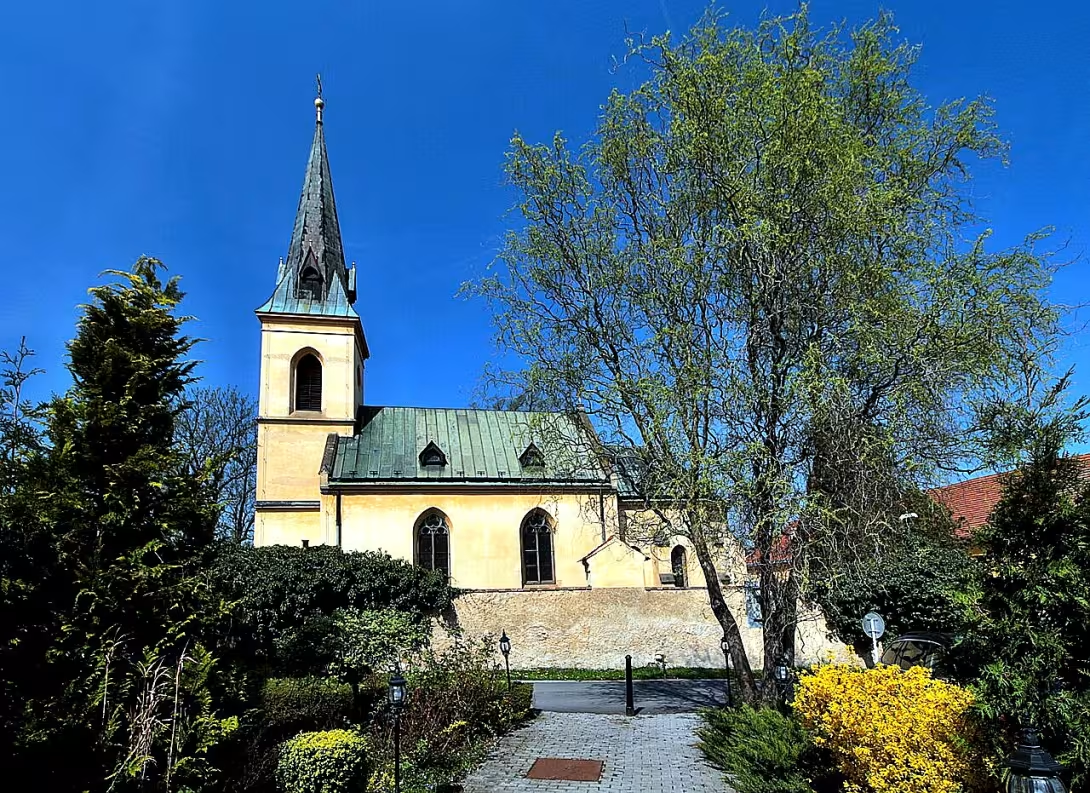
The church is located in HloubětínA, in the street Hloubětínská on the territory of the city of Praha 14. Its history is inextricably linked to the foundation of the village itself, which is first mentioned by the Papal Charter of Innocence III of 1207. This document records three villages including Hloubětína (written as Lupatine) which give the order of German knights. Between 1207 and 1232, a church was supposed to be set up dedicated to Saint George, the patron saint of this military order. The construction was done in Romanesque style.
1232 brought about a change of ownership. Queen Konstancie Uherská, widow of the Otakar I Overmind, bought Hloubětín for a planned monastery of cisterns, but later donated to her daughter Anezka. She gave it to the fraternity managing the hospital. In 1237 this brotherhood was obtained from Pope Řehora IX. church статут; Thus came the order of the red star cruisers, which remains here to this day. The Papal List of Greek IX. of 1238 confirms Hloubětín as property of this order.
The first architectural intervention was the year 1355, when the Gothic Tower added to the Romanesque church during the reign of Charles IV; that stood on the north side of the presbytery, where the sacristy later found itself. The Thirty Years' War has complicated the temple - it has been plundered by the army of Emperor Ferdinand II and melted down by its bells. Only a small bell remained on the tower. In 1654, two more bells were added, which Jan Miller of the Golden Crown and his wife Judita showed the sign on the bell.
In 1695 comes the baroque. The Grand Master of the Order of Cruisers Pochul had the church changed the facade and made further adjustments. The building supervisor entrusted Christopher Dientzenhofer, who also supplied the inventory. Other craftsmen - carpenter Jirka Skalník created marble door posts and stonework details - contributed to the elegance of reconstruction. At the same time, the main ship was extended by nine feet. The interior from the beginning of the 18th century (the oldest inventory dates from 1700-1702) contained statues depicting Resurrection, Ecce Homo and Mother Painful, paintings of the Conception of the Virgin Mary and Saint John Nepomuk. The noble stone ceiling decorated the scene of the victorious battle of the emperor Constantine, four oil paintings then told the legend of cruisers.
The ledger, conducted since the autumn of 1815, illustrates the 19th century. In 1817, the carpenter Brejcha made a roof repair. Fourteen years later, the pillars were strengthened. A fundamental change came in 1847 when the original tower was torn down and a new tower in the facade was built in a neo-gothic style; The old tower then replaced the sacristy.
Since 1964, the church has been protected as a real estate monument. Today it serves as a parish temple of the deep parish and remains under the rule of the order of the red star cruisers, which has been here for eight centuries.
Then and now
Drag the slider to compare how the landmark may have looked when it was built with the view today.
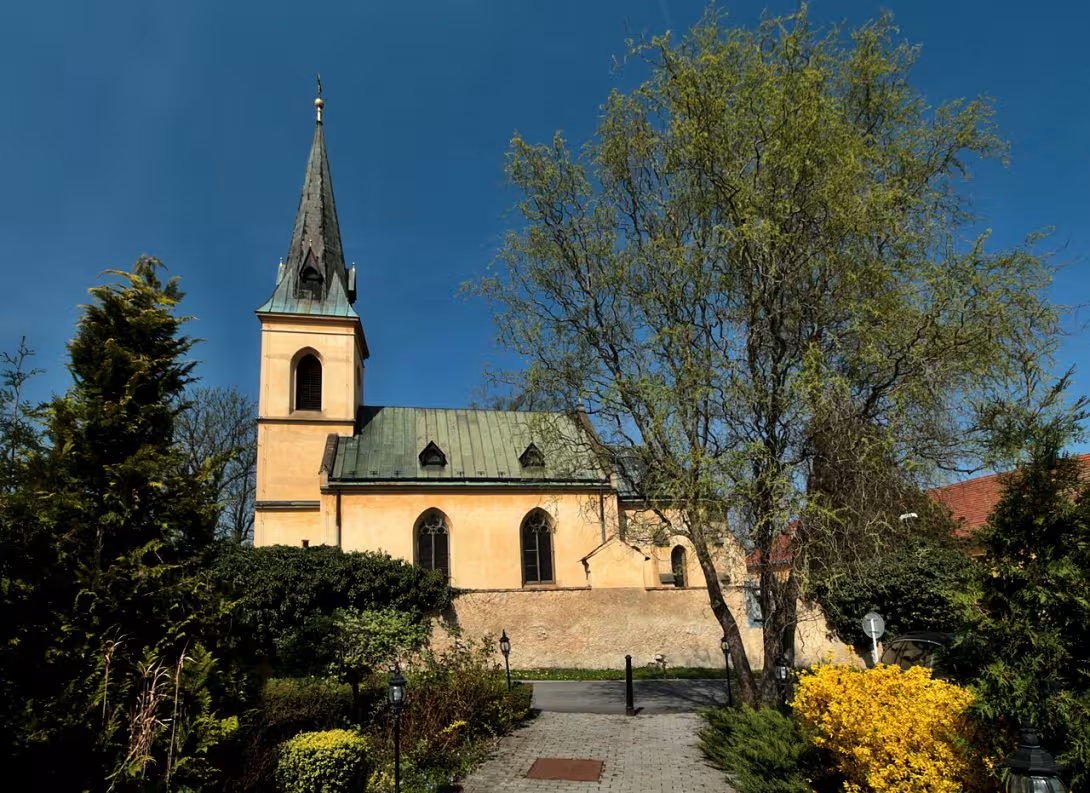

The historical appearance on the left is an AI-generated visualisation and serves as inspiration only.
Historical milestones
- 1207
- The first mention of Hloubětín as a gift of the German Knights' Order of Otakar.
- 1238
- Confirmation of ownership of Hloubětín by order of cruisers with red star papal charter.
- 1355
- Added Gothic tower on the north side of the presbytery.
- 1695
- Modifications to the facade and expansion of the main ship by nine feet.
- 1847
- Ripping down the old tower and building a new tower and sacristy.
- 1964
- Declaration by the church a real estate monument.
Architectural development
Originally a Romanesque building, later a Gothic church with a tower built in 1355. In 1695 it was expanded and equipped with a new front of Christopher Dientzenhofer. In 1847, the original tower was torn down and replaced by a new building according to the design of Antonín Sänger.
Historical events
1207: first mention of Hloubětín in Pope Innocence III's list; 1695: baroque adjustment of the facade and expansion of the ship; 1847: Construction of a new tower and sacristy.
Owners
German knights (1207-1232), order of cruisers with red star (from 1238)
Points of interest
- The church was built in Romanesque style and dedicated to Saint George, patron saint of the order of the German knights. - The order of red-star cruisers has been here for eight centuries. - During the Thirty Years' War, the temple was plundered and its bells melted, leaving only one little bell. - In 1695, Grand Master Pocháchal had changed the facade and made modifications under the supervision of Christopher Dientzenhofer. - The original tower was torn down in 1847 and replaced with a new tower in a neo-gothic style.
Guide
This guide is narrated by a synthetic voice generated by artificial intelligence.
Show guide text
This text was created by artificial intelligence and has not been editorially reviewed. It may contain inaccuracies.
The Church of Saint George in Prague's Hloubětín is a Roman Catholic parish church, the main church of the Hloubětín parish. It is managed by the Order of the Knights of the Red Star. It is a Gothic single-nave church with a number of neo-Gothic modifications. It was declared a cultural monument in 1964.
Its origins are connected with the earliest mention of Hloubětín itself. In 1207, Pope Innocent the Third confirmed that Přemysl Otakar the First had donated Hloubětín and several other villages to the Order of German Knights. They held the community for only a quarter of a century. It was precisely during this period that the church most likely came into being. This is suggested by its dedication to Saint George, the patron saint of the German Knights. The original building was Romanesque.
In 1232, Hloubětín was purchased by Queen Constance of Hungary, the widow of Přemysl Otakar. She eventually gave it to her daughter Agnes as one of the sources for running a hospital, which was cared for by a brotherhood. From this later emerged the Order of the Knights of the Red Star, and Pope Gregory the Ninth confirmed their ownership of Hloubětín in 1238. The first modifications came in 1355 during the reign of Charles the Fourth. The church then received a Gothic tower on the northern side of the presbytery.
During the Thirty Years' War, the church was plundered by the forces of Emperor Ferdinand the Second and the bells were melted down. Only a small bell remained on the tower. In 1654, two more bells were added to it, cast at the expense of the knight Jan Miller from Zlatá Koruna and his wife Judith.
In 1695, the Grand Master of the Knights Pospíchal gave the church a new façade. The modifications were directed by Kryštof Dientzenhofer, who also provided the furnishings. The main nave was then extended by nine feet. The marble door hinges were made by the stoneworker Jirka Skalník, and the locksmith work was done by Hans Georg Knobloch. An inventory from around 1700 lists three altars, sculptures of the Resurrection, Ecce homo and Our Lady of Sorrows, as well as paintings of Saint John of Nepomuk and Saint Wenceslas. On the vault, there used to be a painted scene from the victorious battle of Emperor Constantine. On the sides, four paintings hung depicting the legend of the Knights. Today the walls are white. From the early 18th century comes the oldest surviving piece of furnishings, a small bell, which still hangs in its place today.
In the 19th century, the roof was repaired and the pillars were reinforced. In 1847, according to a design by Antonín Sänger, the old tower was demolished and a sacristy was built in its place. A new neo-Gothic tower rose at the façade of the church.
Tips for visitors
The best time to visit St. George's Church in Hloubětín is autumn or spring season, when vegetation is in the surrounding meadows and groves in full force. This time of year offers a quiet atmosphere and beautiful lighting conditions for photos.
Check current connections and routes in the traffic search engine.
When you visit St. George's Church, remember to bring a quality camera. The best places for photography are the garden in front of the temple and the interior of the church, especially during the sunny noon or evening when the light is ideal for capturing details.
In the vicinity of the church there is a picturesque park with beautiful garden architecture, which offers quiet moments to walk. For those who want to explore more history and culture, it is advisable to visit neighbouring areas of Prague such as the chateau in Břevnov or Strahov monastery.
For families with children, a visit to St. George's Church is a good opportunity for a short walk. Children can enjoy the garden and park areas where they can play or learn more about the history of the place.
Frequently asked questions
Can the monument be visited?
Religious buildings are usually open mainly during services; at other times a visit is normally arranged with the parish or the operator. We have not verified specific times.
Where is the monument?
Location: Hloubětínská, Hloubětín, Praha, Hlavní město Praha. The map on this page shows the exact spot.
Why is the monument protected?
It is listed in the Central List of Cultural Monuments of the Czech Republic as a cultural monument (register no. 40711/1-1639).
For kids
Imagine going back to when Hloubětín was a small country town. St. George's Church stood in the middle of the village and was a place where important offices and celebrations took place.
This place looked different than today. It was a time when people lived in wooden houses and cultivated land with the help of animals. Local traders sold fruit and vegetables in markets and markets. Mass and funerals were held in St. George's church, and the locals went to it for prayer and comfort.
Businesses nearby
Do you run a restaurant, accommodation, shop, museum, rental, wellness or other visitor service near this monument? Show yourself directly to the people heading to it — this is how they will see you in the app and on the web:
Events nearby


Zdroj akcí: otevřená data měst a obcí ČR (Národní katalog otevřených dat) a kalendář akcí Národního památkového ústavu.
Nearby
Catastral area Hloubětína in the city area Praha 14
Accommodation nearby
Trips and activities nearby
Guided tours, tickets and activities nearby from GetYourGuide
Affiliate link: if you buy from the partner, we may receive a commission. The price for you does not change.
Search tours and activities →Themed route
Thematic cruise route around St. George's Church (Hloubětín)
1.Kostel svatého Jiří (Hloubětín) - Type: Cultural landmark - Why is it worth a visit: This Baroque church is one of the oldest sacral buildings in the village Hloubětín. Its history dates back to the 14th century, making it an important place for understanding local architecture and history.
2. Municipal Office Hloubětín - Type: Local administration - Why is it worth visiting: The Municipal Office offers the opportunity to learn more about local events and the history of the village. It is also a place where information about other attractions can be obtained.
3. XZ nav - Type: Local center - Why is it worth a visit: Naves is the vital heart of the village where there are various small businesses and restaurants. It's an ideal place to relax after a church tour and explore the local spirit.
4. Children's complex Hloubětín - Type: Public greenery - Why it is worth a visit: This space is an excellent place for relaxation and well-being. It is suitable for families with children, where they can enjoy outdoor environment and various entertainment activities.
5. St. Anne's Chapel - Type: Cultural landmark - Why is it worth a visit: The chapel is another historic place in Hloubětín, which represents Baroque architecture. Its quiet environment and beautiful location offer an ideal way for reflection after visiting St. George's Church.
This route allows you not only to see the main cultural monument, but also to immerse yourself in the daily life and history of the village Hloubětín.
Seasonal recommendations
In spring, the church surrounds the awakening greenery and fine colors of flowering trees that give the monument a fresh look. The atmosphere is full of hope and light is soft, which is ideal for walking around. We recommend wearing layered clothes because morning cold can still be felt. The best place to visit is in the morning when the air is the cleanest.
The summer season brings sharp sun and rich colors of surrounding nature that highlight the details of the facade. The air is hot and you will find pleasant cold in the premises of the temple. Due to high season and high attendance, it is advisable to come first thing in the morning to avoid the biggest crowds. Don't forget light summer clothes and plenty of fluids.
Autumn leaves around the church create a color contrast with the stone of the building and a misty wound gives the place a mysterious, melancholy mood. The light is golden in this period and falls at a lower angle. The practical recommendation is to wear moisture resistant shoes and a warm sweater. The ideal time for a visit is the late afternoon when the atmosphere is quietest.
In the winter, the monument works with a shear and calm, especially if it is covered by a layer of snow that will dampen the surrounding noise. The interior is cozy at this time, especially during the Advent period. It is necessary to choose very warm clothes and solid shoes.
Visualizations and artistic views


The visualisations are generated by artificial intelligence and serve as inspiration.
Photos from the area
Real photos taken near the monument


Zdroj a licence jsou uvedeny u každého snímku.
Atmosphere of the place
This atmospheric visualisation of the place and period was generated by artificial intelligence. It is not real footage of the location.
Tips from visitors
No tips yet. Be the first!
Log in and add your tip.
Sources and literature
Photos: VitVit / CC BY-SA 4.0 — Wikimedia Commons. The author and licence also appear when you hover over the image.
Faktickým podkladem tohoto textu byl článek na Wikipedii, jehož autory jsou přispěvatelé Wikipedie. Článek je dostupný pod licencí CC BY-SA 4.0.
Location on the map




Příběhy a pověsti
Legendy, pověsti a příběhy spjaté s touto památkou

Fotografie návštěvníků
Zatím žádné fotografie. Buďte první, kdo přidá fotografii z návštěvy!
Log in a přidejte svou fotografii nebo hodnoťte.
Za ověřenou návštěvu v aplikaci získáte víc bodů — poznáme podle GPS, že jste na místě.
Reviews and comments