



Horácké divadlo v Jihlavě Theatre building
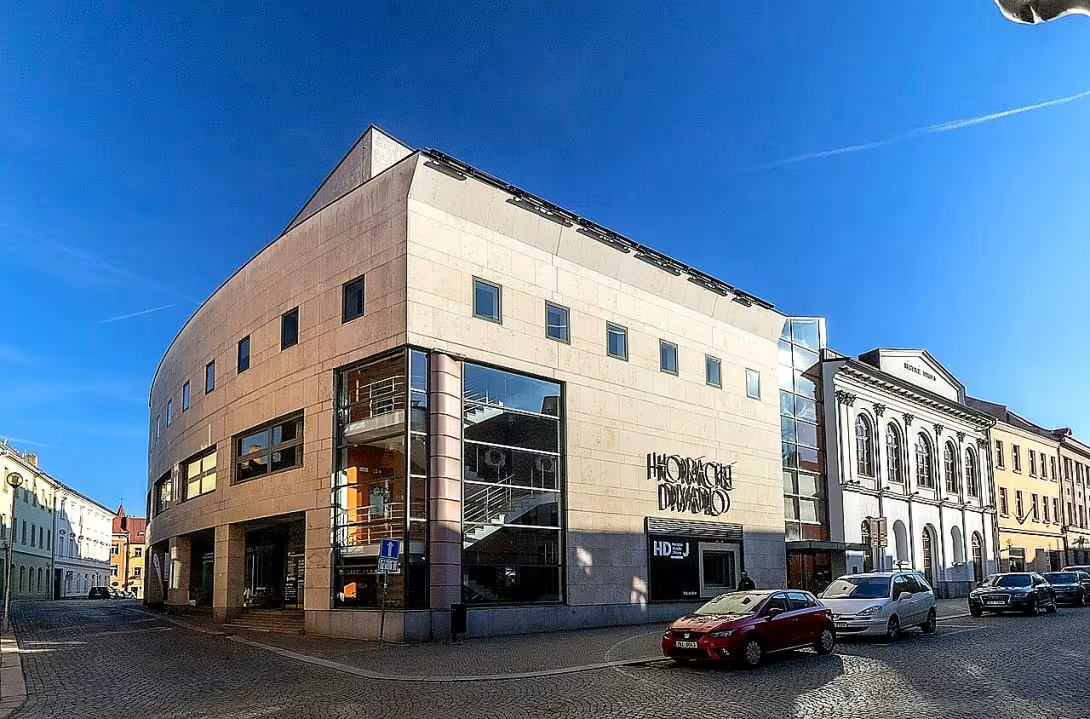
Horácké divadlo v Jihlavě is a permanent professional drama scene of the Vysočina Region with over 80 years of tradition. The current building on the corner of Komensky and Theatre was completed in 1995. It is the first stone theatre built in the Czech Republic for more than a hundred years.
The history of the Jihlava Theatre goes far into the past; The German scene is already documented in 1740. In 1792 it was played in the former hospital church of Saint Elizabeth. The first Czech performance took place in 1840, when the group of M. Saydlerová introduced the game Czech and German in the hall of the House of Three Princes. In 1849, Johan Okonski purchased the decrepit building of the Capuchin monastery with the church of St. Francis and converted it into a theatre. This building was subsequently purchased by the city in 1865. The Horacký Theatre itself was created as a Czech scene in Vysočina in 1940. On October 18, the Court of Love began its work in Trebič. During World War II, the theatre was closed by German authorities, but in May 1945 it moved permanently to Jihlava.
The current complex was built between 1992 and 1995 according to the design of architects Václav Králiček, Vladimir Krátý, Tomas Brix, Miroslav Melen and Jan Vančura. The construction uses modern design methods and offers variable space. The building includes a large scene with a capacity of 315 seats, a small scene for 80 spectators, a theatre club, a cafe and a multifunctional rehearsal room.
The ownership of the theatre went to the city Jihlava in 1865, since 2003 it has been the founder of Vysočina Region. An important event in the history of the building was a visit of emperor Franz Joseph I in 1866. In modern history, the object was visited by the then President of the Czech Republic Václav Havel on March 7, 1996. During extensive reconstruction and completion in the 1990s, the artistic ensemble was forced to operate in the spare premises of the theatre of the psychiatric hospital Na Kopěkku.
Today, the theatre has a set of 21 members, and on average 10 prime ministers report a year. Since 2024, there has been a second set called HD _ Jee, which focuses on children and young audiences. The quality of the art work is confirmed by the nominations for the Theatre Critics Prize in the category of the Theatre of the Year 2020 as well as the individual achievements of actors such as Michal Krause and Lenka Schreiber at the Thalia Prize.
The Horácké Theatre represents an important cultural centre of the region, which successfully links a long tradition with modern traffic requirements. Visiting this place offers the opportunity to become familiar with the quality of theatrical creation in the premises, which are a unique example of Czech theatre architecture at the end of the twentieth century.
Historical milestones
- 1940
- Opening of the Horace Theatre in Třebíč.
- 1992
- The laying of the foundation stone of the new theatre building.
- 1995
- Completion and festive opening of the new theatre building.
- 1996
- Visit of President Václav Havel in the theatre.
Architectural development
The original theatre spaces in Jihlava were created by adaptation of older buildings, including the former monastery. The current complex was built between 1992 and 1995 on the basis of a project by a group of architects. The construction uses modern design procedures and offers variable space for various types of performances.
Historical events
On October 18, 1940, the Horácké Theatre started its activities in Třebíč. In May 1945 the theatre moved permanently to Jihlava. A new theatre building was opened in 1995.
Owners
City of Jihlava (since 1865), Vysočina Region (since 2003)
Points of interest
- The contemporary theatre building completed in 1995 is the first stone theatre built in the Czech Republic for more than 100 years. - Horace Theatre was created as a Czech scene in Vysočina in 1940 and started its activities in Třebíč. - In 1866 Emperor František Josef I. visited the building and in 1996 President Václav Havel visited the building. - During the reconstruction in the 1990s, the ensemble had to play in the premises of a psychiatric hospital. - Since 2024 a second set focused on children and young spectators has been active in the theatre.
Guide
Show guide text
This text was created by artificial intelligence and has not been editorially reviewed. It may contain inaccuracies.
Welcome to the site that became one of the key cultural centres in the Highlands. You are standing in front of the Horace Theatre in Jihlava, an artistic creation that will lift you to the world of dramatic art and historical memories.
Horace Theatre is a permanent professional drama scene with a rich tradition. Its roots date back to 1940, when its activities started in Třebíč as the first Czech scene in Vysočina. After many years, the theatre moved to Jihlava and in 1992 a foundation stone was laid for a new building, which was inaugurated in 1995. This building on the corner of Komenský and Theatre streets is the first stone theatre built in the Czech Republic for more than a hundred years, making it a unique monument.
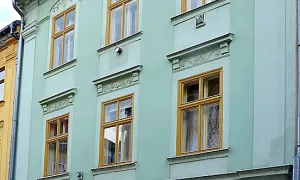
Look up at the elegant facade of the building. It is the work of architects Václav Králiček, Vladimir Kratke, Tomas Brix, Miroslav Melena and Jan Vančura. The building is a modern reference to the history of theatre, which seeks to combine tradition with contemporary architecture. Note the elegant facade and its harmonious relation to the surrounding environment.
Horace Theatre is also a place that combines key personalities from Czech history. In 1866, Emperor František Josef I. visited the building, indicating its long-standing importance on the cultural scene. And in 1996, President Václav Havel hosted the theatre, which further emphasizes the theatre as a place of historical and political significance.
The interesting thing is that Horácké Theatre represents the first stone building built for theatre activities after more than a hundred years. This success reflects the determination and passion of the local community, which has maintained the lively tradition of theatre in the Highlands.
Let's move on to further examination. The theatre offers not only artistic performances, but also cultural programs and events that revive its space. The inner complex includes a large and small scene, a theatre club and a cafe, which all represents an ideal place for anyone enjoying the theatre.
Thank you for your visit. I hope this guide inspired you to explore this fascinating place and its rich history more thoroughly. Let your visit to the Horace Theatre become the beginning of other discoveries in Jihlava.
Tips for visitors
The best time to visit is the evening performance, when the theatre building comes to life with its architecture and social atmosphere. We recommend you come in advance so you can see the modern interior finished in the 1990s.
The theatre is located in the heart of the city. The location is easily accessible by foot from the main urban hubs of public transport.
To visit the theatre, choose a social garment corresponding to the cultural event.
The theatre building offers interesting views especially from the outside thanks to its modern architecture on the corner of the streets. Inside the theatre follow the instructions of the staff, as photography during the performance is not allowed for copyright reasons.
In the immediate vicinity you can visit the historical center of Jihlava, the church of St. James the Greater or explore the Jihlava underground. For families with children, the theatre is a great goal thanks to a wide range of games, while the surrounding historic streets are suitable for easy walking.
Frequently asked questions
Can the monument be visited?
The building is in use (offices, a school, shops and the like). The interior is generally accessible only during operating hours and tours are not usually offered; we have not verified the details. You can see the exterior from the street.
Where is the monument?
Location: Jihlava. The map on this page shows the exact spot.
Why is the monument protected?
It is listed in the Central List of Cultural Monuments of the Czech Republic as a cultural monument (register no. 1550688335).
Businesses nearby
Do you run a restaurant, accommodation, shop, museum, rental, wellness or other visitor service near this monument? Show yourself directly to the people heading to it — this is how they will see you in the app and on the web:
Nearby
Historické centrum města Jihlavy, kostel svatého Jakuba Většího, jihlavské podzemí.
Accommodation nearby
Trips and activities nearby
Guided tours, tickets and activities nearby from GetYourGuide
Affiliate link: if you buy from the partner, we may receive a commission. The price for you does not change.
Search tours and activities →Themed route
Thematic cruise route: Historical center and underground city Jihlava
1. Horace Theatre - Type: Theatre building - Why is it worth visiting: Horace Theatre is one of the most famous cultural institutions in Jihlava. It is a place where various theatre performances and cultural events are held, which enrich both local and visitors.
2. Church of St. Jacob the Greater - Type: Cathedral - Why is it worth a visit: This church is one of the oldest and most beautiful Gothic buildings in Jihlava. Its history dates back to the 13th century, making it an important cultural and historical place.
3. Underground of Jihlava - Type: Historical underground spaces - Why is it worth a visit: The underground of Jihlava offers a unique view of the history of the city. It's a set of old tunnels and caves that were once used for various purposes, including defense and storage.
Visiting order: - Start your route at the Horace Theatre where you can imagine the current program or look at the architecture of the building. - Then move towards the historical centre and visit the church of St. Jacob the Greater. You can appreciate its architectural appearance and perhaps take a look at the interior. - After all, if you have time and interest, visit the southern underground. This way you can see the history of the city from a completely new perspective.
This route will allow you to familiarise yourself with the key cultural and historical aspects of Jihlava.
Seasonal recommendations
Spring: In the spring period Horácké divadlo v Jihlavě offers visitors a stunning view of flowering gardens and trees that come to life after a freezing winter period. The sun illuminates the theatre with a more juicy light, creating an attractive atmosphere for visitors. At this time it may be advisable to visit a memorial on Wednesday week when the crowd load is usually lower than on weekends. It is recommended to wear clothes by temperature - lighter clothes and short gloves can be ideal for temporary weather.
Summer: Summer brings long days with plenty of sunshine to the Horace Theatre in Jihlava, which increases the attractiveness of this historic place. Summer is also the period of the highest crowd load, so it is recommended to come early in the morning or later in the day to avoid long fronts. Hot clothes and sun protection (for example, hat, sunglasses) are necessary during this period.
Autumn: In the autumn months, the Horace Theatre offers visitors beautiful leaf coloring and temperate temperatures, creating a peaceful atmosphere to explore the sights. This time is suitable for those looking for mild temperatures without the extremes of summer sun or winter frost. Visiting this season usually reminds of spring, which allows you to visit the memory even on weekends without fear of long queues.
Winter: Winter months bring cool air to the Horace Theatre of Jihlava and the possibility of enjoying a quiet walk around the monument if the weather is favourable. In this period it is advisable to visit a memorial during Wednesday week when the crowd load is lower than on weekends and holiday days. Hot clothes, such as long jackets and gloves, are essential for a comfortable visit, and if possible check the weather to avoid unpleasant conditions.
Visualizations and artistic views

The visualisations are generated by artificial intelligence and serve as inspiration.
Photos from the area
Real photos taken near the monument


Zdroj a licence jsou uvedeny u každého snímku.
Tips from visitors
No tips yet. Be the first!
Log in and add your tip.
Sources and literature
Photos: VitVit / CC BY-SA 4.0 — Wikimedia Commons. The author and licence also appear when you hover over the image.
Faktickým podkladem tohoto textu byl článek na Wikipedii, jehož autory jsou přispěvatelé Wikipedie. Článek je dostupný pod licencí CC BY-SA 4.0.
Location on the map


Příběhy a pověsti
Legendy, pověsti a příběhy spjaté s touto památkou
Fotografie návštěvníků
Zatím žádné fotografie. Buďte první, kdo přidá fotografii z návštěvy!
Log in a přidejte svou fotografii nebo hodnoťte.
Za ověřenou návštěvu v aplikaci získáte víc bodů — poznáme podle GPS, že jste na místě.
Reviews and comments