



Hornická kulturní krajina Abertamy – Horní Blatná – Boží Dar Landscape heritage zone
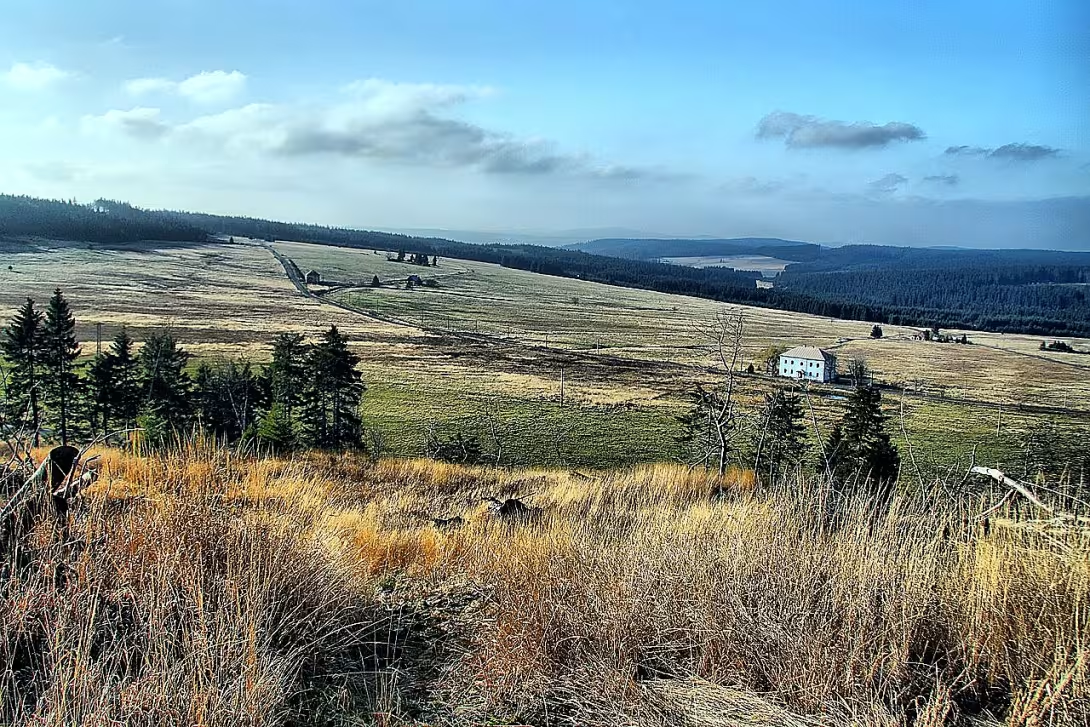
Hornická kulturní krajina Abertamy – Horní Blatná – Boží Dar is an extensive complex in the Erzgebirge Mountains, which documents the centuries-old tradition of mining tin ores. The area was declared a landscape monument zone in 2014. Includes the territory of the cities of Abertamy, Upper Blatna and God's Gift in the district of Karlovy Vary. Since 2019, it has been included in the UNESCO World Heritage List as part of the Erzgebirge / Krušnohoří Mining Region.
The beginnings of the local mining fields fall in the twenties and thirties of the 16th century. Shortly after the foundation of Jáchymov there were three planned upper cities: Upper Blatna, Abertamy and God's Gift. The development of mining in the 16th century, motivated by the findings of tin ore, affected the landscape and the urbanism of these settlements.
The architectural character of the cities, especially Upper Blatná, is based on Renaissance urban planning with a typical chessboard plan. The landscape is interwoven with numerous technical monuments, which are evidenced by four centuries of mining activity. The most important elements include historical stalls, shafts, piles and extensive water management systems. A unique piece is a 11.6 kilometer long Blaten water moat from the 16th century. It was used to supply the mines with water and was declared a cultural monument in 1981.
In the area there are remains of mining in the form of sinks and pints. These include, for example, the Wolf Pits on Blaten Hill, which resulted in the collapse of the largest tin mines in the region. Other important locations are the Zuzana mine near Bludna, the Mauritius mine near Clovecná or the Hražený brook region. Its untouched mining area between Komáří vrůch and Terror Mountain gained cultural heritage status in 2015. In the case of God's Dar, the vaults are visible, which represent the remains of the historical rice of tin ores.
The area is now being managed to preserve the image of centuries of mining and to promote sustainable tourism. Visitors can freely discover the montage monuments of European importance within the landscape monument zone, which are embedded in the geomorphological complex of Klínovec Hornatina.
This monument is an extraordinary testament to the technical maturity and economic expansion of Krušnomountain mining in the early modern era. The visit to the area offers a unique opportunity to learn the authentic form of the historical landscape, which, after centuries, has retained its technical and urban character.
Historical milestones
- 1530
- The beginnings of the mining fields and the creation of upper cities.
- 1981
- Blaten Water Trench entered on the list of cultural monuments.
- 2014
- Declaration for the landscape monument zone.
- 2019
- Entry into the UNESCO World Heritage List.
Architectural development
The landscape has evolved since the 16th century in direct connection with the development of mining and the creation of cities on a chessboard plan. Includes technical monuments such as the 11,6 km long Blatenské water moat, and remains of mining in the form of sinks and pints. The architectural character of the cities is influenced by Renaissance urbanism.
Historical events
2014: Declaration for the Landscape Monument Zone. 2019: Entry into the UNESCO World Heritage List.
Points of interest
- In the year two thousand and fourteen, this area was declared a landscape monument zone. Since the year two thousand nineteen has been on the World Heritage List. - Upper Blatna, Abertamy and God's Gift were planned to be built in the upper city, which was created shortly after the foundation of Jáchymov. Their creation and development of tin ore mining in the sixteenth century had a major impact on the landscape and urbanism. - The architectural character of the cities, especially Horní Blatná, is based on Renaissance urban planning with a typical chessboard plan. - The Blaten Water Trench is a unique eleven-sixth-tenth-mile-long work from the 16th century. It was used to supply the mines with water and in the year one thousand nine hundred eighty-one was declared a cultural monument. - Wolf pits on Blaten Hill were created by the collapse of the largest tin mines in the region. In the case of God's Dar, the vaults are visible, which represent the remains of the historical rice of tin ore.
Guide
Show guide text
This text was created by artificial intelligence and has not been editorially reviewed. It may contain inaccuracies.
Welcome to the heart of the Ernest Mountains. You are standing in a place where the natural beauty of wild mountain peaks combines with the incredible power of human effort. While you're looking around, believe me, you don't just see the plain valleys and hills. You see a living document written for centuries. Feel this atmosphere, this calm, which is only superficial. Under your steps, deep underground and in the very structure of this landscape, there is a story about finding treasures, hard work, and how a man could completely transform the face of the whole country. This area that is now surrounding you is something much bigger than just a set of villages and paths. It is a large-scale entity that shows how the mining of precious metals has created a whole new type of world.
Let us now return together in time to understand why this place is so special. To understand the present, we need to look at the beginnings that go deep into the 16th century. More than five years ago, at the turn of the twentieth and 30th years of the year a thousand five hundred thirty, a whole new chapter of history began to be written here. People came here with hope and a clear goal. They were looking for tin, the precious metal that was crucial to the development of technology and crafts at the time. It is this search for ore that has become the engine that has moved this entire territory. What was previously just inhospitable and wild mountain slopes began to turn into an organized space. Here were born the first mining settlements to become important centres in the future.
Now pay attention to how this landscape is arranged. Although it may seem to you that cities and villages here lie naturally, it is actually a result of very careful planning. Take a look at the locations of the villages such as Abertamy, Upper Blatna or God's Gift. These places were not created by a random cluster of houses. It was deliberately built mining towns. Their creation was closely linked to the development of mining, as it happened in nearby Jáchymov. Notice how these settlements are integrated into a separate terrain. Their structure, their arrangement in the valleys and on the slopes, reflects the needs of the people who lived and worked here. Even though you're looking at a quiet landscape today, in its shape, you can still see the old, strict logic of the mining order. Every road, every place where the human eye has stopped has a reason why it's lying here right now.
When you look at the surrounding mountains, you might be wondering who shaped this whole country. Although the names of the particular people who have benefited here have been lost in the fog of time, their presence is felt in every detail of this landscape. Imagine the thousands of unknown hands dealing with hard rock, the thousands of people who built homes here and created communities in conditions that might scare us today. This landscape is a monument to unknown heroes who have created the basis for the region's flourishing. Their lives were inseparable from the rhythm of mining and the mood of the mountains. Even if we don't read about them in textbooks, their legacy is in every piece of this earth, every extermination stone and every shape of the valley.
Did you know that this region is so extraordinary that the whole world recognized it? It's a fascinating fact that gives this place meaning. This area has gone a long way to be recognized as the treasure of humanity. Already in the year two thousand fourteen, this area was declared a landscape monument zone, starting with its protection on a wider scale. But that was just the beginning. The true peak of recognition was that, since the year two thousand nineteen, this mining landscape has been listed on the most prestigious list of world heritage. This means that what you see and what you are standing in is one of the most valuable cultural and natural treasures on our planet. It is a rare combination of human work and natural processes that is unprecedented throughout the world.
And if you're even more interested in history, you can focus on other sights in the surrounding area, such as the Blaten Water Trench, which was already written on the list of cultural monuments in the year one thousand nine hundred eighty-one. All these elements, from the old waterways to the mining fields themselves, form one big, amazing puzzle, which is this landscape.
So don't let them take you, but keep going. Let the atmosphere of these mountains drift. Go through the roads that people came here hundreds of years ago. Feel the silence of the mountains, but also the hidden story that takes place here. Every step can lead you to a new discovery. This landscape has something to offer you if you look at it with the eyes of a man looking for more than a beautiful view. I wish you a wonderful journey and many interesting experiences while researching this special place. I will say goodbye to you and leave you with your own impressions and admiration of this beautiful land.
Tips for visitors
The best time to visit is the late spring or summer, when the trips in the Erzgebirge mountains are well viable and the weather is more stable. Autumn offers beautiful color scenery, but count on more frequent fog and cold.
To move in the field, wear solid shoes suitable for the mountains and layered clothes, because the weather changes very quickly. Don't forget enough fluids and snacks, because there may not be food options at every step of the country in the more remote parts.
For photography there are ideal places near the Wolves pits or prospects from Blatensky Hill where you can capture a unique mining landscape. The best light for images is shortly after sunrise or before sunset, when low rays highlight the relief of terrain.
For families with children, the area is great thanks to educational paths that bring the history of mining in a fun way. In the vicinity you can visit the Mauritius mine near the Stallion, the city of Horní Blatná or the natural park Golden Hill, offering interesting experiences for both small and large researchers.
Frequently asked questions
Can the monument be visited?
This is a structure in a public space that can usually be seen from outside free of charge. We have not verified that this particular one is freely accessible.
Where is the monument?
Location: Karlovarský kraj. The map on this page shows the exact spot.
Why is the monument protected?
It is listed in the Central List of Cultural Monuments of the Czech Republic as a cultural monument (register no. 1867758789).
Businesses nearby
Do you run a restaurant, accommodation, shop, museum, rental, wellness or other visitor service near this monument? Show yourself directly to the people heading to it — this is how they will see you in the app and on the web:
Nearby
Vlčí jámy, důl Mauritius u Hřebečné, Blatenský vrch, město Horní Blatná, přírodní park Zlatý kopec, Božídarský Špičák.
Accommodation nearby
Trips and activities nearby
Guided tours, tickets and activities nearby from GetYourGuide
Affiliate link: if you buy from the partner, we may receive a commission. The price for you does not change.
Search tours and activities →Themed route
Thematic cruise route: Hornická kulturní krajina Abertamy – Horní Blatná – Boží Dar
1. Abertamy Mining Cultural Landscape - Type: Cultural landmark - Why is it worth a visit: This area is witnessing a rich mining history dating back to the 14th century. Visit the ancient mines and discover how silver and gold were extracted here.
2. Wolf pits - Type: Historical site - Why is it worth a visit: these ancient mines were used already in Roman colonizers. Their unique underground corridor system offers an interesting view of the mining past.
3. Mauritius mine at Stallion - Type: Mining monument - Why is worth a visit: The mine is one of the oldest mining sites in the area and offers a trip underground where you can imagine the life of miners. It's the perfect place to know gold mining techniques.
4. Upper Blatty - Type: City - Why is it worth a visit: This town is famous for its history and beautiful views of the surrounding mountain. Visit its centre where you can enjoy a quiet walk on the streets with rich historical architecture.
5. Divine Pointy - Type: Mountain - Why is it worth visiting: This height offers unforgettable views of the surrounding countryside. It is an ideal place for skiers and tourists who want to enjoy natural beauty and quiet moments in the snowy landscape.
This route offers a combination of cultural and natural experiences that allow you to know the rich history and beauty of the mining area.
Seasonal recommendations
Spring: In the spring period, the Mining Cultural Landscape Abertamy - Upper Blatna - The gift of God develops a wonderful flower, which brings a lively and colorful atmosphere. Sun rays illuminate the landscape with their warm spring, which increases the attractiveness of visitors. At this time, the openness of the area may be an appropriate opportunity to observe natural revival. We recommend visiting the morning when there is a chance to meet with a smaller number of people and enjoy quiet walks. Due to the medium temperature, the clothing should be mild, without missing protective cover for possible rain loss.
Summer: Summer offers the greatest attraction for visitors thanks to long days and warm sunlight, which decorate the landscape in full beauty. It is a good time for active entertainment outdoors such as hiking or cycling. However, due to the popularity of the area, a high number of visitors can be expected, especially on Wednesday. It is recommended to arrive early in the morning or later in the afternoon in order to avoid crowds and enjoy more peaceful walks. Don't forget the protective sun cover and enough drinking water.
Autumn: In the autumn season the landscape becomes a special atmosphere when tree leaves move into colour shades. A beautiful change of color and a quieter attendance makes this time ideal for relaxing walks. Sunshine days are still present, but temperatures are gradually decreasing, which means it is advisable to wear mild clothes. In addition, you could use the opportunity to observe natural processes such as evaporation and preparation for winter.
Winter: Winter season offers a unique atmosphere, especially if snow falls. The landscape is transformed into a room with white raincoats, which is ideal for visitors looking for a calm and slightly winter ambition. Due to lower temperatures, we recommend wearing warm clothes and protective equipment for legs such as high-heel shoes. Despite a calmer visitor, it is advisable to visit the area in the morning or in the middle of the day when the probability of miracles and peace is higher.
Visualizations and artistic views


The visualisations are generated by artificial intelligence and serve as inspiration.
Tips from visitors
No tips yet. Be the first!
Log in and add your tip.
Sources and literature
Photos: Petr Kraumann / CC BY 3.0 — Wikimedia Commons. The author and licence also appear when you hover over the image.
Faktickým podkladem tohoto textu byl článek na Wikipedii, jehož autory jsou přispěvatelé Wikipedie. Článek je dostupný pod licencí CC BY-SA 4.0.
Location on the map
More monuments – Karlovarský kraj
Show all in the region
Příběhy a pověsti
Legendy, pověsti a příběhy spjaté s touto památkou
Fotografie návštěvníků
Zatím žádné fotografie. Buďte první, kdo přidá fotografii z návštěvy!
Log in a přidejte svou fotografii nebo hodnoťte.
Za ověřenou návštěvu v aplikaci získáte víc bodů — poznáme podle GPS, že jste na místě.
Reviews and comments