






Hrazany Oppidum
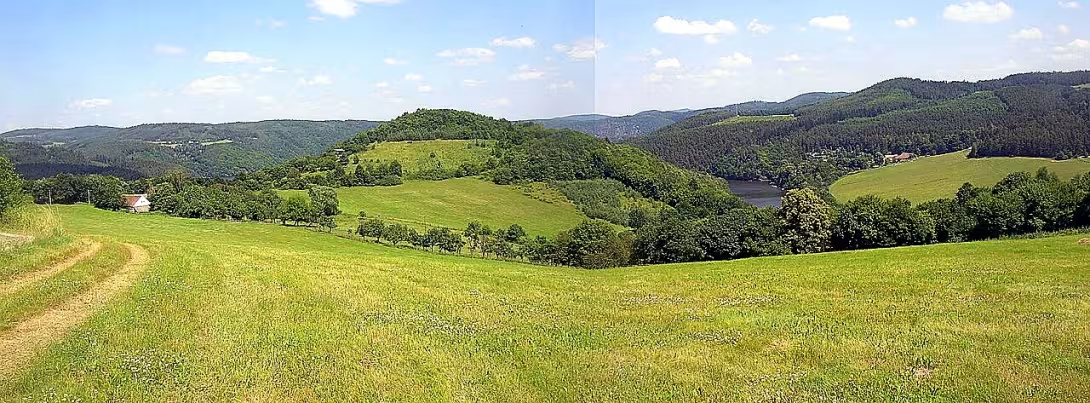
The castle Hrazany is an important Celtic oppidum which is situated on top of Doubí and Redka in the Central Bohemian Region, about 10 kilometres north of Sedlčan. This site is protected as a cultural monument of the Czech Republic. It is a key document of Celtic settlement in Bohemia and has in the past served as an important guard fort on the trade path connecting the Danube with the inland.
The oldest settlement is documented between 550 and 460 BC, where there was a scattered settlement with yard construction. The oppidum itself was created in the 2nd century BC. At that time, the first firewood fortification surrounding the area of 30 hectares was built. During the 1990s, the complex underwent extensive reconstruction of fortifications and internal buildings. In the mid-1st century BC, the oppidum grew to a total area of 39 hectares and experienced a period of peaceful development.
The construction of the walls evolved from the original palisades to the larger walls of stones and beams, which were between five and six metres wide. The area is divided into four parts: the foreshadow on the north slope of Red, the vertex of Red with the main entrance gate, the central valley in the saddle between the hills and the top of hill Doubí. In oppida led about six gates built according to standardized Celtic models. The inner structure consisted of fortified yards with square houses and unique shroud dwellings on stone terraces which were not found on any other Celtic oppid. The premises have been identified with metal and metal workshops, jewelry workshop, weaving condition and documents of gold stripping.
Historical sources suggest that oppidum worked as a guard fort protecting buyers traveling along the Vltava. At the turn of the 2nd and 1st century BC, part of the fortifications burned down, followed by extensive restoration. At the end of the settlement, a roadblock was built at Gate B, probably in response to concerns about the Germanic tribes' attacks. The disappearance of oppida was not as dramatic as other Celtic sites in Central Bohemia and did not occur suddenly.
Today the archaeological site is located in the district of Příbram above the confluence of Vltava and Mastník. Visitors can see the remains of the fortifications and the structure of the premises in the field. In the attic near gate B, deep tracks are still visible from the cars of the then commercial caravan.
Hrazany represents unique evidence of the maturity of Celtic civilization and its involvement in European trade networks. Visiting this place offers a unique opportunity to look at the history of fortified settlements that shaped the form of prehistoric settlements in our territory.
Historical milestones
- 550-460 BC l.
- The first significant settlement of the location by yard construction.
- 2nd Century B.C.
- The creation of oppida himself and the first firewood fortification.
- 90th years of the 1st century B.C.
- Extensive building activity, rebuilding of fortifications and yard buildings.
Architectural development
The original pallet fortifications were gradually replaced by a larger structure of stones and beams 5 to 6 metres wide. The area was divided into four parts, including the prepaid and acropolis, with the gates being built according to standardised Celtic models. During existence, the oppid of several phases of reconstruction and expansion of the fortifications went through.
Historical events
The creation of oppida in 2nd century B.C., fire and destruction of part of the fortifications at the turn of 2nd and 1st century B.C., extensive construction activity in the 1990s 1st century B.C.
Points of interest
- The fort is situated on top of Doubí and Red in the Central Bohemian Region. - There was a cabin on the stone terraces which was not identified on any other Celtic oppid. - Oppidum served as a guard stronghold on the trade trail and protected buyers traveling along the Vltava. - In the attic near gate B, deep tracks are still visible from the cars of the then commercial caravan. - The disappearance of oppida was not sudden or as dramatic as other Celtic sites in central Bohemia.
Guide
Show guide text
This text was created by artificial intelligence and has not been editorially reviewed. It may contain inaccuracies.
Welcome to the historical site Hrazany, one of the most important Celtic oppid in the Czech Republic. You are standing on the peaks of Doubí and Red, where this fascinating location is spread over the stunning view of the confluence of the Vltava and the Mast. In front of you is a huge square, which once served as a living to play with people and goods traveling along the trade path connecting the Danube with the inland.
Let's go into history. The castle Hrazany was inhabited already in the 6th century BC by yard construction, which suggests early human settlement and organized lifestyle. However, the real origin of oppida dates back to the 2nd century BC, when a complex system of fortifications began to develop here. It was a period of intensive development and construction that led to the creation of a firewood fortification protecting the entire area of 39 hectares.
Now look up at the wall system that once provided the safety of the people. Notice the stripe of land and wood which together formed a defensive line against the enemy. The fort was protected by six gates, each with its own access system. These gates were not only narrow passages, but also strategic points that allowed control over the movement of people and goods.
In the 1990s BC, there was extensive construction activity, leading to changes in fortifications and yard buildings. This was the time when oppid evolved into its highest form, prepared for any threats.
Although specific architects are not known, the ingenuity and complexity of the structure show a high degree of organisation and technical ability of the then inhabitants. The fort served as a key point on the trade path that combined various cultures and economies.
The interesting thing about this place is finding shroud dwellings on stone terraces. This type of housing did not find parallels on any other Celtic oppid, suggesting the uniqueness and adaptability of the Hrazans in their construction and environment.
Now look around you. Notice the atmosphere of ancient times that this complex has preserved in its remains. Although many specific details are now lost in the dust of time, every stone and every cliff tells the story of the lives of the people who once inhabited this land.
The invitation is to explore other parts of oppida that reveal more about its history and architecture. Whether you look at the walls or notice the location of the gates, every bit of this place has its own story.
Thank you for your attentive listening and I hope this guide has inspired you to consider further visits. Whether it's exploring other historical monuments or just a moment of peace in nature, Hrazany has much to offer to any curious visitor. With God and hope for another meeting!
Tips for visitors
The best time to visit is spring or autumn, when vegetation is lower and the terrain of the castle is clearer, making it easier to navigate between the remnants of the valleys. In summer the location can be covered with high grass. Parking is possible in the village Hrazany, from where it leads to the location of the pedestrian road; We recommend using our own car as public transport to this area is limited and requires longer walking. Take with you fixed shoes suitable for the field, plenty of water and snacks, because there are no refreshment stands on the castle itself. A golden hour at sunrise or sunset is most suitable for photography, with low light highlighting the reliefs of Celtic valleys and offering breathtaking views of the Vltava Valley. In the surroundings you can visit the Sláska dam, the confluence of Vltava and Mastník or the picturesque village Radíč, while for families with children the trip is ideal as a light nature walk connected with the discovery of history, but the terrain is not suitable for baby carriages.
Businesses nearby
Do you run a restaurant, accommodation, shop, museum, rental, wellness or other visitor service near this monument? Show yourself directly to the people heading to it — this is how they will see you in the app and on the web:
Nearby
Sláska dam, the confluence of Vltava and Mastník, the village Radíč.
Accommodation nearby
Themed route
1. Radíč (municipality) - A quiet village that serves as a pleasant starting point for the whole walk. 2. Hrazany (archaeological site) - The main destination of the trip, where you can explore traces of ancient human settlements. 3. Confluence of Vltava and Mast (natural interest) - The meeting place of two watercourses offers a beautiful view of the surrounding landscape. 4. Slápa dam (water work) - An ideal place for relaxing at the water and a pleasant ending all day.
Seasonal recommendations
Spring: In the spring season, Hrazany turns into a shining shelter, where the warm sun joins the blooming shrubs and trees. The atmosphere is full of life when nature begins to bloom again. Visitors can enjoy mild weather with warm morning hours and cooler evenings. At this time it is advisable to come in early afternoons to avoid possible rainfall that may occur during the period of transformation. It is recommended that you wear clothes on layers so that you are prepared for both warm sunlight and mild wind.
Summer: Summer is Hrazany the most popular time for visiting. The sun illuminates the archaeological landscape and brings with it a warm, bright day. The atmosphere is full of energy, but also large crowds interested in history and natural beauty. The best time to visit is early in the morning or later in the evening to avoid the peak noon hours when there can be a significant temperature and crowd. It is recommended to wear light clothes, sunglasses and enough drinking water to protect against the sun.
Autumn: In autumn the Hrazany offers a lovely color change. Tree leaves turn into golden and red shades, creating a beautiful background for historical ruins. The atmosphere is calmer than in the summer, with fewer visitors and a mild temperature. The best to visit Hrazany in the early afternoons, when the sun still illuminates the landscape, but is colder than in the noon hours. It is recommended to wear warm clothes and shoes with helmets to protect against cold winds.
Winter: The winter visit of the Hrazans offers a unique atmosphere where the sun illuminates the snow hills and the cold air gives the place peace. Archaeological ruins in this period have a romantic view, but the attendance is limited to days without snow to close the roads. The best time to visit is at noon when the sun provides the most light and heat. It is necessary to wear warm clothes, protective shoes and helmet to protect yourself from cold air and possible snow.
Visualizations and artistic views

The visualisations are generated by artificial intelligence and serve as inspiration.
Photos from the area
Real photos taken near the monument


Zdroj a licence jsou uvedeny u každého snímku.
Tips from visitors
No tips yet. Be the first!
Log in and add your tip.
Sources and literature
Fotografie: User:Miaow Miaow / Public domain — Wikimedia Commons. The author and licence also appear when you hover over the image.
Faktickým podkladem tohoto textu byl článek na Wikipedii, jehož autory jsou přispěvatelé Wikipedie. Článek je dostupný pod licencí CC BY-SA 4.0.
Location on the map
Příběhy a pověsti
Legendy, pověsti a příběhy spjaté s touto památkou
Fotografie návštěvníků
Zatím žádné fotografie. Buďte první, kdo přidá fotografii z návštěvy!
Přihlaste se a přidejte svou fotografii nebo hodnoťte.
Za ověřenou návštěvu v aplikaci získáte víc bodů — poznáme podle GPS, že jste na místě.
Reviews and comments