






Hrobka rodiny Josefa Förstera Tomb
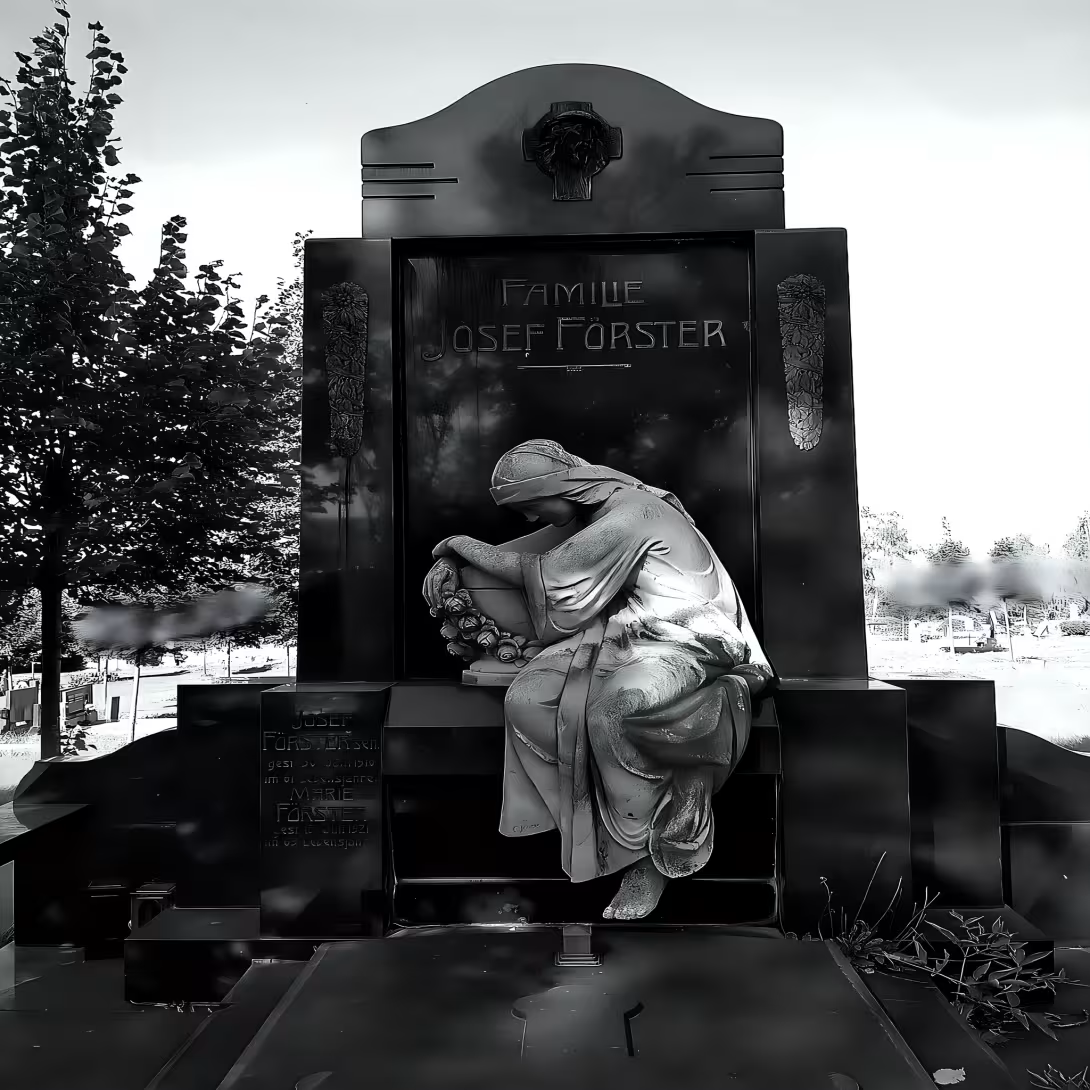
Hrobka rodiny Josefa Förstera, located in the cemetery in Zlaté Hora in the district of Jeseník, is a cultural monument of the Czech Republic declared in 1994. This late Art Nouveau monument, made by the academic sculptor Engelbert Kaps shortly after 1921, is an important monument due to its artistic value and historical context. The tomb consists of two Förster family tombs and is realized by a black granite with a statue of a grieving woman from white Laaser marble and the head of Christ from bronze. Its importance lies not only in the visual impression but also in the historical context of the 1920s, when Czechoslovakia was in the period of economic stability and the development of crafts.
The creation of the tomb is closely linked to Josef Förster, an important local stone entrepreneur. In 1921 Engelbert Kaps, an academic sculptor, employed himself to create a tomb for the Förster family. This project was implemented in the style of late Art Nouveau, which reflected the artistic trends of the time. The tomb is proof of the prosperity and cultural importance of local entrepreneurs in the post-World War I period.
The architecture of the tomb is characteristic of late Art Nouveau, which is seen in its complex design and used materials. The main elements include a black granite construction with a statue of a grieving white Laaser marble woman, which is wrapped around a wreath of pink flowers. The additional element is the head of Christ with a crown of thorns made of bronze. This idea of a grieving woman has parallels with the tombstone of Markian Šashkevich at the Ličakivsky cemetery in Lvov, although it differs in the colour of statues.
The tomb was declared a cultural monument of the Czech Republic in 1994 and its restaurant took place in 1997. This status confirms its artistic value and historical importance. The tomb remains with the Förster family, which contributes to its personal and cultural importance.
Today the tomb in the Golden Mountains is available for visiting. Its artistic value and historical context make it an interesting location not only for local residents but also for tourists. Hrobka rodiny Josefa Förstera is a reminder of the region's rich cultural heritage and the significant contribution of individuals such as Josef Förster.
The search for historical monuments such as the tomb of Josef Förster's family allows us to better understand the past and appreciate the cultural heritage. This monument represents not only artistic value but also historical context, which is important to preserve for future generations. Visiting the tomb in the Golden Mountains means traveling to the past and honoring local stories and traditions.
Historical milestones
- 1994
- Declaration for the cultural monument of the Czech Republic
- 1997
- Restaurant Tombs
Architectural development
The tomb is made of black granite, and the statue of a grieving woman is made of white Laaser marble. The complementary element is the head of Christ from bronze.
Historical events
In 1994 the tomb was declared a cultural monument of the Czech Republic and its restaurant took place in 1997.
Points of interest
- Hrobka rodiny Josefa Förstera is a cultural monument of the Czech Republic declared in 1994.
- This late Art Nouveau monument was made by academic sculptor Engelbert Kaps shortly after 1921 and is an important monument due to its artistic value and historical context.
- The tomb consists of two Förster family tombs, realized from black granite with a statue of a grieving white Laaser marble woman and the head of Christ from bronze.
- The creation of the tomb is closely linked to Josef Förster, an important local stone entrepreneur, and reflects the artistic trends of the late Art Nouveau.
- The tomb was declared a cultural monument of the Czech Republic in 1994 and its restaurant took place in 1997.
Guide
Show guide text
This text was created by artificial intelligence and has not been editorially reviewed. It may contain inaccuracies.
Welcome to the Golden Mountains. You have just stopped in front of a place that carries deep calm and at the same time the incredible power of artistic expression. You're standing right in front of Josef Förster's family tomb. Before we embark on a detailed discovery, let us just stand for a moment, soak up the atmosphere of this cemetery and perceive the presence of this monumental work. In front of your eyes is a set of two tombs that are not just a simple sign of the end of life, but a celebration of memory and art. Feel the weight of the history that radiates from these stones, and be aware of how human destiny intersects in this space with the unwavering beauty of creative work.
Now let's move forward in time and understand how this fascinating whole came into being. This monument is not the work of a random craftsman, but the result of the work of a man who at the time represented the ultimate artistic education. The author of the whole building is the academic sculptor Engelbert Kaps. The work was created shortly after 1921, which is a very interesting historical moment. The world was in a period of great change, moving from one century to another, and art was trying to find a new language that could express the complexity of human existence. Kaps put his expertise in this work and his ability to work with the form so that the tomb does not only act as a place of sadness, but as a permanent and dignified monument.
Now pay attention to the architecture itself and to what you're seeing right now. The entire building is realized in late Art Nouveau style. If you imagine this style, it will be clear to you why this monument seems so harmonious and yet so significant. The late Art Nouveau was already carrying some ripening, a distance from the initial enthusiasm for ornaments, and it was moving towards a greater sense of overall structure and elegance. Notice how different materials intertwine here. The author deliberately combined various types of surfaces and textures, which gives the tomb dynamics and depth. This combination of materials is not random; It is used to keep the visitor's eye traveling throughout the building and to discover new details, new shadows and new lights. Even though the tombs consist of two parts, they act as one whole and inseparable, underlining the family unity that the creator wanted to express.
When you look at these monumental shapes, you can ask who all this was made for. The main character whose name is inextricably linked to this place is Josef Förster. Although his personal life within this monument is not being spoken of directly, the very existence of such a rich and artistic work suggests to us that the Förster family was part of an important society based on tradition, dignity and lasting legacy. This monument is their voice that echoes through decades telling us that their existence had its weight and its beauty.
You may now wonder how this precious object got to us in such good condition. Here we come to one of the most important facts that makes this monument special for all of us. This tomb is not only a private property of the family, but it has become part of our common heritage. Its high artistic value was so obvious that in 1994 it was officially declared a cultural monument of the Czech Republic. This is a recognition that confirms that the work of Engelbert Pocka is worth more than one cemetery. And in order for this beauty not to be lost in the abyss of time, a thorough restaurant was carried out in 1997. By taking care of the tomb and being protected as a national treasure, you can see it today in its original, fascinating form.
Here is also the little mystery that can lead you to this place again. Think about how many people have passed these tombs in the last hundred years. How many generations have seen the world change around them, while this monument remains unwavering in its form. How did the purpose of the Art Nouveau change from the time Kaps created it until today, when we see it as a historical artifact? This tomb is like a time capsule that connects us to people from 1921 and allows us to perceive their aesthetic feelings.
Now that you have taken the basic view of this place, I suggest you take a slow walk around the entire building. Change the angle of view, take a closer look at the details, and then step away again to see how the tomb fits into the entire cemetery space. Feel how light changes on different materials and how in every detail the academic sculptor's championship is reflected. Let yourself be consumed by the atmosphere of this place and spend a moment in the silentium of memories that these stones bear. Thank you for making time to discover this piece of history. We wish you a pleasant further journey along the Golden Mountains and other interesting experiences while exploring the monuments of our region. Goodbye.
Tips for visitors
The best time to visit the tomb of Josef Förster's family is in the spring or autumn period when vegetation is in full force and the light is ideal for photography. These months also offer mild weather compared to sunny summers.
Parking can be found near the cemetery, but we recommend using public transport for easier access. You can check the current connection online or via mobile applications.
When visiting, make sure you have suitable shoes and clothes with you, especially if you visit the tomb at a colder time of the year. Photography is possible from different angles around the monument; the best light offers morning and evening.
In the vicinity of the cemetery, specifically in the Golden Mountains, there is a historical cemetery with other interesting monuments. For families with children it is advisable to visit the surrounding natural spaces where children can play and enjoy the outdoor environment.
Businesses nearby
Do you run a restaurant, accommodation, shop, museum, rental, wellness or other visitor service near this monument? Show yourself directly to the people heading to it — this is how they will see you in the app and on the web:
Nearby
The cemetery in the Golden Mountains
Accommodation nearby
Themed route
1. Cemetery in Golden Mountains Type: Entry area Why: Start walking in a quiet environment and orientation in space.
Hrobka rodiny Josefa Förstera Type: Monument Why: The main objective of the visit and a significant family grave with architectural value.
3. Cemetery in Golden Mountains Type: Funeral area Why: Final walk between the other tombs within the whole area.
Seasonal recommendations
Spring: In spring the surroundings of the monument are revived thanks to the future green and fine light that creates a sense of renewal. The atmosphere is fresh and calm, which perfectly combines with the historical character of the place. We recommend taking layered clothes in case of sudden temperature changes and visiting the tomb in the morning when the attendance is minimal.
Summer: In summer, the monument is surrounded by full growth and strong sun creates significant shadows on the stone details. In the main summer season there are more people at historical places, so it is best to arrive early in the morning to enjoy your privacy. Prepare light clothing and sun protection to make your tour pleasant even during hot days.
Autumn: Autumn moons bring melancholy and beauty to the place thanks to fog and colored leaves. The low sun in this period best highlights the carvings and the structure of the monument. It is advisable to wear waterproof shoes and warmer layers of clothing as moisture may be increased. The ideal time to visit is in the afternoon when light creates the most profound effects.
Winter: In winter, the tomb is very noble and the silence of the freezing season underlines its historical weight. Snow and frost can give stone a unique look, but daylight is very limited. Very warm clothes and tight shoes are necessary to move on a slippery surface. The best thing is to schedule a visit around noon to use the longest part of the day.
Visualizations and artistic views

The visualisations are generated by artificial intelligence and serve as inspiration.
Photos from the area
Real photos taken near the monument


Zdroj a licence jsou uvedeny u každého snímku.
Tips from visitors
No tips yet. Be the first!
Log in and add your tip.
Sources and literature
Fotografie: DuchCasu / CC BY-SA 4.0, rozlišení zvýšeno umělou inteligencí — Wikimedia Commons. The author and licence also appear when you hover over the image.
Faktickým podkladem tohoto textu byl článek na Wikipedii, jehož autory jsou přispěvatelé Wikipedie. Článek je dostupný pod licencí CC BY-SA 4.0.
Location on the map

Příběhy a pověsti
Legendy, pověsti a příběhy spjaté s touto památkou
Fotografie návštěvníků
Zatím žádné fotografie. Buďte první, kdo přidá fotografii z návštěvy!
Přihlaste se a přidejte svou fotografii nebo hodnoťte.
Za ověřenou návštěvu v aplikaci získáte víc bodů — poznáme podle GPS, že jste na místě.
Reviews and comments