






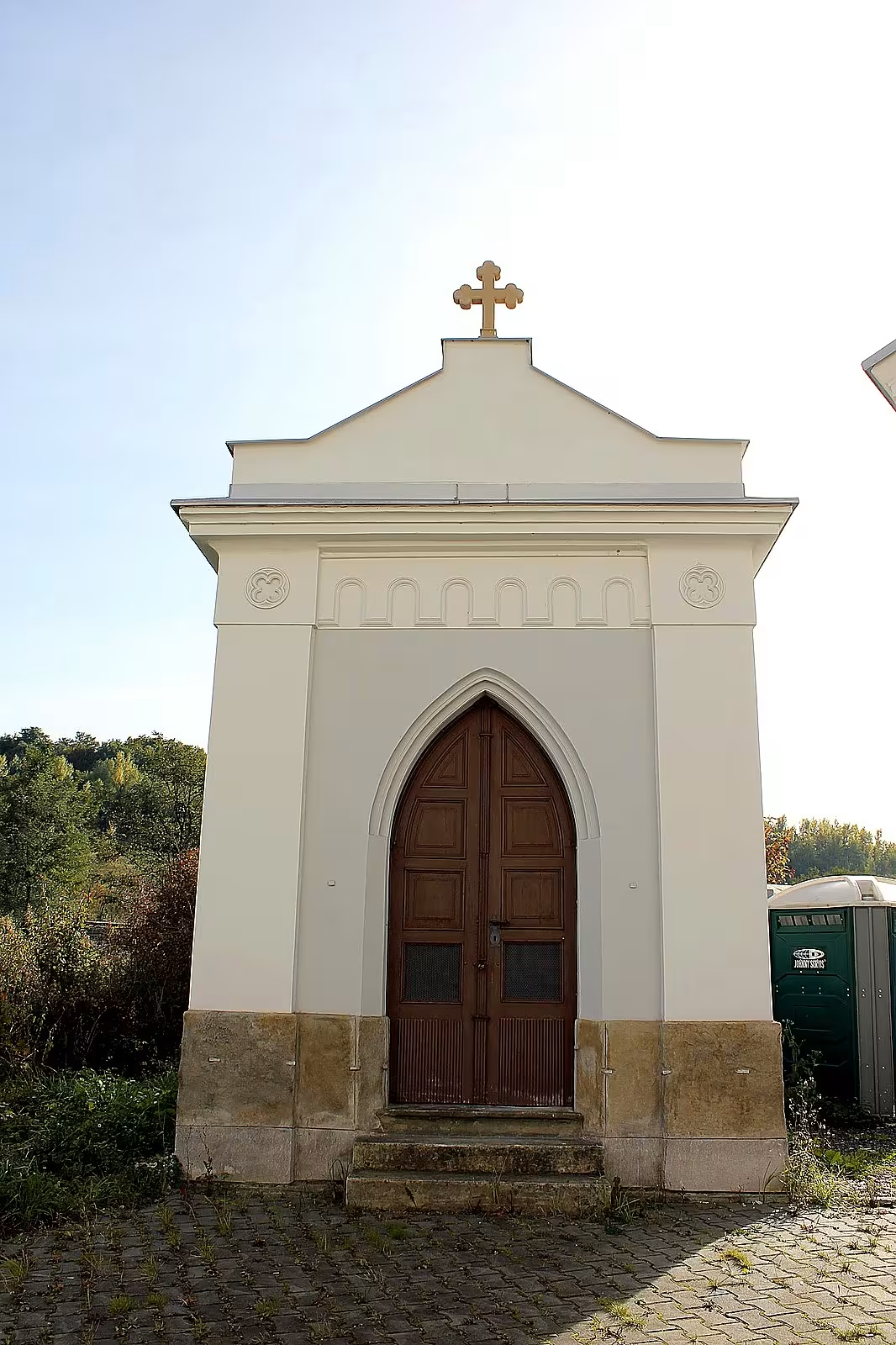
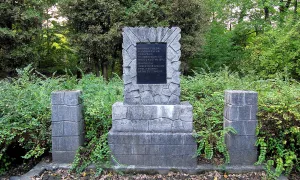
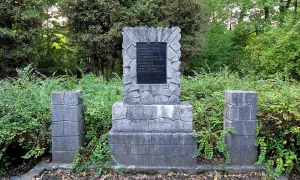
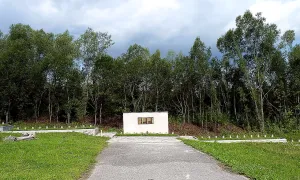
Hrobka rodiny Stanieků Tomb
This page was machine-translated from Czech. The translation has not been language-checked and may contain errors.
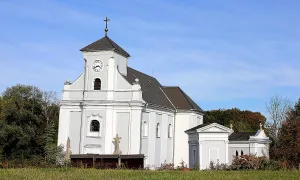
The Staniek Family Tomb stands by the Church of Saint Peter of Alcantara in the Doly district of Karviná and is protected as part of the church’s monument site. The church, known as the Leaning Church, is a late Baroque religious building and is protected as a cultural monument of the Czech Republic. Thanks to a tilt of almost 7 degrees caused by mining subsidence, it is listed in the Czech Book of Records and Curiosities as the most leaning church in the country.
According to the sources, a wooden church dedicated to Saint Martin, first mentioned in 1447, stood on the site of the present building or nearby. A medieval stone baptismal font from this older building has survived in a corner of the present church. The present masonry building was commissioned by Jan František Larisch and built between 1756 and 1759. It was consecrated in 1759 by Philipp Gotthard Schaffgotsch, Bishop of Wrocław.
Architecturally, it is a single-nave hall church whose interior has kept its uniform furnishings from the time it was built. The high altar holds a painting of the titular saint, Saint Peter of Alcantara, which was overpainted in 1924. The Rococo features of the interior include a statue of Saint John the Baptist with two cherubs on the canopy of the pulpit. In the 19th century the church tower was altered and given a half-timbered belfry storey. After storm damage in 1957, this was replaced by a pyramidal roof. In 2026 a reconstruction began that is intended to return the church to its mid-18th-century appearance; the fibre-cement roofing has been replaced with the original red clay plain tiles known as beaver tails. The work also includes repairs to the adjacent tomb.
The building’s pronounced tilt is a direct consequence of intensive black coal mining in Karviná. During mining, 27 seams with a total thickness of about 50 metres were extracted beneath the church. By 2011 the ground had subsided by roughly 37 metres. In the 1990s the church was earmarked for demolition because of its dangerous condition. Thanks to the efforts of the then parish priest, Ernest Dostal, however, the demolition order was revoked. A general repair and structural stabilisation of the building took place in 1994–1995.
The tower has a clock with an illuminated dial. In 2012 two new bronze bells by the bellfounder Josef Kadlec were installed, dedicated to Saint Peter of Alcantara and Saint Henry. During the reconstruction a crypt was discovered, and an archaeological survey uncovered four graves and the foundation masonry of a chapel, probably from the 15th century.
Today the Church of Saint Peter of Alcantara serves as the parish church of the Roman Catholic parish of Karviná-Doly. Its story has become part of cultural awareness, not least thanks to Karin Lednická’s successful novel trilogy The Leaning Church and the documentary O zaniklé Karvinné (On Vanished Karvinná).
This monument is a unique testimony to the transformation of the landscape by industrial activity and to perseverance in saving cultural heritage. A visit offers the chance to see with your own eyes an exceptional technical and historical phenomenon that has become a symbol of the whole region.
Then and now
Drag the slider to compare how the landmark may have looked when it was built with the view today.
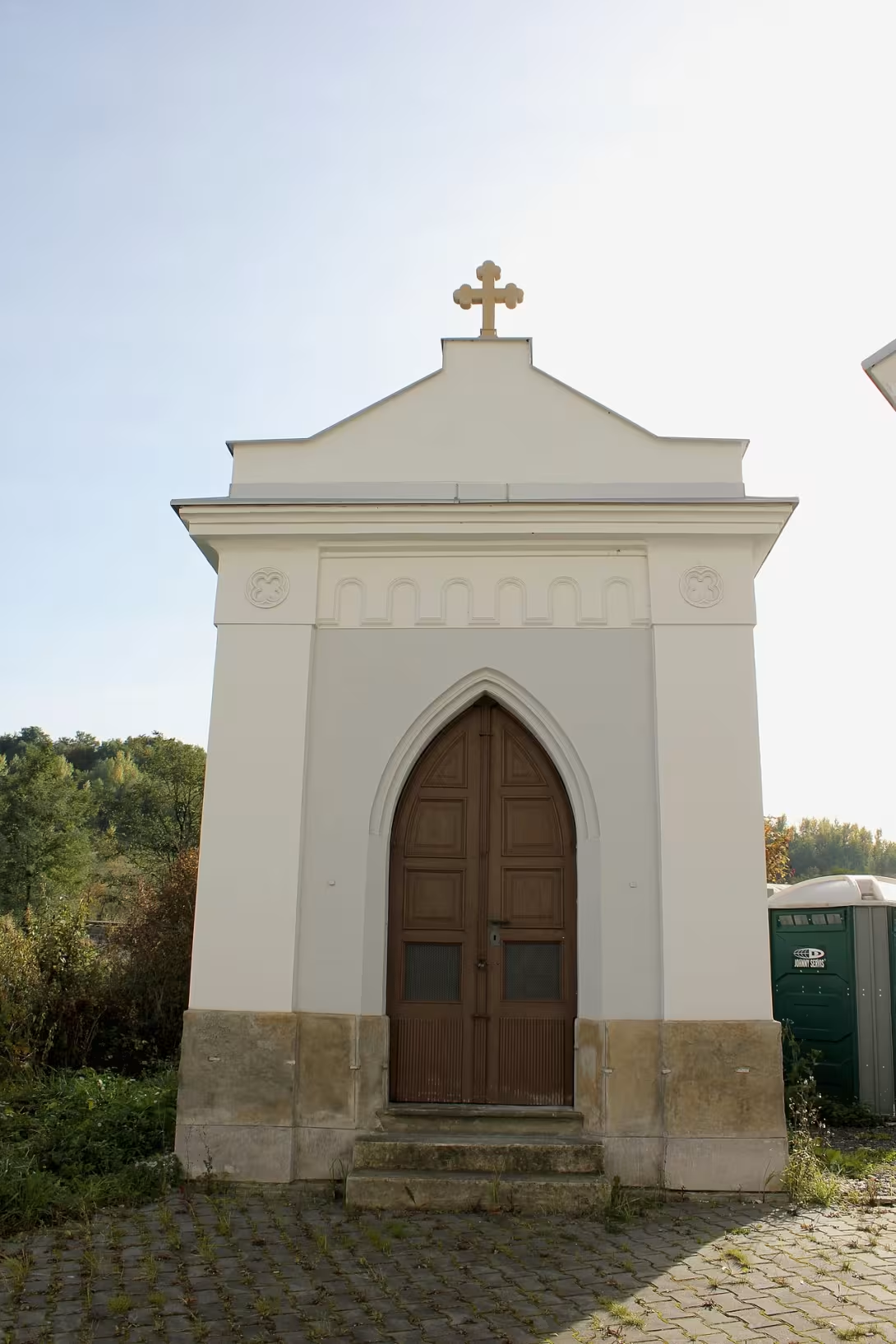
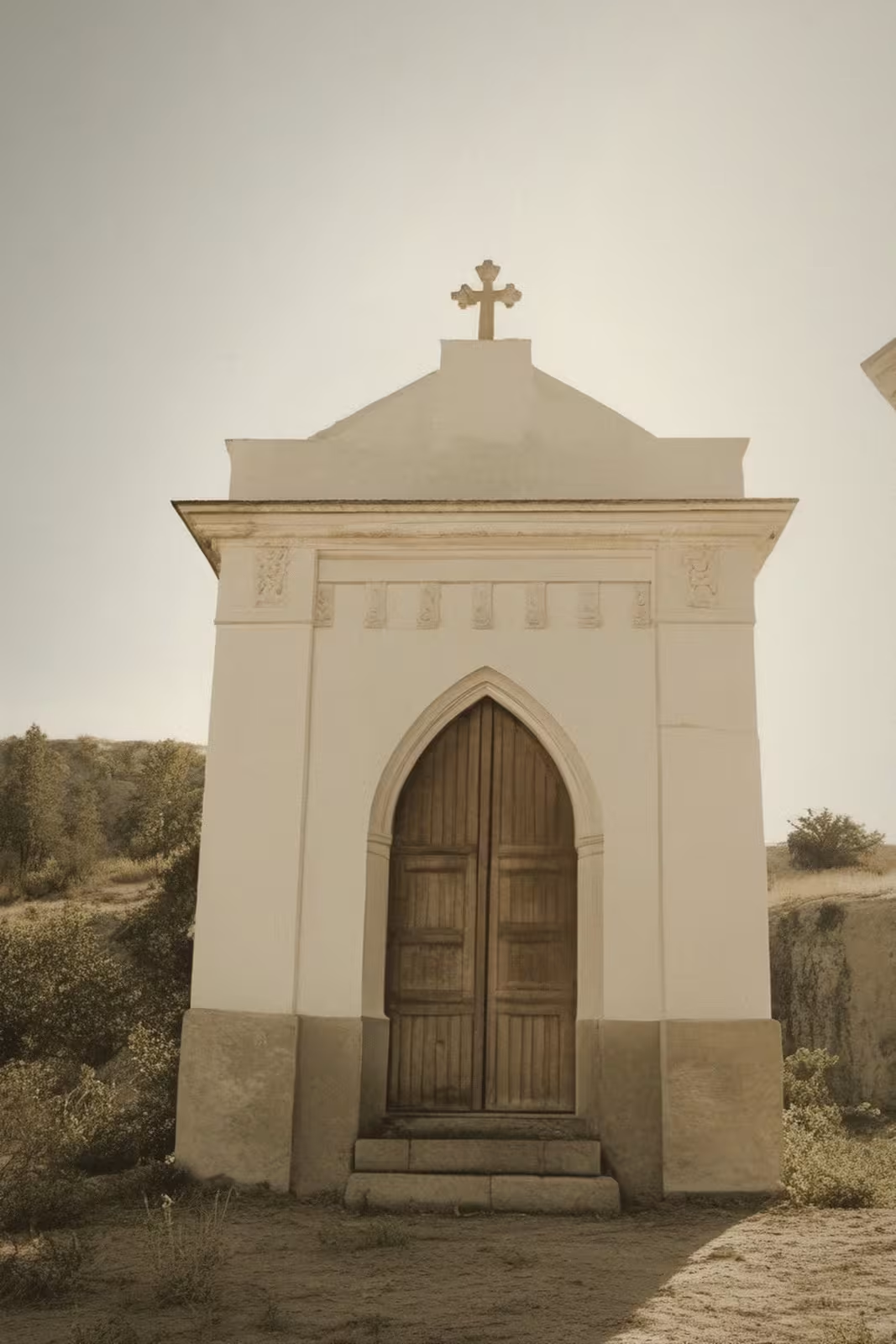
The historical appearance on the left is an AI-generated visualisation and serves as inspiration only.
Historical milestones
- 1759
- Consecration of the church by Bishop Philipp Gotthard Schaffgotsch.
- 1957
- The tower, damaged by a windstorm, was taken down and replaced by a pyramidal roof.
- 1995
- Completion of the general repair and structural stabilisation of the church.
- 2026
- Start of the roof replacement, façade renovation and repair of the adjacent tomb.
Architectural development
In the 19th century the original Baroque building was given a half-timbered belfry storey, which was later replaced by a pyramidal roof. The interior has kept Rococo features such as the statue of Saint John the Baptist on the pulpit. In 2026 a reconstruction began in which the roof regained its original red clay tiles, and the adjacent tomb is also being repaired.
Historical events
1759: Consecration of the church by Bishop Philipp Gotthard Schaffgotsch. 1957: The damaged tower was taken down after a windstorm. 1994-1995: General repair and structural stabilisation of the church.
Owners
Roman Catholic Church
Points of interest
– The church is listed in the Czech Book of Records and Curiosities as the most leaning church in the country, thanks to a tilt of almost 7 degrees. The tilt was caused by subsidence from intensive black coal mining. – A medieval stone baptismal font has survived in a corner of the present church; it comes from an older wooden church first mentioned in 1447. – In the 1990s the church was earmarked for demolition because of its dangerous condition, but the demolition order was revoked thanks to the efforts of the parish priest Ernest Dostal. – During the reconstruction a crypt was discovered, and an archaeological survey uncovered four graves and the foundation masonry of a chapel, probably from the 15th century. – The reconstruction that began in 2026 is intended to return the church to its mid-18th-century appearance; the fibre-cement roofing has been replaced with the original red clay beaver-tail tiles, and the adjacent tomb is also being repaired.
Guide
Show guide text
This text was created by artificial intelligence and has not been editorially reviewed. It may contain inaccuracies.
Welcome to Karviná, to the district of Doly. You are standing in front of a building that probably caught your eye at first glance with its unusual, even unsettling appearance. It is the Church of Saint Peter of Alcantara, but many of us know it simply and colloquially as the Leaning Church. Notice the feeling you get when you look at it. Does the building seem to lean slightly? You are right. This first impression is not a trick of your eyes but tangible evidence of the history of this place. This church is not just a religious building but a living symbol of how deeply people can interfere with the very substance of the earth, and how architecture responds to such interventions.
Let us now go back in time together to understand how this story began. The church you see before you was built in its present form between 1756 and 1759. At that time the Baroque style was flourishing here, bringing a new aesthetic and spiritual level to the area. It is important to know, however, that this masonry building was not the first church here. On its site, or nearby, there originally stood an older wooden church. It was this transition from timber to masonry that marked the flourishing of the community and the ambitions of the time. The high point of this first stage was the consecration of the church in 1759, led by Bishop Philipp Gotthard Schaffgotsch. Imagine that festive moment, when people gathered in this area — much quieter then than the later industrial centre — to celebrate the completion of their new church.
Now turn your attention to the architecture itself and to what you can see right now. Look at the façade and take in the overall atmosphere of the building. Although the architects who designed it are unknown today, their work has survived the centuries, albeit in an unexpected form. The strongest element accompanying you now is that very tilt. The building has leaned by almost seven degrees. If you look closely, you will see how this imbalance affects the overall character of the building. It was not intended by the builders but was the result of intensive black coal mining in the surrounding area. Undermining — the process in which empty spaces form below the surface where coal has been extracted — caused significant subsidence. The ground beneath the church simply shifted, and the building moved with it.
When you look up at the roof and the tower, notice its particular shape. What you see today is not the original form of the tower. In 1957 a destructive windstorm hit the area and damaged the tower so badly that it had to be taken down. It was then replaced by a pyramidal roof, which gives the church its present silhouette. It is a reminder that this building has had to contend not only with forces from the depths of the earth but also with the elements from the sky. So that the church could continue to stand safely and serve people, a general repair and thorough structural stabilisation were completed in 1995. But work on the building does not end there. If you notice the state of the façade and roof, you should know that in 2026 another major reconstruction began, including renovation of the façade, complete replacement of the roofing and repair of the adjacent tomb.
This place is linked with the names of people who left their mark on it. Besides the bishop Schaffgotsch already mentioned, the history of this place is associated with names such as Jan František Larisch and Ernest Dostal. They were people who, in different periods, influenced life in this area and helped maintain the continuity of faith and culture in an environment constantly transformed by the mining industry. It is fascinating to think how these people saw their relationship to a building that slowly but relentlessly began to tilt before their eyes.
Now I would like to invite you to a curiosity that may not be visible at first glance but that carries a secret of the past. If you went inside, you would find a medieval stone baptismal font in a corner of the church. It is a fascinating object, because it comes from the original wooden church that stood here before the Baroque building. This font is like a bridge between eras. While the building itself has changed, tilted and been repaired, this one stone element has remained the same for centuries, reminding us that even in times of great change there are things that stay firm and unchanged.
It is precisely this combination of stability and instability that makes the Church of Saint Peter of Alcantara a unique place. Thanks to its tilt of almost seven degrees, the building is listed in the Czech Book of Records and Curiosities as the most leaning church in the country. It is a paradoxical distinction. What was technically a problem and a threat of collapse has become the most striking feature and a symbol of the whole region. The church has thus become a monument to the transformation of the landscape. It shows us how powerfully human activity can affect the surface of the planet and how architecture must adapt to new, often unpredictable conditions.
As you stand before this building, try to imagine the journey it has been through. From a wooden church, through Baroque glory, alarming subsidence, storms and modern repairs, to its present status as a record holder. It is a story of perseverance, of the struggle against gravity and of the ability to find beauty even in what is clearly wrong or crooked.
Before we say goodbye and you move on, I recommend spending a moment quietly watching the line of the roof against the sky. Try to realise that every centimetre of this tilt tells of thousands of tonnes of mined coal that once powered the industrial revolution. This church is essentially a petrified record of the work of thousands of miners who worked deep beneath your feet.
Thank you for taking this short journey through the history of the Leaning Church with me. I now invite you to explore more of the Doly district and discover other hidden stories of this fascinating region. I wish you a pleasant onward journey and many new experiences. Goodbye.
Tips for visitors
The best time to visit is in the morning or at sunset, when the leaning tower and the surrounding landscape take on a unique atmosphere. Because of the open space around it, the place is very photogenic in soft light that emphasises the tilt of the building.
You can reach the monument by car. If you prefer public transport, the site is served by local connections; please look up the current timetables and the best connection in an up-to-date journey planner.
We recommend bringing sturdy footwear for walking on uneven ground and a camera. For the best shots of the Leaning Church, use a wide-angle lens from a low angle, which further emphasises the dramatic tilt of the tower caused by mining subsidence.
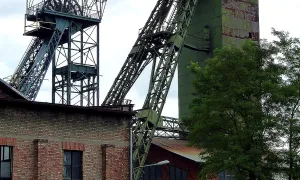
The Karviná-Doly area offers a unique view of the remains of vanished buildings, a reminder of the turbulent history of coal mining in the region. A walk around the area suits lovers of industrial history and melancholy landscapes.
For families with children, the site is interesting for its story of the “leaning church”, which often fascinates children. We recommend combining your visit with an easy walk around the area, where you can observe the transformation of the landscape, but keep an eye on children near historic structures and uneven ground.
Businesses nearby
Do you run a restaurant, accommodation, shop, museum, rental, wellness or other visitor service near this monument? Show yourself directly to the people heading to it — this is how they will see you in the app and on the web:
Nearby
🏰 Historic sites (254)
- Panna Marie 0.0 km
- Pomnik katastrofy górniczej z 12 kwietnia 1924 1.9 km
- Pomník horníkům 2.7 km
- Valtr Elsner 2.8 km
- Hermína Elsnerová 2.8 km
- Poslední vozík z dolu ČSA 3.6 km
- Poslední vozík z dolu Darkov 3.6 km
- Poslední vozík z dolu ČSM 3.7 km
- Poslední vozík z dolu 9. květen 3.7 km
- 1924-1918 + 1939-1945 3.9 km
- Ordinace MUDr. Glasera 4.0 km
- Obětem 1. a 2. světové války 4.1 km
- sv. Jan Nepomucký 4.2 km
- Madona 4.2 km
- Panna Maria Bolestná 4.2 km
- Kostel Povýšení sv. Kříže 4.2 km
- sv. Jan Nepomucký 4.2 km
- sv. Patrik 4.3 km
- Památník obětem obou světových válek 4.3 km
- Zámek v Karviné-Fryštátě 4.3 km web
🍽️ Restaurants and dining (709)
- Golf Resort Lipiny 2.5 km
- Delikana 3.7 km web
- Panda 3.9 km
- Tamarín 4.1 km
- Bistro Darkov 4.1 km
- Dělnický dům 4.1 km Centrum 231/3 web
- Fajna Pizza 4.2 km Chrost 1177/2 web
- Dinos Restaurant 4.2 km +420 774 002 162 web
- U Koplíků 4.3 km
- Restaurace Baron 4.3 km
- Elektra 4.3 km Masarykovo nám. 5/4
- Společenský dům Lázní Darkov 4.3 km
- cafe BB bar 4.4 km
- Majaček 4.4 km
- Venezia 4.4 km
- Rest&rt 4.4 km
- Bok of Ka 4.4 km Svatováclavská 33/2
- Orlovka 4.4 km
- restaurace Na kopečku 4.4 km web
- Restaurant Letiště 4.4 km web
🏨 Accommodation (72)
- Country Motorest 4.0 km
- Apartmany BB 4.4 km
- Vulture 4.4 km U Pošty 371/4 web
- Koleje Slezká univerzita 4.6 km Na Vyhlídce 1079/1
- Hotel Impuls 4.8 km U Hřiště 1324/13b web
- Hotel Sport 5.6 km web
- Penzion Urban 5.8 km +420603783554 web
- U Jelena 5.8 km +420 608 751 517 web
- Lázně Darkov, a.s. 6.4 km Čsl. armády 2954/3 +420596372210 web
- Boršičanka 7.1 km
- Restaurace a penzion U Lesa 7.1 km +420 732 595 205 web
- Penzion Amerika 7.1 km +420 736 627 315 web
- Zámek Havířov 7.5 km web
- Penzion U Popelků 7.6 km +420 724 200 838 web
- Resort Těrlicko 7.8 km +420 724 387 666 web
- U Balona (Slezský pivovar) 8.0 km Selská 1329/43 +420 596 810 914; +420 601 550 001 web
- Jaškovská krčma 9.0 km web
- Hotel Fridrich 9.0 km U Hotelu 728/1 +420 596 423 229 web
- Kemp Rostislav Rypien 9.2 km +420 604 239 075
- Penzion Pod Zámkem 9.4 km +420 725 178 819
🚲 Rentals and sport (105)
- Modelářské letiště Hohenegger 1.6 km
- Sportisimo 3.8 km
- Tipsport 3.9 km
- Sportovní centrum Na Císařství 3.9 km web
- Sportovní hala Horní Suchá 4.2 km
- STaRS Karviná - víceúčelová hala 4.2 km
- Hala házené 4.5 km
- Cyklo ADS cykloservis 5.5 km
- sportovní areál 5.5 km
- Kola Go 5.5 km
- Bazén Stars 5.5 km
- Letní koupaliště 5.5 km
- Sportisimo 6.0 km
- Sportisimo 6.4 km web
- Squash centrum 6.5 km
- Městský sportovní areál 6.6 km
- Bazén Delfínek 6.8 km web
- Městská sportovní hala 6.8 km web
- Sportovní hala 6.8 km
- Slovan Havířov 6.9 km
🥾 Hiking and nature (167)
- Lazy 3.6 km
- Sad Boženy Němcové 4.0 km
- Lázeňský park 4.4 km
- Zámecký park 4.4 km
- sady Bedřicha Smetany 4.4 km
- Univerzitní park 4.7 km
- Vrchlického sady 5.1 km
- lesopark 5.6 km
- Volontérská studánka 5.7 km
- Zádomí 6.4 km Těšínská 230+
- Lázeňský park, Lázně Darkov 6.6 km
- Labyrint 7.3 km
- Park u Náměstí Republiky 7.4 km
- Pastuchovka 7.4 km
- Odbočka Petřvald 7.4 km
- Něbrojův kopec 7.5 km
- Vyhlídka na Beskydy 7.7 km
- Kolonie Pokrok 7.8 km
- Park na ul. Hálkova 7.8 km
- Kotulova dřevěnka 7.9 km web
Accommodation nearby
Themed route
1. The Karviná-Doly area (Type: territory). This area forms the overall setting of the trip and reflects its industrial character. 2. Remains of buildings that vanished because of coal mining (Type: historic site). Here you can see traces of former housing that had to make way for mining. 3. The Staniek Family Tomb by the Leaning Church (Type: religious monument). The main destination of the trip; the Church of Saint Peter of Alcantara is one of the few buildings left from the original Karvinná.
Seasonal recommendations
Spring: In spring the surroundings of the church and the tomb are quiet and green. Bring clothes for changeable weather.
Summer: In summer the long days give plenty of light for photographing the tilt of the church. It is most pleasant here in the morning or late afternoon; bring light clothing and something to drink.
Autumn: In autumn the coloured leaves underline the melancholy atmosphere of a landscape marked by mining. We recommend clothing for cooler weather and possible rain.
Winter: In winter the place is quiet and has few visitors. Check in advance whether you can visit the inside of the church; do not forget warm clothes and sturdy shoes.
Visualizations and artistic views


The visualisations are generated by artificial intelligence and serve as inspiration.
Photos from the area
Real photos taken near the monument


Zdroj a licence jsou uvedeny u každého snímku.
Tips from visitors
No tips yet. Be the first!
Log in and add your tip.
Sources and literature
Faktickým podkladem tohoto textu byl článek na Wikipedii, jehož autory jsou přispěvatelé Wikipedie. Článek je dostupný pod licencí CC BY-SA 4.0.
Location on the map
Příběhy a pověsti
Legendy, pověsti a příběhy spjaté s touto památkou
Fotografie návštěvníků
Zatím žádné fotografie. Buďte první, kdo přidá fotografii z návštěvy!
Log in a přidejte svou fotografii nebo hodnoťte.
Za ověřenou návštěvu v aplikaci získáte víc bodů — poznáme podle GPS, že jste na místě.
Reviews and comments