






Husův dům (Praha 1) Building
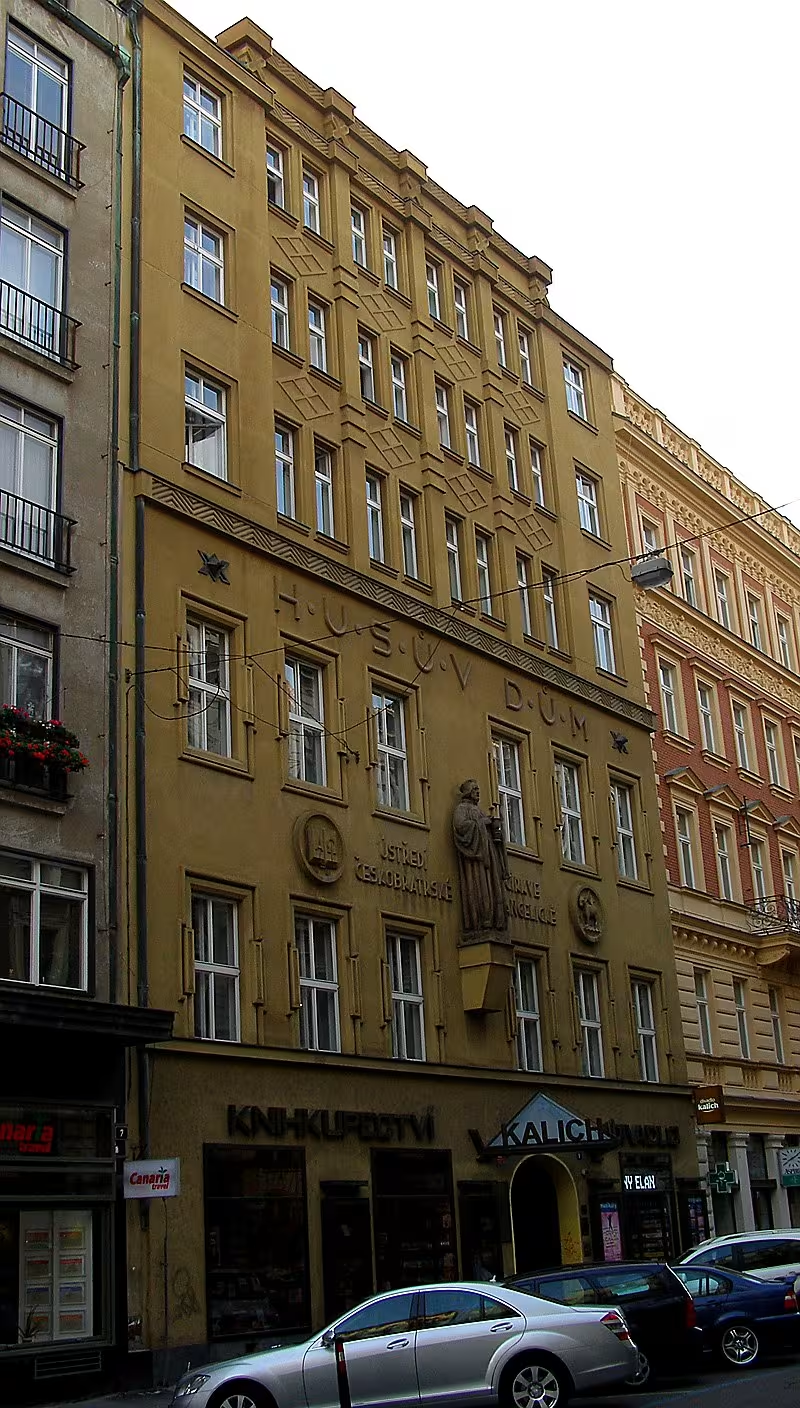
Husův dům, a historic building in Prague's New Town, is a significant cultural and historical landmark in the Czech Republic. Originally a medieval house, it was renovated in the Renaissance and Baroque styles before being rebuilt in 1923 by architect Bohumír Kozák. The building is notable for its Cubist facade and its role as the headquarters of the Evangelical Church of Czech Brethren.
The building's history dates back to the medieval period, but little is known about its earliest years. It was renovated in the Renaissance and Baroque styles before being rebuilt in 1923. That year, architect Bohumír Kozák transformed the building into its current form, adding a Cubist facade and three new floors. The facade features a statue of Jan Hus by Ladislav Kofránk and a Cubist design reflecting the architectural trends of the time.
The building's architecture is a notable example of Cubist design in Prague. The Cubist facade, designed by Bohumír Kozák in 1923, is a distinctive feature of the building. The interior and exterior were also renovated during this period, with the addition of a functionalist annex in 1935-1936.
Throughout its history, the building has had several owners and administrators. Today, the Synodní rada Českobratrské církve evangelické and Ústřední církevní kancelář Českobratrské církve evangelické are its owners. The building served as the headquarters of the Evangelical Theological Faculty of Charles University from 1950 to 1995.
The building has been the site of several key events and curiosities. The Cubist facade was designed by Bohumír Kozák in 1923, and the building features a statue of Jan Hus by Ladislav Kofránk. The building houses a theater, a publishing house, and a pension, and is a significant cultural and historical landmark in the Czech Republic.
Today, Husův dům is a popular tourist destination and a must-see for those interested in architecture and history. The building is open to visitors, offering a glimpse into the country's rich cultural heritage. Visitors can explore the building's unique Cubist facade and learn about its history and significance in the context of Czech architecture and culture.
Then and now
Drag the slider to compare how the landmark may have looked when it was built with the view today.
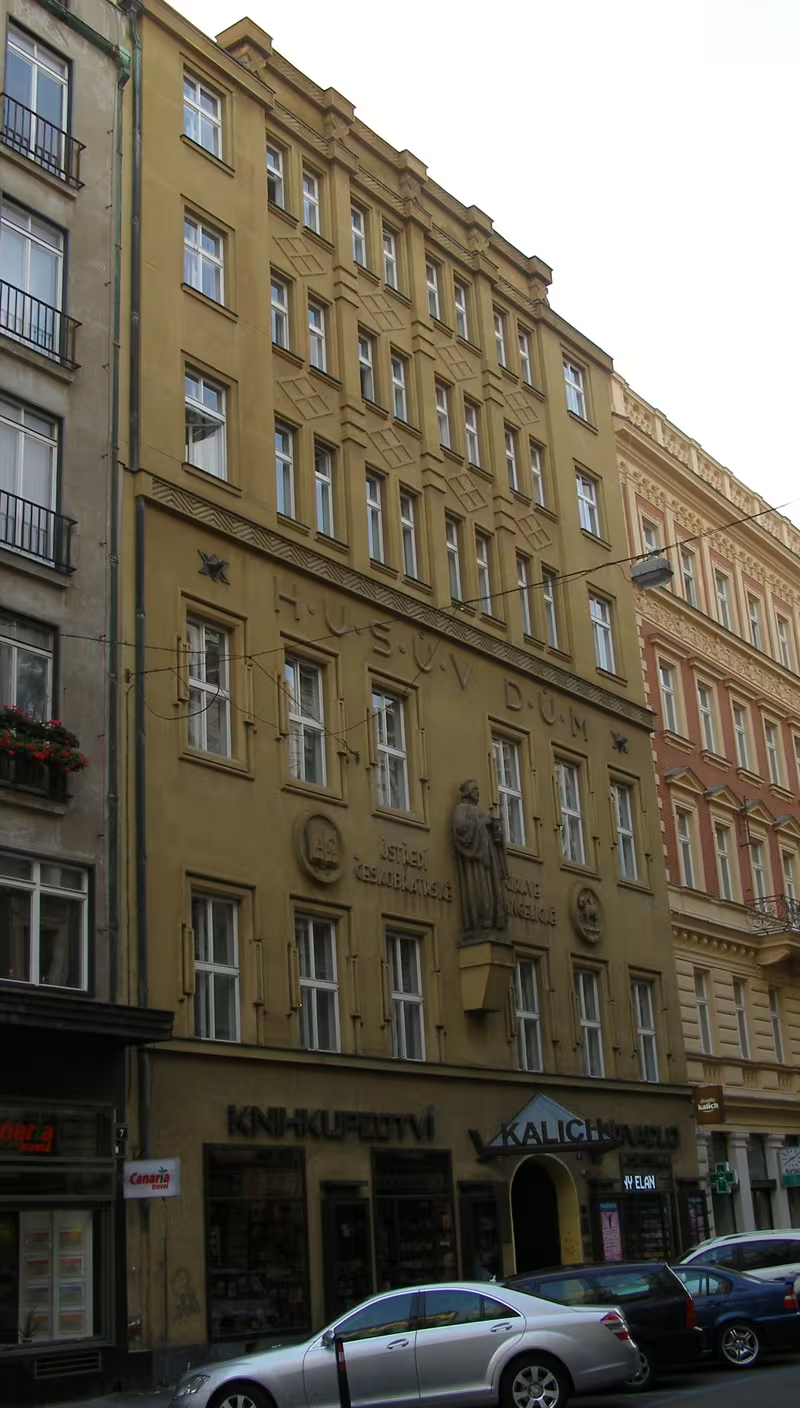

The historical appearance on the left is an AI-generated visualisation and serves as inspiration only.
Historical milestones
- 1350
- Medieval house built
- 1750
- Renaissance and Baroque renovations
- 1922
- Original building demolished
- 1923
- Rebuilt in Cubist style
- 1935
- Functional annex built
- 1950
- Headquarters of Evangelical Theological Faculty of Charles University
- 1995
- Headquarters moved out
Architectural development
The building was originally a medieval house, renovated in the Renaissance and Baroque styles. In 1923, it was rebuilt in its current form by architect Bohumír Kozák, who added a Cubist facade and three new floors. The building was also expanded with a functionalist annex in 1935-1936.
Historical events
The building was rebuilt in 1923 by architect Bohumír Kozák.
The Cubist facade was designed by Bohumír Kozák in 1923.
The building was used as the headquarters of the Evangelical Theological Faculty of Charles University from 1950 to 1995.
Owners
Synodní rada Českobratrské církve evangelické, Ústřední církevní kancelář Českobratrské církve evangelické
Points of interest
– The building was originally a medieval house, but its exact age and history from this period are unknown.
– The facade of the building features a statue of Jan Hus, a Czech reformer, designed by Ladislav Kofránk, and a Cubist design that reflects the architectural trends of the time.
– The building served as the headquarters of the Evangelical Theological Faculty of Charles University from 1950 to 1995.
– The building houses a theater, a publishing house, and a pension, making it a unique and multifunctional cultural and historical landmark.
– The building's Cubist facade is a notable example of Cubist design in Prague, and its unique architecture makes it a popular destination for tourists interested in architecture and history.
Guide
This guide is narrated by a synthetic voice generated by artificial intelligence.
Show guide text
This text was created by artificial intelligence and has not been editorially reviewed. It may contain inaccuracies.
You'll find Hus's House in Prague on Nové Město, at number 9 Jungmannova Street. It bears the identification number 22 and is protected as a cultural monument of the Czech Republic.
Its foundations are medieval. The building later underwent Renaissance and early Baroque renovations. It acquired its present appearance in 1923, when architect Bohumír Kozák rebuilt it for the Synodal Council of the Czechoslovak Hussite Church. Until then, the two-story building received three additional floors.
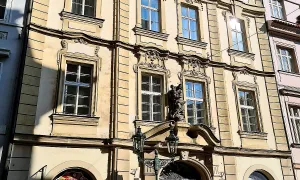
The facade facing the street was redesigned in a Cubist style. In the center stands a statue of Jan Hus by Ladislav Kofránek on a corbel. Around it runs an inscription of the Central Office of the Czechoslovak Hussite Church and it is complemented by reliefs. One depicts an open Bible with the letters alpha and omega, the other a Lamb. A decorative Cubist cornice separates the new floors from the original ones, and beneath it on the facade is the inscription Hus's House.
Between 1935 and 1936, a five-story Functionalist building was added in the courtyard. It was designed again by Bohumír Kozák.
The house continues to serve the church to this day. It is home to the Synodal Council of the Czechoslovak Hussite Church and its Central Church Office. There is also the Kalich publishing house with a bookstore and other evangelical institutions, including the Association of Evangelical Preachers, the Union of Evangelical Youth, and the editorial offices of the magazine Czech Brother. The house also includes a pension, and the Kalich theater operates in the courtyard building. Between 1950 and 1995, the present Evangelical Theological Faculty of Charles University also had its seat here.
Frequently asked questions
Can the monument be visited?
The building is in use (offices, a school, shops and the like). The interior is generally accessible only during operating hours and tours are not usually offered; we have not verified the details. You can see the exterior from the street.
Where is the monument?
Location: Praha 1, Hlavní město Praha. The map on this page shows the exact spot.
Why is the monument protected?
It is listed in the Central List of Cultural Monuments of the Czech Republic as a cultural monument (register no. 1000151878).
Businesses nearby
Do you run a restaurant, accommodation, shop, museum, rental, wellness or other visitor service near this monument? Show yourself directly to the people heading to it — this is how they will see you in the app and on the web:
Events nearby

Zdroj akcí: otevřená data měst a obcí ČR (Národní katalog otevřených dat) a kalendář akcí Národního památkového ústavu.
Nearby
The building is located in the heart of Prague's New Town, near the Old Town Square.
Accommodation nearby
Trips and activities nearby
Guided tours, tickets and activities nearby from GetYourGuide
Affiliate link: if you buy from the partner, we may receive a commission. The price for you does not change.
Search tours and activities →Themed route
The Husův dům in Prague 1 is a must-visit destination for history buffs and architecture enthusiasts. Here's a suggested 4-stop itinerary to explore the area:
1. Husův dům (Main Attraction) Experience the beauty of this Gothic Revival building, which served as the residence of Jan Hus, a Czech reformer, in the 15th century. Admire the stunning architecture and learn about the significance of this historic site.
2. Old Town Square (Nearby Landmark) Walk to the nearby Old Town Square, a vibrant hub of activity in the heart of Prague's New Town. Admire the stunning architecture, street performers, and lively atmosphere.
3. Astronomical Clock (Nearby Landmark) Visit the famous Astronomical Clock, a medieval astronomical clock that's one of the oldest in the world. Watch the animated figures and learn about the history behind this incredible timepiece.
4. Old Town Hall (Nearby Landmark) Explore the Old Town Hall, a beautiful Gothic building that houses the Astronomical Clock. Take a guided tour to learn about the history and significance of this iconic landmark.
Seasonal recommendations
Jaro In the spring season, Husův dům is surrounded by blooming trees and green nature, creating a pleasant atmosphere. The building's lighting is soft and natural, allowing visitors to appreciate its historical value. Since spring is a time when people often go out, it’s best to arrive at Husův dům early in the morning or late afternoon to avoid larger crowds.
Léto During the main summer season, Husův dům is a very popular destination for tourists and visitors of Prague. To avoid crowds, it's good to arrive at the building early in the morning or late in the afternoon. The lighting is stronger than in other times of the year, allowing visitors to see details of the historical architecture.
Podzim In autumn, Husův dům is surrounded by beautiful colorful leaves on trees, creating a pleasant atmosphere. The lighting is soft and natural, allowing visitors to appreciate its historical value. Since autumn is a time when people often go out, it’s best to arrive at Husův dům early in the morning or late afternoon to avoid larger crowds.
Zima In winter, Husův dům is covered with a quiet blanket of snow, creating a calm atmosphere. The lighting is soft and warm inside the building, allowing visitors to appreciate its historical value.
Visualizations and artistic views


The visualisations are generated by artificial intelligence and serve as inspiration.
Photos from the area
Real photos taken near the monument


Zdroj a licence jsou uvedeny u každého snímku.
Tips from visitors
No tips yet. Be the first!
Log in and add your tip.
Sources and literature
Photos: Michal Kmínek / CC BY-SA 3.0 — Wikimedia Commons. The author and licence also appear when you hover over the image.
Faktickým podkladem tohoto textu byl článek na Wikipedii, jehož autory jsou přispěvatelé Wikipedie. Článek je dostupný pod licencí CC BY-SA 4.0.
Location on the map
More monuments – Praha 1
Show all in the municipality

Příběhy a pověsti
Legendy, pověsti a příběhy spjaté s touto památkou
Fotografie návštěvníků
Zatím žádné fotografie. Buďte první, kdo přidá fotografii z návštěvy!
Log in a přidejte svou fotografii nebo hodnoťte.
Za ověřenou návštěvu v aplikaci získáte víc bodů — poznáme podle GPS, že jste na místě.
Reviews and comments