

inundační most přes Lužnici Inundation bridge
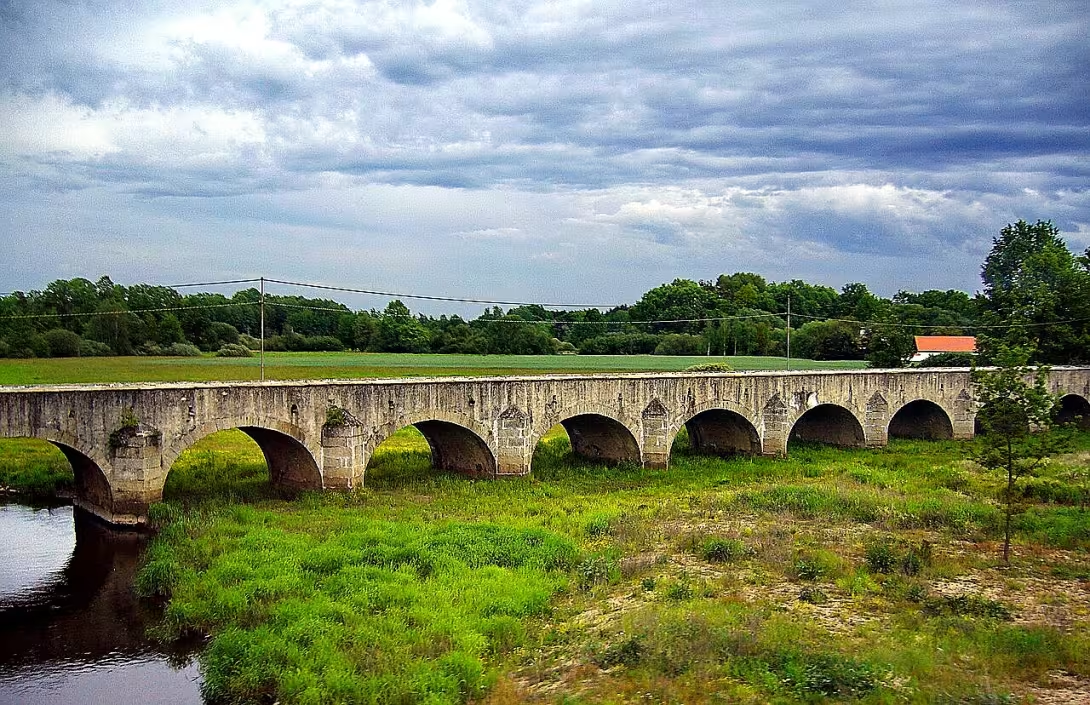
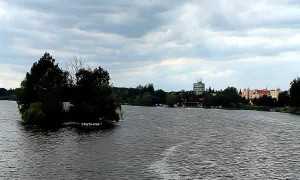
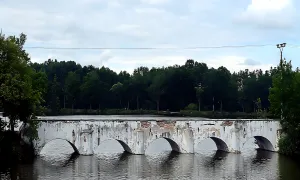
The Inundační Most přes Lužnici is a Baroque stone flood bridge in the Třeboň area, spanning the Lužnice river and its floodplains. Built in 1799 by Prince Jan Schwarzenberg, it replaced earlier wooden structures frequently destroyed by war and floods. The bridge features twelve semi-circular arches and rubble stone construction, measuring 119 meters long and 7 meters wide.
Wooden bridges were originally built here in 1594 and 1604, but French troops destroyed them in 1741 to obstruct the Habsburg army. Prince Schwarzenberg commissioned the current stone structure to provide a reliable crossing over the Lužnice. The bridge was designed by Josef Rosenauer, who also built the Schwarzenberg and Vchynicko-tetovský shipping canals.
As a significant cultural monument of the Czech Republic, the Inundační Most přes Lužnici was added to the Central List of Cultural Monuments in 1963. It served as a vital long-distance transport link until the late 20th century, when the rerouting of the I/34 road removed it from the main route.
Today, the protected monument remains open to visitors, who can appreciate its architectural beauty and the surrounding landscape. The bridge has also appeared in several Czech films, including Pan Vok odchází and Líbánky.
Ultimately, the Inundační Most přes Lužnici is a remarkable Baroque landmark that has played an important role in the region's history. Its unique architecture and historical significance make it a must-visit destination for anyone exploring the rich heritage of the Czech Republic.
Then and now
Drag the slider to compare how the landmark may have looked when it was built with the view today.
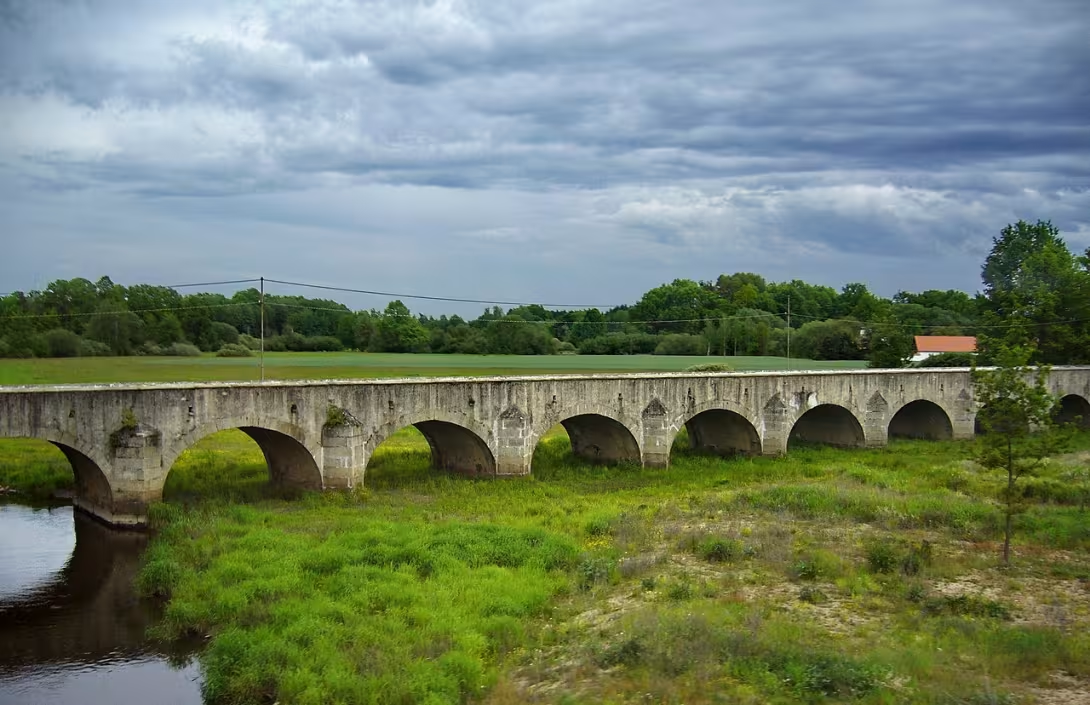
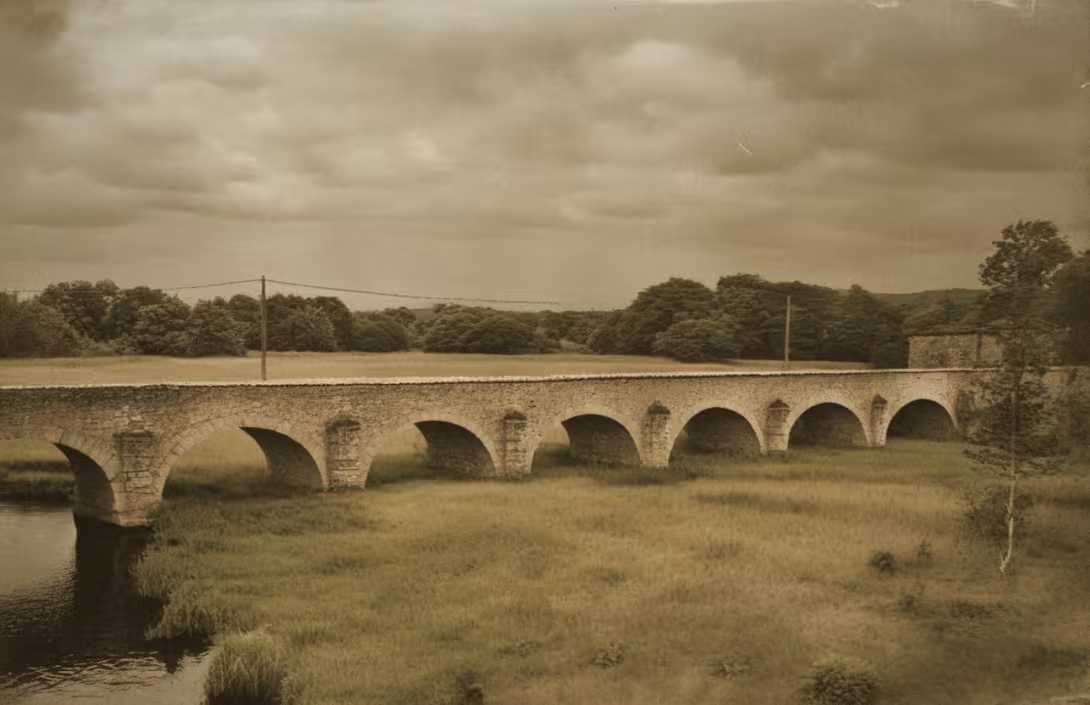
The historical appearance on the left is an AI-generated visualisation and serves as inspiration only.
Historical milestones
- 1594
- Jakub Krčín z Jelčan built a 902m wooden bridge to avoid detours caused by the flooding of the Rožmberk pond.
- 1741
- French troops destroyed the existing bridges to hinder the progress of the Habsburg army.
- 1799
- Prince Jan Schwarzenberg commissioned the construction of the current stone bridge.
- 1963
- The bridge was entered into the Central List of Cultural Monuments of the Czech Republic.
- 1988
- The bridge was removed from long-distance traffic after the I/34 road was rerouted.
Architectural development
The site originally featured wooden bridges built in 1594 and 1604. The current stone structure was completed in 1799 using rubble stone and ashlar blocks for the piers. It consists of twelve semi-circular arches with a total length of 119 meters and a width of 7 meters.
Historical events
In 1741, previous wooden bridges on this site were destroyed by French troops to obstruct the Habsburg army. In 1988, the bridge ceased to be part of the main long-distance route after the I/34 road was rerouted.
Owners
Commissioned by the Krumlov dukes, specifically Prince Jan Schwarzenberg in 1799.
Points of interest
– The Inundační Most přes Lužnici is a Baroque stone flood bridge built in 1799 by Prince Jan Schwarzenberg.
– The original wooden bridges were destroyed by French troops in 1741 to obstruct the Habsburg army, and the current stone structure was commissioned to provide a reliable crossing over the Lužnice.
– The bridge features twelve semi-circular arches and rubble stone construction, measuring 119 meters long and 7 meters wide.
– It served as a vital long-distance transport link until the late 20th century, when the rerouting of the I/34 road removed it from the main route.
– Today, the protected monument remains open to visitors, who can appreciate its architectural beauty and the surrounding landscape.
Guide
This guide is narrated by a synthetic voice generated by artificial intelligence.
Show guide text
This text was created by artificial intelligence and has not been editorially reviewed. It may contain inaccuracies.
Welcome. You are standing at a truly remarkable threshold, a place where the engineering of the past meets the shifting rhythms of the natural world. As you look out before you, take a moment to let your eyes wander across the landscape of Třeboň. You are witnessing the inundační most přes Lužnici, a structure that has stood as a silent witness to centuries of change, spanning the wide, breathing floodplains of the Lužnice river. Notice how the bridge stretches across the horizon, its form integrated into the very essence of this watery landscape. It is not merely a way to cross from one side to the other; it is a testament to human persistence in the face of an unpredictable environment.
To understand why this bridge looks the way it does, we must travel back much further than the stone you see today. Imagine this area hundreds of years ago, a landscape dominated by the management of water and the constant threat of its overflow. In 1594, a visionary named Jakub Krčín z Jelčan recognized a critical problem. The flooding of the Rožmberk pond often forced travelers into long, exhausting detours. To solve this, he commissioned a massive wooden bridge, stretching over nine hundred meters, designed to keep the routes open even when the waters rose. It was a feat of its time, a wooden lifeline for the region.
However, history is often as turbulent as the river itself. In 1741, the relative stability of these routes was shattered by the chaos of war. As French troops moved through the territory, they sought to disrupt the movement of the Habsburg army. To achieve this, they did what many armies have done throughout history: they destroyed the existing bridges. The wooden structures that had served the people for generations were lost to the flames and the currents, leaving the landscape fractured and the people isolated.
It was not until the end of the eighteenth century that the landscape regained its permanent connection. In 1799, Prince Jan Schwarzenberg decided that the era of fragile wooden crossings must come to an end. He envisioned something far more enduring, something capable of withstanding both the seasonal fury of the Lužnice and the uncertainties of human conflict. He commissioned the construction of the stone bridge that you are observing right now. This was a transition from the temporary to the eternal, a shift from wood that rots and burns to stone that endures.
As you turn your attention to the structure itself, please take a closer look at the architecture. This is a masterpiece of the Baroque era, designed by the architect Josef Rosenauer. Even without being an expert in architecture, you can feel the deliberate rhythm and strength of the design. Notice the twelve semi-circular arches that support the weight of the bridge. There is a beautiful, mathematical harmony in the way these arches repeat, creating a sense of stability and grace.
The bridge is built from rubble stone, a construction method that gives the structure its rugged, organic character. As you look at the texture of the stone, you can see how it seems to belong to the earth itself. This is not a polished, delicate monument meant for a palace garden; it is a functional, powerful piece of infrastructure designed to endure the elements. The way the stone is laid, the strength of the arches, and the sheer scale of the construction all speak to the ambition of the era. It was built to be a vital link for long-distance transport, a heavy-duty artery for the movement of goods and people that would remain essential for nearly two centuries.
The stories of the people behind this monument are as layered as the stone itself. Think of Jakub Krčín z Jelčan, the man who first understood the complex relationship between the water and the roads of this region. Think of the soldiers in 1741, whose actions left a scar on the landscape. And then, consider Prince Jan Schwarzenberg, a man of immense influence who saw the necessity of investing in the long-term stability of his lands. His decision to build in stone changed the geography of Třeboň forever.
There is a certain quiet dignity in the bridge today, a quality that comes from its transition from a busy highway to a protected monument. For a long time, this was a place of noise, of heavy wagons and eventually motor vehicles, serving as a crucial part of the I/34 road. But in 1988, everything changed. The main traffic was rerouted, and the bridge was relieved of its heavy burden. It was no longer a frantic corridor of commerce, but something more precious. It became a place of reflection. This shift allowed the bridge to be appreciated for its historical and architectural value rather than just its utility. This importance was officially recognized in 1963, when it was entered into the Central List of Cultural Monuments of the Czech Republic.
As you stand here, perhaps you can sense the mystery of the river. The Lužnice is a living entity, and this bridge is its partner. The very name, the inundační most přes Lužnici, reminds us that this structure was built with the flood in mind. It was designed to let the water pass, to coexist with the floods rather than fight them. It is a lesson in resilience—knowing when to stand firm and how to let the currents flow through.
As you continue your journey through Třeboň, I invite you to keep this sense of history with you. Whether you are walking across the stone arches or simply observing them from the bank, remember that you are standing on a piece of history that has survived wars, floods, and the passage of centuries. Take your time, breathe in the air of the floodplains, and enjoy the peaceful atmosphere that this magnificent structure helps to create. Thank you for joining me, and please, enjoy the rest of your exploration.
Tips for visitors
Best time to visit the flood bridge is during spring and autumn when the weather is mild and sunny, making it ideal for photography. The surrounding landscape of Třeboň and the Rožmberk pond creates a picturesque setting that's perfect for capturing stunning images.
You can also take public transportation to get there; simply check your favorite ride-sharing app or website for the latest schedules.
When visiting the flood bridge, be sure to bring comfortable walking shoes, as you'll want to explore the surrounding area. Don't forget your camera and a pair of binoculars to get up close and personal with the Lužnice river's wildlife.
The best spots for photography are near the bridge's arches, where you can capture the stunning views of the Rožmberk pond and the surrounding landscape. The golden hour just before sunset is especially magical, so try to time your visit accordingly.
If you're looking for something to do nearby, head to the Lužnice river or the Rožmberk pond within 30 minutes. You can take a leisurely walk, have a picnic, or simply enjoy the serene atmosphere.
Frequently asked questions
Can the monument be visited?
This is a structure in a public space that can usually be seen from outside free of charge. We have not verified that this particular one is freely accessible.
Where is the monument?
Location: Třeboň. The map on this page shows the exact spot.
Why is the monument protected?
It is listed in the Central List of Cultural Monuments of the Czech Republic as a cultural monument (register no. 1000146505).
Businesses nearby
Do you run a restaurant, accommodation, shop, museum, rental, wellness or other visitor service near this monument? Show yourself directly to the people heading to it — this is how they will see you in the app and on the web:
Events nearby





Zdroj akcí: otevřená data měst a obcí ČR (Národní katalog otevřených dat) a kalendář akcí Národního památkového ústavu.
Nearby
🏰 Historic sites (49)
- historický kamenný most 0.8 km
- Jakub Krčín 2.7 km
- Ema Destinová 3.0 km
- Josef Bašta 3.5 km
- Rybářské muzeum 4.0 km 723 942 096 web
- svatý Jan Nepomucký 4.7 km
- klášter Augustiniánů 4.8 km
- Třeboň v marcipánu 4.9 km Masarykovo náměstí 103 +420601133025 web
- Třeboň 105 4.9 km Masarykovo nám. 105
- morový sloup 4.9 km
- Zámecká lékárna 4.9 km Březanova 118 web
- Socha Sv.Jana Nepomuckého 5.0 km
- svatý Jan Nepomucký 5.0 km
- Jakub Krčín z Jelčan 5.1 km
- Josef Šusta 5.1 km
- Památce vojínům 1914-1918 5.1 km
- Skanzen Ludmila 5.2 km
- Na památky zlaté svatby knížete Adolfa Josefa a Idy ze Schwanzenbergu 5.3 km
- Čertova šlápota 5.3 km
- Fuglhaus 7.1 km
🍽️ Restaurants and dining (123)
- Rožmberská hospůdka 0.2 km +420 384 391 029 web
- Hospoda u Pytláka 0.2 km +420 721 667 904
- Pergola u Sv. Víta 3.1 km
- U Milánků 3.4 km +420607837682
- Stop Cafe 3.4 km web
- Motel Petra Voka 3.4 km
- U Emy Destinové 3.5 km
- Pod kopečkem 3.7 km
- Koliba 3.8 km
- Restaurace U Vodníka 4.4 km
- Kopretina 4.5 km +420 725135889 web
- Top Spin 4.5 km
- Vietnamská restaurace Symfonie 4.6 km K Bertě 195
- Hospoda Stříbřec 4.6 km +420 777 500 006
- Adéla 4.7 km
- U Kapra 4.8 km
- U Míšků 4.8 km Husova 11 +420384721698 web
- U Čerta 4.8 km
- Cafe Pokrok 4.8 km Masarykovo náměstí 22
- Steak & Café 4.8 km
🏨 Accommodation (89)
- Penzion Cyklista 3.5 km Vodarenska 543
- Renata 3.5 km
- U Čápa 3.6 km
- Na Hradečku 3.8 km
- Kemp Mláka 3.9 km
- Na Seníku 4.3 km
- Design Hotel Romantick 4.5 km
- Wellness Hotel Harmonie 4.6 km K Bertě 195 web
- U Bumanu 4.7 km
- U Kubalů 4.8 km Husova 13 +420 736 76 76 13 web
- U Míšků 4.8 km Husova 11 +420384721698 web
- Bílý koníček 4.8 km
- Pelikan 4.8 km
- Myslivna 4.8 km +420 384 721 833 web
- Galerie 4.9 km +420 384 385 293 web
- U Františka 4.9 km Rožmberská 36
- Zlatá Hvězda 4.9 km Masarykovo náměstí 107 +420384757111 web
- Rožmberská bašta 4.9 km web
- Vratislavský dům 4.9 km web
- Vila Jasmína 4.9 km Jablonského 571 +420 725 837602 web
🚲 Rentals and sport (7)
- Electropower 4.8 km
- Fitness Reprezentant 4.8 km
- MEPO 4.9 km
- Veloservis Kocanda 5.4 km
- Ostende 6.3 km
- COP Slověnický mlýn 10.9 km
- Sportcentrum Mrkáček 14.0 km
🥾 Hiking and nature (50)
- bývalá vojenská střelnice 3.1 km
- Kotěrova vodárenská věž 3.4 km
- Třeboňské seníky 4.1 km
- bývalá bobrovna 4.2 km
- Komenského sady 4.9 km
- Pivovar Regent 5.0 km
- Zámecký park 5.1 km
- písečný přesyp 5.3 km
- Lázeňský park 6.1 km
- Kamenný vrch 7.4 km
- Čoudkův vrch 8.2 km
- Letecke muzeum Libořezy 8.7 km
- Dunajovická Hora 8.9 km
- Čapí vrch 9.2 km
- psí hřbitov 9.3 km
- Milenec 9.6 km
- V Rájích 9.7 km
- vyhlídková věž Lomnice 9.8 km
- Památné stromy 9.9 km
- Hanzlův kopec 11.4 km
Accommodation nearby
Trips and activities nearby
Guided tours, tickets and activities nearby from GetYourGuide
Affiliate link: if you buy from the partner, we may receive a commission. The price for you does not change.
Search tours and activities →Themed route
Třeboň Heritage Trail
The main attraction of this trail is the Inundační Most (Floodgate Bridge) spanning the Lužnice River in Třeboň. This historic bridge is a must-see, offering stunning views of the surrounding landscape.
Stop 1: Rožmberk Pond Type: Nature Reserve Why visit: As one of the largest fishponds in Central Europe, this picturesque pond is home to diverse aquatic life and offers serene surroundings for a relaxing stroll. (Approximate distance from Inundační Most: 0.5 km)
Stop 2: Lužnice River Type: Scenic Viewpoint Why visit: Take in the breathtaking views of the river, which flows gently through the picturesque landscape. You can also spot local wildlife and enjoy a peaceful moment by the water's edge. (Approximate distance from Rožmberk Pond: 1 km)
Stop 3: Inundační Most Type: Historic Landmark Why visit: This iconic bridge is an engineering marvel, offering unique insights into the region's history and architecture. Be sure to take in the panoramic views of the surrounding countryside from its elevated vantage point.
Seasonal recommendations
Spring
As you visit the historic inundation bridge over Lužnice (most) in Třeboň during spring, you'll be greeted by the gentle warmth of the sun and the vibrant colors of nature awakening from its winter slumber. The atmosphere is filled with the sweet scent of blooming flowers and the soft chirping of birds.
Practical tips: Be prepared for moderate crowds, and dress comfortably in layers as the weather can be unpredictable. Consider visiting early in the morning or late in the afternoon to avoid the peak tourist hours.
Summer
During the summer months, the inundation bridge over Lužnice (most) in Třeboň takes on a lively atmosphere, with warm sunshine and lush greenery surrounding you. The air is filled with the sound of laughter and chatter as families and friends enjoy picnics and outdoor activities.
Practical tips: Plan your visit early in the day to beat the crowds, and don't forget to pack sunscreen, hats, and comfortable shoes for a fun-filled day out.
Autumn
As autumn arrives, the inundation bridge over Lužnice (most) in Třeboň transforms into a picturesque scene, with golden leaves rustling in the gentle breeze. The atmosphere is cozy and inviting, with the scent of ripe fruit and woodsmoke filling the air.
Practical tips: Take advantage of the milder weather and visit during the week to avoid crowds. Dress warmly, as the evenings can get chilly, and don't forget your camera to capture the stunning autumn foliage.
Winter
During the winter months, the inundation bridge over Lužnice (most) in Třeboň takes on a serene quality, with snowflakes gently falling onto the frozen landscape. The air is crisp and cold, but the atmosphere is peaceful and tranquil.
Practical tips: Wrap up warmly and consider visiting during the week to avoid crowds.
Visualizations and artistic views


The visualisations are generated by artificial intelligence and serve as inspiration.
Photos from the area
Real photos taken near the monument


Zdroj a licence jsou uvedeny u každého snímku.
Tips from visitors
No tips yet. Be the first!
Log in and add your tip.
Sources and literature
Photos: Tanya Dedyukhina / CC BY 3.0 — Wikimedia Commons. The author and licence also appear when you hover over the image.
Faktickým podkladem tohoto textu byl článek na Wikipedii, jehož autory jsou přispěvatelé Wikipedie. Článek je dostupný pod licencí CC BY-SA 4.0.
Location on the map
Příběhy a pověsti
Legendy, pověsti a příběhy spjaté s touto památkou

Fotografie návštěvníků
Přidat fotografiiZatím žádné fotografie. Buďte první, kdo přidá fotografii z návštěvy!
Máte k místu vzpomínku nebo zajímavý příběh?
Log in a přidejte svou fotografii nebo hodnoťte.
Za ověřenou návštěvu v aplikaci získáte víc bodů — poznáme podle GPS, že jste na místě.
Reviews and comments