






Jaroslavický mlýn Water mill
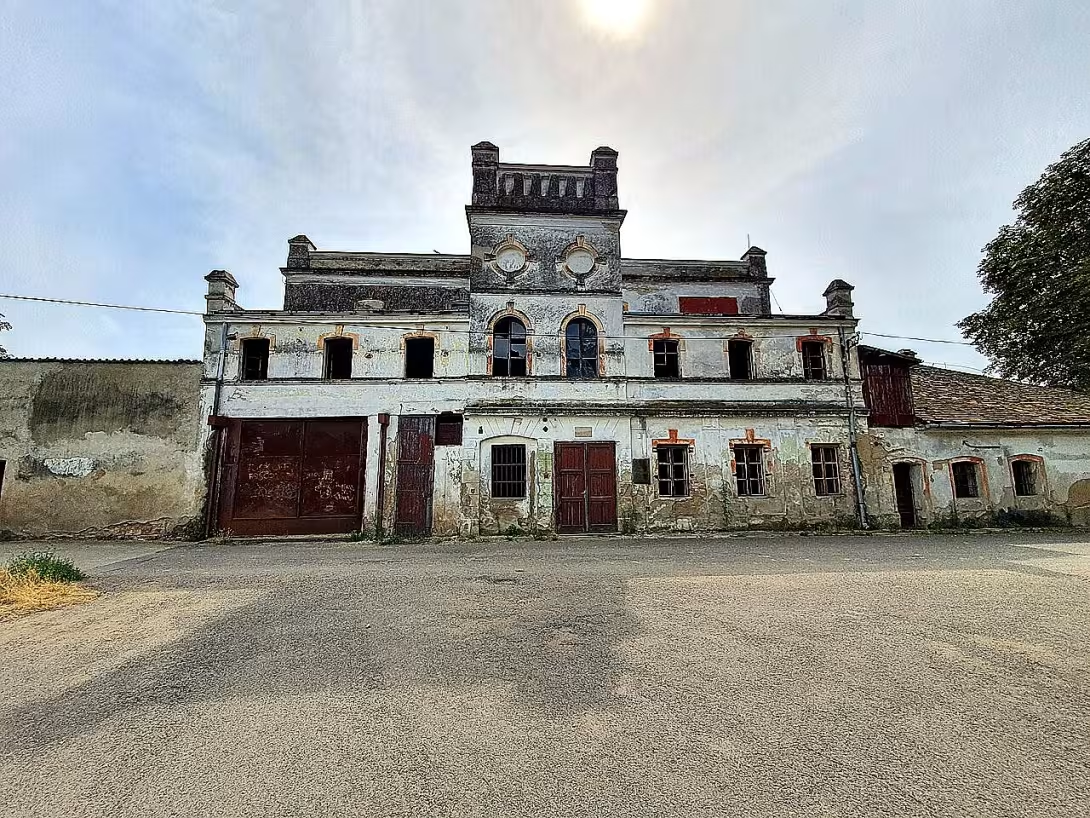
Jaroslavický mlýn, water mill in the village Jaroslavice in the district of Znojmo, lies on the river Dyji northeast of the local castle. The building in its current form dates from the end of the 17th century and is protected as a real cultural monument of the Czech Republic.
It is assumed that in this location the mill was already built in the 14th century when the Dysko-mill drive was built. The original building probably disappeared after the first quarter of the 16th century, where a brewery was subsequently set up. The current building was created in the late 17th century during the Baroque period, which was characterized by the development of industry and agriculture in the Czech Republic.
The monument protection consists of a set of buildings including a new and old water mill, a former steam boiler room, a granary and a wall with two pillars.
Water designed to drive the water wheel and later turbines led a long drive from the pond through the floodgates, while the drain channel brought it back to the Dyje River. Before the mill itself, the drive was divided into two arms on which turbines were installed until 1972. In 1930 the mill had two Francis turbines with a capacity of 3.5 m ³ / s, a drop of 4 meters and a total output of 120 HP, to which the dynamo was connected.
In 1930 the mill belonged to the heirs of Jan Graf. Subsequently, there was a technical change in 1993 when turbines were replaced by a new unit of 860 mm in diameter, with a capacity of 90 kW.
Currently, the object is completely stripped of its original technology. The only preserved functional element is electricity generation.
Jaroslavický mlýn represents an important technical unit with a long history of water use in the region. It is advisable to visit it during a tour of the historical premises in Jaroslavice.
Historical milestones
- 14th Century
- Construction of Dysko-Mill drive and probable formation of mill
- Around 1525
- The destruction of the original building and establishment of the brewery
- End of the 17th century
- Building the current building of the mill during the Baroque period
- 1930
- Owning the heirs of Jan Graf and operation of Francis turbines
- 1972
- Removal of turbines from drive arms
- 1993
- Replacement of turbines with new unit MPV Turbeko
Architectural development
The mill was originally equipped with a water wheel and later a turbine which led the water from the pond through the floodgates. In 1930, the mill had two Francis turbines and a dynamo. Until 1972, there were turbines on both arms, which were replaced in 1993 by a new turbeko MPV turbine with a capacity of 90 kW.
Historical events
- 14th Century
- The likely position of the mill.
- 16. century, first quarter
- The demise of the original mill and the creation of the brewery in its place.
- End of the 17th century
- The position of the new mill.
Owners
In 1930 he belonged to the heirs of John Graf.
Points of interest
- The current form of the building dates back to the end of the 17th century and is protected as a real cultural monument. - It is assumed that the mill in this location was already in the 14th century, while the original building probably disappeared after the first quarter of the 16th century and was replaced by a brewery. - The monument protection is made by a new and old water mill, a former steam boiler room, a granary and a wall with two pillars. - In 1930 the mill had two Francis turbines with a total output of 120 HP and attached dynamism. - At present, electricity generation is the only preserved functional element.
Guide
Show guide text
This text was created by artificial intelligence and has not been editorially reviewed. It may contain inaccuracies.
Welcome to Jaroslavice. Stop for a moment, take a breath and feel the surroundings. Right now, you're standing in front of a place where for centuries the power of water mingles with human labor and ingenuities. In front of you is Jaroslavický mlýn, a fascinating testimony about economic life in this part of South Moravia. Look at the total complex of buildings that are now surrounding you. Do you perceive the calm that accompanies the flow of the Dyje River? It is this river that was and is the heart of the whole complex, because without its tireless stream the mill could never exist. This building is not just a ordinary building, but a protected real estate cultural monument of the Czech Republic, which means that in every stone and every detail of it the history of our ancestors is written.
Let us now return together in time, far deeper than our eyes allow. To understand the importance of this place, we have to move to the 14th century. Imagine the landscape back then, in the Middle Ages. It was during this period that the so-called Dysko-Mill Drive was built, which is essentially an artificial water bed that was designed to bring the power of the river directly to the mill wheel. It is believed that the first mill was created here at this time. It was the cornerstone of the local economy, a place where cereals turned into flour and people from surrounding villages met. It was a space full of noise, dust and constant movement.
History, however, is not a straight line, but rather a river with many meanders. Around the year a thousand and five hundred twenty made a fundamental change. The original medieval building probably died and a brewery was set up in its place. Try to imagine this transformation. Instead of grinding the grain, beer started to boil here, which required different equipment, but still the same source of energy - water from Dyje. Brewing was a symbol of prosperity and prosperity at the time. This chapter in history is over, but it has prepared the ground for what you see today.
Now pay attention to the buildings themselves before you. What you are seeing today is the result of extensive construction from the late seventeenth century. During the Baroque period, the current building of the mill was built. Notice how dominant it is in the landscape. Look at the facade and feel the atmosphere of this complex. Monumental protection not only protects one building, but the whole set of elements. Look around and look for new and old water mill. It's two parts that together form the core of the operation.
In addition to the mills themselves there are other important parts. Notice the boundary wall that borders the space. Wear its two characteristic pillars, which served as entry points and gave the whole area a representative look. Also look for a granary, a building designed for long-term storage of grain, which was absolutely necessary for every miller. And if you look closely, you'll see the former steam boiler room. It's a very interesting detail because it tells us about the technological transition. While the water remained the main, at some stage the miller began to rely on steam power to ensure production stability even when the river Dyje had a lower flow rate.
When you're standing in front of a mill like this, you might be interested in who worked here in the last decades. Let's move on to the year one thousand nineteen thirty. At that time the mill was owned by the heirs of Jan Graf. It was an era of modernization. It was during this period that the so-called Francis turbines were operated in the mill. Francis's turbine was the cutting edge of technology at the time, allowing for a much more efficient conversion of energy flowing water into mechanical work than old mill wheels. Imagine the sound of rotating turbines and the rhythm of work that filled these walls in the year one thousand nineteen thirty.
Here we come to the part that can act as a technological mystery. In the year one thousand nine hundred seventy-two there was a fundamental change when turbines were removed from the shoulders of the drive. So the mill lost its original dynamics for a time. But the life of this place didn't stop. A few decades later, in the year one thousand nine hundred ninety-three, there was another revival. The turbines were replaced by a new unit, specifically a device of type MPV Turbeko. It is fascinating to realize that one and the same location, where the water was flowing in the fourteenth century for grinding grain, was able to adapt to the technology of the late twentieth century.
Think about how many generations have passed here. From medieval craftsmen to Baroque builders to modern techniques. Jaroslavický mlýn is not just a pile of stone and wood, it is a living organism that has survived centuries, changes in regimes and technological revolution. The fact that he stands before you today as a cultural monument is proof of his value to all of us.
Now I encourage you to look around in peace. Go through the perimeter of the wall, look at the granary, and try to imagine what was going on here. Feel the contrast between the peace of the river Dyje and the industrial history of this place. You may notice how the water in the drive still moves quietly, as if it were whispering stories about mills, breweries and turbines that used to work here.
That concludes our short journey through the history of the Jaroslavic Mill. I hope you've found time to feel the spirit of this place and appreciate its architectural and technical value. It's a place where nature meets human work in complete harmony. You are now being left to explore the surroundings. I wish you a pleasant rest of the day and an inspirational continuation of your journey along the beautiful corners of our landscape. Goodbye.
Tips for visitors
The best time to visit is spring and autumn months, when the landscape around the Dyje River is the most colorful and the current of the water at the mill works most naturally.
Pack comfortable shoes suitable for your journey in the field by the river and plenty of drinking water. Due to the position near the water stream, it is advisable to bring an insect repellent.
For the best photos, look for a golden hour before sunset, which will highlight beautifully the texture of the old mill and steam boiler room. The ideal angle is a view from the bank of the river Dyje, which captures the whole architecture of the complex.
Families with children will appreciate the opportunity to observe the water mill mechanism and explore the differences between the old and the new part of the construction, which is an educational experience that children will familiarise with the history of technology.
Frequently asked questions
Can the monument be visited?
This is a technical monument. Some are open as exhibitions, others are out of use or on private land. We have not verified whether this one is accessible.
What are the opening hours and admission?
We have not verified the opening hours or admission. Current information is published by the operator.
Where is the monument?
Location: Jaroslavice, Jihomoravský kraj. The map on this page shows the exact spot.
Why is the monument protected?
It is listed in the Central List of Cultural Monuments of the Czech Republic as a cultural monument (register no. 1000026018).
Businesses nearby
Do you run a restaurant, accommodation, shop, museum, rental, wellness or other visitor service near this monument? Show yourself directly to the people heading to it — this is how they will see you in the app and on the web:
Nearby
🏰 Historic sites (74)
- pran 0.3 km web
- Panna Maria 0.4 km
- sv Antonín Paduan 2.4 km
- Parting of the Virgin Mary with Jesus 2.6 km
- sv Jan Nepomucký 2.7 km
- Gedenkstätte der Gemeinde Joslowitz 2.7 km
- victims of World War I 2.7 km
- Weinpresse 3.3 km
- Saint Sebastian 3.4 km
- Statue of Jan Nepomuk 3.7 km
- Water mill in Slupi 3.7 km web
- Weinpresse 4.9 km
- sv Jan Nepomucký 5.0 km
- Immaculate conception of the Virgin Marie 5.0 km
- Memorial Liberation of the Red Army 5.1 km
- sv. 5.1 km
- sv Florian 5.1 km
- Castle Dyjakovice 5.1 km
- sv Josef 5.1 km
- Panna Maria 5.1 km
🍽️ Restaurants and dining (83)
- Hostinec 2.4 km
- Castle 3.0 km
- Restaurant Hrade 3.0 km
- Heda 4.8 km
- Guesthouse Dyje 4.8 km
- Hospodka U Markéty 4.9 km
- Radler Rast 5.4 km
- Seefelderhof 6.6 km
- Gasthaus Bsteh 6.6 km + 43 2527 203 web
- Heda 7.1 km
- Siestahittn 8.9 km web
- Herbert, Bernd und Fredi's Hütte 9.7 km
- Pizzeria Anna 9.8 km Krhovic 81 + 526 420 774 562 web
- Waldgasthaus Lindenhof 10.2 km + 43 2522 20697 web
- Winzerhof Hörmann 10.4 km + 43 2943 2272
- Weindomizil Hagn 10.4 km + 43 2943 2256 web
- Pulkautaler 10.5 km web
- Schlosswirtshaus Mailberg 10.7 km + 43 660 7613493 web
- Landgasthaus Holzer 10.7 km + 43 2526 7234 web
- Retro guesthouse Funhouse 10.9 km
🏨 Accommodation (32)
- Guesthouse Subtitle 0.5 km + 420 739 088 927 web
- Táboríštáště Hrade 2.6 km web
- U Claw 5.2 km
- JUFA Weinviertel 6.8 km + 4357083730 web
- Tábor Krhovice 7.5 km web
- Pension Deer farm Ječmeniztě 7.8 km web
- Wohnmobilstellplatz Haden 9.0 km Kellertrift + 43 2943 23 03 web
- Guesthouse For three lip 10.3 km + 420 604 872 264 web
- Gästezimmer Puhwein 10.4 km
- Winery Viktorín s.r.o. 10.5 km web
- Hotel Zetocha 10.7 km + 420 515 274 233 web
- Schlosshotel Mailberg 10.7 km + 43 2943 30301 web
- Táboríště Hevlin 10.7 km web
- Hotel la Port 11.1 km Dysaks 198 + 420 777 111 101 web
- Frühstückspension Seidl 11.3 km
- Weingut Rain 11.5 km + 43 2944 26622 web
- Sportcentrum Shanov 12.0 km + 420 602 508 548 web
- Therme Laa - Hotel & Spa 12.2 km Thermenplatz 3 web
- Schliesselberger 12.3 km Johannes Brahms-Gasse 3
- Wunderland 12.3 km Staatsbahnstraße 57
🚲 Rentals and sport (10)
- Hodonice 8.7 km web
- Relax centrum 9.1 km
- Sportclub Laa 10.9 km web
- Mörth Sports 11.0 km Thayapark 29
- Tom's Radhaus 11.7 km Nordbahnstraße 19c
- Sportcentrum Shanov 12.0 km
- Adidas 12.8 km
- Regatta Great Outdoors 12.8 km
- BHF Laa an der Thaya 12.9 km
- Hirschenbergstation 13.7 km
🥾 Hiking and nature (46)
- Saliterweide Zwingendorf 5.7 km
- PP Crow top 8.0 km
- auf der Ebm 8.3 km
- PP Hevlín Lake 8.7 km
- Karlov 8.8 km
- Count Studanika 9.0 km
- Kellergasse Haden 9.3 km Kellertrift
- Schlüsselerlebnis Mailberg 10.3 km
- Willis Lieblingsplatz 10.3 km
- View Heidbergwarte 10.3 km
- Kellergasse Zipf 10.4 km Oberer Zipf web
- PP Tasovice slopes 10.6 km
- Kellergasse Rosenpoint 10.6 km Rosenpoint web
- PP Tasovice slopes 10.8 km
- Sport-Park-Diepolz 10.9 km
- PP Tasovice slopes 11.0 km
- Diepolz Park 11.0 km
- Buchberg 11.4 km
- Neustiftpark 11.6 km
- Compact of St. Urbanovi 11.7 km
Accommodation nearby
Themed route
Thematic cruise route - Jaroslavický mlýn and surroundings
1. Jaroslavický mlýn (Water Mill) * Why is it worth a visit: * This historic water mill is a unique example of a traditional industry that was an important part of the local economy. Visit and see how the past has benefited from hydropower.
2. Church of St. Wenceslas (Church) * Why is it worth visiting: * This church is not only the sacral centre of the village, but also an architectural pearl with a rich history. Its interior and artistic decoration attract many visitors.
3. Municipal Office (historical object) * Why is it worth a visit: * Imagine how the affairs of the village were previously governed in this historic building. It's a great example of local administration and architecture.
4. Public transport stop (house) * Why is it worth a visit: * This house is not only a modern stop for buses, but also a place where you can enjoy a beautiful view of the village and its surroundings.
5. Local market (historical site) * Why is it worth a visit: * Visit this traditional local market where food and goods were previously sold. Today, it's a place to meet residents and tourists.
This route will guide you through the historical and cultural center of Jaroslavic, each point offering a unique perspective on the past and the present of this picturesque village.
Seasonal recommendations
In spring the mill surrounds the awakening nature and the increased flow of water in the stream creates a dynamic atmosphere. It is an ideal time to observe the first flowers and fresh greenery around the building. We recommend moisture-resistant shoes because the roads can be muddy after melting snow. The best place to visit is in the morning when the air is the cleanest.
The summer season brings bright light and rich colors of the landscape, while the cool shade at the water offers a pleasant escape from the heat. Expect more visitors because of the season, so come first thing in the morning to avoid the biggest clusters. Choose light, breathable clothes and don't forget the sun protection.
In autumn, the surroundings of the mill turn into gold and red tones, while morning fog gives the memory a mysterious and nostalgic touch. For photography we recommend late afternoon, when the light is softest and the color most intense. Due to the changing weather, reach for layered clothes and waterproof jackets.
In winter, the construction works calmly and soberly, especially if it is covered by a layer of snow and the frost makes the landscape fragile. The atmosphere is quiet and meditative, which allows you to perceive architecture without disturbing elements. Don't forget the warm thermal linens and quality winter shoes.
Visualizations and artistic views


The visualisations are generated by artificial intelligence and serve as inspiration.
Photos from the area
Real photos taken near the monument

Zdroj a licence jsou uvedeny u každého snímku.
Tips from visitors
No tips yet. Be the first!
Log in and add your tip.
Sources and literature
Photos: Dusivka / CC BY-SA 4.0 — Wikimedia Commons. The author and licence also appear when you hover over the image.
Faktickým podkladem tohoto textu byl článek na Wikipedii, jehož autory jsou přispěvatelé Wikipedie. Článek je dostupný pod licencí CC BY-SA 4.0.
Location on the map

Příběhy a pověsti
Legendy, pověsti a příběhy spjaté s touto památkou

Fotografie návštěvníků
Zatím žádné fotografie. Buďte první, kdo přidá fotografii z návštěvy!
Log in a přidejte svou fotografii nebo hodnoťte.
Za ověřenou návštěvu v aplikaci získáte víc bodů — poznáme podle GPS, že jste na místě.
Reviews and comments