



Jezuitský dvůr Fortress
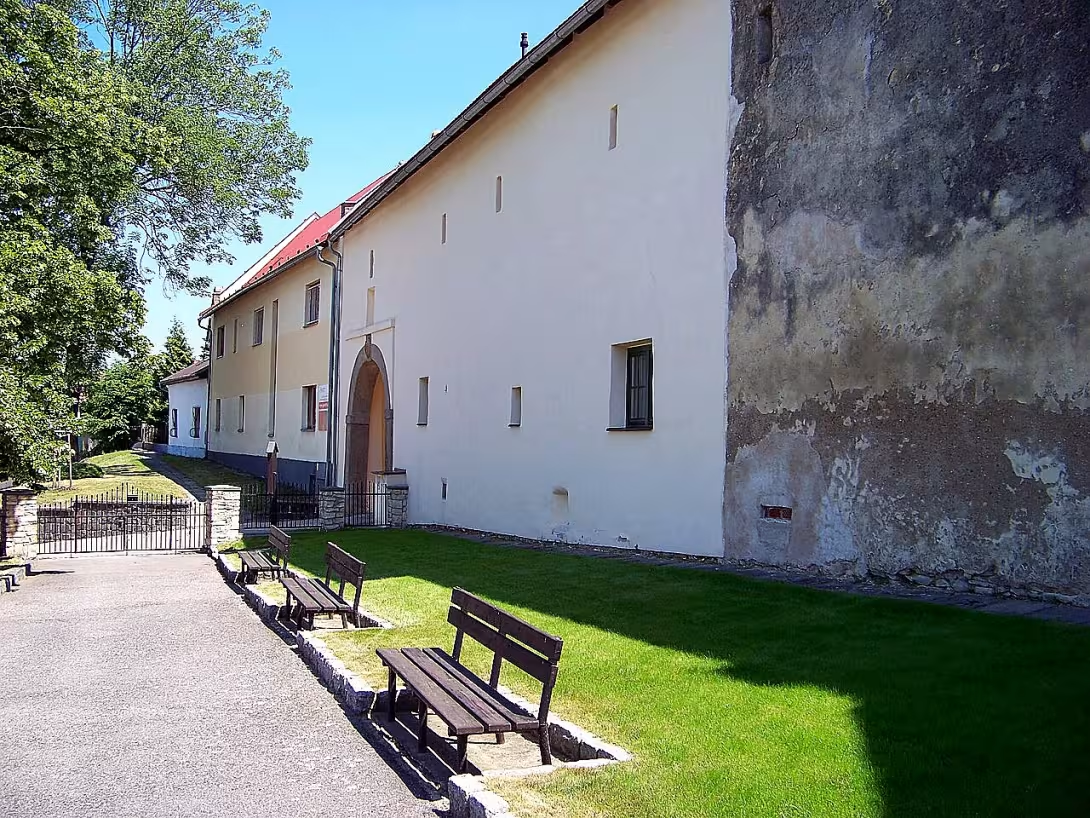
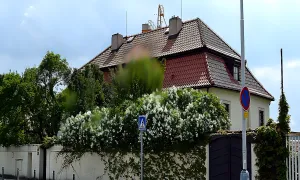
Jezuitský dvůr in the Front Kopanina is a former Jesuit complex created by the reconstruction of an older medieval fortress. Located in Prague 6 near the rotunda of Saint Mary Magdalene. His history is marked by changes in property conditions from the Middle Ages to the Jesuit period of influence. The object serves as an important witness to the changes in land use in this location.
Ves Kopanina first appeared in the historical papers in 1285. From 1363 to 1372 Jan ze Smilovic a Kopaniny was based here and in 1393 it was the owner of Záviš z Kopaniny. Then the court went into the hands of Prague townspeople.
From the original medieval fortress, a belt of buildings with numbers described 1 and 30 has been preserved today. These structures form the central core of the building and include a vaulted entrance to the yard and a vaulted cellar. At a later stage of conversion to the Jesuit court, the fort itself was not restored, as the Jesuits concentrated on the restoration of the sailing yard.
The first documented mention of the fort dates back to 1408, when Jindřich z Ziegelheimu sold it to Albrecht Chotka. In 1416, the object bequeathed Peter and Catherine, the children of his late brother Bernard. Later Albrecht's wife Klara and Jan of Kopanina bought together the villages from the orphans of Peter and Catherine Chotková and held it until 1454. In 1543 the court was already desolate and belonged to the monastery of St. Catherine. After the sale of the monastery to the official desk of the land Isaiah Velík from Šonov in 1566 followed confiscation. The sovereign then donated the grounds to the Jesuits at St. Kliment's in 1573.
The interesting thing is that during the reconstruction, the original fortress was not restored, which affected today's construction. The history of the place reflects the complex structure of ownership, when the court was in the possession of St. Catherine's monastery during the wasteland.
Today, this historical entity is an important element in the vicinity of Saint Mary Magdalene's rotunda. It is a suitable goal for interested people in the history of rebuilding medieval buildings and transforming land use in Prague 6.
Historical milestones
- 1285
- Ves Kopanina first listed in the papers.
- 1408
- Court sold to Albrecht Chotka.
- 1566
- Court sold to Isaiah Velík from Shonov.
- 1573
- A court donated to the Jesuits at St. Kliment's.
Architectural development
The original fort was converted into a Jesuit court where the fortress itself was not restored. Parts of the buildings with arched entrance and basement were preserved from the original building.
Historical events
- 1285
- Ves Kopanina first recorded in the papers.
- 1408
- Court and fort sold to Albrecht Chotka.
- 1566
- Court sold to Isaiah Velík from Shonov.
- 1573
- A court donated to the Jesuits at St. Kliment's.
Owners
Ves Kopanina was first listed in 1285. In 1363- 1372 it was held by Jan ze Smilovic a Kopaniny, followed by Záviš z Kopaniny (1393). In 1408, Jindřich z Ziegelheimu sold the court to Albrecht Chotka. After the death of Bernard, the village of Albrecht's wife Clara and Jan of Kopanina bought from the orphans Peter and Catherine Chotková (until 1454). In 1543 the court was owned by the monastery of St. Catherine, then the Prior sold it to Isaiah Velík of Shonov (1566), who lost it to confiscation. In 1573, the monarch gave the court to the Jesuits at St. Kliment's.
Points of interest
The building was created by rebuilding an older medieval fortress. - Located in Prague 6 near the rotunda of Saint Mary Magdalene. - From the original medieval fortress today, the belt of buildings with numbers described 1 and 30 were preserved. - These buildings include arched entrance to the courtyard and arched cellars. - The original fort was not restored when it was converted into the Jesuit court, as the Jesuits focused on restoring the sailing yard.
Guide
Show guide text
This text was created by artificial intelligence and has not been editorially reviewed. It may contain inaccuracies.
Welcome to the Front Kopanina. Stop for a moment, take a breath and feel the atmosphere of this quiet corner of Prague. You're standing in front of an object that carries layers of centuries of history. In front of you is Jezuitský dvůr, a place that may appear at first glance, but if you look closely, you will begin to read the story of power, faith and time changes. Notice the buildings that form the boundary of this space. This is where the medieval past meets the modern-world influence of religious order. It is a place where the fate of the surrounding lands was once decided and the interests of noble generations and spiritual authorities met.
Now let's go back in time together to understand how this place came to be. The history of Kopanina dates back to the 1930s. The first written mention of this village dates back to 1285, which tells us that people lived and spent here even when early Czech statehood was formed. But what you see today as a court, in the original sense, was not just an economic centre. It was created by the reconstruction of a much older medieval fortress. So imagine that there was once a fortified building in this place, which was intended primarily to defend and as a symbol of the local lord's power. The fortress was at that time the cornerstone of landscape management and its existence here shows the strategic importance of this place.
Now pay attention to what you see right in front of you. Although the court has changed significantly over the years, you can still find traces of the original fort. Focus your view on a belt of buildings with numbers of one and thirty. It is these structures that are the most valuable witnesses of the past that have lived to our days. Notice the arched entrance to the yard. This element is not just an architectural detail, but a gateway to another world. The entrance vault tells us about the craftsmanship of builders and that the object should be representative and functional. In addition, there are cellars beneath the ground, which were necessary in the past to store supplies and maintain cold. It is these arched spaces that are silent witnesses to the everyday lives of people who worked and lived here hundreds of years ago. Look at the overall layout of the buildings and see how organically the space has adapted to its functions.
But who lived in these walls and who rules here? The history of this place is confused with the names of the men and women who left their mark in history. In the early days there were personalities like Jan ze Smilovic a Kopaniny or Záviš z Kopaniny. They were people for whom the fortress was home and the center of their influence. In time, however, the owners were changing and with them the fate of the whole complex. In 1408, the court was sold to Albrecht Chotka. The Chotky family was a major player at the time, and their arrival meant a new chapter in the history of this place. Later there are also names such as Jindřich z Ziegelheimu or Peter and Kateřina Chotka. Each of them brought something of their own into the court, whether it was economic improvements or social changes in the area.
The breaking point occurred in the 16th century. In 1566, the court came into the hands of Isaiah Velík of Shonov. However, this was only a short stop before the most important change. In 1573, the court was donated to the Jesuits at St. Kliment's. At this very moment, the original noble fortress became the Jesuit court. Jesuit, as a member of the company of Jesus, brought with them new discipline, education and religious enthusiasm. The court stopped being merely a fortified seat and became part of a wider network of assets of this influential order. This change reflects the broader trends of the time when church institutions gained on wealth and influence, and the original defence functions of the fort gave way to administrative and economic needs.
Perhaps now you'll find one interesting thing that makes this place a fascinating riddle. Think about how much the purpose of one building can change. The chateau of defense, which was intended to protect the people and to protect the Lord's power, became a monastic property used to maintain the religious order. It is fascinating that, despite these radical changes in use and ownership, the elements that you see today have been preserved. The arched entrance and cellar are like bridges that connect us to a period when Kopanina was a completely different place, separated from the noisy centre of Prague by dense forests and fields. It's basically a hidden jewel in the heart of a modern metropolis that reminds us that history isn't just in textbooks, but it's carved into stone and a vepan into the vaults that you're walking around.
Now, when you look around you, notice the proximity of the rotunda of Saint Mary Magdalene. This neighborhood is not random. The whole area of the Front Kopanina is a unique historical whole, where the spiritual centre in the form of rotunda meets the economic and administrative centre in the form of this court. Together, these monuments tell us a story about how the Prague landscape developed and how the priorities of the people who lived here changed. From the medieval need for security to Renaissance ambitions to the baroque influence of the church.
I hope you enjoyed this short journey through time. Jezuitský dvůr is no longer the center of power or the seat of the Order Brothers, but still carries the dignity and mystery of past times. I suggest you now go around the buildings in peace, look again at the details of the arched entrance, and try to imagine what sounds sounded like 500 years ago. You may have heard the rustling of horses in the gates, the rustling of the clothes of Jesuit monks or the voices of the farms managing their land.
We now invite you to further explore the area. If you continue, do not forget to visit the mentioned rotunda, which will complete your picture of this unique place. Thank you for spending time with us at Jesuit Court. We wish you a pleasant further walk and many new discoveries in the historic streets of Prague. Goodbye.
Tips for visitors
The best time to visit the Jesuit Court is spring or autumn, when the weather is favourable and the surrounding vegetables in Front Kopanina provide a pleasant contrast to historical architecture.
Access to the monument is ensured by car and public transport. Check the current connection of public transport and departure times in the traffic information search, as they can change.
In order to explore the premises, bring comfortable shoes, because the terrain around the fortress and the rotunda can be uneven. We also recommend adding a drinking regime, especially in the summer months, and a light snack if you plan to stay longer in the quiet environment of the yard.
1 and no. 30. The most beautiful images are obtained when you capture the contrast between the historical fortress and the adjacent rotunda of St. Mary Magdalene, which creates a unique composition.
In the immediate vicinity of the monument is the rotunda of Saint Mary Magdalene, which is an integral part of the cultural heritage of the Front Kopanina. This location offers a quiet environment suitable for short walks and admiration of historical buildings without the need for long trips to further parts of the city.
Frequently asked questions
Can the monument be visited?
Some buildings of this kind are open for guided tours, others serve another purpose or are privately owned. We have not verified whether and when this monument is open – please ask the operator.
What are the opening hours and admission?
We have not verified the opening hours or admission. Current information is published by the operator.
Where is the monument?
Location: Přední Kopanina, Hlavní město Praha. The map on this page shows the exact spot.
Why is the monument protected?
It is listed in the Central List of Cultural Monuments of the Czech Republic as a cultural monument (register no. 1001780967).
Businesses nearby
Do you run a restaurant, accommodation, shop, museum, rental, wellness or other visitor service near this monument? Show yourself directly to the people heading to it — this is how they will see you in the app and on the web:
Events nearby
Zdroj akcí: otevřená data měst a obcí ČR (Národní katalog otevřených dat) a kalendář akcí Národního památkového ústavu.
Nearby
🏰 Historic sites (1642)
- Saint Wenceslas 1.0 km
- Sv Juliána 1.5 km
- Dinosauria 1.6 km Ke Kopanina 421 + 420 702 222 433 web
- Памятник советским солдатам 09.05.1945 1.8 km
- Vanicek Memorial 2.1 km
- Return of Czechoslovak gingerbread RAF 2.2 km
- Robert B. Holmes 2.5 km
- Red Army 2.7 km
- Sárecká Hradiště 2.9 km
- Memorial to the victims of World War I and World War II 3.2 km
- Tomáš Garrigue Masaryk 4.0 km
- Castle Jeneralka 4.1 km
- Basin of the statue of St. Salvatori 4.1 km
- Archeological Park Liboc 4.1 km + 420 224 314 978 web
- Ball 4.3 km
- Spitfire - František Fajtl 4.3 km
- Hussite 4.3 km
- Letocastle Starda 4.3 km
- Daniel Adam from Veleslavin 4.4 km
- Otto Wichterle 4.6 km
🍽️ Restaurants and dining (5003)
- U violin 0.1 km
- _ 0.2 km
- Six Continents 1.8 km K Airport 32
- U Frog 1.9 km Square Fallen 95
- U Kostela 2.1 km Rýznerova 19 / 5
- Mumu Locanda 2.1 km + 420 771 166 635 web
- Restaurant Air Club 2.1 km
- So Coffee 2.2 km
- Orijinal Restaurant 2.2 km
- Kavíno 2.2 km Nebusic 88
- Paul 2.2 km
- Starbucks 2.2 km
- Avion 2.3 km Aviatic 12
- Costa 2.3 km
- UGO Freshbar 2.3 km
- Burger King 2.3 km Aviatic 0 + 420 220 113 474 web
- Oléo Pazzo Mediterranean Bistro 2.3 km Aviatic 8
- Brica Express 2.3 km
- Pauls 2.3 km
- Costa 2.4 km
🏨 Accommodation (766)
- Guesthouse Oto Plus 0.1 km K Fifty 10 + 420737823135 web
- Holiday Inn Prague Airport 1.8 km + 420 236 161 111 web
- Ramada Airport Hotel Praha 2.1 km web
- Hostel Modra 2.2 km K Airport 916 / 8
- Courtyard Prague Airport 2.3 km Aviatic 1092 / 8 + 420 236 077 077 web
- Dolce Villa Hotel 2.6 km
- Blue Stodola 3.2 km + 420 220 406 444 web
- Žban 3.4 km nad Lavu 672 / 5 + 420 725 956 457 web
- Spartakiad 3.5 km nad Lavu 105 / 6 + 420 235 311 222
- SK Aritma Praha 3.8 km + 420 235 358 551 web
- Sporthostel Scandinavia 4.0 km Lost 737
- Pension Windmill 4.0 km Ruzynská 96 / 3 + 420 235 30 16 86 web
- Villa St. Tropez 4.1 km web
- Skyhotel Prague 4.1 km
- Krystal 4.1 km José Martí 2 + 420 220 563 411 web
- Meritum 4.2 km Old square 14 / 8 + 420 235 007 711 web
- Penzion Jasonou 4.6 km Dvořák 238
- Avion 4.8 km
- Hotel Avion 4.8 km _ + 420220188800 web
- Home 4.9 km
🚲 Rentals and sport (468)
- Elektrokole 2.5 km
- Electro rental ecolo. cz 2.5 km
- Swimming pool Wild Sharka 2.6 km
- Swimming pool Wild Sharka 2.6 km
- Rock Point 2.8 km Fajtlová 1090 / 1 + 420 233 320 924 web
- Sportisimo 2.8 km
- Bowling Blue Stodola 3.2 km
- JamJam 3.4 km web
- SK Aritma Praha 3.7 km + 420 725 956 456 web
- Sportcentre European 3.8 km web
- Cap- shop. cz 3.8 km José Martí 31
- C. A.P. 3.8 km
- Max Fitness European 3.9 km European 178 web
- TJ Sokol Liboc 3.9 km
- Kubasport 3.9 km + 420 608 083 109 web
- Wall Ruzyne 4.0 km web
- Pála Vízner Tennis 4.2 km web
- Cycloservice Onderka 4.7 km web
- TJ Host 4.7 km web
- Sokolovna 4.7 km
🥾 Hiking and nature (488)
- Háj 1.3 km
- LKPR spot point 1.3 km
- Outlook platform 1.5 km
- Nebuchi Rock 2.3 km
- LKPR Spotting Point 2.3 km
- Large black tower 2.3 km
- Skaly 2.4 km
- Šárecká Habrovka 2.4 km web
- Šárka 2.4 km web
- Upper thief 2.5 km
- Cert 2.5 km web
- Miniature airport LEGO 2.5 km
- Girl Jump 2.6 km
- Outlook Terrace for the Public 2.6 km
- Illusion Art Museum 2.6 km
- Cert legs 2.7 km
- Kuliška 2.7 km
- Březinka 2.8 km web
- Žban 2.9 km
- Šesták's well 3.0 km
Accommodation nearby
Trips and activities nearby
Guided tours, tickets and activities nearby from GetYourGuide
Affiliate link: if you buy from the partner, we may receive a commission. The price for you does not change.
Search tours and activities →Themed route
1. Jezuitský dvůr (fortress), historical object, tour of the exterior appearance and architecture of the building. 2. Internal courtyard, area, space for observing details of the fortress and sucking up the historical atmosphere. 3. Historical exposition, museum section, familiarisation with life in this place through exposed objects. 4. The immediate park, outdoor space, relaxation in a quiet environment right by the monument.
Seasonal recommendations
Spring brings about the fortress of awakening nature and fresh green color, which contrasts with older walls. Light is soft and pleasant in this period, which is ideal for observing building elements without sharp shadows. We recommend taking layered clothes because the morning cold can still be felt. It is the best time for those who seek peace and want to avoid the first summer wave of visitors.
In the summer months the atmosphere is alive and the sun strongly highlights the surface of historical materials. Due to higher temperatures and greater interest of people, it is best to arrive early in the morning to enjoy the cooler air and avoid the biggest crowds. Clothes should be light and breathable, also remember to protect against the sun and plenty of water.
Autumn visit offers a melancholy touch and wonderful golden colors surrounding vegetation. The foggy morning gives the place mystery and highlights the historical appearance of the Jesuit court. It is appropriate to have ready waterproof footwear and a warmer layer of clothing, mainly because of the variable weather. The afternoon low sun creates very interesting shadows on the walls of the monument.
Winter in this location is very raw and very peaceful, often accompanied by grey sky or snow. The atmosphere is quiet and lonely, which makes it possible to observe history unnoticed. Due to short days and cold, it is necessary to aim carefully with warm clothes and plan a visit in clear hours of the day. Watch out for any slippery surfaces on the road to the fort.
Visualizations and artistic views


The visualisations are generated by artificial intelligence and serve as inspiration.
Photos from the area
Real photos taken near the monument


Zdroj a licence jsou uvedeny u každého snímku.
Tips from visitors
No tips yet. Be the first!
Log in and add your tip.
Sources and literature
Photos: ŠJů (cs:ŠJů) / CC BY-SA 3.0 — Wikimedia Commons. The author and licence also appear when you hover over the image.
Faktickým podkladem tohoto textu byl článek na Wikipedii, jehož autory jsou přispěvatelé Wikipedie. Článek je dostupný pod licencí CC BY-SA 4.0.
Location on the map
Příběhy a pověsti
Legendy, pověsti a příběhy spjaté s touto památkou

Fotografie návštěvníků
Zatím žádné fotografie. Buďte první, kdo přidá fotografii z návštěvy!
Log in a přidejte svou fotografii nebo hodnoťte.
Za ověřenou návštěvu v aplikaci získáte víc bodů — poznáme podle GPS, že jste na místě.
Reviews and comments