



Jiráskovo divadlo (Hronov) Theatre building
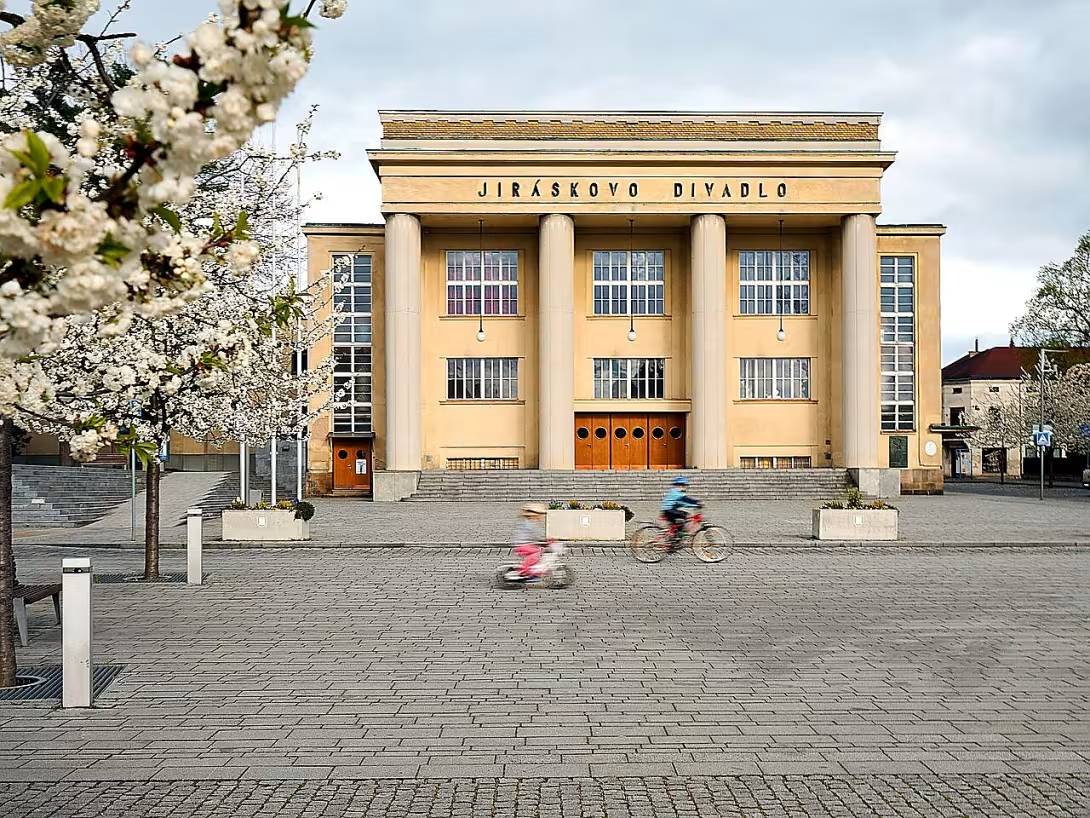
Jirásek's theatre in Hronov is an important constructivistic construction with elements of neoclassicism, which is one of the important works of modern architecture of interwar Czechoslovakia. Located on the square in HronovA, a town located in the north-east of Bohemia in the district of Náchod, it works as a centre of international shows of the amateur theatre Jiráskova Hronov. Since 1964, it has been protected as a cultural monument.
The beginnings of the local amateur theatre date back to 1823, when the local watchmaker Antonín Knahl decided to perform theatre after his return from Prague. The first stage was created in 1826 in the old school, but the permit to run the theatre was obtained only in 1847, and the actors subsequently appeared in the inn U blue star in the square. In the 1960s and 1970s, the native Alois Jirásek played and directed here as a student. After celebrating his seventy birthdays in 1921, an initiative for the construction of his own theatre was established, which led to the establishment of the Cooperative for the construction of the Jirásek Theatre in Hronov in 1925. The project was developed free of charge by Prague architect Jindřich Freiwald, who originally planned a museum, library and reading room. The ceremonial laying of the base stone took place in the summer of 1928 with the participation of Jirásek himself.
The construction took place between 1929 and 1930 and was completed by the company Veselý, Goldschmid and Hartman. The theatre was officially opened on September 28, 1930 with a performance by Lucerna. The building has a rectangular floor plan with an eastern entrance front facing the Czechoslovak Army Square. The entrance to the building takes place through the elevated ground floor through the Porticus with four columns and the inscription Jirásek Theatre. The facade consists of three window axes and a six-wing wooden front door with round windows. The entire object has a grey plaster and an even roof with a yellow brick sign with a toothed plaster band. Above the stage is a square superstructure made of yellow bricks and in the back of the south side facade is rounded staircase risalite.
The interior contains marble lined foyer, in which are placed busts of Alois Jirásek by Jan Štursa and Josef Čapek by Karl Lidický and Vojtěch Kerhart. The original building contains two halls: a large theatre hall with a capacity of 320 seats on the ground floor and 80 seats on the balcony, which can also serve as a cinema, and a small hall with a capacity of 40 to 70 seats, mainly used as exhibition space. On the second floor there is a museum focused on the work of Alois Jiráska and the history of the book Hronovska.
After 1948 the theatre went to the administration of ROH in the then Bavarian races Master Aloisa Jirásek, n. Hronov. In 1952- 1953 reconstruction took place and in the 1970s the building was modified for film screening purposes, with a technical background and a multipurpose hall designated as ROH club. In 1999, the project started to build a multifunctional Čapkova Hall with a capacity of 600 sitting or 1 000 standing visitors, but it was not fully completed by 2019.
The Jirásek Theatre represents a valuable section of local history and modern architecture of the Náchod district. It is an important place for the cultural life of the region and for people interested in the architecture of the interwar period. The building is worth a visit as a witness to a theatre tradition dating back over two centuries.
Then and now
Drag the slider to compare how the landmark may have looked when it was built with the view today.
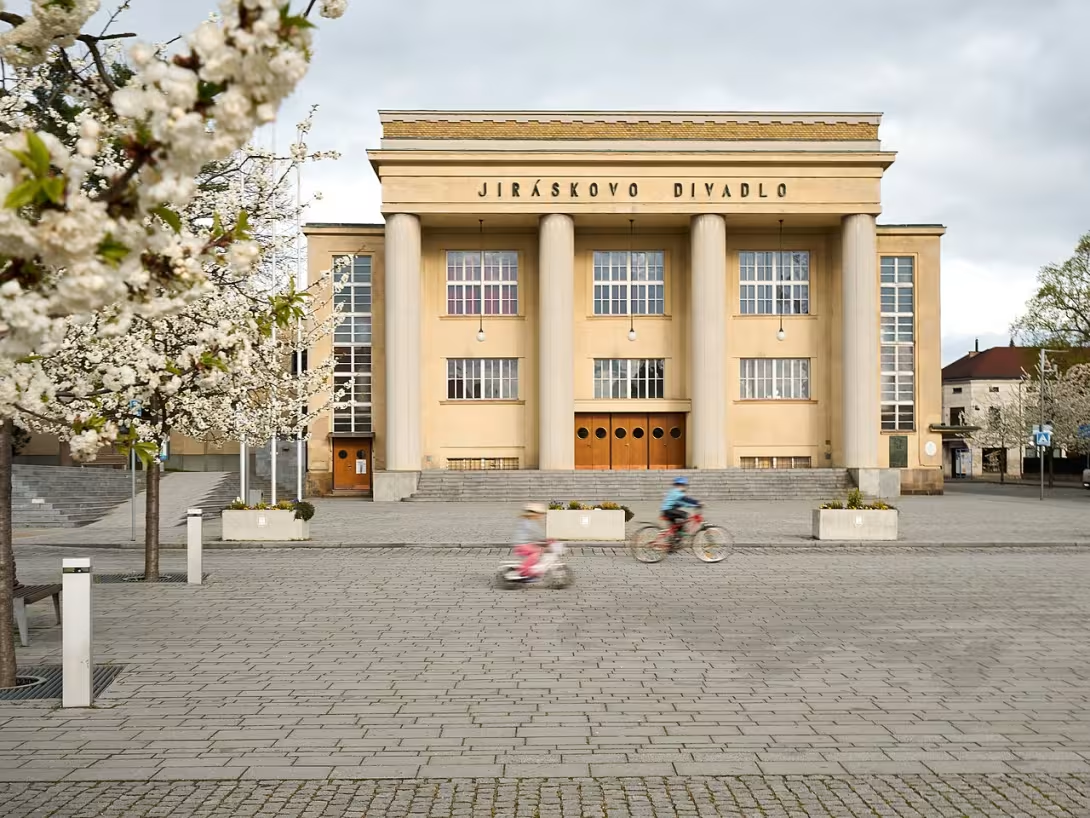

The historical appearance on the left is an AI-generated visualisation and serves as inspiration only.
Historical milestones
- 1826
- The creation of the first stage in the old school.
- 1928
- The ceremonial laying of the base stone.
- 1930
- Official theatre opening.
- 1964
- A list of cultural monuments.
Architectural development
The original building from 1930 was later supplemented with technical facilities and hall for ROH club. In the 1970s, the building was modified for cinema use. In 1999, a project was launched to build a new hall.
Historical events
1826 the formation of the first stage in the old school; 1928 laying of the base stone; 1930 building opening; 1964 declaration for cultural heritage.
Owners
Since 1948 under the administration of ROH.
Points of interest
- Jirásek's theatre is a constructive building with elements of neoclassicism and is one of the important works of modern architecture of interwar Czechoslovakia. - The theatre works as a centre of international shows of the amateur theatre Jiráskova Hronov and is protected as a cultural monument since 1964. - The beginnings of the local amateur theatre date back to 1823, when the local watchmaker Antonín Knahl decided to perform theatre performances. - The ceremonial laying of the foundation stone took place in the summer of 1928 with the participation of Alois Jirásek himself, which had an impact on the initiative for the construction of the theatre. - The construction was completed by the company Veselý, Goldschmid and Hartman and officially opened on September 28, 1930 with a performance by Lucerna.
Guide
Show guide text
This text was created by artificial intelligence and has not been editorially reviewed. It may contain inaccuracies.
Welcome to Hronov. You're standing in front of a building that's much more than just an ordinary art house. It's a place that carries the soul of this whole city and its surrounding region. Look at this structure that stands before you and try to perceive its presence. Do you feel the gravity and the strange energy that radiates from this place? This is Jirásek's theatre, a symbol of culture and history, which will now invite you on a journey through time.
In order to fully understand why this building is so important, we need to go back deep into the past together. The theatre tradition in this city is not new, it has very deep roots. Already in the year one thousand eight hundred twenty-six, at a time when the world around us seemed completely different, the first stage of the theatre was created. It wasn't a magnificent building, it was a simple place in the old school. Yet that is where passion was born to tell stories that still live in this city today. Since then, however, people's needs have changed and theatrical life has grown. After a long time of waiting and building the community came a major breakthrough. In the year one thousand nine hundred twenty-eight, the foundation stone was ceremoniously laid for the building you are now observing. It was a moment of great hope and faith in the future blossom of culture. And already in the year one thousand nine hundred thirty, the greatest moment happened - the official opening of this theatre. Since then, this building has served as a pillar of culture for the entire Náchod district and its importance has only deepened with each year.
Now pay attention to the architecture of the building itself, which now surrounds you. If you look at its overall form, you'll notice something very interesting. This building is not just a random cluster of walls, but a masterpiece that represents the time between two world wars. The architect Jindřich Freiwald designed it and his vision was very brave. Notice how two different worlds connect here. On the one hand, there is a strong influence of constructyvism. This direction focused on clear shapes, logic and functionality, which was a manifestation of modern and progressive thinking in Czechoslovakia. On the other hand, the architect also inserted elements of neoclassicism into the building. These elements give the building some nobility, peace and harmony that makes it dignified. It's a fascinating combination of modern world views with a tradition that creates a unique whole. Look at the building lines and see how these two styles complement each other without contradicting each other. It's exactly the kind of architecture that defined the face of the state back then.
When you look at the name of this place, you'll probably get the name of the famous writer Alois Jirásek in your mind. His name is not only an ornament, but it is a connection with a deep Czech history and soul. This theatre is firmly linked to the great personalities who shaped our culture. In the spirit of this place we can remember artists like Antonín Knahl or the genius creator Josef Čapek. Although you may not be looking at their particular works right now, their contribution and their legacy are felt in every corner of this place. This theatre was made for people who wanted to create, people who had something to say to the world, and it was these people who left their mark.
He may now ask you what makes this place so special even now that the world is changing so quickly. Is this just a historical monument? Not at all. Since the year one thousand nine hundred sixty-four, this building has been officially protected as a cultural monument, suggesting its irreplaceable value for our heritage. But her real power lies in what's going on inside right now. This theater is not just a museum of the past, it's a living center. It serves as the main place for international shows of amateur theatre. It's a fascinating fact that this city, thanks to the theatre, becomes a center where talented people from many different places meet to share their passion for art. It's a place where enthusiasm, creativity, and the ability to tell stories that connect us all.
When you look at this construction you might feel that time has stopped, but actually it's just the opposite. This theatre is a bridge between the past and the future. It is a place that remembers the steps of architects and actors from the last century, but also opens the door to new talent coming from all over the world. It is a symbol that culture is a constant movement and constant growth.
I hope this brief view of history, architecture and the importance of the Jirásek Theatre has helped you better understand what lies behind his facade. Let yourself be inspired by the beauty of this place and its surroundings. Continue to walk Hronov and pay attention to other details that this city offers. Thank you for spending this moment with us and for choosing to know this important piece of our history. We wish you a beautiful rest of the day and many other experiences during your next survey.
Tips for visitors
The best time to visit the Jirásek Theatre in Hronov is autumn or spring, when the weather is pleasant and the probability of sunlight increases. This period also offers a beautiful view of historical construction in a quiet environment.
When visiting, remember clothes suitable for autumn or spring weather as well as shoes for comfortable walking. If you plan to stay longer, it can be a useful guide or map of the sights.
The photography of the Jirásek Theatre offers the best possibilities from the Czechoslovak Army Square, where the view of the overall construction is ensured. Sunlight in the early morning or late afternoon provides the best conditions to capture details of architecture.
In the vicinity of the Czechoslovak Army Square, where the theatre is located, you can visit other historical and cultural monuments. For families with children it is advisable to explore nearby park zones or squares where children can play in peace.
Frequently asked questions
Can the monument be visited?
Some buildings of this kind are open for guided tours, others serve another purpose or are privately owned. We have not verified whether and when this monument is open – please ask the operator.
What are the opening hours and admission?
We have not verified the opening hours or admission. Current information is published by the operator.
Where is the monument?
Location: Hronov, Královéhradecký kraj. The map on this page shows the exact spot.
Why is the monument protected?
It is listed in the Central List of Cultural Monuments of the Czech Republic as a cultural monument (register no. 1000126658).
Businesses nearby
Do you run a restaurant, accommodation, shop, museum, rental, wellness or other visitor service near this monument? Show yourself directly to the people heading to it — this is how they will see you in the app and on the web:
Events nearby
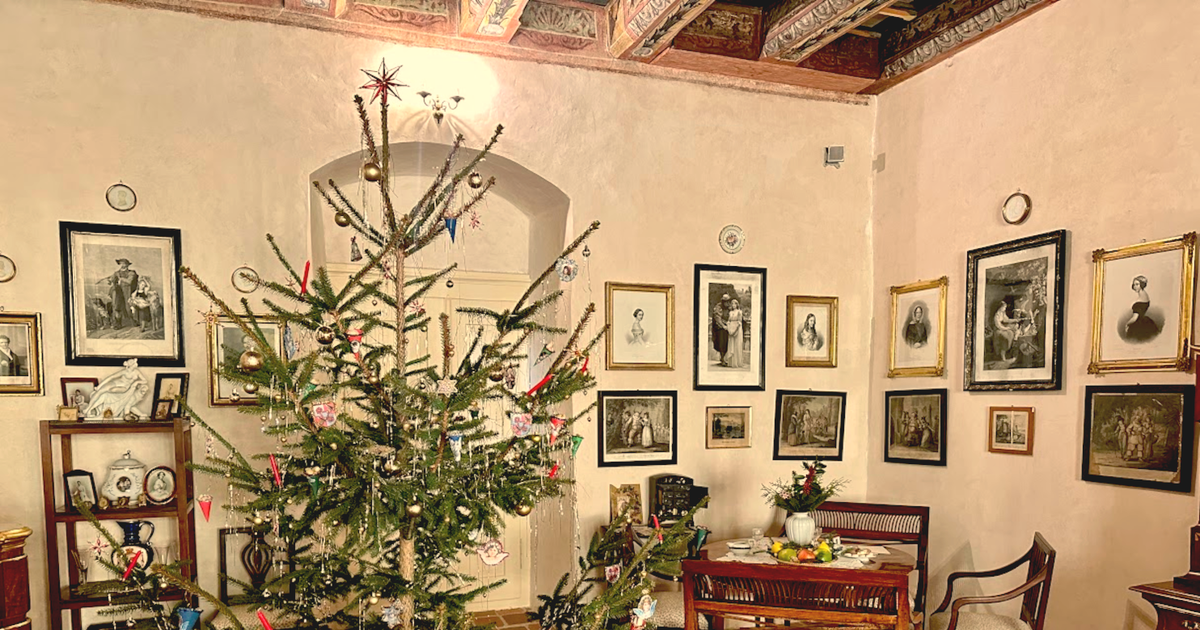
Zdroj akcí: otevřená data měst a obcí ČR (Národní katalog otevřených dat) a kalendář akcí Národního památkového ústavu.
Nearby
Náměstí Československé armády v Hronově.
Accommodation nearby
Themed route
1. Square of the Czechoslovak Army, Square: Central place in the village, which serves as an ideal starting point of the trip. 2. Entry to Jirásek Theatre, facade: The outer part of the building, which represents the entrance to the world of culture. 3. Vestibule Jirásek Theatre, indoor space: A place to meet and rest before the beginning of the performance. 4. Hall of Jiráskova Theatre, Theatre: Main space for viewing theatre games and cultural events.
Seasonal recommendations
In the spring life awakens around the theatre and the surrounding green begins to bloom. The light is delicate and pleasant in this period, which creates an optimistic atmosphere for walking to the building. We recommend wearing layered clothes because the morning cold can be present while the afternoon is already warm. It's the perfect time for a visit where there aren't as many crowds as there are in the high summer season.
Summer Months Bring To Hronova bright sun and warm evenings that give the theatre a merry charge. Due to summer time and tourists, there are more people around, so it is better to arrive a little earlier so that you can do everything in peace. Choose the clothes light and summer, but keep in mind that the interior can be a little colder thanks to air conditioning or specific building layout.
The autumn season offers wonderful leaf colours and often a foggy, quiet blow, which gives the theatre a little tajmen touch. The atmosphere is rather melancholy and cozy, which perfectly matches theatrical art. To visit you must have prepared warmer clothes and possibly an umbrella because the weather can change quickly. The best thing to do is plan visits to the afternoon show where the day starts to get shorter.
In winter time the surroundings of the theatre are often covered with snow and the light is weak, which creates a cozy and quiet atmosphere. In advent time, the city changes, but the building itself remains a solid roof over its head in cold weather. We strongly recommend wearing very warm clothes and shoes with good grip due to possible ice travel. Also check the current opening times before travelling, which may be shorter in winter months.
Visualizations and artistic views


The visualisations are generated by artificial intelligence and serve as inspiration.
Photos from the area
Real photos taken near the monument


Zdroj a licence jsou uvedeny u každého snímku.
Tips from visitors
No tips yet. Be the first!
Log in and add your tip.
Sources and literature
Photos: Radekhomola / CC0 — Wikimedia Commons. The author and licence also appear when you hover over the image.
Faktickým podkladem tohoto textu byl článek na Wikipedii, jehož autory jsou přispěvatelé Wikipedie. Článek je dostupný pod licencí CC BY-SA 4.0.
Location on the map

Příběhy a pověsti
Legendy, pověsti a příběhy spjaté s touto památkou
Fotografie návštěvníků
Zatím žádné fotografie. Buďte první, kdo přidá fotografii z návštěvy!
Log in a přidejte svou fotografii nebo hodnoťte.
Za ověřenou návštěvu v aplikaci získáte víc bodů — poznáme podle GPS, že jste na místě.
Reviews and comments