



kamenný most v Putimi Road bridge
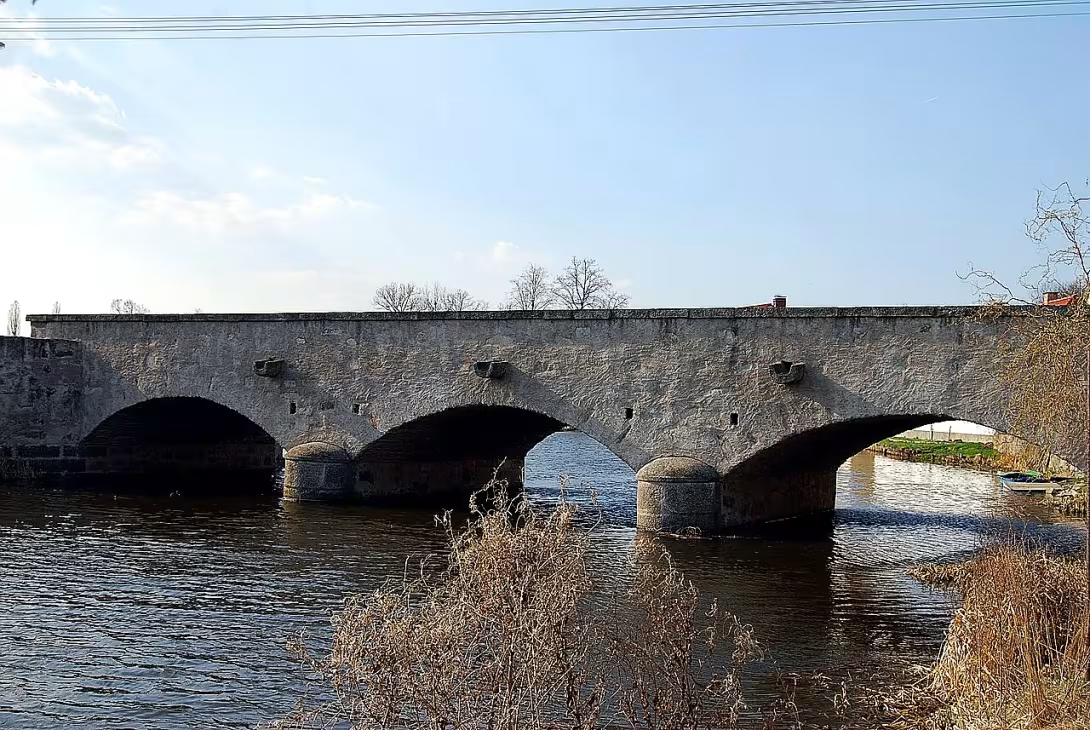
Stone bridge in Putimi is a road construction from 1882- 1884, which surpasses the mill drive of the Blanice River in the Písek district. The building is listed in the Central List of Cultural Monuments of the Czech Republic and forms part of the village monument zone Putim.
The bridge was built on the western edge of the village on the road Písek - Razice in the place where the wooden bridge originally served. Its creation fell into the period of expansion of infrastructure and construction of permanent road connections in Bohemia at the end of the 19th century. At that time, historism and the use of massive stone structures dominated technical constructions.
The construction is built from roughly carved large stone blocks paired with concrete and the overall object is equipped with rough plaster. It is a massive construction with three segment arches with a span of six metres, whose vaults are located three meters above the surface. The arches carry two central pillars and two shore supports. The middle pillars are rounded on both sides and end with round canopy with a ledge carved from one piece of stone. The whole building is finished with oblique, almost vertical wings of quarry stone, with regular low treated block masonry used in their lower parts.
The upper part consists of a bridge with a road, which has been paved with granite cubes since 2003. The wagon is 6.0 metres wide, the total length of the bridge is 24.9 metres and the load capacity is up to 10 tonnes. On both sides there are plastered walls 50 cm wide and approximately one metre high. They cover parapet granite plates with a slope outwards. The drainage is solved by a longitudinal gradient outside the bridge and by transverse gradients into three pairs of stone gutters. Over the middle pillars are placed pairs of small vertically rectangular holes for water drainage.
A key event in the newer era of construction was the flood in August 2002. The bridge was then flooded to about 50 centimeters above the rail and subsequently damaged. The repair was carried out in 2003 with a financial subsidy of CZK 550 000 from the South Bohemia Region. This event is reminiscent of a stone placed in front of the bridge, which bears the carved character of the village and the water surface with the date 2002.
The history of the trough under the bridge is also interesting. In 1922-1926, the original stringed shoulder of the river Blanice was converted into a mill drive in the framework of regulation, which leads the water from the sluice lake to the Rouček Mill. This drive was last cleaned in 2014.
The monument is now fully accessible and serves its original road purpose. It represents a valuable example of technical construction in the late 19th century and is an important element of the local cultural environment. Visiting this building offers the possibility to observe detailed stone craft within the village monument zone.
Historical milestones
- 1882
- The beginning of the stone bridge construction.
- 1884
- Finishing bridge construction.
- 1963
- Entry into the Central List of Cultural Monuments of the Czech Republic.
- 2002
- Flood and damage to the bridge during the flood.
Architectural development
The construction is made of large stone blocks lined with concrete and is plastered. The bridge has three arches with a span of six metres, which carry two central pillars and two coastal supports. The wagon was paved with granite cubes in 2003.
Historical events
In August 2002 the bridge was flooded to 50 cm above the railing and damaged. In 2003, the financial subsidy of the South Bohemia Region was corrected.
Points of interest
- The bridge from 1882-1884 replaced the original wooden building on the western edge of the village. - The construction has three arches and its middle pillars are finished with round canopy carved from one piece of stone. - In August 2002, the bridge was flooded to about 50 centimeters above the railing. - Before the bridge there is a stone with a village emblem and a water level sign from 2002. - Koryto under the bridge was changed in 1922-1926 into a mill drive leading to the Rouček Mill.
Guide
Show guide text
This text was created by artificial intelligence and has not been editorially reviewed. It may contain inaccuracies.
Welcome to Putimi. Right now, you're facing one of the silent but very important witnesses of local history. In front of you, there is a stone bridge, which is surprisingly firmly connecting both sides of the mill wheel of the river Blanice. At first glance, it may seem like an ordinary travel structure, but if you look at it more carefully, you will see a piece of real craft and endurance from the end of the nineteenth century. Feel the atmosphere of this place where the water slowly rolls under the stone vaults and where time seems to slow down for a while.
Now let's move back more than 140 years in time. Imagine that there was once a wooden building in the place where this solid stone bridge is today. However, wood is subject to rot and wear in such an exposed place where water flows. It was therefore decided that it was time for a change. In the year one thousand eight hundred eighty-second began the construction process, which was to bring stability and endurance. The work lasted two years and in the year one thousand eight hundred and eighty-four this stone bridge was finally completed. It was not only about more comfortable transport on the western edge of the village, but about an investment in the future to serve generations. Although today we do not know the names of particular architects or builders, their work speaks for them.
Now pay attention to the design itself and look at the details that form the face of this bridge. Note that the construction is not made up of one large empty space, but consists of three segment arcs. These arches are built from roughly carved stone blocks. It is this roughness of the surface that gives the bridge its specific, rustic character. If you look closer at the bottom, notice the middle pillars. They are finished with round canopy, which are carved from one piece of stone. It is a delicate detail that shows that the builders did not only want to build a functional path, but also took care of aesthetics and resistance to water flow.
This bridge is not just an ordinary road across the river. Since the year one thousand nine hundred sixty-three it has been officially registered as a cultural monument of the Czech Republic. This means that the state has recognised its historical and architectural value. The bridge is also an integral part of the village monument zone in Putimi, which means that together with the surrounding houses and streets it forms one comprehensive picture of the old Czech village, which is important to preserve for future generations.
But if you look at these solid stones, you might feel that they're unbreakable. But history tells us that even massive structures can be threatened by the forces of nature. The most dramatic moment in the new era of this bridge occurred in August of the year two thousand and two. At that time, the Putim and its surroundings were hit by devastating floods. The water in the mill wheel was rising so high that the bridge was completely flooded. Imagine the look when the water was running over the railing itself at about 50 centimeters. It was a moment of great uncertainty when there was a risk that water would carry with it everything that happened in the road. The bridge was damaged at the time, but thanks to its quality construction from the late nineteenth century he survived this test with water.
Also interesting is the location of the bridge on the western edge of the village, where the wooden structure used to fulfil its role. It's fascinating to think how many people have gone through it all these years, how many trucks have gone through it and how many stories have happened here. Although we do not know here any famous personalities to visit the bridge, every resident of Putimi who passes through it daily becomes part of its history.
Now stop and look at those stone arches again. Feel the contrast between the stationary rock and the water constantly flowing under it. This bridge is a symbol of stability in a variable time. It's a reminder of the time when it was built with balance and for eternity, without the rush we know from today.
Thank you for accompanying me on this short trip to Putimi history. I hope you enjoyed the view of this beautiful stone bridge and that you were interested in his story. Now I invite you to take a quiet look around, explore the rest of the village monument zone and discover another hidden corner of this picturesque village. I wish you a pleasant continued journey and a beautiful day spent in Putimi.
Tips for visitors
For the best visual experience we recommend a visit in spring or autumn months. In this period the surrounding nature of the river Blanice is the most lively and light is more suitable for observing the details of the construction thanks to the lower sun.
When shooting, focus on three stone arches of the bridge. The best results are obtained in the morning or just before sunset, when the shadows under the arches create an interesting depth effect and highlight the texture of the stone.
Within the village monument zone of the village Putim you can walk around and observe the historic atmosphere. For families with children it is ideal to walk near the river flow, which offers a quiet environment to observe water.
The place can be transported both by car and by public transport; Check the current connection in the search engine. To move around the road Sand - Razice and near the water stream we recommend to carry comfortable shoes and drinking water.
Frequently asked questions
Can the monument be visited?
This is a structure in a public space that can usually be seen from outside free of charge. We have not verified that this particular one is freely accessible.
Where is the monument?
Location: Putim. The map on this page shows the exact spot.
Why is the monument protected?
It is listed in the Central List of Cultural Monuments of the Czech Republic as a cultural monument (register no. 1000147881).
Businesses nearby
Do you run a restaurant, accommodation, shop, museum, rental, wellness or other visitor service near this monument? Show yourself directly to the people heading to it — this is how they will see you in the app and on the web:
Nearby
Most se nachází na silnici Písek – Ražice v rámci vesnické památkové zóny obce Putim u řeky Blanice.
Accommodation nearby
Themed route
Here is the design of the thematic route:
1. The village monument zone Putim (area) - Walk between historic houses, which shows the original character of the village. 2. Stone bridge in Putimi (monument) - The main destination of the road, which represents a unique building work through the water flow. 3. Blanice River (Water Flow) - A natural element under the bridge that forms the landscape framework of the whole place.
Visualizations and artistic views

The visualisations are generated by artificial intelligence and serve as inspiration.
Photos from the area
Real photos taken near the monument


Zdroj a licence jsou uvedeny u každého snímku.
Tips from visitors
No tips yet. Be the first!
Log in and add your tip.
Sources and literature
Photos: Richenza / CC BY-SA 3.0 — Wikimedia Commons. The author and licence also appear when you hover over the image.
Faktickým podkladem tohoto textu byl článek na Wikipedii, jehož autory jsou přispěvatelé Wikipedie. Článek je dostupný pod licencí CC BY-SA 4.0.
Location on the map
More monuments – Putim
Show all in the municipality
Příběhy a pověsti
Legendy, pověsti a příběhy spjaté s touto památkou
Fotografie návštěvníků
Zatím žádné fotografie. Buďte první, kdo přidá fotografii z návštěvy!
Log in a přidejte svou fotografii nebo hodnoťte.
Za ověřenou návštěvu v aplikaci získáte víc bodů — poznáme podle GPS, že jste na místě.
Reviews and comments