



Kanovnický dům na Novém Městě House
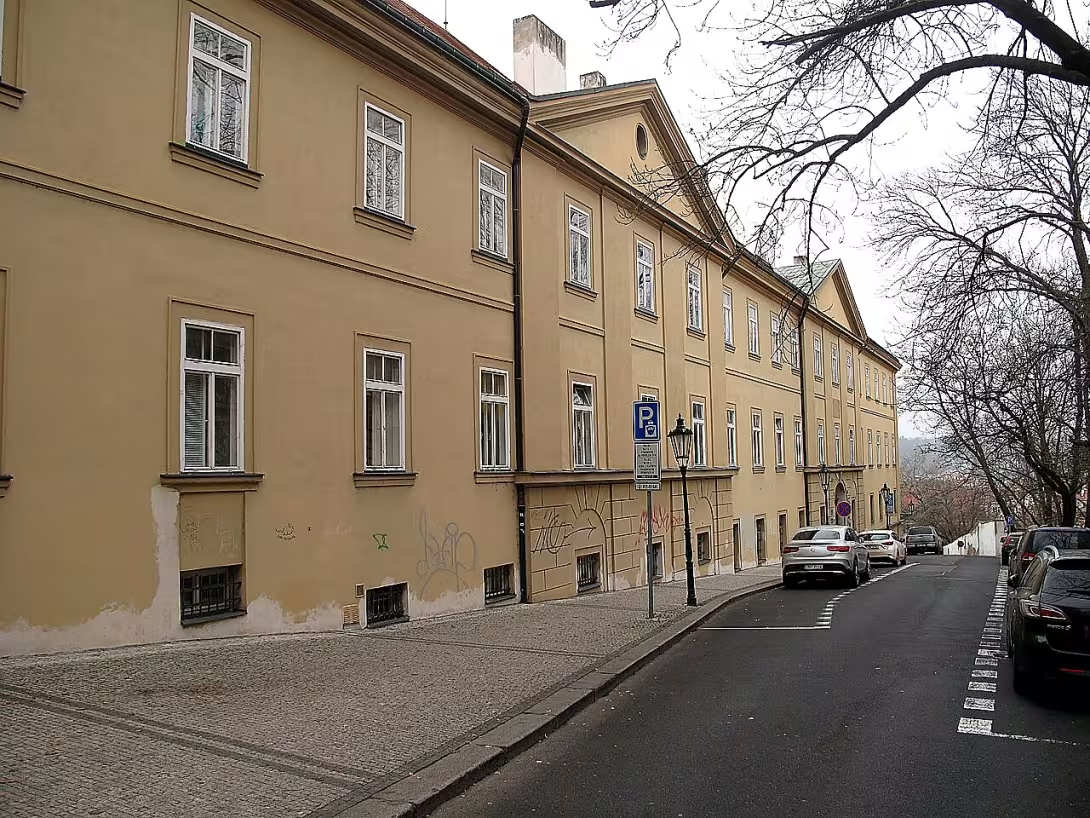
The canovice house in Apolinářská street in Prague's New Town is a valuable classical building. Since the end of the 18th century he served as the first hospital in Prague. The building has been protected as a cultural monument of the Czech Republic since 1958 and today it is used by the Adictology Clinic of the General Faculty Hospital in Prague.
The original house was built here at the end of the 14th century after the capital transferred from Sada in 1362. In the middle of the 18th century, namely from 1746 to 1750, the older building was replaced by a new late Baroque building. A significant break in the history of the building occurred in 1789. Emperor Josef II. then decided to set up Prague's first maternity centre as part of public health reforms. This was intended to provide the background primarily to poor free women who needed to hide the birth.
The building design of the house corresponds to the classicist design from 1790 to 1791, by the architect Franz Anton Leonard Herget. The building has a floor plan in the shape of the letter L. The area includes a large garden and two smaller houses, one ground floor and the other storey. A large number of arched spaces have been preserved in the interior, which illustrate the historical value of the building. On the facade there is a Latin inscription resembling Emperor Josef II, Leopold II and Franz I in connection with the care of safe childbirth.
The administration of the building has undergone significant changes in the 19th century. Since 1824, professor of obstetrics Antonín Jan Jungmann worked here. He introduced a letter of birth, and within the clinic he set aside a secret ward for secret births. In addition, before retirement, he divided the operation into the part intended for doctors and the part for midwives. Since 1875 part of the building served as a mental institution and there was a professor of psychiatry and neurology, MUDr. Antonín Heveroch.
Today, the Canovnice House is part of an area near the Church of St. Apolinara and the Earth Maternity Hospital. As a cultural monument, it represents an important evidence of the development of social care and health care in Czech countries during the period of enlightened absolutism. Visiting this place offers insight into the history of Prague medicine and reminds of changes in the building from the capitular residence to the modern clinical workplace.
Historical milestones
- 1362
- The settlement of the surrender transferred from the Saad.
- 1789
- The establishment of the first Prague Maternity Hospital by Emperor Joseph II.
- 1958
- Declaration for the cultural monument of the Czech Republic.
Architectural development
The original canon house was built at the end of the 14th century. From 1746 to 1750 it was replaced by a late Baroque construction. Subsequently, between 1790 and 1791 he underwent a classical treatment for the needs of the maternity ward.
Historical events
In 1789 Emperor Josef II. established the first hospital in Prague. Classicist design of the building according to the design of Franz Anton Leonard Herget took place between 1790 and 1791. Since 1875, part of the building has been used as a mental institution.
Points of interest
- The building has served since the late eighteenth century as the first hospital in Prague to provide facilities for poor single women in need of secrecy. - The original house was built at this place at the end of the fourteenth century after the transfer of the capital from the Sada. - On the facade of the house there is a inscription in the language of the ancient Romans, which resembles Emperor Joseph the second, Leopold the second and Franz the first in connection with the care of safe childbirth. - Since the year eighteen hundred and seventy-five part of the building served as an institution for people with mental illness and there lived a professor of psychiatry and neurology Antonín Heveroch. - The building design of the house corresponds to the classicist design from seventeen hundred ninety to seventeen hundred ninety-one, by the architect Franz Anton Leonard Herget.
Guide
Show guide text
This text was created by artificial intelligence and has not been editorially reviewed. It may contain inaccuracies.
Welcome to the heart of Prague's New Town. You are standing right in front of a building that carries an incredible depth of time and a silent witness to many changes that have passed through Prague. The canon house you have right in front of you does not act at first sight as a monumental palace, but its peaceful and balanced form contains stories that go beyond ordinary cafes and business passages of this place. Feel this atmosphere, feel the contrast between today's traffic and history, which is written into every stone of this building.
Now let's go back deep into the past together to understand how this object came into being. The roots of this place go much further than they might seem. Already at the end of the 14th century, in the year 133,62, a plot began to take place here, which defined the character of the entire area. During this period, a capitula was established here, which was transferred from the Sada. This means that this place has been linked for centuries with spiritual life and the administration of church affairs. Imagine then Prague, then troubled and rising times, when the foundations of the future city were built here.
Over time, however, the needs of the city and the building itself changed. What you see today is the result of a major reconstruction that took place in the eighteenth century. It was then that the older object was transformed into a form that allows us today to perceive its classical character. If you look at its structure now, you can see the harmony and order that this style brings. The whole building has a very specific ground plan in the shape of L. This shape is not random, it influenced the way the building fits into the city building and how it creates its own inner spaces. The name of the architect Franz Anton Leonard Herget is behind this architectural form. His work in this building has given the building the balanced and dignified face that you perceive right now. Even if you look at the outer walls, know that inside, there are many arched spaces that are evidence of the then championship and give the interior a sense of tonnage and history.
But now pay attention to the most important and impressive parts of the history of this house. In seventy-eight nine, there was an event that completely changed this object and gave it a new human dimension. Emperor Josef II. has decided that this house will serve as the first hospital in Prague. But it wasn't just an ordinary hospital. It was an institution with a very specific and sensitive mission. It was intended for women from the socially weaker classes who needed a safe and above all discreet place to come into the world.
This is where the history of big decisions meets the most intimate moments of human life. Imagine the women coming here. They were often poor or single women who sought refuge and protection in this house. The birth home was supposed to provide the facilities they lacked in the company at the time and allow them to give birth in peace, regardless of their social status. This aspect of humanity and social welfare makes this place special. The Canon House was not just a building of stone and mortar, it was a space where there was a need to help with the need to preserve human dignity in the most difficult times.
Other important names are associated with this place, which left a trail in the history of Prague. In connection with this place and its era, Antonín Jan Jungmann or Antonín Heveroch, for example, have been written in the people's memory and history. Their presence in this context reminds us that this place was part of the wider cultural and social movement that shaped our country in the eighteenth and nineteenth centuries.
You might find one interesting thing that gives this place some depth. This maternity home was set up precisely to allow poor women to give birth in private, which they otherwise could not afford. At a time when the social situation of many people was very difficult, this house served as a quiet port. It was a place where there was a connection between the need to provide medical care and the need to hide weakness and distress, which was very important for the company at the time. This discretion was a key element that allowed women to come here with the hope of a safe and dignified start of a new life for their children.
Today, this building is declared a cultural monument to the Czech Republic, which is a recognition of its immense value. Since the year one thousand nine hundred fifty-eight, this building has been protected as part of our common heritage. It is proof of how the needs of the city change, how society changes, but how, after centuries, certain spaces remain a symbol of caring for others.
Now, if you're going on the streets of New Town, take this feeling with you. Feel every building around you not as a mere installation, but as a place that has its own soul and its own secrets. The Canon House has just revealed a piece of its history, from church roots to human aid in the era of enlightenment. I wish you a beautiful tour of the rest of this wonderful city and I hope that these traces of the past will continue to accompany you. Thank you for spending this moment with us.
Tips for visitors
For a peaceful tour of the exterior of the classical building we recommend the morning hours, where there is less excitement and light better depicts architectural details of the facade. Take with you comfortable shoes for walking on paving blocks and camera, the best pictures are taken from the opposite side of the street where the L-shaped floor plan stands out. In the immediate vicinity you can visit the nearby church of St. Apolinar or visit the historical building of the Earth Maternity Hospital near Apolinar. For families with children, the location is suitable as part of a walk around the historic New Town, and we recommend planning the route to include adjacent park areas around the monument.
Frequently asked questions
Can the monument be visited?
This is a residential or farm building, not a museum with opening hours. Please view it from public space and respect the owners' privacy. We have no information about access to the interior.
Where is the monument?
Location: Nové Město, Hlavní město Praha. The map on this page shows the exact spot.
Why is the monument protected?
It is listed in the Central List of Cultural Monuments of the Czech Republic as a cultural monument (register no. 1000152140).
Businesses nearby
Do you run a restaurant, accommodation, shop, museum, rental, wellness or other visitor service near this monument? Show yourself directly to the people heading to it — this is how they will see you in the app and on the web:
Events nearby

Zdroj akcí: otevřená data měst a obcí ČR (Národní katalog otevřených dat) a kalendář akcí Národního památkového ústavu.
Nearby
Kostel svatého Apolináře, Zemská porodnice u Apolináře.
Accommodation nearby
Trips and activities nearby
Guided tours, tickets and activities nearby from GetYourGuide
Affiliate link: if you buy from the partner, we may receive a commission. The price for you does not change.
Search tours and activities →Themed route
Thematic cruise route: Kanovnický dům na Novém Městě and surroundings
1.Kanovnický dům na Novém Městě - Type: Historical object - Why is it worth a visit: This architecturally interesting house is part of the cultural heritage of the village Nové Město. Its history and construction represent a fascinating view of the city's past.
2. Church of St. Apolinar - Type: Religious object - Why is it worth visiting: The church is not only the spiritual centre of the village, but also an architectural monument with a rich history. His interior and art equipment are a real treasure for history lovers.
3. Earth Maternity Hospital at the Apolinar - Type: Historical site - Why is it worth visiting: This place is important for understanding the social and health development of the village. It is a monument that resembles the history of obstetrics and care for mothers and children.
The distances between the points are short, which makes it easy to move along the route. This cruise route offers a compact and rich experience with the history and culture of the village Nové Město.
Seasonal recommendations
In the spring, the surroundings of the house awaken to life and the young green gives the place freshness. The soft spring light beautifully highlights the facade details and creates an optimistic atmosphere. We recommend visiting the memory in the morning when the air is the cleanest. Due to the changing weather, it is best to choose layered clothes.
The summer season brings intense sun and hot air, which creates a pleasant contrast with the cold thick walls of the building. Expect more visitors in the main season, so it is advisable to come right after opening to avoid crowds. Dress up light, breathable substances and do not forget enough fluids.
In autumn, the surroundings turn into golden tones and morning fog gives the building a mysterious, melancholy atmosphere. Light is lower and finer in this period, which is ideal for observing architecture. It's practical to have a waterproof cloak with you and plan a visit until late afternoon before it starts to get dark soon.
In winter the monument is peaceful and quiet, especially if it is covered by snow. Short days mean that the building is soon lit by the surrounding lamps, which creates a cozy feeling. It is necessary to take warm winter clothes and to check in advance the shortened opening times that are common in this period.
Visualizations and artistic views


The visualisations are generated by artificial intelligence and serve as inspiration.
Photos from the area
Real photos taken near the monument


Zdroj a licence jsou uvedeny u každého snímku.
Tips from visitors
No tips yet. Be the first!
Log in and add your tip.
Sources and literature
Photos: Juandev / CC BY-SA 4.0 — Wikimedia Commons. The author and licence also appear when you hover over the image.
Faktickým podkladem tohoto textu byl článek na Wikipedii, jehož autory jsou přispěvatelé Wikipedie. Článek je dostupný pod licencí CC BY-SA 4.0.
Location on the map
More monuments – Nové Město
Show all in the municipality


Příběhy a pověsti
Legendy, pověsti a příběhy spjaté s touto památkou
Fotografie návštěvníků
Zatím žádné fotografie. Buďte první, kdo přidá fotografii z návštěvy!
Log in a přidejte svou fotografii nebo hodnoťte.
Za ověřenou návštěvu v aplikaci získáte víc bodů — poznáme podle GPS, že jste na místě.
Reviews and comments