



kaple svatého Kříže (Žďár nad Metují) Chapel
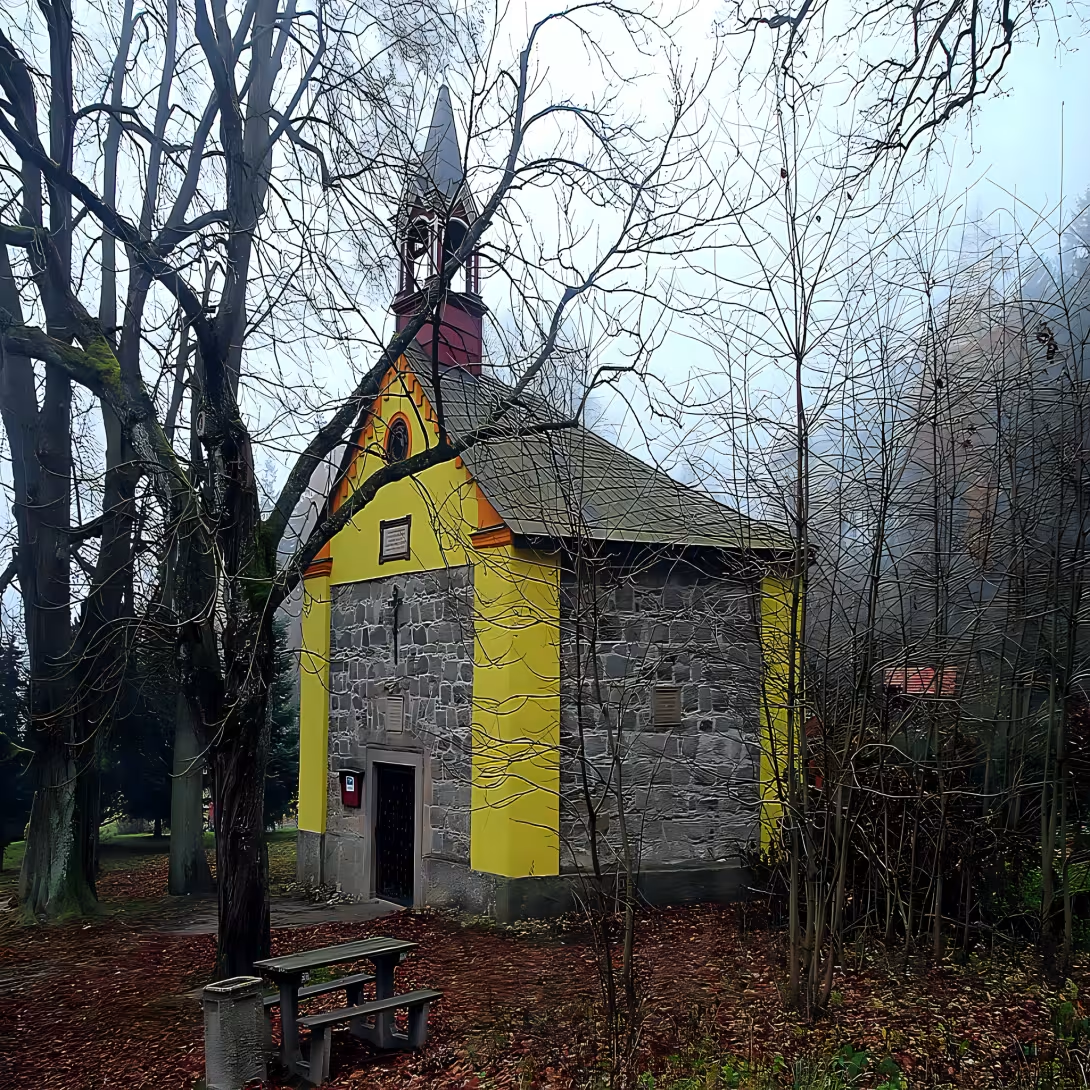
The Chapel of the Holy Cross stands on the hill Odesh in the northern Bohemian landscape near Police nad Metájí. This satiously repaired building belongs to the Police parish and is protected as a cultural monument. Her story begins long before her present appearance - it connects with the events that changed the fate of local people.
In 1421, a Silesian soldier invaded Bohemia and burned down the city of Police. Since the city could not resist, its inhabitants and the people of the surrounding villages had resorted to the top of Odesh, where the hussy forest and the rock shelter promised protection. According to legend, their hiding place was revealed by the master miller Holinka, who was tied to a tree and beheaded for treason. Soon after, a cross was built in the place of his execution - it became the core of the later built chapel.
In 1484 the first chapel of the Holy Cross was built here. Its importance grew, especially after it was allegedly attributed in the 16th century to the miraculous recovery of the blind girl. In 1515, the Polish Petr Bílek went all the way to Rome to help obtain a hundred-day reprieve for anyone who visited the chapel on the specified days, made a confession and contributed to its maintenance. This confirmation bula was issued on 24 March of the same year. Many police procession took place to obtain indulgences.
The construction was gradually changing. In 1669 the Abbot of the Broum monastery Tomáš Sartorius had the wooden chapel rebuilt; The altar was consecrated on 30 June 1669. Since it was not enough to build a new stone church according to the project of Polish builder Pavel Jelínek in 1711. The construction was completed in 1720. The church had three altars - the main Holy Cross and two sides of St. Lawrence and St. Benedict, sanctified by September 22, 1737. It was, however, abolished in 1787 by Joseph II; the remaining stone was sold and demolished in 1788.
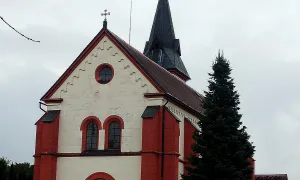
The remains of the old church were built in 1859 by Celestine Velec of Ostaš, who allegedly made a commitment on the battlefield of Saint Lucia in the Austrian-Italian war that if he returned healthy, he would restore the Ostaše Chapel. This still stands as a walled construction of an irregular six-sided plan, with a small quadruple tower with a bell. Inside it is 875 centimetres wide and 6 meters long at the widest point; Two windows against the entrance illuminate it. In 1924, the chapel was repaired to a cargo of owner and innkeeper's Pohla, buying a new bell from the Broum workshop Octavian Winter, sanctified on 8 June 1924.
Today, church services are held on the occasion of the Holy Cross Day, which is celebrated on September 14. The place remains the place of pilgrimage and the memories of eternity of loyalty.
Then and now
Drag the slider to compare how the landmark may have looked when it was built with the view today.
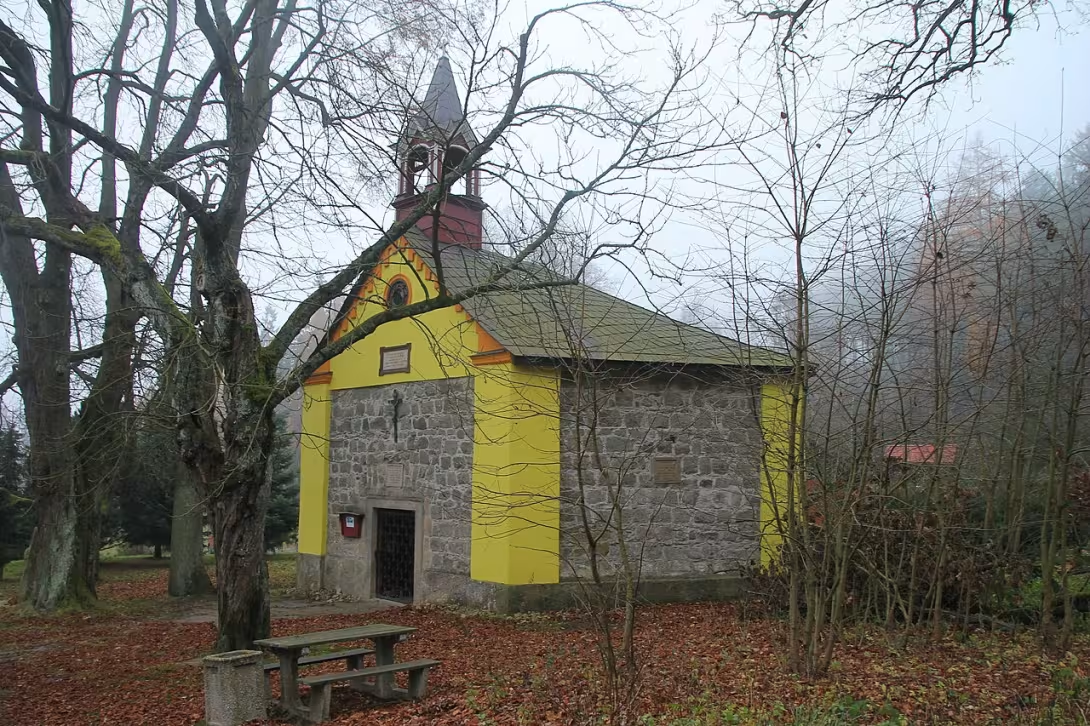
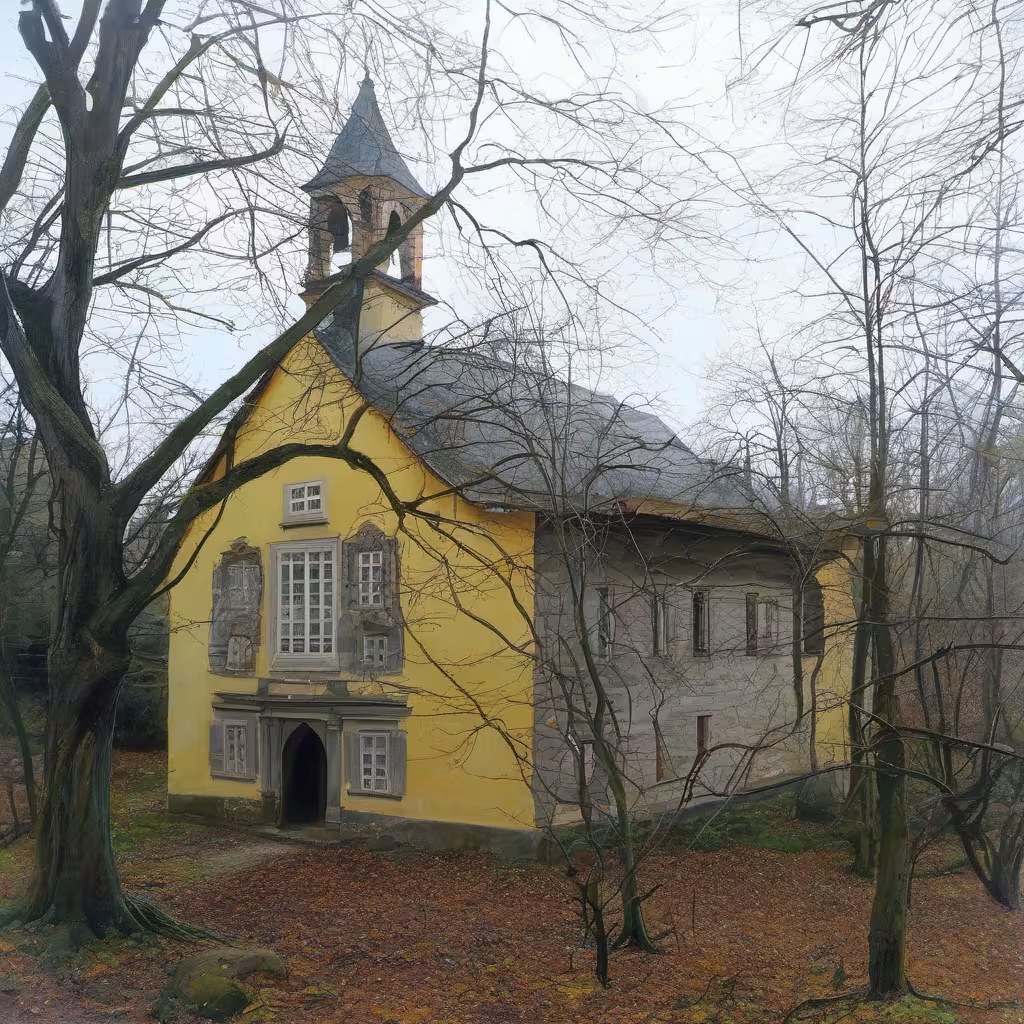
The historical appearance on the left is an AI-generated visualisation and serves as inspiration only.
Historical milestones
- 1421
- The Silesian invasion of the Police and the shelter of the people of Odesi.
- 1484
- Building the original chapel of the Holy Cross.
- 1515
- Issue of papal bulls granting indulgences to visitors of the chapel.
- 1720
- The completion of a new stone church.
- 1859
- Construction of the current chapel by Celestine Velec.
- 1924
- Fix the chapel and sanctify the new bell.
Architectural development
On the place of execution of the miller Holinka was first erected a cross, in 1484 then a wooden chapel. He had Abbot Tomáš Sartorius rebuilt it in 1669. In 1711-1720 a new stone church was built according to the project of Paul Jelinek, which was however dismantled in 1788. The current brick chapel of an irregular six-sided plan was built in 1859.
Historical events
In 1421 the inhabitants hid in Odesh from the Silesian invasion. In 1515, a papal bull was issued confirming indulgences for pilgrims. In 1787, the church was abolished by Josef II and then demolished. The current chapel was built in 1859.
Owners
Celestýn Velc (Wölze), later innkeeper Pohl
Points of interest
- The chapel of the Holy Cross stands on the hill of Odesh in a landscape near Police nad Metují and is protected as a cultural monument. - Her core was a cross built on the site of the execution of the chief miller Holinka, who, according to legend, revealed the whereabouts of the refugees from the Silesian soldiers in 1421. - In the sixteenth century the place was allegedly attributed to the miraculous recovery of the blind girl and Petr Bílek in Rome acquired a hundred-day remission confirmed by the bulge of March 1515. - The original church was abolished in 1787 by Josef II., the remaining stone was sold and demolished in 1788 and he built in 1859 today's chapel Celestín Velec of Osoš. - The current chapel is a walled building of an irregular six-sided plan with a small quadruple tower, and in 1924 it was repaired and received a new bell from Oktavián Winter's broum workshop.
Guide
This guide is narrated by a synthetic voice generated by artificial intelligence.
Show guide text
This text was created by artificial intelligence and has not been editorially reviewed. It may contain inaccuracies.
The Chapel of the Holy Cross stands on the Ostaši hill above Žďár nad Metují. It belongs to the Roman Catholic parish of Police nad Metují and is a protected cultural monument.
Its origins are connected with the military events of 1421. At that time, the Silesians invaded Bohemia and on May 27th they burned down Police. The town had no fortifications, so many of its inhabitants and people from the surrounding villages hid on Ostaši. The hill was at that time covered with dense forest and the rocks provided shelter, even though only for a smaller number of people. According to legend, the hiding place was revealed by a miller named Holinka from Hlavňová. For this betrayal he was tied to a tree and beheaded. At the place of his execution they then erected a cross, and in 1484 a wooden chapel of the Holy Cross was built there, somewhat further to the west of the present one.
The place gained significance in the 16th century when a blind girl was reportedly miraculously healed there. In 1515, Petr Bílek from Police traveled to Rome and helped to obtain an indulgence for anyone who visits the chapel on designated days, confesses and contributes to its maintenance. From Police, processions would then often come here.
In 1669, the abbot of Broumov Monastery, Tomáš Sartorius, had the chapel rebuilt and enlarged. However, pilgrims continued to increase, so in 1711 the abbot Otmar Daniel Zinke commissioned the Police polisher Pavel Jelínek to build a stone church. It was completed in 1720 and in addition to the main altar of the Holy Cross, it had altars of Saint Lawrence and Saint Benedict. Joseph the Second closed the church in 1787. Jan Palata from Žďár bought the stone and demolished the building a year later. The cross from the main altar ended up in Police.
The present chapel was built in 1859 from the remaining stone by Celestýn Velc from Ostaši. According to the account, he had made a vow for it on the battlefield in the Austro-Italian War, if he came out of the battle alive and well. In 1924, its owner, innkeeper Pohl, had it repaired, and with donations a new bell was obtained from the workshop of Oktavián Winter in Broumov.
The chapel is built of brick and has an irregular hexagonal ground plan. Inside it is six meters long and at its widest point measures just under nine meters. The roof, originally covered with shingles, is decorated with a small four-sided tower with a bell. The interior is lit by only two windows opposite the entrance.
Services are held here on the feast of the Exaltation of the Holy Cross, on September 14th.
Tips for visitors
Best time to visit the Holy Chapel The cross is from April to October when the weather is mild and the sun shines on the hill where the chapel is located. The tour is suitable even in winter, but it is necessary to wait for good weather to make you like photography.
We recommend taking clean shoes and clothes with us because it is a rural location. Don't forget your glasses and your sun blade too, so the light won't hurt you.
The best places for photography are in front of the chapel and on the hill behind it. It is also appropriate to take pictures during the February period when there are bright yellow flowers around the chapel.
You can also visit the Police over Metuje, which lies about 10 minutes walking from the chapel. You can visit the local church and explore the historical center.
For families with children we recommend a tour accompanied by a guide or familiar with the history of the chapel. Children can also play on the hill where there is much room to run and play.
Frequently asked questions
Can the monument be visited?
Religious buildings are usually open mainly during services; at other times a visit is normally arranged with the parish or the operator. We have not verified specific times.
Where is the monument?
Location: Žďár nad Metují, Královéhradecký kraj. The map on this page shows the exact spot.
Why is the monument protected?
It is listed in the Central List of Cultural Monuments of the Czech Republic as a cultural monument (register no. 102469).
For kids
Imagine going back 167 years to a time when the country was full of change and flourishing. And just then, in 1859, the chapel of the Holy Cross was built on the hill above the city of Žďár nad Metují. You think it was like a game? That's it!
Today, if you go back to that time, you'll see that there were people who tried to live in harmony with nature and God. They were farmers, shepherds and merchants who tried to provide for family and home. And right here, on the hill, was one of the most famous places where sacred festivities and pilgrimage took place.
Businesses nearby
Do you run a restaurant, accommodation, shop, museum, rental, wellness or other visitor service near this monument? Show yourself directly to the people heading to it — this is how they will see you in the app and on the web:
Nearby
Ostaš is a distinctive table mountain in CHKO Broumovsko with an extensive rock town, views and tourist trails in the vicinity of Police nad Metuje.
Accommodation nearby
Themed route
Holy Cross Chapel Type: Monuments, sacral construction Why is worth a visit: This unique chapel is a dominant village Žďár nad Metují and offers a view of the history of the region. Its architecture and location make it a key point for understanding the cultural heritage of this territory.
Ostas Type: Table Mountain, natural monument Why is worth a visit: The distinctive table mountain in CHKO Broumovsko represents the ideal destination for nature lovers and tourists. Its steep walls and flat tops create a dramatic silhouette that is visible from a large part of the area.
Rock Town Type: Natural formations, rock system Why is worth a visit: The vast rock town in Odeshi offers fascinating geological formations and opportunities for climbing or walking. The rock gates and towers form a wild landscape that attracts discovery and photography.
Prospects Type: Preview points Why is it worth a visit: Panoramic views of Broumov and surrounding mountains are opening from the views around Odesa. These points are ideal for relaxing and admiring the beauty of the landscape after a more challenging climb.
Tourist routes Type: Marked paths Why is it worth a visit: The network of tourist routes around Police nad Metují connects individual attractions and allows for a comfortable exploration of the region. The paths lead along the ridges and valleys, which provides a varied experience for every visitor.
This route combines cultural memory with natural beauty, which ensures a balanced and engaging program. The beginning of the chapel allows a gradual transition to natural dominance, the distances between points being adequate for a daily trip.
Seasonal recommendations
Spring in Zdar nad Metuje brings the surrounding nature to a new life, which gives the chapel of the Holy Cross a fresh and optimistic character. The surrounding meadows and forests turn bright green and the morning fog gradually recede to the warm rays of the sun, which give picturesque light to the stone wall of the monument. During this period you will not meet crowds of tourists, so you will enjoy the tour in complete peace and quiet, ideal for contemplation. Due to the variable March or April weather and occasional mud on the access routes, it is worth putting on fixed waterproof shoes and packing a windbreaker. The best time to visit is in the morning, when sunlight creates unique shadows on the facade of the chapel.
Summer brings a full tourist season to the region, when the chapel of the Holy Cross becomes a popular destination for hikers and cyclists travelling through Broum. The surrounding beech and mixed forest vegetation provides a welcome shade and air smells of resin and blooming herbs, while sharp midday light makes all architectural details of the building stand out. As this is the most frequent period of the year, it is recommended to arrive either early in the morning after dawn, or in the evening, when the noise dies and the temperature of the air falls to more pleasant values. Don't forget to pack enough drinking water in your backpack, sun-proof headgear and light breathable shoes suitable for longer hiking routes in the surrounding slightly legged terrain.
Autumn transforms the landscape around Zdar nad Metuje into a colorful palette of shades of yellow, red and brown, giving the chapel of the Holy Cross an extremely melancholy and romantic atmosphere. The low sun creates long, dramatic shadows during the afternoon and the morning novelty on the fallen leaves gives the place a fabulous touch. In these months you will only meet few visitors, which makes autumn an ideal time for those who seek complete privacy and deeper contact with history without disturbing elements. Since the days are getting colder and cold wind is blowing from the Polish border, it is imperative to wear several layers of warm clothes, a quality jacket and gloves.
Winter covers the chapel of the Holy Cross in deep silence and snow sheets, which will visually turn the whole building into a quiet oasis of calm in the middle of a sleeping landscape. The short days and the slant rays of the winter sun irradiate the white snow and create an almost mystical mood underscored by the crunch of the freezing snow under your feet. Due to the limited time of day, it is best to plan your trip to around noon when there is the best chance of a clear sky and the highest temperature. Do not forget the winter hikes with anti-slip soles, because the access routes can freeze, and put on a warm coat, hat and scarf so that you can enjoy your stay outside fully without uncomfortable cooling.
Visualizations and artistic views


The visualisations are generated by artificial intelligence and serve as inspiration.
Photos from the area
Real photos taken near the monument

Zdroj a licence jsou uvedeny u každého snímku.
Atmosphere of the place
This atmospheric visualisation of the place and period was generated by artificial intelligence. It is not real footage of the location.
Tips from visitors
No tips yet. Be the first!
Log in and add your tip.
Sources and literature
Photos: Draceane / CC BY-SA 4.0, rozlišení zvýšeno umělou inteligencí — Wikimedia Commons. The author and licence also appear when you hover over the image.
Faktickým podkladem tohoto textu byl článek na Wikipedii, jehož autory jsou přispěvatelé Wikipedie. Článek je dostupný pod licencí CC BY-SA 4.0.
Location on the map

Příběhy a pověsti
Legendy, pověsti a příběhy spjaté s touto památkou
Fotografie návštěvníků
Zatím žádné fotografie. Buďte první, kdo přidá fotografii z návštěvy!
Log in a přidejte svou fotografii nebo hodnoťte.
Za ověřenou návštěvu v aplikaci získáte víc bodů — poznáme podle GPS, že jste na místě.
Reviews and comments