



Kaple svatého Václava (Brůdek) Chapel
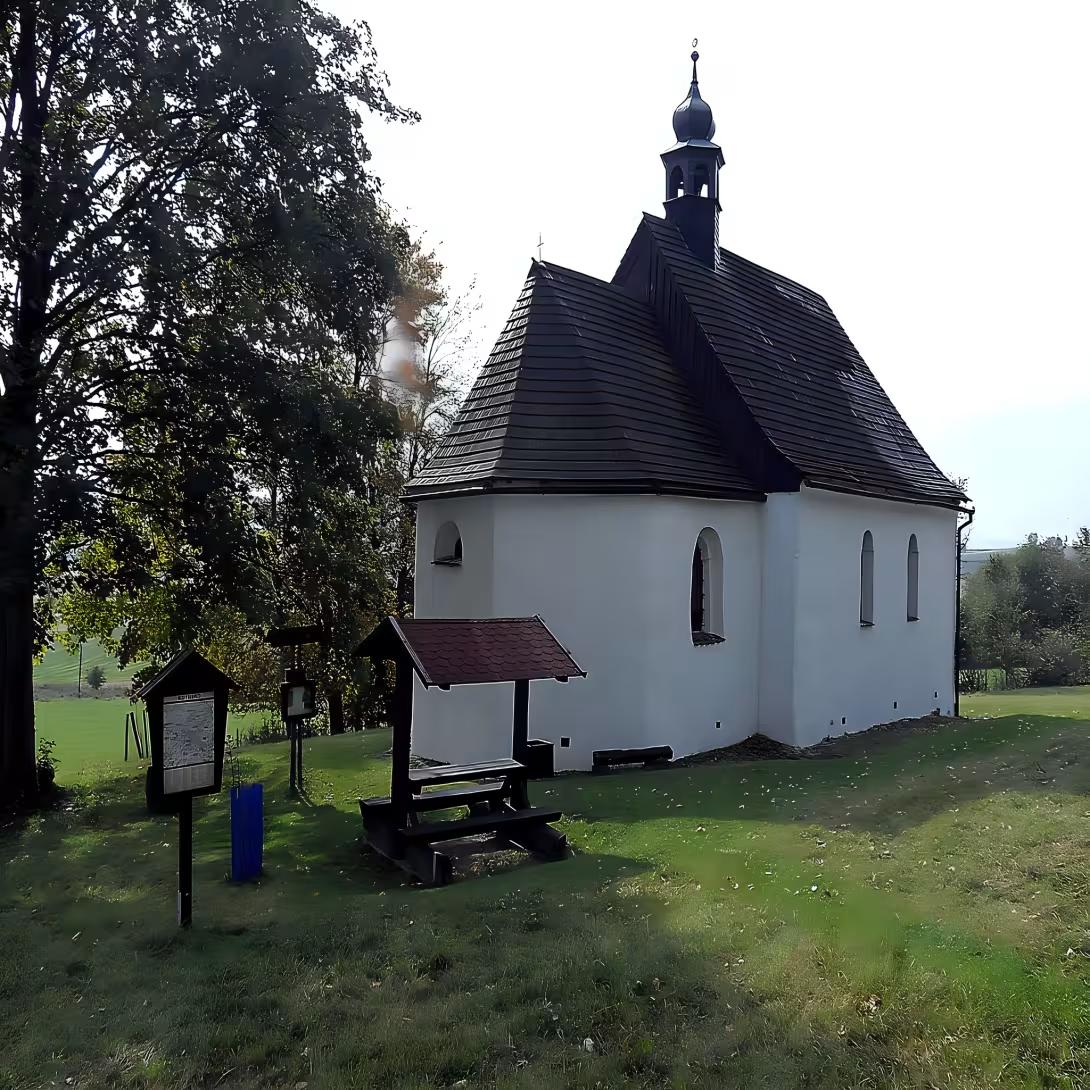
The chapel of St. Wenceslas at Břežek is part of the Clerk parish and stands as simple but interesting testimony of the early modern age. It is a Roman Catholic chapel (also referred to as a filial church), which we protect today as a cultural monument of the Czech Republic.
The building of the chapel clearly had a longer history than it would appear at first sight. Although it was built only in the seventeenth century, namely in 1669-1671, tradition attaches it to much older roots. Some sources mention that it should be preceded by a church from the fourteenth century, which, however, stood in the extinct village of Zdemily. The village Brůdek was allegedly founded in its place in the first half of the seventeenth century, but this is a mere conjecture. In addition, the popular tradition of the chapel links it to the church, which was to be founded in the eleventh century on the memory of the Battle of Bředek. The historian František Palacký later attributed the origin of Břetislav I in 1040 without substantiated evidence, but these claims do not have solid foundations. In more recent times, the chapel was repaired with the contribution of Count Bedřich of the Stadium in 1878 and 1890.
The building of the chapel is characterized by its simplicity and lack of typical styles of its own elements. The ship has a rectangular plan of 8 × 7.8 metres, with walls in the facade extending into simple shields. Side sides break a pair of rectangular windows. The entrances are located in the west facade and in the south side of the window. The boat has a flat ceiling with a wooden round supported by two wooden columns. The presbytery is adjacent by boat on the east side and is lit by three windows with semi-circular ends. Both parts separate the semi-circular victory arch. The presbytery is encased in the vault with lunnets. The thickness of all walls is 80 centimeters.
The original equipment preserved an early Baroque pulpit dated 1686. The three baroque altars are more or less understood as worthless from an artistic point of view. The rest of the equipment comes from the late nineteenth century. The central picture is a portrait of St. Wenceslas by the painter Ignatius Amerling (1837-1912), located on one of the altars.
The chapel stands as a modest pen of historical wealth and tradition surrounding it. Its vague beginnings and intricate legends of older structures make it a place where reality and traditions meet. / p >
Then and now
Drag the slider to compare how the landmark may have looked when it was built with the view today.
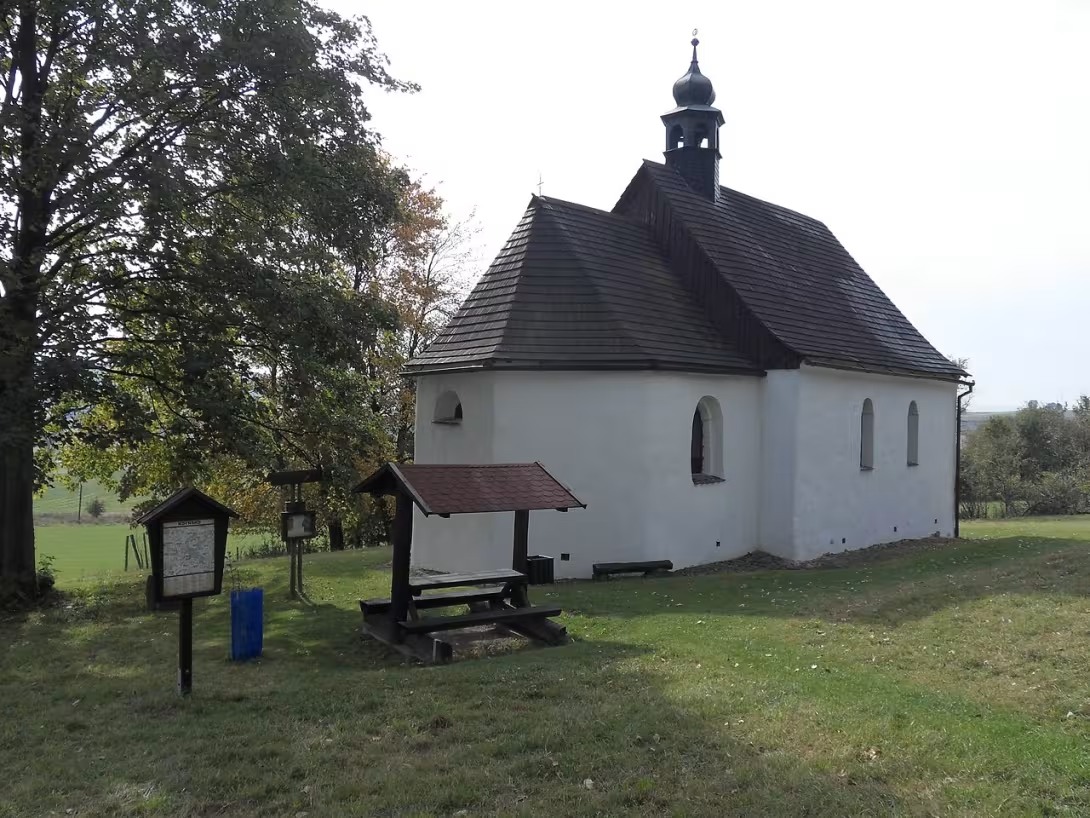

The historical appearance on the left is an AI-generated visualisation and serves as inspiration only.
Historical milestones
- 1686
- Equipment of the chapel early Baroque pulpit.
- On one of the altars is a picture of St. Wenceslas by Ignatius Amerling.
Architectural development
The chapel lacks typical essentials, which is characteristic of some other churches in the surrounding villages. The ship has a rectangular plan and walls running into simple shields. The presbytery is encased in the vault with lunnets.
Historical events
- 1669-1671
- The position of St. Wenceslas's Chapel at Bředek.
- 1878 and 1890
- Repairs with the contribution of Count Bedřich of the Stadium.
Points of interest
- St. Wenceslas Chapel is protected as a cultural monument of the Czech Republic. - Although it was built in 1669-1671, tradition ascribes it to older roots, perhaps even a church from the 14th century or the eleventh century. - The chapel had repairs with the contribution of Count Bedřich of the Stadium in 1878 and 1890. - The original equipment preserved an early Baroque pulpit dating back to 1686. - The central picture is a portrait of St. Wenceslas by the painter Ignatius Amerling (1837-1912).
Guide
This guide is narrated by a synthetic voice generated by artificial intelligence.
Show guide text
This text was created by artificial intelligence and has not been editorially reviewed. It may contain inaccuracies.
The Chapel of Saint Václav near Brůdek belongs to the Mrákovo parish and is also referred to as a subsidiary church. It was not built until the seventeenth century. Nevertheless, it is traditionally associated with a much older event, the Battle of Brůdek from the eleventh century. Today it is protected as a cultural monument.
The chapel was built between 1669 and 1671. Later it was repaired twice, in 1878 and in 1890, with the support of Count Friedrich of Stadion. In the literature, it is sometimes stated that it had an older predecessor, a church mentioned already in the fourteenth century. However, that stood in the now vanished village of Zdemily. The village of Brůdek apparently emerged on the site of Zdemily in the first half of the seventeenth century. But this is merely a conjecture.
The chapel was connected to the Battle of Brůdek in the nineteenth century by František Palacký. He identified it with a small church that was supposedly founded by Bretislav the First in 1040 to commemorate his victory. However, there is no evidence for this connection.
The building has no pronounced stylistic features, which is typical of other churches in the surrounding villages as well. The nave has a rectangular ground plan and measures eight by seven point eight meters. Both façades end with simple gables and on the side walls there are pairs of rectangular windows. The chapel is entered from the west and also from the south side below a window. To the east of the nave is the presbytery, through which light enters by way of three windows with semicircular arches. The walls are eighty centimeters thick. The nave has a flat ceiling and a wooden gallery supported by two wooden columns. It is separated from the presbytery by a semicircular triumphal arch. The presbytery is vaulted with a cross vault with lunettes.
From the original furnishings, only an early Baroque pulpit from 1686 has been preserved. The chapel also has three Baroque altars. However, Ferdinand Vaněk and Karel Hostaš considered them to be artistically worthless. The other furnishings date from the end of the nineteenth century. On one of the altars hangs a painting of Saint Václav by the painter Ignác Amerling, who lived from 1837 to 1912.
Tips for visitors
St. Wenceslas's chapel is a small wooden building, whose visit is best in quiet hours of the day, ideally morning or late afternoon. In these times the surroundings are less disturbed and the light falling on the historic wooden structure creates an atmosphere that underlines the traditions associated with the local wonders of ancient battles.
Traffic availability is ensured by car and public transport. For passengers by public transport we recommend to verify the current connections and timetables in the search engine, as the lines may be limited and depend on the time of day and the day of the week.
When visiting, bring comfortable shoes that allow you to move safely around the terrain, and a light layer of clothing depending on the weather. Since this is an outdoor monument, it is advisable to have drinking water and possibly light snacks if you plan to stay longer in nature. Remember also to check the weather forecast so that the trip is not disturbed by adverse conditions.
For photography it is best to use the soft light of the morning or evening hours that highlight the texture of the wood and the historical character of the construction. Try different points of view to capture both the details of the chapel and its relationship to the surrounding landscape. If possible, avoid sharp midday sun, which can create hard shadows and affect image quality.
Since there are no specific places in the area in the background, we recommend focusing on the memory itself and its immediate surroundings. For families with children the visit can be interesting thanks to stories about myths and ancient battles that can be told to children on the spot. However, it is important to ensure the safety of children in view of the outdoor environment and possible uneven terrain.
Frequently asked questions
Can the monument be visited?
Religious buildings are usually open mainly during services; at other times a visit is normally arranged with the parish or the operator. We have not verified specific times.
Where is the monument?
Location: Brůdek, Plzeňský kraj. The map on this page shows the exact spot.
Why is the monument protected?
It is listed in the Central List of Cultural Monuments of the Czech Republic as a cultural monument (register no. 33569/4-2044).
For kids
Imagine going back to when the first people lived here. It was a great forest landscape full of wild animals and trees. Where the chapel of St. Wenceslas stands today, there was a small settlement of people who lived in wooden cottages.
These people used to hunt and collect. They hunted animals like bears, deer or wild boar. They collected the fruits of trees and herbs that helped them heal various diseases. It was hard work, but they all lived together in harmony with nature.
Businesses nearby
Do you run a restaurant, accommodation, shop, museum, rental, wellness or other visitor service near this monument? Show yourself directly to the people heading to it — this is how they will see you in the app and on the web:
Nearby
The chapel is located near the village Brůdek.
Accommodation nearby
Themed route
1. Chapel tank (Type: Area) - A walk in the immediate vicinity of the building offers space for peaceful contemplation. 2. Kaple svatého Václava (Brůdek) (Type: Sacral monument) - A tour of the inner space and admiration of religious elements. 3. Exposure in the chapel (Type: Exhibition) - Detailed view of historical objects and stories associated with this place.
Seasonal recommendations
Spring brings to the surroundings of the chapel the awakening nature and fresh green color, which makes a very vivid impression. The morning sun offers fine lighting, ideal for observing the details of the building in a quiet environment. We recommend wearing layered clothes because even though it is warmer, it may still be cold in the morning. For possible rains, prepare for any mud on the road.
During the summer, the surrounding area is covered in dense vegetation and the days are very long, allowing a visit within a wide time frame. The atmosphere is full of sunlight and life. In the main summer season, however, it is advisable to arrive early in the morning to avoid the biggest crowds while enjoying more pleasant temperatures. Don't forget enough fluids and direct sun protection.
Autumn brings a melancholy atmosphere into the landscape and paints the surrounding trees into shades of gold and red. Frequent morning fog gives the chapel a mysterious and magical touch. It's the perfect time to take pictures with low, warm light. For a relaxing visit we recommend to choose fixed, waterproof shoes and a warmer jacket, because wet weather and cooling are common during this period.
Winter turns the surroundings into a quiet, snowy landscape that highlights the loneliness and beauty of the historical monument. A short day and snow reflecting light create a very specific, pure visual impression. Due to low temperatures it is absolutely necessary to have very warm clothes and quality accessories. Before the journey itself, we recommend monitoring the weather forecast to ensure safety while moving in difficult terrain.
Visualizations and artistic views


The visualisations are generated by artificial intelligence and serve as inspiration.
Photos from the area
Real photos taken near the monument


Zdroj a licence jsou uvedeny u každého snímku.
View from the area
This animation was generated by artificial intelligence from a real photograph of the surroundings. The motion and details are not real footage of the location.
Atmosphere of the place
This atmospheric visualisation of the place and period was generated by artificial intelligence. It is not real footage of the location.
Tips from visitors
No tips yet. Be the first!
Log in and add your tip.
Sources and literature
Photos: Jik jik / CC BY-SA 4.0, rozlišení zvýšeno umělou inteligencí — Wikimedia Commons. The author and licence also appear when you hover over the image.
Faktickým podkladem tohoto textu byl článek na Wikipedii, jehož autory jsou přispěvatelé Wikipedie. Článek je dostupný pod licencí CC BY-SA 4.0.
Location on the map
More monuments – Brůdek
Show all in the municipality

Příběhy a pověsti
Legendy, pověsti a příběhy spjaté s touto památkou
Fotografie návštěvníků
Zatím žádné fotografie. Buďte první, kdo přidá fotografii z návštěvy!
Log in a přidejte svou fotografii nebo hodnoťte.
Za ověřenou návštěvu v aplikaci získáte víc bodů — poznáme podle GPS, že jste na místě.
Reviews and comments