






Kaplička svaté Barbory Niche chapel
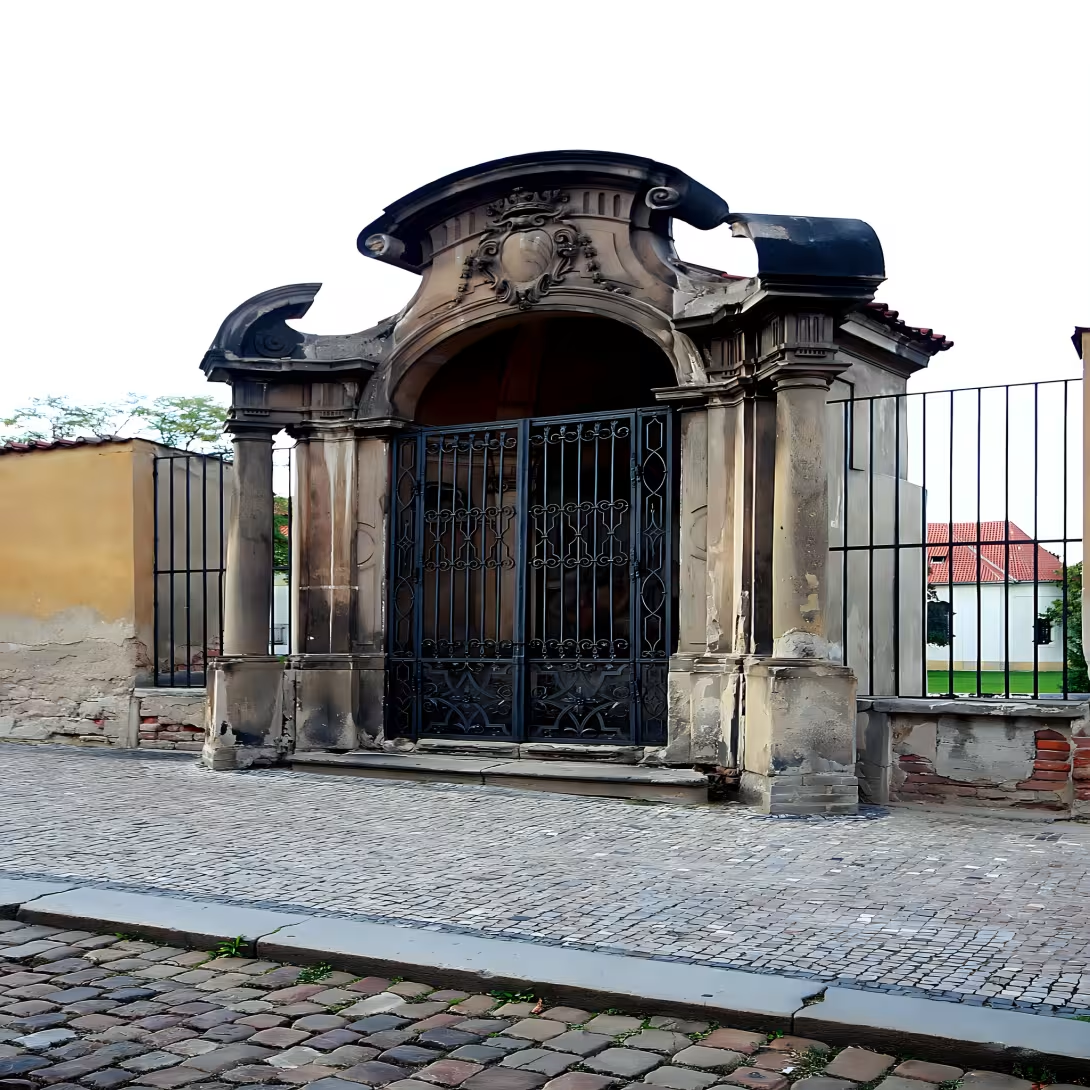
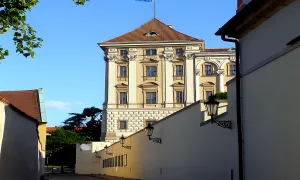
Kaplička svaté Barbory is a baroque niche chapel on Loretanská Street on Prague Hradčany. This cultural monument was created between 1725 and 1730 according to the design of architect František Maximilian Kaňka. It is particularly remarkable by its incorporation into the wall of the small Černín Palace.
The construction of the chapel was financed by Count Štěpán Kinský during the period of the high Baroque. The then Czech countries placed great emphasis on sacral architecture and the emotional activity of works of art. This approach was in line with the European climate, which, after the Spanish heritage wars, stabilised and wished for absolute monarchy to flourish.
The architectural representation of the building is made up of a semi-liptic niche with enchantment, supplemented by side niche. The facade of the dorian columns on the plinth and pilasters. A significant element is the ledge, which ends the front and turns into volutes on the sides. Above the columns there are volut wings with segment air part of the ledge. The central cartouche is decorated by the character of the Kinski family and the entrance space protects the ornamental grate.
The interior is decorated with fresco on the back wall by the painter Václav Vavríce Reiner. The scene captures the legend of the confession of a thieving knight, in whose background are visible knights struck on a stake. From the end to the scene, St. Barbara looks down. The original Reiner painting has been repainted in the past.
At the time of the creation belonged to the Kinský family, later the administration became a monument care. Historical records show that the chapel was restored in 1858.
Today, the chapel of St. Barbara is accessible as part of a tour of the historical centre of Hradčan. It is located in the immediate vicinity of the Lorethanske Square, the Černín Palace, Loretta and Prague Castle. This monument represents a valuable piece of Baroque architecture, which completes the historic character of Lorethanska Street. Visiting the site offers the opportunity to get acquainted with the work of František Maximilian Kanka and the iconography of the legend of St. Barbara.
Historical milestones
- 1725
- The opening of the chapel building according to the design of František Maximilian Kaňka.
- 1730
- Completion of chapel construction.
- 1858
- Reset the chapel.
Architectural development
The chapel was built as a semi-liptic niche with a wedge and side niche. The facade is divided by Doric columns on the plinth and pilasters, the ledge being closed on the sides by fronton and volutes. The entrance space is closed by an ornately shaped grid.
Historical events
1725-1730: Construction of the chapel for the cargo of Count Stephen Kinski. 1858: Restoration of the chapel carried out.
Owners
Rod Kinský (at the time of construction), then the administration of historical care.
Points of interest
- The chapel is remarkable by its integration into the fenced wall of the little Chernin Palace. - The construction of the chapel was financed by Count Štěpán Kinský during the period of the high Baroque. - The central cartouche of the building is decorated with the character of the Kinsky family and the entrance space protects the ornamental grate. - The interior is decorated with the fresco of Václav Vavríce Reiner, which depicts the legend of the confession of the knight who robbed him. Historical records show that the chapel was restored in 1858.
Guide
Show guide text
This text was created by artificial intelligence and has not been editorially reviewed. It may contain inaccuracies.
Welcome to the heart of Prague's Hradčan, a place where history can't only be read in books, but where you can literally feel it on every stone block and every detail of the surrounding architecture. You're standing right on Lorethian Street, one of those Prague roads that brings you right to the biggest secrets of the royal city. In front of your eyes, there is now an unusual and very special object, which at first glance can act as a mere part of the surrounding wall, but on closer examination it reveals its true, noble essence. It is the chapel of St. Barbara, the Baroque niche chapel, which is so perfectly integrated into space that it seems to be a natural part of it, yet it stands out with its elegance and spiritual charge. Feel this atmosphere, feel the calm that radiates this place, even if you are near a busy center.
To understand why this place looks just like this, we must return to a time when the baroque dominated Prague's face in all its glory and dynamism. Imagine the period around 1725, the first time this sacral site was planned and built here. It was not just an ordinary building, but a project to reflect power, faith, and the aesthetic sense of the then nobility. The main mover of this whole building was Count Štěpán Kinský. The House of Kinský belonged to the most important and influential families in the country and their presence in this part of Prague was very strong. Count Štěpán Kinský decided to fund this chapel, not only expressing his religious devotion, but also leaving a permanent signature of his family in the very structure of the city. The whole construction lasted several years and was completed in 1730, which was the period when the Baroque style reached its peak, with emphasis on movement, light and rich ornamental.
Now pay attention to what you see right in front of you. The chapel is not a separate building that you could enter as a house, but it is a so-called niche chapel. It means that it is directly part of the wall of the small Black Palace. This integration into the wall is an architectural masterpiece that requires tremendous sensitivity for scale and space. Look at her shape. The chapel is characterized by its semi-liptic niche. This curve is not random; Baroque architects loved round, smooth lines that create a sense of movement and depth. Notice how this curvature harmonises with the surrounding wall and how it creates a space for light that falls inside under angles that change the appearance of the whole object depending on the time of day.
If you come any closer now, you can see the details that make this chapel a real work of art. The centre cartouche is located in the middle of the building. This decorated plate is not only a decorative element, but serves as a symbolic center of the entire composition. Here you can see the character of the Kinski family, which is a clear proof of who was the patron saint of this place. It's like the signature of an artist or donor who remains carved into stone for future generations. And when your eyes slide down to the actual entrance into the chapel space, you will see the ornamental grate. This grate has a dual function. On the one hand it protects the inner space of the chapel and its sacred essence, on the other hand it serves as a transparent interface between the outside world and the spiritual world, allowing us to look inside without disturbing its peace.
This whole architecture is the work of one of the greatest masters of his time. It was designed by František Maximilian Kaňka himself. If you know the history of Czech architecture, this name must be known to you. Kaňka was an architect who was able to translate the Baroque style into a shape that was not only monumental but also extremely elegant and thoughtful. His ability to work with space, as we see at this chapel, is proof of his genius. He himself was not just a builder, he was the creator of space that spoke to people through his shapes.
In addition to architecture, painting plays a fundamental role here. Even if you cannot enter the interior freely, his soul is defined by the fresco created by Václav Vavřinec Reiner. Reiner was an important representative of the Baroque painting and his work in this chapel gives the whole place the right charge. The fresco inside the chapel is the element that complements the architectural splendor of the Kanyk Nika and creates a visible dialogue between stone and color. Imagine the dynamics of color and light that are reflected from the walls inside this niche.
It's fascinating to see how this chapel endured over the centuries. Although the reconstruction was carried out in 1858, its original Baroque character was preserved. It is rare that such a dense city can maintain a detail that serves as a silent witness to history.
You may be interested in the unusual integration. Most of the chapels you meet in Prague stand separately as their own buildings, have their own towers or their own courtyard. But this chapel of St. Barbara is different. It's a chapel that hides in a wall that's part of a palace complex, and yet retains its own identity and dignity. It's like a hidden treasure that you have to knowingly look for to really reach out to you. This symbiosis between defense, the wall, and prayer, the chapel, is a unique example of how the baroque managed to link practical functions with high art.
Now that you've learned the history, the creator and the details of this place, I suggest you stop for a moment in silence. Take another look at the semi-liptic niche, assess the work of Master Kanka, and try to imagine what this street looked like three centuries ago, when the first hammer blows were heard here when building this chapel for Count Kinski.
Thank you for spending this moment with us in discovering the beauty of Hradčan. We hope that this little but incredibly rich Baroque detail has brought you new insights into the history of our city. Continue to walk these historic streets and let yourself be carried away by the other surprises that await you around the palace and cathedral. Goodbye.
Tips for visitors
The best time to visit is early in the morning or in the evening, when the Loretan Street is quieter and the sunlight is beautifully reflected from the baroque facades, creating an ideal atmosphere for a tour.
The location is very well accessible by public transport and on foot from nearby historical neighborhoods; parking in this location is limited, therefore we recommend to use the detention parking outside the centre and continue with the public transport connection.
It is preferable to use a wide-angle lens to photograph the chapel, which captures a detailed baroque niche in the context of historical development; The best light for the images can be obtained during side lighting during the morning.
In the immediate vicinity, within 30 minutes' walk, you can visit the Loretanská Square, Černín Palace, Loreto or Prague Castle, offering a rich cultural experience.
For families with children the location is suitable as part of a walk in Hradčany; we recommend taking comfortable shoes with us, because historic streets are paved with cat heads, and a snack you can enjoy in adjacent parks.
Businesses nearby
Events nearby

Zdroj akcí: otevřená data měst a obcí ČR (Národní katalog otevřených dat) a kalendář akcí Národního památkového ústavu.
Nearby
Loretine Square, Chernín Palace, Loreto, Prague Castle.
Accommodation nearby
Trips and activities nearby
Guided tours, tickets and activities nearby from GetYourGuide
Affiliate link: if you buy from the partner, we may receive a commission. The price for you does not change.
Search tours and activities →Themed route
Thematic cruise route from Hradčan
1. Kaplička svaté Barbory (chapel) - * Type: * Chapel - * Why is it worth a visit: * This picturesque chapel is part of the altar of Loretan and serves as a place of prayer and peace. Its history dates back to the 17th century, when it was built as a result of the miraculous healing of Princess Mary Anne of Habsburg.
2. Lorelai Square - * Type: * Square - * Why is it worth a visit: * This historic square is famous for its Loretan altar, which is one of the oldest and largest in Europe. The square was designed as part of the Renaissance planning of Prague and offers a beautiful view of the surrounding architecture.
3. Chernín Palace - * Type: * Palace - * Why is it worth a visit: * This Baroque palace was built in the 17th century for the Czech king and is famous for its impressive architecture and historical events that took place here. Today it serves as the seat of the President of the Czech Republic.
4.Loreta - * Type: * Roman Catholic Chapel - * Why is it worth visiting: * Loreta is one of the most important sacral monuments in Prague, famous for its rich history and architecture. The chapel was built as a replica of the original Loretta in Italy and is often visited for its spiritual values.
5. Prague Castle - * Type: * Castle - * Why is it worth visiting: * Although Prague Castle is not part of the area in a narrow sense, its proximity to the Hradčany makes it an ideal conclusion to the route. Its history dates back centuries and offers a view of Prague, which is nowhere else.
This route will guide you through key historical and cultural places Hradčan, offering a deep insight into the rich past of this part of Prague.
Seasonal recommendations
Spring: Kaplička svaté Barbory in Hradčany offers visitors a unique experience in the spring season when nature wakes up from its winter sleep. Sun rays illuminate the chapel and its surroundings, creating a warm and fertile feeling. At this time the flowers are around the chapel full of color and odor, while the trees begin to frown. For a visit it is advisable to go in the spring at noon when the sun is brightest and nature offers its fullness. It's good to remember a mild suit because temperatures are still variable.
Summer: Summer in Hradčany is the perfect time to visit the chapel of St. Barbara. Sunny days and long evenings offer an opportunity to explore this historic monument in the best lighting. Due to the attractive environment, the main summer season increases traffic, so it is recommended to come earlier on the day. Hot clothes and sun protection are essential for comfort during the visit. The summer experience can be improved by a short rest in the park around the chapel where warm sunlight can be enjoyed.
Autumn: In autumn, Kaplička svaté Barbory offers visitors an atmosphere full of peace and quiet. Tree leaves turn into vivid colors, creating a beautiful background for photographs. The temperatures are mild, so it is advisable to wear clothes according to the temperature and maybe even an umbrella because it can be more moist. At this time the attendance rate is reduced, allowing you to enjoy the chapel in peace. The best time for a tour is usually early afternoon or early evening.
Winter: The winter visit of St. Barbara's Chapel offers a completely different experience. The warm lighting of the chapel contrasts with a cool atmosphere and maybe even snow around it, which creates a romantic mood. At this time it is important to wear warm clothes, including hat and gloves, because winter temperatures are cold. The opening time of the chapel may be shorter, so it is advisable to inform about the time before the visit. Winter Dawn and the concept of a dazzling environment create a unique experience for anyone who visits this monument in a cold season.
Visualizations and artistic views


The visualisations are generated by artificial intelligence and serve as inspiration.
Photos from the area
Real photos taken near the monument

Zdroj a licence jsou uvedeny u každého snímku.
Tips from visitors
No tips yet. Be the first!
Log in and add your tip.
Sources and literature
Fotografie: Matěj Baťha / CC BY-SA 3.0, rozlišení zvýšeno umělou inteligencí — Wikimedia Commons. The author and licence also appear when you hover over the image.
Faktickým podkladem tohoto textu byl článek na Wikipedii, jehož autory jsou přispěvatelé Wikipedie. Článek je dostupný pod licencí CC BY-SA 4.0.
Location on the map

Příběhy a pověsti
Legendy, pověsti a příběhy spjaté s touto památkou
Fotografie návštěvníků
Zatím žádné fotografie. Buďte první, kdo přidá fotografii z návštěvy!
Přihlaste se a přidejte svou fotografii nebo hodnoťte.
Za ověřenou návštěvu v aplikaci získáte víc bodů — poznáme podle GPS, že jste na místě.
Reviews and comments