



Vikářská Street
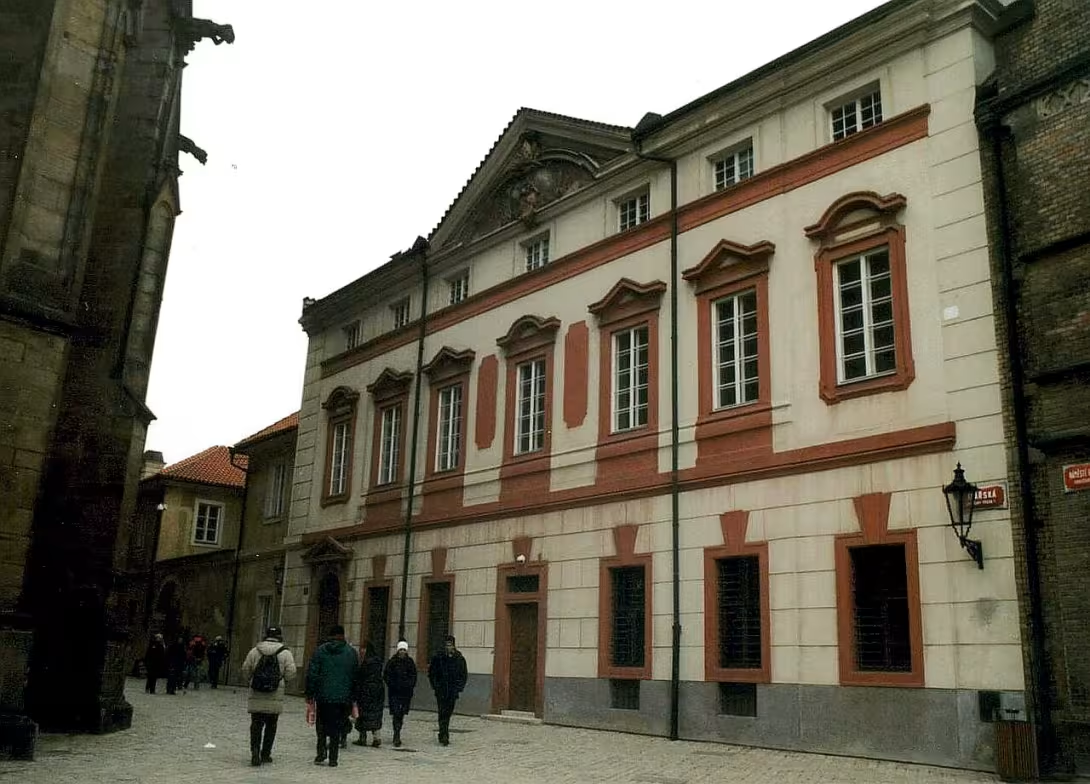
Vikářská is a historic street on Prague Castle in Prague. It leads from St George's Square to the west front of the Cathedral of St. Vitus, Václav and Vojtěv. It is remarkable from the Romanesque period to the Baroque reconstruction to historism. It is closely linked to the saint's surrender.
Already in Romanesque time, there was a building in the middle of the street called the monastery of the church of Prague. Members and servants of the chapter lived here later, although they probably lost their homes in the first half of the 16th century. The property was re-acquired after 1750, when the streets, according to the vicars, also got their current name. At certain times, for example in the 1980s, some of the buildings belonged to royal property.
Architectural space is defined by a cathedral that occupies the entire south side. A significant construction is the capitular deanery (No. 2, No. 37), which was rebuilt in the highest Baroque style by J. B. Santini. Its eastern part resembles a small palace. The lower left side is surrounded by a small courtyard, separated from the street walls with decorative metal lattice doors. In this yard is a commemorative record of Benedict Rejt who lived here.
Another building is Malá Vikárka (no. 4, no. 38), Baroque building from around 1700. In the 16th century there was a butler based over the light, which was the name of the Royal Lichtkomorra. The large Vikárka (No.6, No.39) consists of a narrow building without entrance from the street and Renaissance part. This one was later modified and has access to access ramps with staircases.
The neighboring house No. 8, No. 40 consists of Capitular School and Old Vikárka. The capitular school has a similar look and history to the western part of the neighboring house No. 39. Old Vikárka is a Neo-Renaissance building from 1877, built according to Josef Mocker's plans. The original building at this place had to be demolished because it reached into the space where the cathedral was built.
The key event in the newer historic street was the establishment of the restaurant Vikárka in 1845. It is based in the buildings of Capitular School and part of the Great Vicar. The establishment is famous for the mention in the stories of Mr Beetle by Svatopluk Czech Republic.
Vikářská offers visitors a concentrated view of the layered history of Prague Castle from Romanesque foundations to neo-Renaissance architecture. It is a place where the spiritual centre of the cathedral is joined with the daily life of capitular officials and traditional Prague gastronomy.
Then and now
Drag the slider to compare how the landmark may have looked when it was built with the view today.
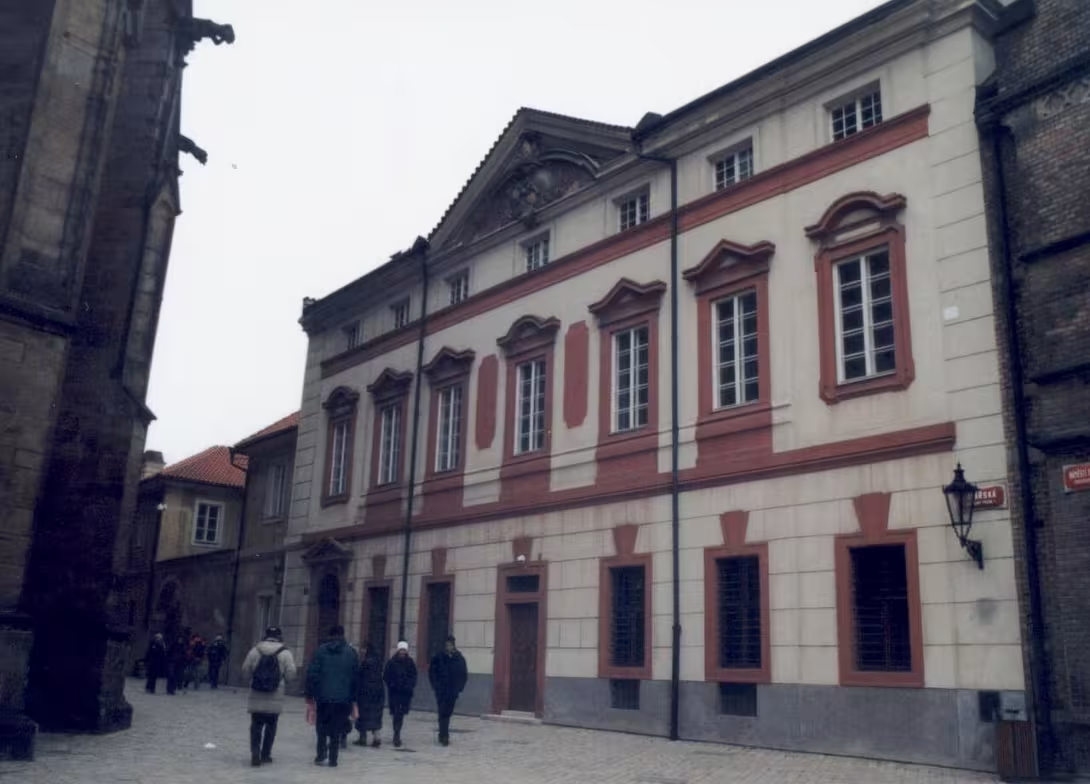
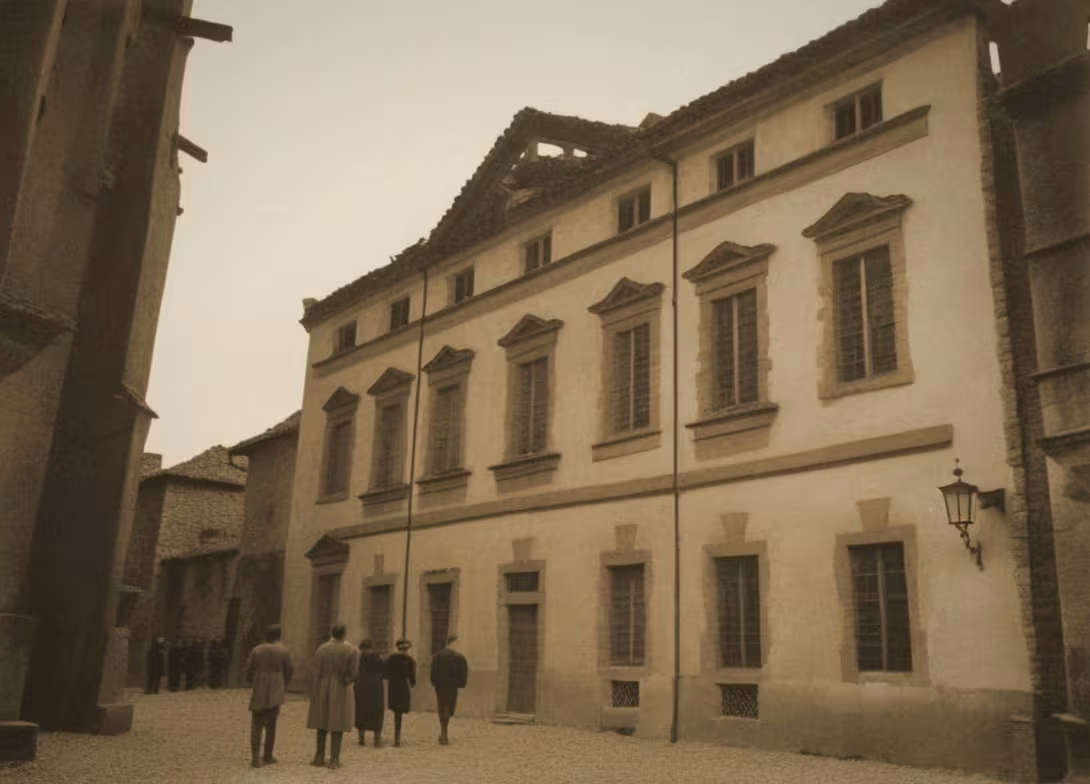
The historical appearance on the left is an AI-generated visualisation and serves as inspiration only.
Historical milestones
- around 1000
- The creation of Romanesque-style buildings and the seat of the chapter
- 1700
- Construction of the building Malá Vikárka in Baroque style
- 1750
- Recovering houses by surrender and the creation of the current street name
- 1845
- Establishment of restaurant Vikárka
- 1877
- Construction of the building Stará Vikárka according to plans of Josef Mocker
Architectural development
The street has evolved from the Romanesque monastery to Renaissance and Baroque reconstruction to historism. The capitular deanery was rebuilt at the top of the baroque J. B. Santinim, while the Old Vikárka was built in the late 19th century in a neo-Renaissance style.
Historical events
1845 - start-up of restaurant Vikárka; 1877 - drawing up plans of Josef Mocker for Neo-Renaissance Old Vikarka.
Owners
St. John's capital (Romanesque period, then again since the mid 18th century), royal property (including the 1980s of the 16th century)
Points of interest
- The street is remarkable from its development from the Romanesque period to the Baroque reconstruction to history. - Capitual deanery was remodeled in the Baroque style by J. B. Santini and in his court there is a board of Benedict Rejt. - The building of Little Vikárka was referred to as the Royal Lichtchamber in the 16th century, because there was a butler over the light. - Old Vikárka is a new Renaissance building from 1877 designed by Josef Mocker. - Restaurant Vikárka was established in 1845 and is famous for the mention in the stories of Mr Buček by Svatopluk Czech Republic.
Guide
This guide is narrated by a synthetic voice generated by artificial intelligence.
Show guide text
This text was created by artificial intelligence and has not been editorially reviewed. It may contain inaccuracies.
Welcome to one of the quietest and most mysterious corners of Prague Castle. You are standing just at the beginning of Vicar Street, which now invites you to walk towards the main facade of St. Vitus Cathedral. When you look around you, you realize you're not just in an ordinary alley, but in a space that breathes through history for over a thousand years. It is a place where different times collide, from the early Middle Ages to the more modern reconstructions of the international century. Feel this atmosphere of peace that contrasts with the noise of tourist currents in other parts of the castle.
Let's stop at the very beginning of this place. Imagine how there was about a year of thousands. At that time, during the period of Romanesque style, the first buildings were created here, which served as the seat of the capitula, a group of books managing the cathedral. The people here knew the church of Prague as a monastery. It was the basic support of spiritual life in the castle. It is this deep tradition that has determined the character of the entire street, which has been closely linked to the department administration for centuries.
Now, when you move on, pay attention to buildings that line your path. Notice how the shapes of houses and the details of their facades change. The street is a fascinating example of how architectural preferences have changed over the centuries. Here you will see elements of the Renaissance, which are light and harmonious, but also baroque elements, which bring more dynamics and expression to space. One of the most important points is the capitular dean. Look at its shapes, which at the time of the peak Baroque was transformed by the famous builder Jan Baptista Santini. His hand created a work that combines spiritual depth with architectural precision.
When you pass the dean's office, I suggest you take a look at his court. It is here that you will find a commemorative record dedicated to Benedict Rejt, a prominent figure who left his mark in the history of this place. It's a little detail, but it reminds us that every wall on this street has a name and a story.
Let's move on to the buildings that carry the name Vicar. Notice the building of Little Vikárka, which was built in Baroque style around 700. It's a building that holds an interesting secret. In the sixteenth century, it was referred to as the Royal LichtChamber. That sounds very special, but it basically meant that there was a royal candlestick chamber, a place where lighting was taken care of. It is fascinating to think that in the areas that we see today as silent historical houses, something as practical as providing light for royal needs was once dealt with.
The street name itself, Vikářská, which we know today, was fixed only after the mid-eighteenth century. In the year seven hundred and fifty houses reclaimed the capitula and with this new beginning came the present name. The vicar was in the church hierarchy a representative of a higher clergyman, and with this function the street name is connected.
If you keep going, you'll hit Old Vicar Building. It looks different from the baroque neighbors, and this is because it was built much later, namely in the year one thousand eight hundred seven days. Its author was Josef Mocker, who tried to return architecture to its historical core. Note how Mocker's work complements the overall picture of the street and concludes its development from the Romanesque period to the Baroque period to history.
The interesting thing that may surprise you is that this street has not always been the home of spiritual and administration. In the year one thousand eight hundred forty-five here was established a place for refreshments, restaurant Vikárka. Imagine the contrast - on the one hand strict capitular administration and on the other hand a place where people could enjoy a little rest and food in the very heart of the castle complex. In these areas, probably people from various social classes met, from high spiritual to castle staff and visitors.
In addition to Benedikt Rejt, other personalities, such as Svatopluk Čech, are associated with this space, who left his necessary trail in Prague. Even though his name may not be carved into every stone, the spirit of the time when poets and thinkers moved in these alleys is still there.
Now look around you again. This street is like an open book. Each house, every window and every facade is a different page from the history of Prague. It is a journey in time that begins in the dark Middle Ages, goes through the pomp of the baroque and ends in the precision of the deviant century. It is rare to find a place where these layers of time are so compact represented and where they do not shout at each other but complement each other.
Notice how this path naturally leads you to the main destination, the Cathedral of St. Vitus. Vikářská Street serves as a quiet prologue for the spectacular culmination of the temple itself. It's a transition from the intimate space of small alleys to the monumental space of the cathedral.
Now that you've explored the main features of this place, I suggest you stop for a while on this street. Try to disconnect from your inner haste and simply perceive the silence that exists here. Try to imagine how vicars walked through here centuries ago in their robes, how candles were shining in the Lichtkomoros, and how people gathered here in the court of the deanery to deal with matters of the Church and the State.
That concludes our short journey down Vicar Street. I hope you enjoyed this insight into the depth of Prague's history. Now you have just a few steps to the main facade of St. Vitus Cathedral, where you have another fascinating chapter of the Prague story. We wish you a pleasant further tour of Hradčan and enjoy every moment you spend in this magical city. Goodbye.
Tips for visitors
The best time to visit is early morning or late afternoon, when there are fewer people in the street and the atmosphere of the historical core of the castle is the most felt. Transport to this area is possible by car and public connections; Check specific routes and connections in current search engines.
In this part of the castle we recommend to take with us comfortable shoes suitable for walking on historic tiles. Since the monument is viewed from the outside, there is no need for any special equipment, only the willingness to walk.
For the best photos we recommend monitoring the impact of light on the facades of buildings. Ideal angles for pictures offer a view towards the main facade of St. Vitus, Václav and Vojtěv Cathedral, which dominates the end of the street.
Within a short walk in the area you can visit St George's Square or Prague Castle itself. All of these places are in the immediate vicinity.
Families with children appreciate the calmer character of this alley compared to the main tourist moves. Children can observe the details of the old buildings and enjoy the journey to the great cathedral.
Frequently asked questions
Can the monument be visited?
This is a structure in a public space that can usually be seen from outside free of charge. We have not verified that this particular one is freely accessible. According to the heritage register the structure is in poor condition – do not enter it and take care nearby.
Where is the monument?
Location: Hradčany, Hlavní město Praha. The map on this page shows the exact spot.
For kids
Imagine going back to when people lived here in small villages and grain grew in fields. It was a beautiful country with forests full of wild animals and rivers that flowed like silver water lines.
In this world there was also a small village where many people lived. They have fed on agriculture and animal husbandry. In the fields they grew grain which served them to eat and it was also possible to cook beer from it. Whoever wanted something extra could go into the woods and hunt wild animals. It was hard work, but it was paid for.
Businesses nearby
Do you run a restaurant, accommodation, shop, museum, rental, wellness or other visitor service near this monument? Show yourself directly to the people heading to it — this is how they will see you in the app and on the web:
Events nearby


Zdroj akcí: otevřená data měst a obcí ČR (Národní katalog otevřených dat) a kalendář akcí Národního památkového ústavu.
Nearby
Katedrála sv. Víta, Václava a Vojtěcha, náměstí U Svatého Jiří, Pražský hrad.
Accommodation nearby
Trips and activities nearby
Guided tours, tickets and activities nearby from GetYourGuide
Affiliate link: if you buy from the partner, we may receive a commission. The price for you does not change.
Search tours and activities →Themed route
Here is the design of the thematic route:
1. Prague Castle (Castle Complex) - The starting point of the trip, where you can admire the expansion of the whole complex. 2. The Cathedral of St. Vitus, Václav and Vojtěv (Temple) - A monumental building with a fascinating architecture that dominates the entire space. 3. Vikářská (others) (monument) - The main destination of the visit, which complements the spiritual atmosphere of the surroundings. 4. St George's Square (urban area) - a quiet place for a walk and a short rest.
Seasonal recommendations
In spring, the surroundings of the castle will awaken to life and bloom. Nature around the monument offers fresh colours and mild temperatures that accompany a pleasant atmosphere of restoration. We recommend visiting the place in the morning when the light is fine and wearing layered clothes so that you don't get caught by cooler morning air.
Summer brings bright sun and the highest temperatures, which make the facade details very visible. In the high season, however, there are the most people, so it is best to choose the time shortly before sunset when the heat is less. Remember light clothes, hat and plenty of water.
In autumn, the surrounding leaves turn into golden and red tones, creating a nostalgic mood. The lighting is softer and gilding during this period, which is ideal for the observation of architecture from the outside. Hot clothes and moisture-resistant shoes are suitable because the morning mist can be cold.
In winter there is a monument in silence and quiet, possibly in white snow. The atmosphere is dreamy, especially in advent time, when the surroundings glow lights. The best is to visit in times when the sun shines highest.
Visualizations and artistic views


The visualisations are generated by artificial intelligence and serve as inspiration.
Photos from the area
Real photos taken near the monument

Zdroj a licence jsou uvedeny u každého snímku.
Atmosphere of the place
This atmospheric visualisation of the place and period was generated by artificial intelligence. It is not real footage of the location.
Tips from visitors
No tips yet. Be the first!
Log in and add your tip.
Sources and literature
Photos: Martin Šanda (Šandík) / CC BY 2.5 — Wikimedia Commons. The author and licence also appear when you hover over the image.
Faktickým podkladem tohoto textu byl článek na Wikipedii, jehož autory jsou přispěvatelé Wikipedie. Článek je dostupný pod licencí CC BY-SA 4.0.
Location on the map
More monuments – Hradčany
Show all in the municipality

Příběhy a pověsti
Legendy, pověsti a příběhy spjaté s touto památkou
Fotografie návštěvníků
Zatím žádné fotografie. Buďte první, kdo přidá fotografii z návštěvy!
Log in a přidejte svou fotografii nebo hodnoťte.
Za ověřenou návštěvu v aplikaci získáte víc bodů — poznáme podle GPS, že jste na místě.
Reviews and comments