



Třetí nádvoří Pražského hradu Courtyard
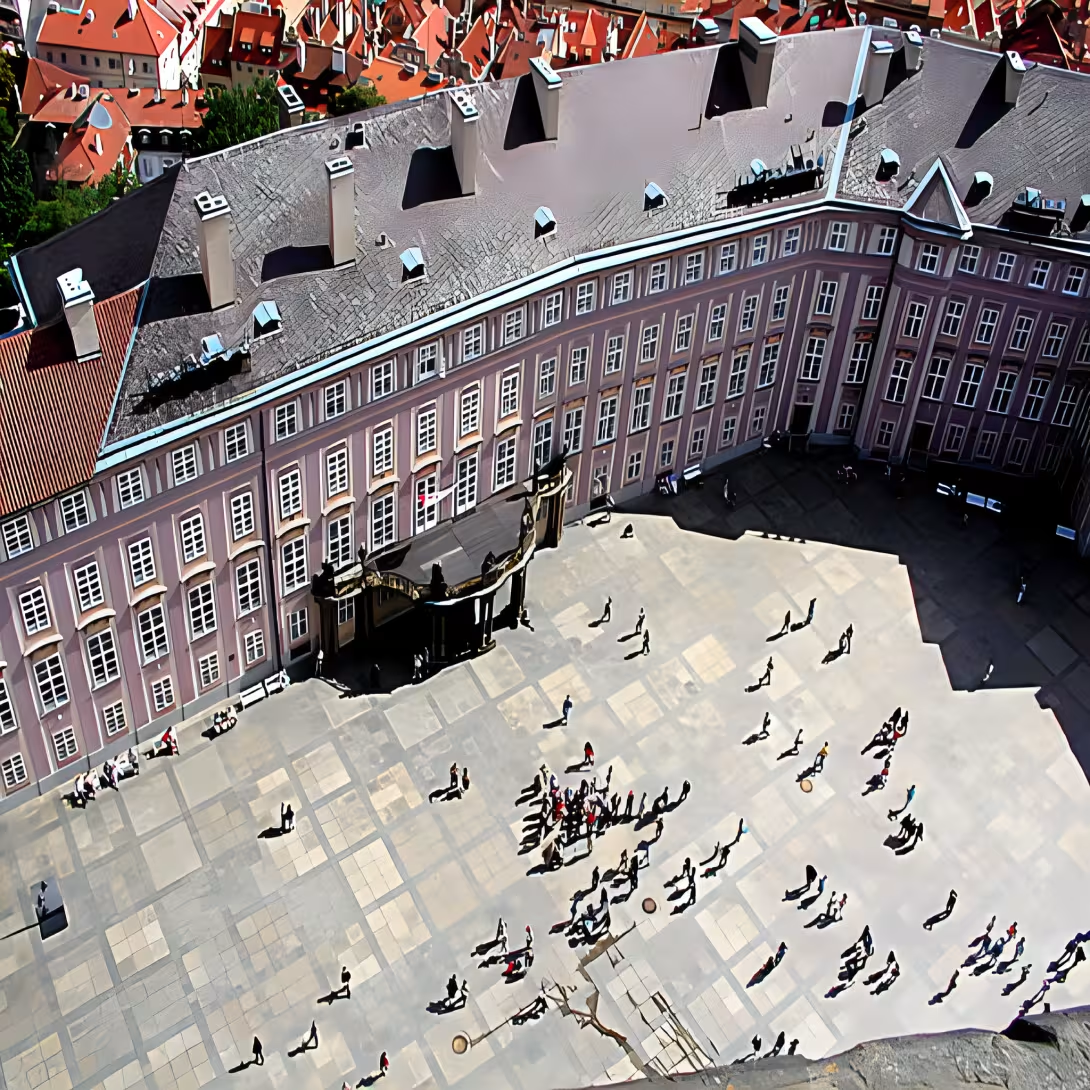
Třetí nádvoří Pražského hradu is the largest of the four courtyard in the Castle and at the same time the easternmost located. For over a thousand years, the centre of power and Catholic church of the Czech state has been concentrated here. The railway station forms the central part of the Castle, to which the entrance from the west is through the entrance from the second courtyard, in the north it passes smoothly to the Vikářská street and in the east it connects through the passage to St George's Square.
The courtyard is dominated by the Cathedral of Saint Vitus, Václav and Vojtěv with its западé two-prison front and the original Golden Gate on the south side. Next to it stands the building of the Old Probostness, a shelter with excavations, an obelisk from 1928 and a statue of St. George. On the east side of the courtyard is the medieval Old Royal Palace, on the west and south side of the newer palace building with the royal balcony, of which on 29 December 1989 shortly after his election as President of Czechoslovakia Václav Havel spoke. Before the entrance to the Old Palace is located the Eagle fountain and the Bull's staircase leads on the south side to the garden of Na Valech.
The original form of the courtyard was different from today. From the west, there was a rise that individual historians and archaeologists identify with the sacred hill of the Live mentioned in the Cosmo Chronicle. The remains of this high ground have been preserved under the Old Proboscy building. To the south, the territory sintered and the eastern part of the courtyard overloaded the ravine with the south flowing stream, which separated the eastern part of the island.
In the first half of the 9th century, the definition of the area is documented by a moat and subsequent extension of the area up to Hradčanská Square. At the same time, the discovery of a burial site with pagan burial elements originated. It is in the area of today's Obelisk and the Old Provost that an important grave of an arms fighter has been found. Around 880, the presence of the elite manifests itself at the first Church of the Virgin Mary in the western part of the castle and the Grand Moravian jewels in Lumbe's garden.
Under Prince Václav I, perhaps in 929, the church of St. Vitus was built in the courtyard as the third castle church, probably in the form of a single-apsid rotunda with an added southern apsid for storing Václav's remains. Around the middle of the 11th century, this rotunda was replaced by a three-boat basilica. In the 14th century, the Prince's Palace was rebuilt and Basilica was replaced by an unfinished cathedral. In the 15th and first half of the 16th century, the building of the palace and the cathedral gradually approached the conclusion and the courtyard was thus released from the previously built space.
The first Habsburgs (1526-1657) built new palace buildings along the south and west sides of the courtyard. Marie Terezie then united all three palace facades in one form, which has been preserved to this day. The cathedral was in 1873- 1929. After 1918 Jože Plečnik compared the area of the courtyard to one plane and incorporated new elements - obelisk, a new fountain with statue of St. George and Bull Stairs to the garden Na Valech.
Then and now
Drag the slider to compare how the landmark may have looked when it was built with the view today.
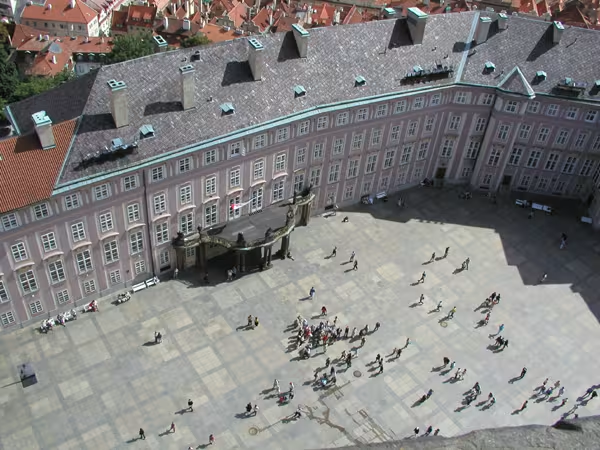
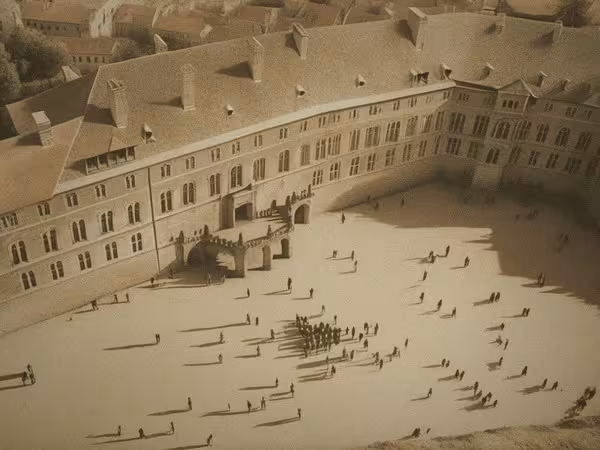
The historical appearance on the left is an AI-generated visualisation and serves as inspiration only.
Historical milestones
- 9th Century
- Supported presence of ruling elite
- 10th Century
- Construction of Saint Vitus rotunda
- 12th century
- The creation of a stone prince's palace
- 1928
- Location of obelisk
Architectural development
Originally arched terrain with high height and stream was gradually stopped by the palace and churches. In the 12th century a stone palace was established and in the 14th century it was replaced by a cathedral basilica. At the time of Marie Terezie the palace facade was unified and in the 20th century the space was leveled into the plane Jože Plečnik.
Historical events
On December 29, 1989, President-elect Václav Havel spoke from the royal balcony.
Owners
Czech State
Points of interest
The third courtyard is part of the complex of historical buildings and areas in Prague Castle.
It is located in its third part, which was originally fortified by the wall.
Guide
This guide is narrated by a synthetic voice generated by artificial intelligence.
Show guide text
This text was created by artificial intelligence and has not been editorially reviewed. It may contain inaccuracies.
The Third Courtyard is the main and largest of the four courtyards of Prague Castle. It is located furthest to the east, in the central part of the Castle, which has been the seat of power and the religious center of the state for over a thousand years. From the west, it is entered through a passage from the Second Courtyard. On the north, it seamlessly transitions into Vikářská Street. On the east, a passage leads between the cathedral and the Old Royal Palace to the square U Svatého Jiří. From the south, the Oxen Staircase leads down to the Na Valech garden.
The dominant feature of the courtyard is the cathedral of Saint Vitus, Saint Wenceslas and Saint Adalbert. It has a two-towered western façade, a tower and an original southern entrance, which is called the Golden Gate. In front of the cathedral stands the building of the Old Provostry, a shelter with excavation finds, an obelisk from 1928 and a statue of Saint George. The eastern side is formed by the medieval Old Royal Palace, in front of whose entrance is the Eagle Fountain. To the west and south stand newer palace buildings with a royal balcony. From it, on December 29, 1989, Václav Havel spoke, shortly after he was elected president of Czechoslovakia.
The present flat surface once looked completely different. From the west stretched a raised area, whose last remnant has been preserved beneath the Old Provostry. Some historians and archaeologists identify it with the sacred hillock Žiži, which is mentioned in Cosmas's Chronicle. Towards the south the terrain sloped down and the eastern part was crossed by a ravine with a stream. From the ninth century dates a burial mound with pagan burial features. Southwest of today's obelisk, the grave of a warrior with a sword, an axe and a dagger was found. The burial ground testifies that the ruling elite stayed here at that time.
Under Prince Spytihněv the First, the fortified settlement was surrounded by a rampart. Prince Wenceslas possibly had a church of Saint Vitus built around 929, likely a rotunda. In the second half of the eleventh century it was replaced by a three-aisled basilica. In the first half of the twelfth century, together with the fortification walls, a southern gate to the courtyard and a stone princely palace were created. In the fourteenth century the palace was rebuilt and in place of the basilica, the cathedral began to be built. The seat of the archbishop was then permanently moved outside the castle. Under the first Habsburgs, new palaces grew up along the southern and western sides of the courtyard. Their façades were unified by rebuilding under Maria Theresa. The completion of the cathedral took place between 1873 and 1929. After 1918, the architect Jože Plečnik leveled the courtyard to one plane and added a new obelisk, a new fountain of Saint George and the Oxen Staircase.
Tips for visitors
For the best experience we recommend a visit in the early morning or late afternoon when there are fewer crowds and light is more pleasant for the tour.
It is advisable to wear comfortable shoes until the tour, as you will be moving around in historical buildings. It is important to be prepared for a longer walk within the entire area.
For lovers of photography are the best places near St. Vitus Cathedral, where the architecture offers amazing shadows and depth. The best light for pictures of monumental buildings is during the morning or late hours of the day.
In the close vicinity you can explore Old Royal Palace or take a walk in Hradčanská Square. These historical points are very easily accessible directly from the courtyard.
For families with children is an ideal stop in the garden Na Valech, which offers a more pleasant environment for movement and rest than the main area.
Frequently asked questions
Can the monument be visited?
We have not verified whether this monument is accessible. Please ask the owner or operator, or the local municipal office.
Where is the monument?
Location: Hradčany, Hlavní město Praha. The map on this page shows the exact spot.
For kids
Imagine going back to the past, until Prague Castle has yet to be decorated with such beautiful buildings as we know today. It was a different era, a different time. And this place, the third courtyard, was at the center of it.
At that time there lived knights and warriors who prepared for the battle and defense of the castle against the enemy. They were men brave and strong. But there were also women and children living in huts and houses inside the fortifications.
Businesses nearby
Do you run a restaurant, accommodation, shop, museum, rental, wellness or other visitor service near this monument? Show yourself directly to the people heading to it — this is how they will see you in the app and on the web:
Events nearby


Zdroj akcí: otevřená data měst a obcí ČR (Národní katalog otevřených dat) a kalendář akcí Národního památkového ústavu.
Nearby
The Cathedral of St. Vitus, the Old Royal Palace, the Garden of the Valech, the Hradčanská Square.
Accommodation nearby
Trips and activities nearby
Guided tours, tickets and activities nearby from GetYourGuide
Affiliate link: if you buy from the partner, we may receive a commission. The price for you does not change.
Search tours and activities →Themed route
1. Hradčanská Square, Square: Historical site serving as an entry point to visit the castle. It offers a beautiful view of the surrounding architecture. 2. Třetí nádvoří Pražského hradu, courtyard: The main destination of the trip, which connects different parts of the castle area. It's the perfect place to feel history. 3. Old Royal Palace, Palace: Important historical residence of Czech monarchs. You can admire royal architecture here. 4. St Vitus Cathedral, Cathedral: Monumental Gothic Temple, which represents the most important building of the complex. It's a spiritual symbol of the state. 5. Garden Na Valech, Garden: A quiet place ideal for relaxing after a tour. It offers a pleasant environment near castle walls.
Seasonal recommendations
In spring, the space comes alive with a fresh green and fine light that highlights the details of architecture. The atmosphere is full of hope and awakening. I recommend wearing more layers of clothing because the weather is unstable at this time. It is best to visit the castle in the morning when the air is purest and the stream of tourists is still mild.
Summer months bring sharp sun and intense colors that create contrast shadows on stone tiles. In the high season there are large crowds of visitors. For comfortable movement choose light, breathable substances and come immediately after opening to avoid the greatest heat and the largest crowd of people.
Autumn season is characterized by golden leaves and often foggy wounds that give the monument a mysterious touch. Light is softer at this time and more pleasant for photography. Practical is the shoe with anti-slip sole due to moisture and visit in late afternoon hours when the sun falls beautifully on the wall.
In winter, the courtyard looks quieter and frosty, while the snow can highlight the outlines of buildings. In advent time, there is a strange, anticipating mood. Don't forget the warm gloves, the hat and the thermo-linens. Count on a shorter opening time and recommend a visit at noon when it is warmer.
Visualizations and artistic views


The visualisations are generated by artificial intelligence and serve as inspiration.
Photos from the area
Real photos taken near the monument

Zdroj a licence jsou uvedeny u každého snímku.
View from the area
This animation was generated by artificial intelligence from a real photograph of the surroundings. The motion and details are not real footage of the location.
Atmosphere of the place
This atmospheric visualisation of the place and period was generated by artificial intelligence. It is not real footage of the location.
Tips from visitors
No tips yet. Be the first!
Log in and add your tip.
Sources and literature
Photos: Jandy Stone / CC BY-SA 2.0, rozlišení zvýšeno umělou inteligencí — Wikimedia Commons. The author and licence also appear when you hover over the image.
Faktickým podkladem tohoto textu byl článek na Wikipedii, jehož autory jsou přispěvatelé Wikipedie. Článek je dostupný pod licencí CC BY-SA 4.0.
Location on the map
More monuments – Hradčany
Show all in the municipality


Příběhy a pověsti
Legendy, pověsti a příběhy spjaté s touto památkou
Fotografie návštěvníků
Zatím žádné fotografie. Buďte první, kdo přidá fotografii z návštěvy!
Log in a přidejte svou fotografii nebo hodnoťte.
Za ověřenou návštěvu v aplikaci získáte víc bodů — poznáme podle GPS, že jste na místě.
Reviews and comments