



Jiřská Street
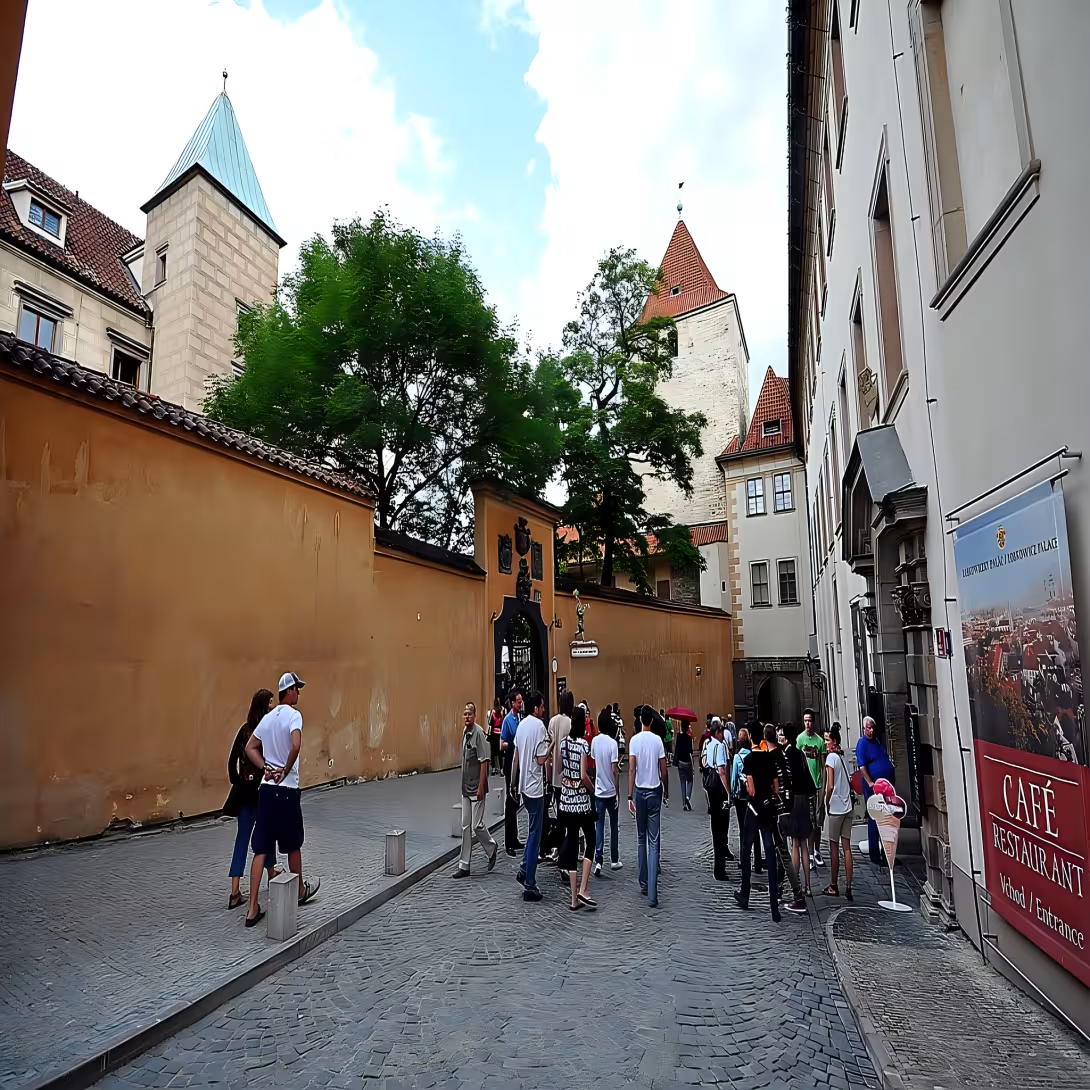
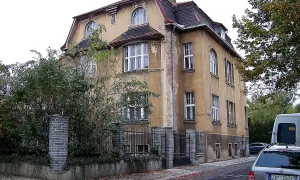
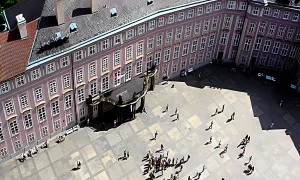
Jiřská is a street in the Prague Castle area in Hradčany, connecting the eastern entrance to Opyše with the square of St George's. It is an excellent development that shows architectural developments from Romanesque to modern 20th century adaptations.
The oldest part of the street is the Romanesque southern tower above the chapel of the Virgin Mary from the middle of the 12th century. In the early 13th century there was a chapel of St. Ludmila, whose floor was built in the 14th century behind Charles IV.
Jiří's architecture is varied. On the left side of the square dominates the southern part of St. George's Basilica and the Baroque chapel of St. John Nepomuk from the beginning of the 18th century. A copy of the late Gothic relief of St. George's stands in the early Renaissance portal. You will also find the building of the Jiří monastery with the eastern court, behind which was once the cemetery and the monastery chapel of St. Anne with the original Romanesque entrance and window. The wing of the monastery, separated from the chapel by a narrow dead end, was built until the end of the 17th century.
On the left side, the Podkybníkovské house, originally Renaissance, was rebuilt in the 19th century and today modified by Pavel Janák in Renaissance style. Next to it stands a Baroque house from the 18th century, also classicically modified by Janák, and a St. Florian house, renaissance with Baroque reconstruction from the 17th and early 18th centuries.
A significant part of the area consists of the Old Purcraby, which includes a Renaissance building with a tower, a Baroque wall with a gate and coats of arms of the highest purcrabs. In the courtyard there is a Black Tower with an annex and a Renaissance eastern gate. Also included are Lobkovická horticulture, known as the Small Lobkovic Palace from the 17th century. In 1961- 1963, the space was converted into a house of children. On the right side of the square there is the Institute of nobility and Lobkovický Palace.
Among the attractions are the terrace in front of the wall separating the Purkraby and the Golden Lane, where summer Shakespearean festivities are held. There's a stairwell and a passageway to Golden Lane.
Jiřská is a unique place for lovers of Czech architecture thanks to the concentration of historical buildings. The walk here allows you to see Romanesque, Gothic, Renaissance and Baroque elements in one place.
Then and now
Drag the slider to compare how the landmark may have looked when it was built with the view today.
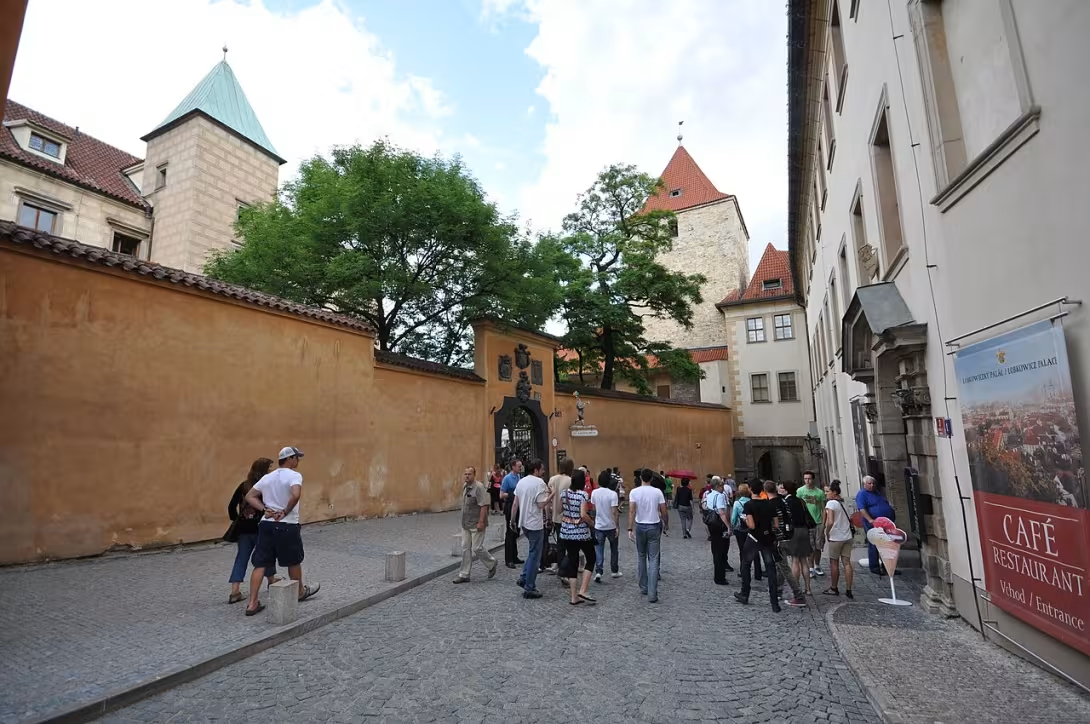

The historical appearance on the left is an AI-generated visualisation and serves as inspiration only.
Historical milestones
- 1150
- romanesque southern tower above the chapel of Our Lady
- 1300
- the creation of the chapel of Saint Ludmila
- 1961
- start modifications of the premises at the Old Purkraby on the Children's House
Architectural development
The building of the street includes Romanesque elements from the 12th century, Gothic adaptations from the 14th century and Renaissance palaces. In later times there were baroque houses and in the 20th century Pavel Janák made modifications to some buildings. In 1961- 1963, the Old Purgrave complex was adapted to the Children's House.
Points of interest
- The building of the street shows the architectural development from Romanesque style to modern modifications of the 20th century. - The oldest part is the Romanesque southern tower above the chapel of the Virgin Mary from the middle of the 12th century. - A copy of the late Gothic relief of St. George's stands in the early Renaissance portal. - The Old Purcraby area includes a Renaissance building with a tower, a Baroque wall with a gate and the highest purple coats of arms. - Summer Shakespearean festivities are held on the terrace outside the wall separating the purcraby and the Golden Lane.
Guide
This guide is narrated by a synthetic voice generated by artificial intelligence.
Show guide text
This text was created by artificial intelligence and has not been editorially reviewed. It may contain inaccuracies.
Welcome to the heart of Prague Castle. You've just entered one of the most fascinating streets of the entire campus. You are standing in Jiří Street, which now surrounds you with its calm yet noble atmosphere. If you look around you, you'll see an area that connects the east entrance to the castle complex in Opyše with St. George's Square. It's where time stopped and where you can feel the hollow space of history in every stone. In front of you is a path that is not just ordinary communication, but a real library in a stone that tells you the story of how our capital and its castle have changed for many centuries.
Let's stop at the very beginning of this place together. Jiřská street is not only a part of the castle, it is a living proof of the development of Czech construction. History begins here in the middle of the twelfth century. Imagine what this place looked like around a thousand hundred and fifty. At that time there was a Romanesque southern tower standing above the chapel of the Virgin Mary. It is the oldest part of the entire space and it serves as an anchor that brings us back to the early Middle Ages. A few centuries later, about a thousand three hundred, the chapel of St. Ludmila joined the premises. These places were not built randomly, they were part of the wider development of the castle area, which was intended to serve as the seat of power, faith and administration of the whole kingdom.
Now that you're right on the street, I suggest you pay full attention to the surrounding buildings. Notice how the shapes and lines of buildings are gradually changing in front of you. Jiřská street is a unique architectural cross section. If you look closely, you'll see the structures next to you from completely different times. From the Romanesque tower to the elegant Renaissance palaces to the Baroque chapel. It is incredible that in such a small space you can watch how the taste of builders changed and how the masonry techniques developed. Note also the buildings that make up the walls of this street. Among them are important buildings such as the Lobkovsky Palace or the Old Purcraby. These buildings give the street its specific character and remind us that people from the highest social classes lived and worked here.
Let me now draw your attention to one very specific detail, which you could easily overlook, but which is extremely valuable. Look at the early Renaissance portal. In its upper part, in a space called tympanone, you'll see a relief. It's a copy of the late Gothic depiction of St. George. This detail is a beautiful example of how different styles combined over time. The Gothic element is inserted here into the Renaissance frame, which creates a harmonious whole. It is a small piece of art that reminds us of the victory of good over evil and the courage embodied by Saint George, who is also the namesake of this street.
When we think about the people who left their trail here, we can't forget personalities like Charles the Fourth. Although some places were built sooner or later, its influence on the whole Prague Castle was crucial. He has made Prague the centre of the empire, and it is thanks to such an approach to the development of the city that we can admire this rich development today. Jiřská Street witnessed the arrival of kings, leaders and senior officials. Instead of the old purcraby you see here, it's been the center of the castle administration and surrounding territories for centuries. It was a place where important matters of the state were decided, where disputes were held and documents were signed that affected the lives of thousands of people.
Now let's think about one interesting thing that might not be visible at first sight, but that gives the street a new dimension. The entire construction of Jiří Street is actually a timeline. If you start at the oldest Romanesque tower in the twelfth century and move on, you will go through the entire development to modern 20th century adjustments. A very interesting point is the year one thousand nine hundred sixty-one, when the modifications to the premises of the Old Purkraby began so that the Children's House could be created. Above these changes was the architect Pavel Janák, who tried with respect to history to adapt space to the new needs of the time. It's fascinating how an old place like this can transform and still remain useful to new generations without losing its soul.
Try to stop for a while and just feel the atmosphere. Imagine the sound of hoof horses on a stone tile, rustling robes of summer, and silent conversations of courtyards. Jiřská Street is not just a set of buildings, it's a space that breathes. It's a place where ancient Romanesque brutality meets Renaissance lightness and baroque expansion. Every house here tells a different story. One speaks of the power and wealth of noble generations, another speaks of deep faith and silent prayer seclusion in the chapel, and another speaks of administration and order of purcraby.
If you look at the facades of the house, feel how different their rhythm is. From the massive walls of the Romanesque period, which were mainly meant to protect and be stable, to more open and decorative shapes of later centuries. This contrast is precisely what makes Jiřská Street so special. It is not a sterile museum where everything is from one period, but it is an organic organism that grew and changed together with Prague.
Now that you have become acquainted with my escort and the history and architecture of this place, I suggest you continue to explore. Let your curiosity guide you. Walk the street slowly, touch the cold walls and look again at the details we talked about. Notice how light hits the old wall and changes shadows during the day. Jiřská Street still has many secrets that only reveal to you if you devote your time and attention to it.
I hope this short trip over time has helped you better understand the importance of this space. It's one of those places where history can't just be read in books, but it can actually be felt. Remember, every step you take after these paving blocks is a step in the footsteps of the thousands of people who passed through here before you.
Thank you for walking down this beautiful street. It's up to you now. Explore the surroundings, perceive the silence of the castle area and be inspired by the genius of our ancestors. I wish you a pleasant rest of the visit to Prague Castle and a wonderful experience while rediscovering this magical city. Goodbye.
Tips for visitors
The best time to visit is early in the morning or just before sunset, when the sun lights beautifully illuminate historical facades. For a pleasant walk we recommend spring or autumn months.
You can reach the location on foot or use public transport; Check the internet search for the current connection.
For photography we recommend to follow the shadows in narrow places, which gives the images depth. Bring comfortable shoes and water.
There are interesting places in the area such as St. George's Basilica, Golden Alleys or Lobkovsky Palace. The whole area of Prague Castle offers many corners to admire.
For families with children, this journey is interesting thanks to all the old buildings that seem like fairy tales.
Frequently asked questions
Can the monument be visited?
This is a structure in a public space that can usually be seen from outside free of charge. We have not verified that this particular one is freely accessible.
Where is the monument?
Location: Hradčany, Hlavní město Praha. The map on this page shows the exact spot.
For kids
Imagine going back to the past, when our country was really magical and full of secrets. It was a time when legends went hand in hand with reality. And it is such an extraordinary monument to Jiřská, an old castle situated near our city.
It was like a game where life and death were played. The inhabitants of the castle lived among walls that protected from danger, but also from mystery. Who lived here? They were knights who fought for their kings and queens, they were priests who prayed for peace and happiness. And there was a castle lady who had her own key to the mystery door.
Businesses nearby
Do you run a restaurant, accommodation, shop, museum, rental, wellness or other visitor service near this monument? Show yourself directly to the people heading to it — this is how they will see you in the app and on the web:
Events nearby


Zdroj akcí: otevřená data měst a obcí ČR (Národní katalog otevřených dat) a kalendář akcí Národního památkového ústavu.
Nearby
Pražský hrad, bazilika svatého Jiří, Zlatá uličky, Lobkovický palác.
Accommodation nearby
Trips and activities nearby
Guided tours, tickets and activities nearby from GetYourGuide
Affiliate link: if you buy from the partner, we may receive a commission. The price for you does not change.
Search tours and activities →Themed route
Here is the design of the thematic route:
1. St George's Basilica - church. It's a place with a long history that serves as a gateway to the premises. 2. Prague Castle - the seat of the monarchs. It offers unique architecture and views of the whole city. 3. Golden aisle - a series of small houses. It fascinates with its atmosphere and history of craftsmen. 4. Lobkovic Palace - noble house. A place where rare works of art can be admired. 5. Jiřská (others) - the main target. Final stop for a deeper understanding of a particular place.
Seasonal recommendations
In the spring, the surrounding area flourishes and the young green is accompanied by fresh air. The sun lights the facades gently in the morning, which is ideal for photography. We recommend light layering of clothing, because in the shade of the castle streets can still be cold.
Summer brings intense light and hot air, which permanent architecture reflects well. There are the most people in the season, which is why it is best to go out at dawn when peace and air are refreshing. Don't forget the hat and plenty of water.
The autumn colors the surrounding trees into gold and red, creating a nostalgic atmosphere. The light is softer and golden, which highlights the details of the building. It is suitable for waterproof clothes and shoes that can handle the wet surface of the pavement.
In winter, there is a monument in silence and frost, possibly under a layer of snow, which gives it an etching elegance. In advent time, the surroundings are lit and cozy. It is necessary to wear a warm coat, wool gloves and a hat so that a walk from the outside brings you joy.
Visualizations and artistic views


The visualisations are generated by artificial intelligence and serve as inspiration.
Photos from the area
Real photos taken near the monument


Zdroj a licence jsou uvedeny u každého snímku.
Atmosphere of the place
This atmospheric visualisation of the place and period was generated by artificial intelligence. It is not real footage of the location.
Tips from visitors
No tips yet. Be the first!
Log in and add your tip.
Sources and literature
Photos: Ralf Roletschek (talk) - Fahrradtechnik auf fahrradmonteur.de / FAL, rozlišení zvýšeno umělou inteligencí — Wikimedia Commons. The author and licence also appear when you hover over the image.
Faktickým podkladem tohoto textu byl článek na Wikipedii, jehož autory jsou přispěvatelé Wikipedie. Článek je dostupný pod licencí CC BY-SA 4.0.
Location on the map


Příběhy a pověsti
Legendy, pověsti a příběhy spjaté s touto památkou

Fotografie návštěvníků
Zatím žádné fotografie. Buďte první, kdo přidá fotografii z návštěvy!
Log in a přidejte svou fotografii nebo hodnoťte.
Za ověřenou návštěvu v aplikaci získáte víc bodů — poznáme podle GPS, že jste na místě.
Reviews and comments