






Na baště sv. Ludmily Castle
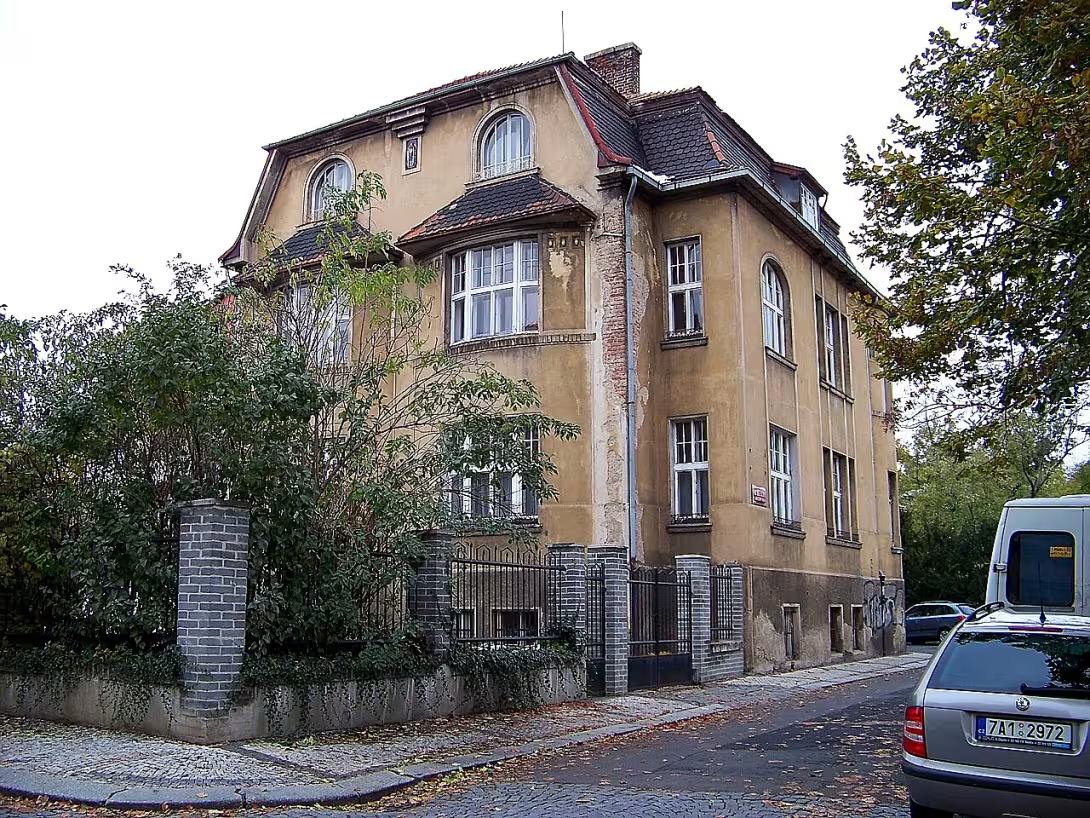
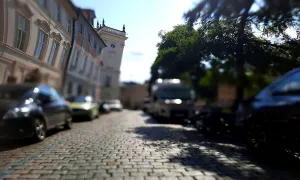
Na baště sv. Ludmily is a street connected with one of Prague's most beautiful places. It forms an arch north of Mickiewicz Street and is named after the bastion of St. Ludmila, which was part of the Mariánska wall - barroc fortification of Prague Castle. Like the neighboring streets of St. Thomas' Bastion, this historic fortification from the turn of the seventeenth and eighteenth centuries follows.
The street painting changed dramatically at the turn of the nineteenth and twentieth centuries. When the fortifications began to break down in the early twentieth century, a place for a new installation opened up. From 1910 to 1913, a luxury villa district grew here - especially on the markets of St. George, St. Ludmila and St. Thomas. The builders concentrated the series "kotay" houses, villas and twin houses, which became part of one of Prague's most exclusive locations. The architectural solution respected the landscape and historical lines of fortification structures, creating a unique urban space.
The surrounding streets form natural elements, especially Charlotte G. Masaryk Park. He was previously known as Park or orchards near the Sandy Gate and since 1971 he has been protected as a cultural monument of the Czech Republic. The park creates the open, green-band character of the district and makes an ideal counterweight to residential buildings.
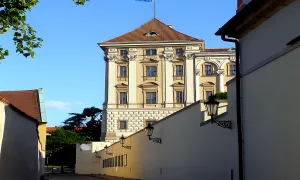
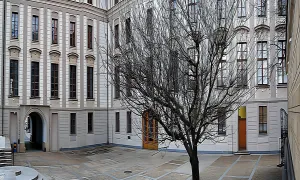
The street features period villas with rich details. Interesting buildings include a villa with painted facade on the number 9, which shows the quality of the original building. Individual houses and villas bear the characteristics of the beginning of the twentieth century and formed, and to some extent formed, a symbol of the higher social position of their owners.
Today the street Na baště sv. Ludmily is a place where history of Prague Castle fortifications is crossed with a model example of the Czech Empire of the 20th century. The blending of the original historical fortification with the modern villa area makes this place in Hradčany interesting for those who understand the layering of Prague history and architectural development.
Then and now
Drag the slider to compare how the landmark may have looked when it was built with the view today.
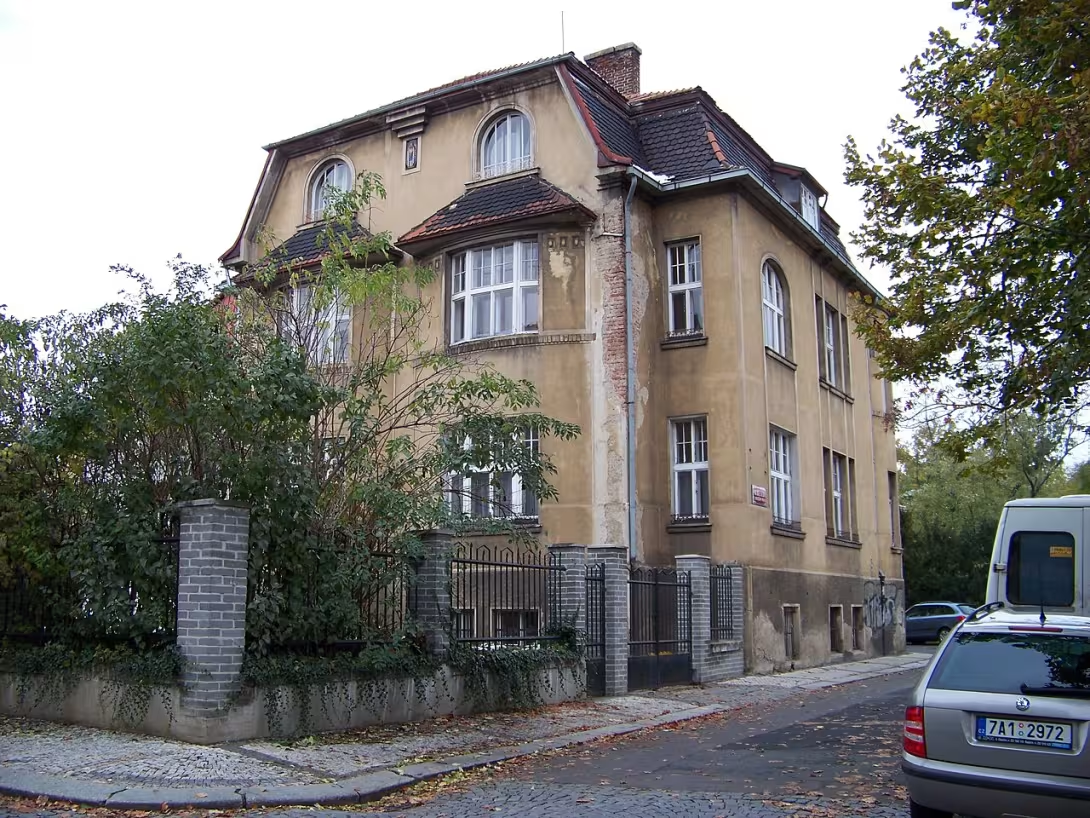

The historical appearance on the left is an AI-generated visualisation and serves as inspiration only.
Historical milestones
- Around 1680-1700
- The creation of the Mariánska castle as part of the fortification of Prague Castle, including the bastion of St. Ludmila.
- 1910-1913
- The cornerstone of the luxurious residential district in the place of former castle baskets, including St. Ludmila's bastion.
- 1971
- Park at the Sandy Gate (today Masarykova) registered as a cultural monument of the Czech Republic.
Architectural development
St. Ludmila's bastion was part of Mariánska walls, which were built in Baroque style. The walls served as a defence system of Prague. After the demolition of the walls in the first half of the 20th century, the bastion was demolished and a street with villas was formed in its place.
Historical events
- 1250
- The castle was built in a Gothic style.
Owners
The castle owners are not known.
Points of interest
- The street Na baště sv. Ludmily copies the course of the Mariánska wall, the Baroque fortification of Prague Castle from the turn of the 17th and 18th centuries.
- From 1910 to 1913 there was a luxury villa district on three bastions, which became one of Prague's most exclusive locations.
- Charlotte G. Masaryk's Park, formerly known as the Sandy Gate Park, has been protected since 1971 as a cultural monument.
- The villa on number 9 features a painted facade with rich details, typical of the beginning of the 20th century.
Guide
This guide is narrated by a synthetic voice generated by artificial intelligence.
Show guide text
This text was created by artificial intelligence and has not been editorially reviewed. It may contain inaccuracies.
Welcome to the heart of historic Prague, one of the most picturesque and mysterious neighborhoods of our city, in Hradčany. You are standing in a place that is a fascinating example of how the face of the metropolis changes over the centuries. You may now see it as a quiet, highly representative neighborhood, full of elegance and history, which manifests itself in every detail of the surrounding buildings. Perhaps you only perceive the calm and the sense of luxury that radiates from the surrounding residences. But try to stop for a moment, soak up the atmosphere of this place and realize that you're standing on the threshold of two completely different worlds. Under your footsteps, there is not only an ordinary path, but an invisible trace of something that once formed an impenetrable stone barrier between the city and the castle. You're standing right where St. Ludmila's monumental bastion once throned.
Let us return together to a time when Prague's safety was a matter of top priority and when its borders were engraved with the strength of stone and dust from the workplaces. Imagine the end of the 17th century. It is the year around the sixteenth to seventeenth, and Praha is undergoing a major modernization of its fortifications. Within this magnificent project, the walls of Mariana are built. It was not just an ordinary wall, but a complex baroque defense system to protect Prague Castle and the whole city from possible attacks. Saint Ludmila's bastion was one of the key points in this system. Imagine the structure that dominated the area at the time and was designed to be not only strong, but also functional within the military strategy at the time. This bastion was part of a wall that surrounded the castle as a shield, a symbol of strength and resilience.
Now pay attention to your immediate surroundings. Although the Baroque bastion itself is no longer visible and its stone shapes have long since been removed, its presence here is still strong and relentless. Look at the course of the street you're on right now. The streets of St. Ludmila's Bastion are not built randomly. If you notice her curvature, you'll see that her direction exactly copies the arc of the former Mariana walls. It's like an invisible print of history that was carved into the very structure of the city. This street is living proof of where soldiers used to move and where massive walls were built. Even though you're looking at more modern architecture today, this line still leads you along the paths of ancient fortifications. It's fascinating geometry that leads us through time.
However, we must now move on to a period where the role of this place has completely reversed. The transition from military to era of luxury was very crucial. In the first half of the twentieth century, the need to maintain the old fortifications began to disappear and the city began to change into a modern metropolis. Between a thousand and nine hundred and ten and a thousand and nine hundred thirteen, a decision was made that changed that view forever. Marian walls have been dismantled. A whole new chapter of history began to emerge in a place where there were old bastion and strong walls. On three bastions, including this very bastion of St. Ludmila, a luxurious villa district was built. This area became immediately one of the most exclusive and prestigious locations in Prague. A place that used to serve defense and war turned into a place for the richest and most important people in the city. This contrast between military determination and aristocratic elegance is still felt here.
It's fascinating to see these two conflicting ages unite in one space. A park we now know as Masaryk is situated just a short distance from you, but its history is even deeper. It used to be called Charlotte G. Masaryk Park and in the year one thousand nine hundred seventy one it was registered as a cultural monument of the Czech Republic. This space gives the whole area peace and reminds that even in the heart of the busy metropolis there are places to relax and remember. It's like a green breath that complements the architecture of this place.
You may now wonder if there is a hidden mystery in this place. It's this invisible line. Even when you look at beautiful villas, each one stands in a place that once was a part of a hard fortress. It's like you're walking around a city with your own memory. The street you walk on is a map of the old world, which modern Praha merely changed into new clothes.
Let this walk lead you further through the beauty of the Hradman. Every step you take leads you along a line that once determined the fate of Prague. So continue your search, perceive the atmosphere of this place and look around you, knowing that you are standing in a place where military determination was confronted with the highest social elegance. Thank you for choosing to make this journey with us.
Frequently asked questions
Is Na baště sv. Ludmily open to the public?
Yes, it is open to the public throughout the year, but it is necessary to respect restrictions and warning signs on the spot.
How do I get to the place by car / public transport?
The best option is parking in the nearby town and walking to the castle. The public transport is not available directly at the monument.
How much is the entrance fee and is it paid on the spot?
Admission is paid on site, the current price list can be found on the official site of the sights.
Is the tour suitable for children and seniors?
The tour is suitable for families with children, but we recommend taking care of the elderly for demanding terrain.
How long does the tour take?
The total length of the tour depends on the individual pace and interest of the visitors.
What are the opening times and booking is required?
The monument is open all year round, but we recommend visiting it during spring or autumn months for better weather.
What's interesting in the immediate vicinity?
In the vicinity there are forests and fields that are suitable for hiking and cycling.
For kids
Imagine going back to the past to the time of King Rehysl Otakar II. At that time, the mighty bastion of St. Ludmila was built in this place. It was a heavily fortified fortress where people had resorted in case of danger.
How did it look here? Who lived here? What happened here? Imagine you're a little knight with a sword and shield. You went down a muddy road that leads to the castle. The road was covered with grass and bushes. As soon as you get closer, you hear people's voices.
Businesses nearby
Events nearby

Zdroj akcí: otevřená data měst a obcí ČR (Národní katalog otevřených dat) a kalendář akcí Národního památkového ústavu.
Nearby
{'street': 'Mickiewicz Street, St Thomas', 'sights': [[{'name': 'Prague Castle', 'distance': 'close, north of the street'}, {'name': 'Charlotte Park G. Masaryk Park', 'distance': 'neighborhood'}], 'natural _ elements': None}
Accommodation nearby
Trips and activities nearby
Guided tours, tickets and activities nearby from GetYourGuide
Affiliate link: if you buy from the partner, we may receive a commission. The price for you does not change.
Search tours and activities →Themed route
Thematic tour of the Hradčany with a visit to St. Ludmila's bastion
1. St. Ludmila's bastion * Type: * Historical wall with view * Why? * The unique part of the original Prague castle fortifications from the 12th century, which offers picturesque views of Prague Castle and surrounding urban landscape. Here you can get acquainted with the architecture of medieval defence and feel the atmosphere of old Prague.
2. Prague Castle (entrance area from Mickiewicz Street) * Type: * Royal residence Why? Although the main part of the castle is extensive, the entrance part near Mickiewicz Street offers the opportunity to explore the area of the bastion and build on its historical context. There is also Park Charlotte G. Masaryk, which is ideal for a short rest period.
3. Park Charlotte G. Masaryk * Type: * Green area with monument * Why? * A quiet place with a monument to the first republic and picturesque trees that offers a rest after walking through the walls. The park is also an excellent place for short relaxation and observation of nearby monuments.
4. To St. Thomas' Bastion * Type: * Street with historical significance * Why? * A short walk along this street will allow you to see other parts of the castle fortifications and build on the atmosphere of medieval Prague. The street is also the starting point for returning to St. Ludmila's bastion.
This route allows you to explore the historic fortification of Hradčan and to follow the important monuments in their immediate surroundings.
Seasonal recommendations
Spring Na baště sv. Ludmily is awakening to a new life in the spring months. The sun illuminates the remnants of the walls with fine, scattered light, which attracts the walks between green trees and the first flowers. The atmosphere is light, the air is clear and full of the smell of flowering trees. This is an ideal time to visit, avoiding crowds and enjoying peace. I recommend a visit in April when the weather is pleasant but not as hot as in summer. Light clothes are suitable, but don't forget the raincoat. The best time to visit is early morning or late afternoon when there are fewer people in the memory.
Summer In the summer months, crowds of tourists gather at St. Ludmila's Bastion, who come here in sunny weather and pleasant atmosphere. The sun shines directly and intensively, creating a contrast between the shady sections of the walls and illuminated areas. Nature is full of beauty, with lush greenery and sometimes flowers that attract bees and butterflies. In the main summer season it is necessary to count with great interest in this location, therefore it is advisable to come before 9 am. Light, airy clothes and plenty of water are recommended as temperatures often exceed 25 degrees Celsius. Don't forget your sunglasses and hat to protect yourself from sunlight.
Autumn The autumn of St. Ludmila's bastion brings a unique atmosphere where leaves on trees are painted in golden, orange and red shades and fall on the remnants of walls. The sun shines low here, creating long shadows and golden sparkles on rocks. The air is colder but still pleasant, and nature offers peace and quiet, which is suitable for meditation or photography. In this period there are far fewer people in the memory than in summer, which allows a peaceful visit. Suitable is clothes in warm colors, which are suitable for autumn environment, and do not forget a warm sweater or jacket. The best time to visit is in September when temperatures are still pleasant, but it starts to cool.
Winter In winter months, St. Ludmila's bastion becomes a place of peace and quiet, surrounded by snow and ice. The sun shines weak and short here, creating a frosty but beautiful atmosphere. Nature is covered with white coating, which gives the place a magical impression. In advent time there are often small markets with Christmas gifts and sweets that add to the atmosphere of Christmas mood. A warm and comfortable outfit is suitable to protect you from the cold. The best time to visit is in the morning when there are fewer people in the memory. The opening hours are shortened in winter, so check out the current times before visiting. Don't forget the warm gloves and hat to enjoy the beauty of the winter environment.
Visualizations and artistic views


The visualisations are generated by artificial intelligence and serve as inspiration.
Photos from the area
Real photos taken near the monument


Zdroj a licence jsou uvedeny u každého snímku.
Atmosphere of the place
This atmospheric visualisation of the place and period was generated by artificial intelligence. It is not real footage of the location.
Tips from visitors
No tips yet. Be the first!
Log in and add your tip.
Sources and literature
Fotografie: ŠJů (cs:ŠJů) / CC BY-SA 3.0 — Wikimedia Commons. The author and licence also appear when you hover over the image.
Faktickým podkladem tohoto textu byl článek na Wikipedii, jehož autory jsou přispěvatelé Wikipedie. Článek je dostupný pod licencí CC BY-SA 4.0.
Location on the map

Příběhy a pověsti
Legendy, pověsti a příběhy spjaté s touto památkou
Fotografie návštěvníků
Zatím žádné fotografie. Buďte první, kdo přidá fotografii z návštěvy!
Přihlaste se a přidejte svou fotografii nebo hodnoťte.
Za ověřenou návštěvu v aplikaci získáte víc bodů — poznáme podle GPS, že jste na místě.
Reviews and comments