



klášter minoritů v Mladé Boleslavi Monastery
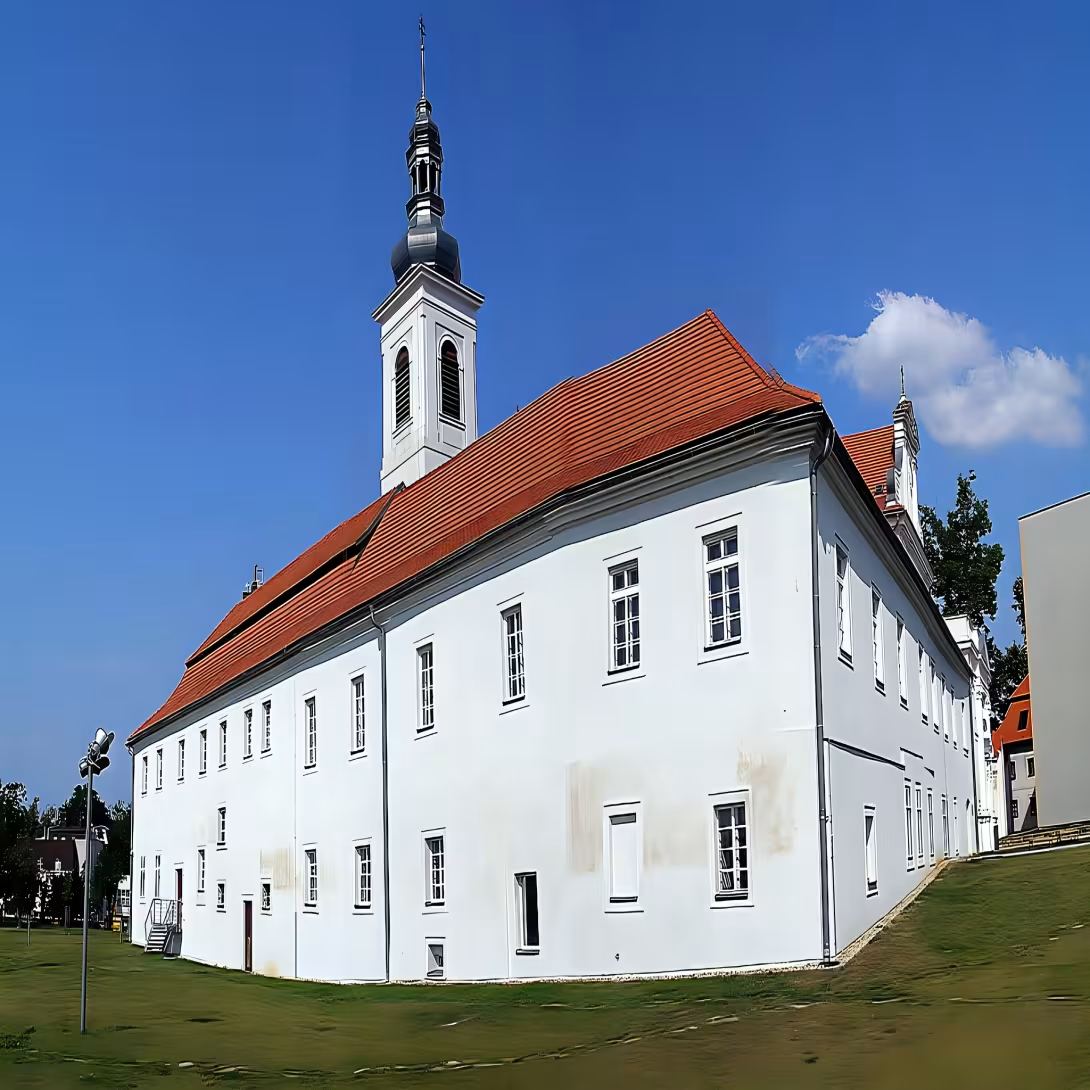
The Minorite monastery in Mladá Byslav, protected as a cultural monument of the Czech Republic, had one of the most subdued histories among Central European monasteries. Although its precise beginnings remain unclear, according to historian Antonín Ludvik Frinda was founded in 1293 when Jan of Michalovic - a nobleman who had made a scientific journey to France and then invested in the construction of a temple with a monastery in a place called Carmel. The monastery has inhabited fifteen monks and five lay brothers. Other researchers, however, considered the actual date of establishment of the year 1345 or 1354, when a significant reconstruction took place in the care of Beneš z Michalovice. At that time the monastery was extended and the ten new conventions were consecrated by Abbot Oldřich, who came from the Benedict Order. The lords of Michalovice remained faithful supporters of the monastery, which soon enjoyed abundant legacies and prosperity.
This time ended in the arrival of the Hussite. In 1421 the monastery was destroyed by hail and its monks expelled. However, the buildings remained standing and were occupied by Czech brothers around 1500, who created a brotherly prayer house and named it the selon of the original tradition of Karmel Mountain.
In the beginning of the anti-reformation in 1625, Mount Carmel was given the order of barefoot carmelitans who mistakenly believed it was their former convention. But the Minorites rightly proved their historical rights and returned to the monastery in 1630. During the Thirty Years' War, the Bosnian Carmelitans failed to meet their intentions - their activities were a direct downturn and they failed to devote themselves to more extensive things.
The restoration of the monastery began after the Thirty Years War and lasted for decades. In 1675-1711 the Minorites repaired the complex and built a new temple of St. Bonaventura, although it was initially only the most necessary buildings. In 1727-1728 a new tract was built with refectory, kitchen, pantry and living space. The construction continued on the new conventional building, with the old convention long remained in ruins. Even in 1752, the convention was so desolate that it threatened to collapse. Only in the period 1754- 1767 was a long construction finally completed, a new oratory was established and the temple adapted for a new life.
But the period of prosperity did not end immediately. In 1784 the Minorite monastery was dissolved and the buildings were handed over to piarists who moved their high school from nearby Kosmonos. Thus ended the 400-year minority era in Mladá Boslav.
Then and now
Drag the slider to compare how the landmark may have looked when it was built with the view today.
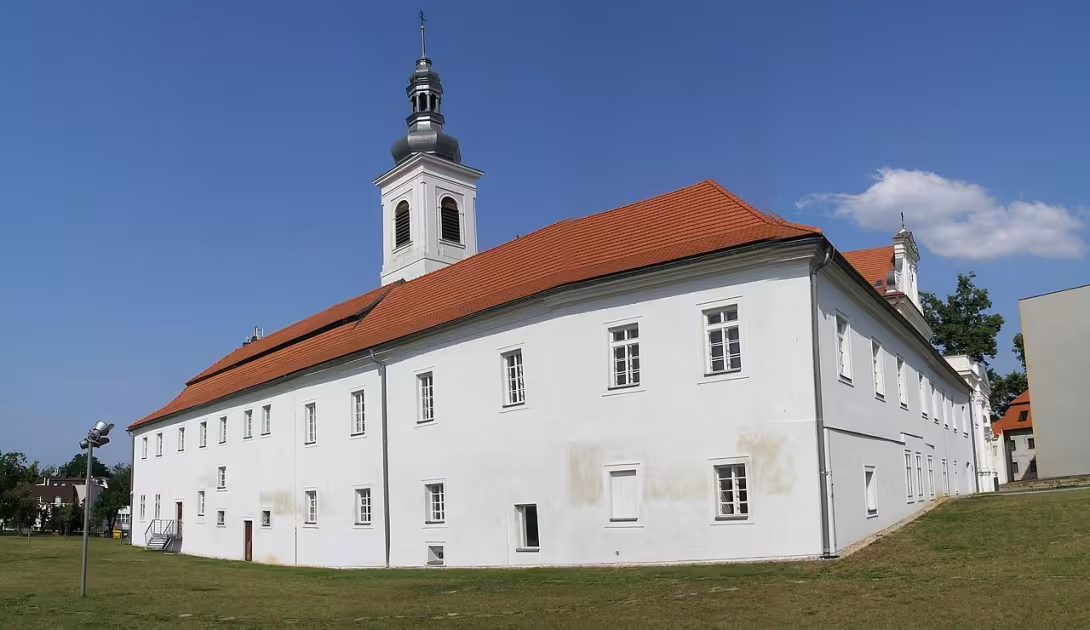
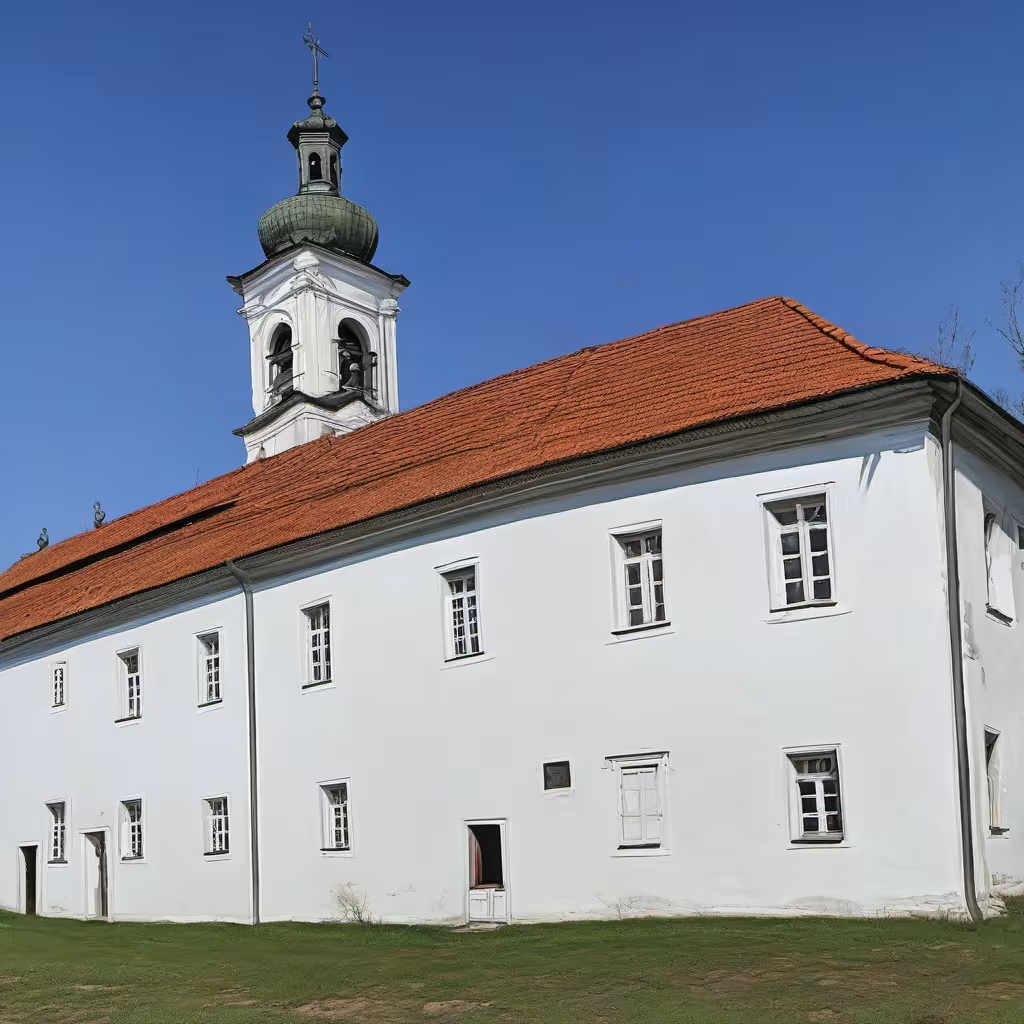
The historical appearance on the left is an AI-generated visualisation and serves as inspiration only.
Historical milestones
- 1293
- Establishment of a monastery of minority on Mount Karmel, probably at the impulse of Jan from Michalovice
- 1345
- Enlargement and reconstruction of the monastery Beneš from Michalovice, the arrival of ten new monks
- 1421
- The destruction of the Hussite monastery, the banishment of the monks, the buildings remained standing
- 1784
- Cancellation of the monastery by Josephine reforms, buildings handed over to piarists
Architectural development
The original Gothic monastery from the 13th century was rebuilt in the 14th century by Beneš of Michalovice. After Hussite attacks and abandonment, the complex was rebuilt in the 17th century, including the construction of a new church of St. Bonaventura and the convention in 1727-1767. Materials include stone, wood and brick, with typical baroque elements such as stucco and frescoes.
Historical events
- 1421
- The destruction of the Hussite monastery, the banishment of the monks, the buildings remained standing
- 1630
- Returning the monastery to minorities after disputes with barefoot carmelitans
- 1727-1728
- Closure of the building of the Baroque Convention with refectory and kitchen
- 1784
- Cancellation of the monastery by Josephine reforms, buildings handed over to piarists
Owners
1293-1345 – Jan z Michalovic (founded), minorité; 1345-1421 – Minorité, Beneš z Michalovic (extended); 1421-1500 – Czech brothers (used buildings); 1625- 1630 – Bosnian carmelitans (temporarily); 1630- 1784 – Minorité; From 1784 – Piarists (gymnasium).
Points of interest
- The monastery was probably founded in 1293, according to historian Antonín Louis Frind in a place called Carmel, and was dedicated to him by the nobleman Jan of Michalovice after his scientific journey to France.
- The original monastery inhabited fifteen monks and five lay brothers of minorities.
- In 1421, during the Hussite wars, the monastery was damaged by hail and his monks were driven out.
- The Czech brothers in the vicinity of 1500 occupied the monastery and named it according to the tradition of Karmel Mountain.
- The Minorites returned to the monastery in 1630 after successfully defending their historic rights against barefoot carmelitans.
Guide
This guide is narrated by a synthetic voice generated by artificial intelligence.
Show guide text
This text was created by artificial intelligence and has not been editorially reviewed. It may contain inaccuracies.
The Minorite monastery in Mladá Boleslav existed with interruptions until the year 1784. Today it is protected as a cultural monument of the Czech Republic.
Reports differ about its beginnings. According to Antonín Ludvík Frind, it was founded as early as 1293 and fifteen monks and five lay brothers settled there. The church and monastery were reportedly built by Jan z Michalovic, who at that time undertook a penitential journey to France. The monastery stood in a place called hora Karmel. The lords of Michalovic remained its constant patrons. In 1345 or 1354, Beneš z Michalovic expanded and rebuilt the monastery, and some scholars considered only this date to be the true founding of the monastery. Beneš worked to bring ten new conventuals in 1345. The monastery was consecrated at that time by Abbot Oldřich of the Benedictine order. The community received numerous bequests and prospered well.
In 1421, the Hussites damaged the monastery and drove out the monks. However, the buildings remained standing. Around 1500, the Bohemian Brethren were given use of it, and they built a brotherhood chapel there and also called it hora Karmel.
At the beginning of the Counter-Reformation, in 1625, hora Karmel fell to the Discalced Carmelites. They believed it was their former convent. The Minorites objected and proved that the building originally belonged to them. In 1630 they returned. So the Carmelites, during their brief activities in the midst of the Thirty Years' War, did not manage to develop significant work in Mladá Boleslav.
After the war, the Minorites repaired the entire complex between 1675 and 1711 and established a new church of Saint Bonaventure. However, these were only the most necessary and modest buildings, so construction continued. In 1727 and 1728, a new wing was built with a refectory, kitchen, pantry, and several rooms. Work on a new convent building also continued, while the old convent remained in ruins. Money was scarce and as late as 1752, there was a threat that the convent would collapse. The construction was only completed between 1754 and 1767. A new oratory was added and the church was renovated.
However, the Minorites did not enjoy the completed monastery for long. In 1784, the monastery was dissolved and the buildings were taken over by the Piarists. They moved their gymnasium here from the nearby Kosmonos.
Frequently asked questions
Is klášter minoritů v Mladé Boleslavi open to the public?
Yes, he's open to the public. The tour can be conducted separately or with a guide.
How do I get to the place by car / public transport?
The Minorite monastery is located in the center of Mladá Byslav, so it is well accessible on foot. If you arrive by car, you can park in the parking lot at the Church of the Assumption of the Virgin Mary and then continue on foot.
How much is the entrance fee and is it paid on the spot?
Admission to the Minorite monastery is free of charge, but it is possible to pay for the tour to accompany the guide.
Is the tour suitable for children and seniors?
Yes, a tour of the monastery of minorities is also suitable for families with children and seniors. The monastery offers a quiet environment and interesting historical information.
How long does the tour take?
The tour can be conducted separately or with a guide that takes approximately 30-60 minutes.
What are the opening times and booking is required?
The Minority Monastery is open to the public during working days from 9:00 to 17:00. Reservation is not necessary, but we recommend to contact the monastery in advance to confirm opening hours.
What's interesting in the immediate vicinity?
The Church of the Assumption of the Virgin Mary, which stands at the site of the original Romanesque church, is located in the immediate vicinity of the Minorite monastery. The church is an important cultural monument and offers beautiful views of the city.
For kids
Imagine going back 733 years, until Mladá Boleslav was a small city full of life and energy. It was an era in which people tried to build a beautiful city with beautiful churches and monasteries.
So in 1293 they built a beautiful Gothic monastery of minorities. It was a house for Franciscan brothers who were engaged in spiritual activities and art. They were artists who created beautiful statues and paintings that are still visible to this day.
Businesses nearby
Do you run a restaurant, accommodation, shop, museum, rental, wellness or other visitor service near this monument? Show yourself directly to the people heading to it — this is how they will see you in the app and on the web:
Events nearby
Zdroj akcí: otevřená data měst a obcí ČR (Národní katalog otevřených dat) a kalendář akcí Národního památkového ústavu.
Accommodation nearby
Themed route
Thematic cruise route: The historical core of Mladá Byslav
1. Minorite Monastery * Type: * Gothic-Baroque monastery with rich history. It is worth visiting for your art treasures such as the altar painting * Madonna with a child * by Peter Brandle, and a calm atmosphere in the heart of the city.
2. Church of St. Nicholas * Type: * Gothic church from the 14th century, only 500 meters from the monastery. It attracts visitors with its medieval frescoes and views from the tower to the historical center.
3. Castle Mladá Boleslav * Type: * Baroque mansion from 18th century with large park. It offers a view of the life of the nobles and the city administration, supplemented by picturesque gardens.
4. Pilgrimage Church of St. John Nepomuk * Type: * Baroque sacral structure on the top, about 3 kilometers from the center. It attracts its dramatic location and historical significance as a pilgrimage place.
* The route leads logically from the monastery through the historical core to Baroque monuments, ideal for lovers of architecture and history. *
Seasonal recommendations
Spring During the spring, klášter minoritů v Mladé Boleslavi will turn into a picturesque oasis, when the sun's rays intersect with the misty air and silvery-coloured arches of the church gain a new, fine shine. Nature blossoms around the monastery - the surrounding area brightens with greenery, and in quiet moments only the roar of leaves and distant bells are heard. The atmosphere is quiet, almost meditative, ideal for walking around the monastery area or for observing how light is reflected in stone details. It is practically appropriate to visit the monastery early in the morning or in the afternoon when there are fewer visitors. Clothes should be easy, but with the possibility of covering during cooler morning or evening hours. In April and May it is recommended to monitor the weather forecast - rainy days can shorten the stay outside, but at the same time add a mysterious, romantic mood to the monastery.
Summer In the summer months the monastery offers a unique combination of historical atmosphere and lively outdoor scenes, where its courts and gardens become a popular place of rest. The sun shines directly into the inner space, creating warm, golden lighting that emphasizes the colour of the stained glass and fresco. The area of the monastery is full of green, but even in hot days you can find relief from heat in the monastery corridors or in shady places. The best time for a visit is early in the morning to avoid crowds that accumulate in the main summer season (July and August) especially in the afternoon. It is recommended light, breathable clothes, sunglasses and a hat, and of course enough water. If you plan to stay longer, use the shade of trees in the monastery park or relax in one of the nearby cafés.
Autumn Autumn brings a unique atmosphere to the Monastery of Minorites in Mladá Bloslav, where golden and red shades of leaves are reflected in the church windows and shadows stretch longer, creating dramatic light effects. The colder air and fog that hover over the historic centre provide a mysterious, almost medieval mood. Nature around the monastery changes - trees dress up in autumn colors, and in quiet days only rustling of leaves is heard. The best time to visit is in the afternoon when the sun shines oblique and creates interesting light games on rocks. Clothes should be layered - warm sweaters or jackets, but with the possibility to take them off at sunny times. In November, especially in advent time, the monastery can become a place for short meditation or walks with Christmas decorations that begin to decorate the surrounding streets.
Winter Winter visit to the Minorite monastery is like entering another world - the snow cover changes its shapes, shadows are sharp and the light that penetrates through the stained glass creates colored spots on stone floors. The freezing air and the silence in the surroundings provide a peaceful, almost sacred atmosphere. The surroundings of the monastery are often covered with snow, which creates an idyllic scenery, ideal for photography. The opening hours of the monastery are shortened in the winter months (December to February), so it is good to know in advance. The best time to visit is in the afternoon when the sun shines strong enough to illuminate the interiors. Clothes should be warm but comfortable - thick jackets, gloves and hats, but also shoes that allow movement on stone sidewalks. In the advent period, the monastery may appear even more magical, surrounded by shining windows and Christmas decorations.
Visualizations and artistic views


The visualisations are generated by artificial intelligence and serve as inspiration.
Photos from the area
Real photos taken near the monument


Zdroj a licence jsou uvedeny u každého snímku.
Atmosphere of the place
This atmospheric visualisation of the place and period was generated by artificial intelligence. It is not real footage of the location.
Tips from visitors
No tips yet. Be the first!
Log in and add your tip.
Sources and literature
Photos: Jan Polák / CC BY-SA 3.0, rozlišení zvýšeno umělou inteligencí — Wikimedia Commons. The author and licence also appear when you hover over the image.
Faktickým podkladem tohoto textu byl článek na Wikipedii, jehož autory jsou přispěvatelé Wikipedie. Článek je dostupný pod licencí CC BY-SA 4.0.
Location on the map





Příběhy a pověsti
Legendy, pověsti a příběhy spjaté s touto památkou

Fotografie návštěvníků
Zatím žádné fotografie. Buďte první, kdo přidá fotografii z návštěvy!
Log in a přidejte svou fotografii nebo hodnoťte.
Za ověřenou návštěvu v aplikaci získáte víc bodů — poznáme podle GPS, že jste na místě.
Reviews and comments