



Kostel svatého Jana Nepomuckého (Mladá Boleslav II) Church
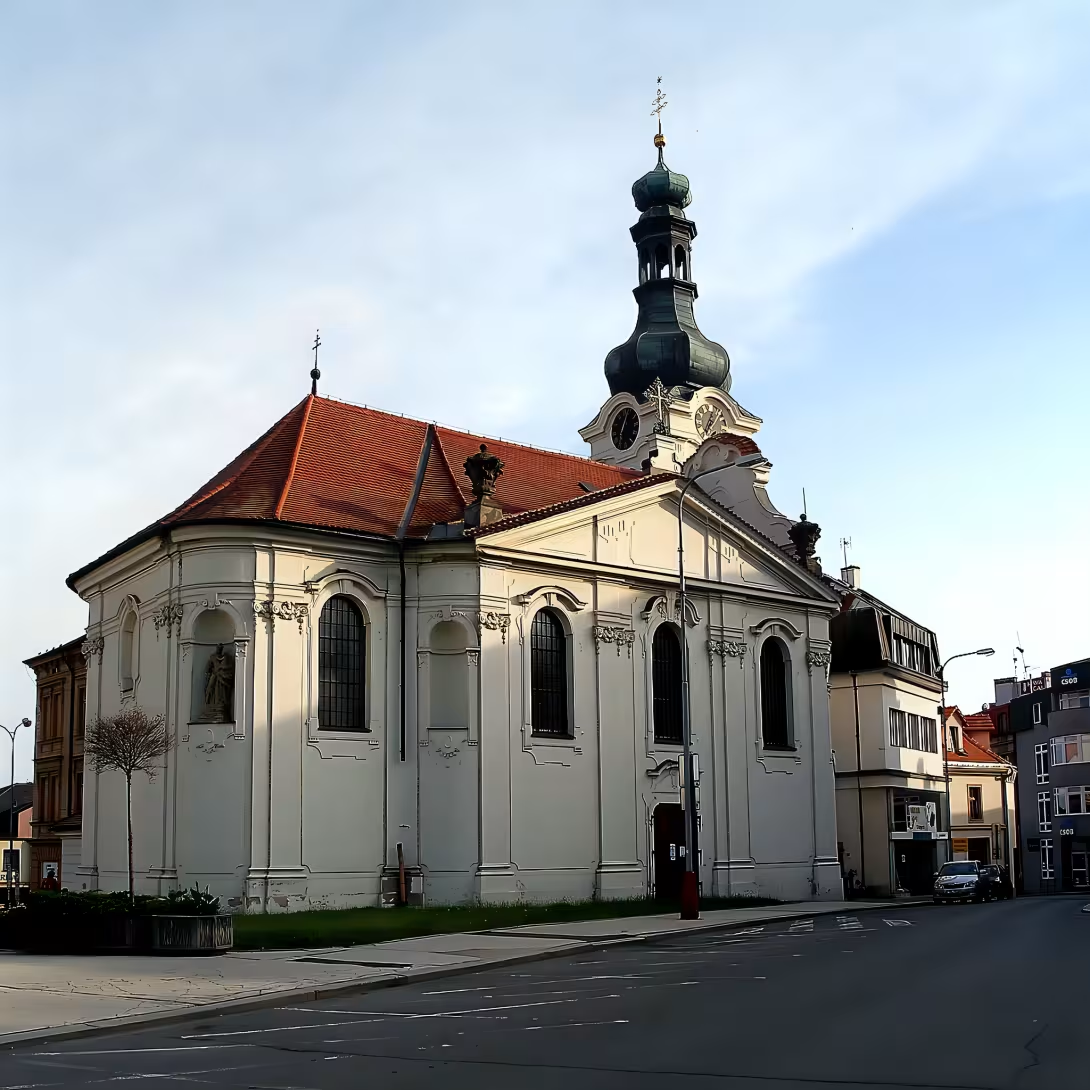
The church of St. John Nepomuk in Mladá Byslav is a Baroque sacral building with a Gothic core, located in Mladá Byslav II in the district of Mladá Boleslav. The building is significant in its long historical development since the middle of the 14th century and rich interior equipment, which includes for example a Baroque altar transferred from Lysá nad Labem.
The original sanctuary was built in the middle of the 14th century in the Upper Suburb, later called the New Town, behind the city gates. At first he was dedicated to St. John the Baptist and surrounded him by a cemetery. The spiritual administration was performed here by the johanites who operated their commendation at the site. This commendation disappeared in 1421 during the Hussite wars. At the end of the Hussite Revolution, the building became a filial church of the Little Bladobolslav Temple of the Assumption of the Virgin Mary. In 1590-1623 he served Lutheran village, but after the Battle of White Hora he returned to Catholic hands again.
It is an architectural monument to a rectangular hall with rounded corners and a narrower rectangular presbytery with rounded edges. The western prism tower is two storey and ends with an onion roof. The inner space is closed by a rolling vault with lunettes. In the years 1902- 1904, the facade took a neo-Baroque form and installed the original Baroque statues of St. Joseph from 1791 and St. John Nepomuk from the 18th century.
During the Thirty Years' War, the church was damaged, which in 1727 led to its fundamental baroque and reconstruction into today's form. In 1787-1812 he served as a shrine for the local military crew. In 1812 it was closed and cleared out due to the decrepit, while then they carried the main altar to St. Havel's church. The building subsequently functioned as a city warehouse until the services were restored in 1816 and the church received a new initiation to St. Jan Nepomucký.
The interior is dominated by a Baroque altar from around 1740, which comes from the abolished monastery in Lysá nad Labem. This frame altar has a retabel divided by karyatides, decorated with gilded vases and angels' plastics. On the door of the tabernacle is depicted the Last Supper of the Lord, while on the side gates stands statues of Moses, Aaron and angels. There is a picture of St. John Nepomucký from Václav Vavríc Reiner from 1740 in the cartouche frame. Other valuable elements include the Baroque pulpit from 1740, the canvas of Saint Peter and Paul from the first half of the 18th century, and the painting of St. Francis Serafinsky and the unknown saint in rococo frames from the second half of the 18th century.
This building is today protected as a cultural monument of the Czech Republic. In 1988- 2002 she underwent a general reconstruction. The history of the building faithfully reflects the changes of the religious and political environment in the region and its visit offers a unique opportunity to admire valuable baroque art.
Then and now
Drag the slider to compare how the landmark may have looked when it was built with the view today.
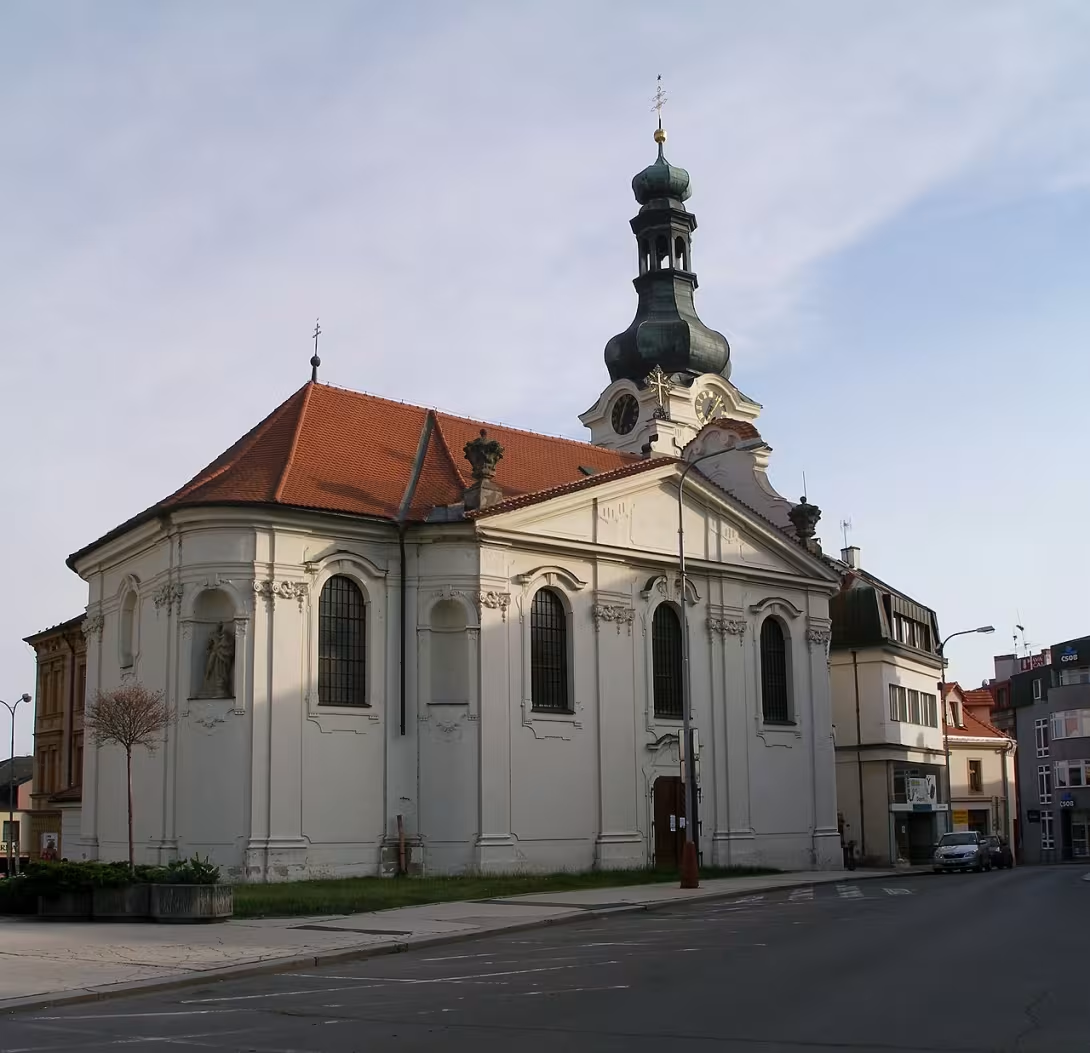

The historical appearance on the left is an AI-generated visualisation and serves as inspiration only.
Historical milestones
- 1350
- Building the original church in the middle of the 14th century behind the gates of the city.
- 1421
- The demise of the Johanite commendation, which performed spiritual administration here.
- 1727
- The baroque and reconstruction of the church to the present form after damage during the 30-year war.
- 1816
- Restoration of services and new initiation of the church to St. John Nepomuk.
- 1902
- Opening of the Neo-Baroque reconstruction of the facade with the location of original Baroque statues.
Architectural development
Originally a Gothic church from the 14th century was essentially baroque in 1727. Architecturally, it consists of a rectangular hall with rounded corners, a narrower presbytery and a western prism tower with an onion roof. In the years 1902- 1904 there was a new Baroque reconstruction of the facade with nobodies for Baroque sculptures. General reconstruction of the whole building took place in the years 1988- 2002.
Historical events
In 1421, the Johanite commendation disappeared. In 1727, the church damaged by the Thirty Years' War was scarred. In 1812 it was closed for debauchery and became a warehouse, but in 1816 services were restored.
Points of interest
- The church is a Baroque sacral building with a Gothic core and its historical development dates back to the middle of the 14th century. - The original sanctuary built in the middle of the 14th century was initially dedicated to St. John the Baptist and surrounded by a cemetery. - From 1590 to 1623 he served Lutheran village but returned to Catholic hands after the Battle of White Mountain. - From 1812 to 1816, the building was closed, cleaned out and served as an urban warehouse. - The interior is dominated by a Baroque altar from around 1740, which comes from the abolished monastery in Lysá nad Labem.
Guide
This guide is narrated by a synthetic voice generated by artificial intelligence.
Show guide text
This text was created by artificial intelligence and has not been editorially reviewed. It may contain inaccuracies.
The Church of Saint John of Nepomuk in Mladá Boleslavi is a Baroque sacred building protected as a cultural monument.
The original church was built in the middle of the 14th century beyond the city gates, on the Upper Suburb, which later became known as New Town. At that time it was dedicated to Saint John the Baptist, served as a parish church and was surrounded by a cemetery. Spiritual care was provided by the Knights Hospitaller, who also had their commandery there. It ceased to exist at the beginning of the Hussite Wars, in 1421. After the Hussite revolution, the church became a subsidiary of the Church of the Assumption of the Virgin Mary.
From 1590 to 1623 it served the growing German Lutheran congregation. After the Battle of White Mountain it returned to the Catholics. During the Thirty Years' War it was damaged, and so it was rebuilt in the Baroque style to its present form in 1727. From 1787 it served the local military garrison. In 1812 it was closed and cleared due to deterioration and the main altar was transferred to the Church of Saint Havel. The building then served the city as a warehouse. Religious services were resumed in 1816 and the church was then rededicated to Saint John of Nepomuk.
From 1902 to 1904 the facade received a Neo-Baroque renovation with niches. Original Baroque sculptures were placed in them, including a statue of Saint Joseph from 1791 and a statue of Saint John of Nepomuk from the 18th century. A general reconstruction of the church took place from 1988 to 2002.
The structure consists of a rectangular hall with rounded corners and a narrower presbytery with rounded edges. On the western side stands a two-story prismatic tower with an onion-shaped roof. The interior is vaulted with a barrel vault with lunettes.
The main Baroque altar was created around 1740 and comes from a defunct monastery in Lysá nad Labem. Its retable is divided by caryatids and is decorated at the top with gilded vases and angel sculptures. On the doors of the tabernacle is depicted the Last Supper. On the side wings of the altar are more angels and sculptures of Moses and Aaron. Above the retable, in a cartouche frame, is a painting of Saint John of Nepomuk with a view of Lysá nad Labem. It was painted in 1740 by Václav Vavřinec Reiner. The Baroque pulpit dates from around 1740. The church also preserves paintings of Saint Peter and Saint Paul from the first half of the 18th century. From the second half of the same century are paintings of Saint Francis of Assisi and an unknown saint in Rococo frames.
Tips for visitors
For a visit to the Baroque church of St. John Nepomuk in Mladá Bloslav, we recommend choosing the morning hours where the sun best highlights historical details in the upper suburbs and in the surrounding streets. This time is also ideal for a peaceful tour without a large number of people.
Take comfortable shoes to walk on historic tiles and possibly a camera with you for a tour. For the best shots of the exterior of this sacral building with the Gothic core, it is worth taking a photo from a mild ceiling, which underlines its historical monumental and unique architecture.
Since there are no other specific tips in the background in the immediate surroundings, we recommend to explore the rest of the historical center Mladá Byslav.
Families with children can take a visit to the church as a light walk associated with the discovery of interesting building elements such as the combination of the Gothic nucleus and baroque form, which can attract even small discoverers.
Frequently asked questions
Can the monument be visited?
Religious buildings are usually open mainly during services; at other times a visit is normally arranged with the parish or the operator. We have not verified specific times.
Where is the monument?
Location: náměstí Míru, Mladá Boleslav II, Mladá Boleslav, Středočeský kraj. The map on this page shows the exact spot.
Why is the monument protected?
It is listed in the Central List of Cultural Monuments of the Czech Republic as a cultural monument (register no. 34657/2-1650).
For kids
Good morning! 299 years ago, exactly in 1727, the church of St. John Nepomuk in Mladá Byslav began to be built. And today, when you go there, you might notice it's an amazing Baroque church.
Many years ago, Mladá Boleslav was a small village where humans and shepherds lived. When the church started to build, it was like a magnificent house that stood above other buildings. People from the neighborhood came to visit and thought, "What is this? It's like a miracle!"
Businesses nearby
Do you run a restaurant, accommodation, shop, museum, rental, wellness or other visitor service near this monument? Show yourself directly to the people heading to it — this is how they will see you in the app and on the web:
Events nearby
Zdroj akcí: otevřená data měst a obcí ČR (Národní katalog otevřených dat) a kalendář akcí Národního památkového ústavu.
Nearby
➜ Zobrazit interaktivní přehled okolí – restaurace, ubytování, půjčovny a další místa v okruhu 15 km.
Data: OpenStreetMap contributors, okruh 15 km.
🏰 Historické památky
- Svatopluk Čech (0.4 km)
- Jan Ámos Komenský (0.4 km)
- Okresní museum Mladá Boleslav - palác Templ (0.4 km – Krajířova 102)
- Muzeum Mladoboleslavska (0.5 km)
- Letci II.sv války (1.1 km)
- 1914-1918 (3.8 km)
- Myškův Hrádek (5.1 km)
- Hradiště Předliška (5.2 km)
🍽️ Restaurace a stravování
- Restaurace Zlatá Kovadlina (0.2 km – Železná 33)
- Pizzeria Diverso (0.4 km – třída T. G. Masaryka 1076)
- Pivnice U Vobrázků (0.4 km – třída T. G. Masaryka 1077)
- Vinárna (0.4 km)
- Sportbar Astra Crücos (0.5 km – třída T. G. Masaryka 1075)
- Krajní mez (2.9 km)
- U Janka (3.2 km – Karla Veselého 795)
- U Fišerů (4.9 km)
🏨 Ubytování
- Hotel Zimní stadion (0.2 km – Viničná 31)
- Hotel Zlatý Kohout (0.2 km – Staroměstské náměstí 31)
- Hotel U Hradu (0.4 km – Staroměstské náměstí 108)
- Viva Residence (0.4 km – Viničná 153)
- Hotel Stefanie (1.0 km)
- JD Penzion - Jiří Novák (1.1 km – Čechova 1277)
- Ubytovna Na Letišti (1.3 km – Regnerova 1199)
- Osvit Hotel (2.5 km – 17. listopadu 1477)
🚲 Půjčovny a sport
- Sokolovna (0.5 km)
- Stevens (1.0 km)
- Sport Český Ráj (1.2 km – Nerudova 616/30)
- Jízdní kola Petr Hlaváč (2.3 km – 17. listopadu 1333)
- Decathlon (2.7 km – Jičínská 1419)
- Sport centrum (3.2 km)
- Galaxie (7.6 km)
- Sokolovna (9.8 km)
🥾 Turistika a příroda
- Info Bus (1.1 km)
- Začátek Zlaté stezky Českého Ráje (1.3 km)
- Debř - Radouč (2.9 km)
- Nová Ves (8.9 km)
- Úpravna vody Rečkov (9.3 km)
- Klokočka (kaple) (10.5 km)
- Obora Klokočka (10.6 km)
- Klokočka (10.6 km)
Accommodation nearby
Themed route
1. Church of St. John of Nepomuk Type: church Why is it worth a visit: This main objective of our route will take on its sacral architecture and important history associated with the worship of this saint. It is the center of spiritual life and the dominant part of the city.
2. Area Church Type: Space Why is worth a visit: The immediate surrounding of the building offers a quiet place to stop and explore details of the exterior decoration. The whole area is illustrated by the historical atmosphere of this place.
Seasonal recommendations
Spring in Mladá Bloslav brings awakening nature, where the surrounding greenery and flowering trees gently contradict the historical architecture of this sacral object. Sunbeams fall at a milder angle and create interesting shadows on the facade, which will be especially appreciated by lovers of rural and urban photography. There are usually no large crowds of tourists during this period, so you will enjoy the tour in complete peace. We recommend to wear fixed shoes because of possible spring rain and layered clothing, because morning cold quickly turns into pleasant afternoon heat. The best time to visit is the morning hours when the city is still alive and the monument breathes a peaceful atmosphere.
Summer on Vyšehrad and in the surrounding historical parts of the city offers long days with bright sun, which fully reveals details of the exterior of the building. The atmosphere is lively and energetic, supported by tourism in the wider surroundings. Due to the warm weather and the main travel season, it is recommended to leave either early in the morning or late in the afternoon when temperatures are more tolerable and sunlight gives the place a golden touch. Light breathable clothes, headgear and plenty of fluids are suitable. Count on meeting more visitors, so it is good to be patient and plan enough time for your tour.
Autumn turns the whole area into a colorful palette of warm colors from yellow to deep red, which gives the monument a melancholy and very photogenic character. The frequent morning mist surrounding the Jizera Valley creates a mysterious mood that persists until the morning. Due to the variable weather, it is necessary to choose waterproof shoes and warmer coat or windbreaker. The crowds of tourists have already thinned considerably, so you can enjoy quiet reflection without disturbing influences. The ideal time for visiting is around noon, when any fog breaks and the sun passes through the autumn herpes for a while.
Winter brings a peaceful and moderate face to Mladá Bloslav, when the snow cover (if it is lying) optically unifies the historical environment to pure white tones. The light in the late afternoon quickly passes into the shadow, which makes the muted inner light and the overall chamber atmosphere stand out. It is necessary to remember warm winter clothes, hat, gloves and firm non-slip shoes as the tiles can freeze. Due to the short days and earlier dimming, it is best to head to the monument around noon. In winter, you will find the absolute minimum of visitors, which guarantees an undisturbed experience.
Visualizations and artistic views


The visualisations are generated by artificial intelligence and serve as inspiration.
Photos from the area
Real photos taken near the monument


Zdroj a licence jsou uvedeny u každého snímku.
Tips from visitors
No tips yet. Be the first!
Log in and add your tip.
Sources and literature
Photos: Jan Polák / CC BY-SA 3.0, rozlišení zvýšeno umělou inteligencí — Wikimedia Commons. The author and licence also appear when you hover over the image.
Faktickým podkladem tohoto textu byl článek na Wikipedii, jehož autory jsou přispěvatelé Wikipedie. Článek je dostupný pod licencí CC BY-SA 4.0.
Location on the map





Příběhy a pověsti
Legendy, pověsti a příběhy spjaté s touto památkou
Fotografie návštěvníků
Zatím žádné fotografie. Buďte první, kdo přidá fotografii z návštěvy!
Log in a přidejte svou fotografii nebo hodnoťte.
Za ověřenou návštěvu v aplikaci získáte víc bodů — poznáme podle GPS, že jste na místě.
Reviews and comments