






Konipas Motte
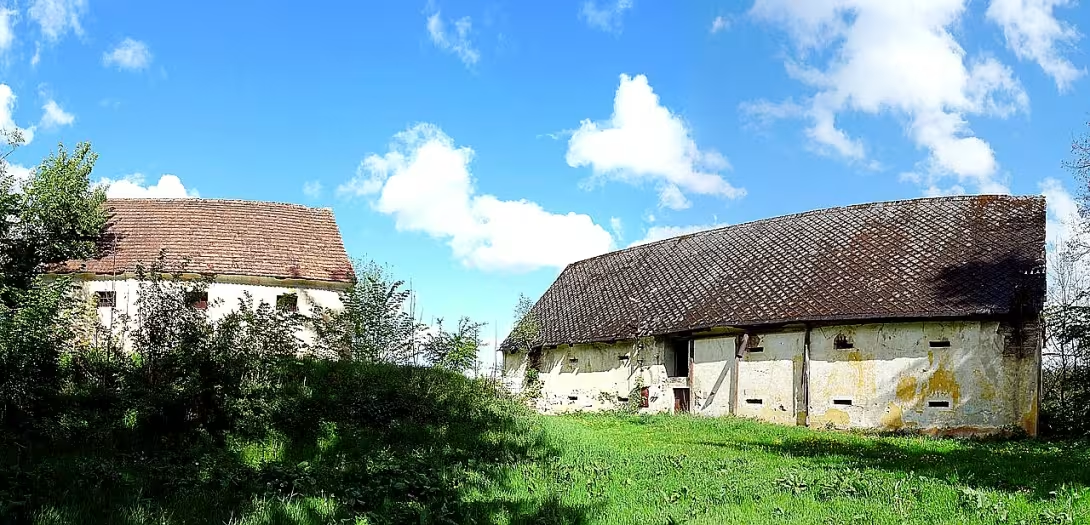
Konipas is an extinct medieval castle in the village of Březina, which belongs to the village of Hořepník. This monument served as a seat of the nobles and is characterized by preserved terrain tracks of fortifications and two stone stacks from the original castle wall.
Little news of the castle's oldest history has been preserved. But the historical context suggests that its existence was linked to intense colonization and the consolidation of noble settlements in the 13th century. The first mention dates back to 1252, when Bedřich z Hořepníka is listed in the sources.
The castle stood on a field wave above the Trnavou river and had a square plan with a strongly rounded front corner. The protection was served by a moat on the northwest and northeast side, before which there was a massive wall. It only survived along the northeast side. The only trace of the original buildings is the unclear terrain signs of construction in the northwest corner. There are two granaries on the castle floor today. The smaller one has a well-arched cellar probably of modern origin.
The castle was the seat of the masters of Hořepníka, with half of Hořepníka and the municipalities of Wíslavice, Polšná, Březina, Kyjov, Opatovice and Smolín. In 1334 he owned a firecracker's estate with Konipas Oldřich III. z Hradce. His son Oldřich sold the estate in 1361 to Jeník from Intermosti. His descendants then started calling themselves Konipas from Konipas. During the first half of the 15th century several owners replaced the castle and in 1457 it was already listed as desolate.
Today, the entire complex is protected as a cultural monument. The original building shows mainly the terrain relics of fortifications and two stone stacks. The visit offers insight into the history of the medieval estate and its gradual settlement and extinction.
Historical milestones
- 1252
- reference to Bedřich from Hořepníka
- 1334
- Oldřich III. z Hradce is the owner of the estate
- 1361
- sale of the manor to Haník from Intermosti
- 1457
- the castle is listed as desolate
Architectural development
The castle had a square plan with a rounded front corner and a moat on the northwest and northeast side. From the original masonry today there are two stone stacks and terrain relics of fortification.
Historical events
1252: first mention of Bedřich of Hořepníka; 1361: sale of the estate to Hansel from Intermosti; 1457: The castle is listed as desolate.
Owners
1252: gentlemen of Hořepníka; Oldřich III. z Hradce; 1361: Jeník z Mezimostí and its offspring (Konipas from Konipas).
Points of interest
- Konipas is an extinct medieval castle in the village of Březina, which belongs to the village of Hořepník.
- The castle served as a seat of nobility and is characterized by preserved terrain traces of fortifications and two stone stacks from the original castle wall.
- The first mention of Konipas dates back to 1252, when Bedřich z Hořepníka is listed in sources.
- The castle was the seat of the masters of Hořepníka and in 1334 his property became part of the estate Oldřich III of Hradec, who sold it to Jeník from Intermostí in 1361.
- Today, the whole complex is protected as a cultural monument and offers insight into the history of the medieval estate.
Guide
Show guide text
This text was created by artificial intelligence and has not been editorially reviewed. It may contain inaccuracies.
Welcome to March at Hořepník. You are standing right now in a place where, many centuries ago, a proud silhouette of medieval manor was soaring. If you were expecting high stone walls, slender towers or monumental gates when you arrived, perhaps the first sight would surprise you. In front of you is not a classic preserved castle, but the so-called castle is extinct. Look closely around you. The place you're on breathes extraordinary calm, but the terrain beneath your feet tells the ancient story of strength, defense and human skill. Feel the strange atmosphere. You're standing in an attic where an ancient medieval past meets nature, which took back what one had taken from it. Notice the extraordinary ripple of the landscape, the distinctive terrain inequalities and the two stone hoarders standing here as silent witnesses of age. These are all remains of a castle called Konipas.
Let us now move together in time to the time when this castle was created and look into its history. The oldest written reports return us to the 13th century, namely the year one thousand two hundred fifty-two. It is this year that the first mention of the seat in which the nobleman Bedřich z Hořepníka is present comes at all. At this time, building fortified settlements was a key way for nobility to secure manor, security and prestige. Originally, this castle served as a proud mansion of the men of Hořepník. Later, however, he went to the hands of the genus who gave him his distinctive and memorable name - they were Konipas from Konipas.
During the fourteenth century, the owners of the estate changed, which was typical of the dynamic period. In the year a thousand and three hundred and thirty-four the holder of the estate became an important nobleman Oldřich the third of Hradec. The important family of lords from Hradec was one of the most powerful in the whole kingdom and ownership of this castle further strengthened their influence in the region. After Oldrich's third, his son, who had the same name, Oldřich, took over the administration. A few decades later, more precisely in the year three hundred and sixty-one, however, another sale took place and the estate was acquired by Jeník z Mezimostí.
Now, if you look at the terrain in front of you, let us try to say goodbye together to the architecture of this place as the country itself reveals it. Now pay attention to the overall layout of the area. The castle had a square plan in its time. Although the preserved wall of residential buildings was not preserved to a height, the castle builders left an indelible mark in the landscape. Look at the massive walls and depths. What you see are terrain relics or remains of the original massive fortification. Notice the deep trench that surrounded the castle. In the Middle Ages, such a moat, along with a boulder, represented a major obstacle to any attacker. Overcoming such a wall and moat required great effort, and thanks to these elements the castle gave its inhabitants a sense of security. Architects and builders of this estate remain unknown to history, but their work on the terrain was extremely effective.
On the next tour, you will notice two stone shooters standing on the premises. At first sight, these buildings will capture their solid, honest stone masonry. And it is here that there is a very interesting connection between the medieval castle and later use of the site. These economic buildings were built from material obtained from the original castle masonry. When the castle lost its residential and military function, its stones were neither forgotten nor wasted. People used them to build these hoops that were used to store grain and other supplies. The stones that used to protect medieval knights and nobles have thus begun to provide a livelihood for the people here.
But the story of Castle Konipas also has a darker chapter, which represents its gradual demise. The development of military tactics, changes in the needs of nobility to the comfort of housing and property shifts led to the castle becoming desolate. The year is one thousand four hundred fifty-seven. In written sources from this year, castle Konipas is for the first time explicitly mentioned as desolate. This means that in the mid-fifteenth century it was no longer inhabited, decayed and gradually transformed into ruins. Life has disappeared from his home space and taken over the place.
Yet the castle did not disappear completely. He turned into a mysterious place full of history. Think about how interesting the story relates to the name Konipas itself. The name, which sounds almost unusual and poetic, was printed both in the name of the village and in the nobility of the Konipas family from Konipas. It is fascinating to see how a solid military point has become an economic background and finally a peaceful monument protected location. The whole area is now rightly protected as a cultural monument, as it represents valuable evidence of medieval settlement, fortification development and how the use of landscapes and human buildings has changed over the centuries.
Now I'm going to invite you to a little walk around. Walk carefully along the edge of the original valleys and feel the depth of the preserved ditch. Imagine how many centuries ago there was a rumble of horses, the talk of medieval inhabitants and the excitement of everyday life at the mansion of the masters of Hořepník or Jeník from Intermostí. Take a closer look at the stone masonry of the hoarders and realize that you are looking at the worked stones that remember the thirteenth and fourteenth centuries.
Thank you for your attention to this remarkable and quiet place. Enjoy the rest of your visit to Březina at Hořepník, soak up the peaceful atmosphere of the countryside and wish you many other wonderful experiences in revealing the secrets of our history.
Tips for visitors
The best time to visit Konipas is in summer, especially in spring or autumn. These periods offer pleasant weather conditions and a beautiful green landscape that gives the castles an even more distinctive character.
Parking for visitors Konipas is not directly near the castle ruins, but you can find parking near the village Hořepník. Transport is possible both by car and by public transport; Check the local search engine for the latest information about routes and connections.
When visiting Konipas it is advisable to bring shoes suitable for walking on uneven terrain, sunglasses and protective clothing. Thanks to the wavy terrain, the journey can be a bit difficult, but it is also an opportunity for beautiful photos.
Photography on Konipas offers the best options in early morning or evening when light is softer and shadow effects add atmosphere. Don't forget to include a walk along the Trnava stream, which gives the landscape even more beauty.
In the vicinity of Konipas there is a village Hořepník where local history and architecture can be explored. For families with children it is a special attraction to be able to walk on the surrounding terrain and play in the open space.
Businesses nearby
Do you run a restaurant, accommodation, shop, museum, rental, wellness or other visitor service near this monument? Show yourself directly to the people heading to it — this is how they will see you in the app and on the web:
Nearby
Trnava stream and surrounding terrain waves in the village area Hořepník.
Accommodation nearby
Themed route
Hořepník (Community) Type: Initial trip point Why is worth a visit: The picturesque village serves as an ideal starting point for exploring the local landscape. It offers a quiet environment and the beginning of the journey to historical and natural attractions in the surroundings.
Potok Trnava (Water flow) Type: Natural interest Why is it worth a visit: The flow of the stream forms the character of the whole landscape and its shores provide a pleasant environment for the relaxation and perception of local nature. The water accompanies visitors along their journey through the wavy terrain.
Ambient field waves in the village area Hořepník (Natural relay) Type: Landscape unit Why is it worth a visit: Mild slopes and waves in the landscape create impressive scenery and make the area an ideal place for easy hiking. The terrain impact allows nice views of the entire location around the creek.
Konipas (Castle) Type: Historical monument Why is it worth a visit: The main objective of the whole journey is a ruin that hides traces of ancient history associated with this region. The site attracts to explore the remains of an old building embedded in local nature.
Seasonal recommendations
Spring at Castle Konipas in Hořepník brings awakening nature, when the surrounding sides cover the carpets of blooming pale and fresh green for the first time softens the rough, exposed walls of the old ruin. Sun rays penetrate thin treetops and create an interesting game of light and shadow on stone foundations, ideal for detailed photography of remains of gothic windows. Since the tourist season is just starting, there are only a lot of peace fans here. Solid hiking shoes are suitable because the freezing ground on the steep access road is very muddy and slippery. Since spring weather shows its variability with frequent showers, do not forget the waterproof jacket and wind-proof layer, as it blows on the raised sharpness.
Summer turns the mountain ruin into a wild oasis with lush vegetation that gives the place a deeply romantic touch of mystery. The early morning fog slowly rises above the valley and leaves cool dew on the rocks, while the afternoon bright sun radiates the white masonry with sharp, contrast light. Due to the main vacations, the most curious are heading here, which is why it is worth getting up early and arriving in the morning before the arrival of mass trips. Wear breathable clothes made of natural materials and headgear, as temperatures rise high in ruins without roof. Don't forget to pack enough drinking water in your backpack and a reliable repellent, as the tall grass around the monument hides insects.
Autumn brings a melancholic mood to the castle area Konipas, underscored by colorful leaves in shades of yellow, orange and red slowly falling from surrounding forests. The low sun creates warm, golden lighting during the late afternoon, which gives the castle walls and tower remains a unique photogenic patina. Visitors are clearly failing, so you will enjoy the ruin almost alone, accompanied by the rustling of the fallen leaves under your feet. The basis of the successful expedition is layered clothing, warm sweater and warm scarf, because the dry wind can quickly cool. Due to frequent foggy haze and moisture, move carefully as the fallen leaves on stone steps and uneven terrain slide dangerously.
Winter covers the Hořepník into deep silence and snow sheets, which completely transforms the silhouette of the castle ruins into a fairy tale scenery of the frozen kingdom. In clear days, clean, freezing air offers distant views of the snowy landscape, and the oblique rays of the winter sun briefly irradiate the frozen walls. In this period, few come here, which guarantees complete privacy for contemplation in the middle of historic walls. The absolute necessity is the quality winter footwear with anti-slip soles, warm thermo-linens, feather jacket, glass and gloves, because staying on the open plain will check your resistance to frost. Remember the short daylight, plan a visit to the morning hours and check that the access routes are not inaccessible after heavy snow.
Visualizations and artistic views

The visualisations are generated by artificial intelligence and serve as inspiration.
Photos from the area
Real photos taken near the monument


Zdroj a licence jsou uvedeny u každého snímku.
Tips from visitors
No tips yet. Be the first!
Log in and add your tip.
Sources and literature
Fotografie: Czeva / CC BY-SA 3.0 — Wikimedia Commons. The author and licence also appear when you hover over the image.
Faktickým podkladem tohoto textu byl článek na Wikipedii, jehož autory jsou přispěvatelé Wikipedie. Článek je dostupný pod licencí CC BY-SA 4.0.
Location on the map
More monuments – Hořepník
Show all in the municipality
Příběhy a pověsti
Legendy, pověsti a příběhy spjaté s touto památkou
Fotografie návštěvníků
Zatím žádné fotografie. Buďte první, kdo přidá fotografii z návštěvy!
Přihlaste se a přidejte svou fotografii nebo hodnoťte.
Za ověřenou návštěvu v aplikaci získáte víc bodů — poznáme podle GPS, že jste na místě.
Reviews and comments