






Konkatedrála Nanebevzetí Panny Marie Church
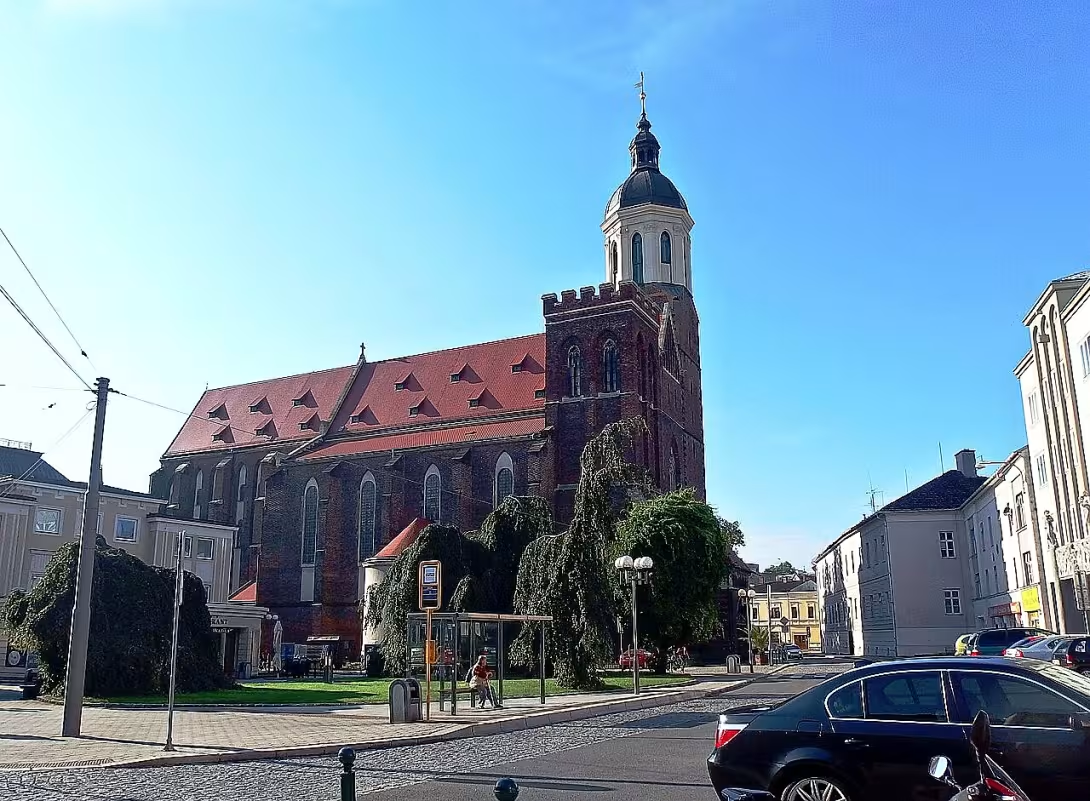
Konkatedrála Nanebevzetí Panny Marie in Opava is a three-boat Gothic church with two towers, which stands on the site of an older Romanesque building from the beginning of the 13th century. His history is linked to the Order of German Knights, who participated in his creation.
The Romanesque predecessor's construction was probably started shortly after 1204. The form of this primordial temple is not known in more detail. The list of Czech King Václav I. of 1237 mentions the parish in Opava in the possession of the Order of German Knights. Later, however, political turbulence hit the building - after the death of Rehysl Otakar II. The work ceased and was restored only after his son Nicholas I. Opava's return from Hungarian captivity. The Gothic reconstruction in the 14th century changed the form of the construction gradually. The completed church became the largest church building in Opava and a new dominant city.
Just before the year 1452, Prince Wilhelm of Opava added to the southern ship the chapel of St. Grave with an altar dedicated to the Death of the Lord, designated as the burial ground of the Opavské Přemyslovů. In 1461 the city was hit by a fire - a flyer cross burned down and a damaged flyer was torn down separating the presbytery from the rest of the temple. This element has not been restored. In the 1950s, city councils managed to cover the southern tower with a representative roof with needles' roofs reaching a height of more than 70 metres.
Reformation to the church has brought turbulence. In 1540, the town council of Opava acquired patronage rights, which was confirmed two years later by Czech King Ferdinand I. Even in 1555, Catholic Blaze Sibenlot was appointed vicar, but in the 1950s, Lutheran preacher Martin Zenkfrei appeared in the temple. The city council forced his stay to bribe the royal officials. The priest Sibenlot, without the Bishop's knowledge, concluded a treaty in which he undertook not to disturb Lutheran preachers for the annual reward of 200 gold. Since then, the church has hardly had a Catholic service.
In November 1569, Olomouc Bishop Wilhelm Prusinovský decided to restore Catholic liturgy. When he began his service on Sunday, November 6, Protestant opponents prevented Jesuit Stephen Rimmer from preaching. The Bishop was in grave danger, and under armed protection he dragged himself to St. Wenceslas's Church. During the state uprising in 1619, the church was taken by Catholics and handed over to Protestants. In 1632, Prince Charles Eusebius of Liechtenstein paid tribute to the pava states - a preserved copper engraving captured the late Gothic interior with an altar and sanctuarium, which was later destroyed by fires in 1689 and 1758.
In 1995, the cathedral was declared a national cultural monument. Since 1996 it has served as the second seat of the Ostrava-Opava bishop and remains one of the most important Gothic buildings in the region.
Then and now
Drag the slider to compare how the landmark may have looked when it was built with the view today.
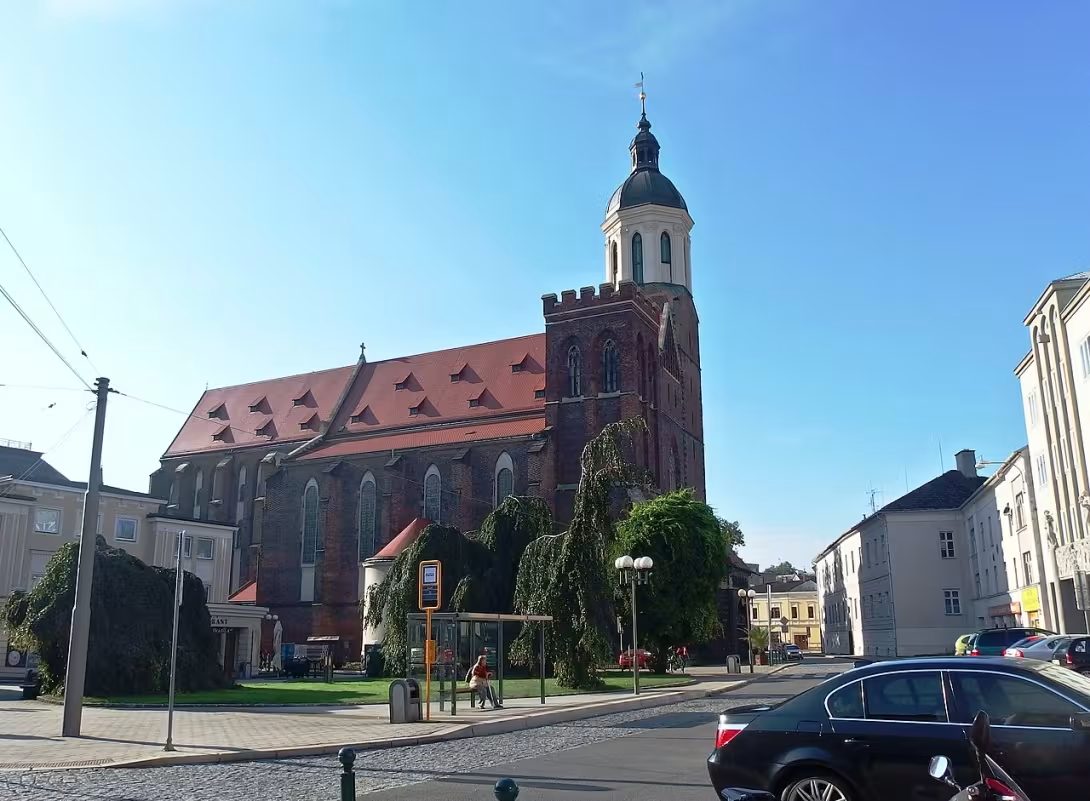

The historical appearance on the left is an AI-generated visualisation and serves as inspiration only.
Historical milestones
- 1204
- Likely to begin construction of Romanesque rectory at the site of the contemporary concathedral.
- 1237
- The Czech king Václav I. confirmed the possession of the Pops parish to the Order of German Knights.
- 1452
- Added to the chapel of St.
Architectural development
The original Romanesque rectory from the beginning of the 13th century was converted into a Gothic tripod church in the 14th century. In 1452, the chapel of St. Grave was built. In the 18th century, Baroque treatment took place, especially on the south tower, which acquired the cross of needles. In the 20th century, further adjustments were made to preserve the original Gothic nature of the construction.
Historical events
- 1237
- The Czech king Václav I. confirmed the possession of the Pops parish to the Order of German Knights.
- 1569
- Protestants in the church have definitely taken control, the Catholic service has been stopped until counter-reform measures.
- 1619
- During the state uprising, the church was taken away by Catholics and handed over to Protestants.
- 1995
- Declared by a national cultural monument.
Owners
The Order of the German Knights, 'since 1540': 'The Opava City Council (with Patronage Law)', 'Since 1996': 'The Roman Catholic Church (the Concathedral of the Ostrava-Opava Bishop)'}
Points of interest
- The church is on the site of a Romanesque building from the beginning of the 13th century, whose exact form is unknown.
- The Order of the German Knights was involved in its creation and in 1237 held the parish of Opava.
- The Chapel of St. Grave was added to the southern ship before 1452 and served as a burial ground of the Opavské Přemyslílovů.
- In 1540 the town council of Opava acquired patronage rights, which was confirmed by Czech King Ferdinand I.
In 1995, the cathedral was declared a national cultural monument.
Guide
This guide is narrated by a synthetic voice generated by artificial intelligence.
Show guide text
This text was created by artificial intelligence and has not been editorially reviewed. It may contain inaccuracies.
Welcome to the Concathedral of the Assumption of the Virgin Mary in Opava!
You are standing in front of one of the most important and visible sacral structures in Moravia. In front of you, there is a monumental gothic tripod structure with a two-seater facade that dominates the entire historic city centre. Air arches, massive pillars and harmonious proportions of the facade attract you immediately. Look at the facade - its architecture is a testament to the centuries that shaped this building. Feel the atmosphere that radiates from it: how Gothic lines meet here with later adjustments that enriched the church with other layers of history.
Let's look a little deeper into the past. This building is in a place where the first Romanesque rectory could have been established in 1204. It became the property of the Order of German Knights in 1237 when the Czech king Václav I. confirmed it as their possession. They participated in its development, although the exact form of the original Romanesque building remains a shadow of the past. It was only in the 14th century that one of the most important religious centres in the region was created.
Now pay attention to some details that may reveal the secrets of this building. On the south side of the church, which you are now seeing, a chapel of St. Grave was built before 1452. It served as a burial ground for the Přemysk Přemysk and was equipped with the altar of the Dead Lord. Although its original form is unknown, its existence reminds us of how important this church was for local nobility and population. Note how this chapel differs from the main ship - its smaller dimensions and its specific shape are typical of the chapel designed to respect the holy relics.
The church has undergone many changes. In the 18th century, baroque modifications enriched it with new artwork and interior elements that gave the construction a new form. In the 16th century he became the centre of Lutheran religion when the Catholic service was stopped. Only later did the church become a Catholic centre again, only in the 19th century. In 1995 it was declared a national cultural monument, which officially recognised its historical value.
One of the most interesting things about this cathedral is that it stands where the Romanesque rectory used to stand. The exact forms of this older building have not been preserved, but its existence reminds us of how long the tradition of religious life is in this place. The order of German knights who worked here left a trail not only in architecture but also in the history of the city. The chapel of St. Grave you just saw was one of the places where the region's religious and political forces met.
Although the church has undergone many changes, its Gothic core remains intact and attracts the attention of every visitor. Take another look at its facade - as powerful pillars meet with fine window arches. Notice how light penetrates through the windows and illuminates the interior, which can reveal the other secrets of this monument.
If you like this cathedral, it's certainly worth getting to know the interior. Here are hidden other historical treasures such as baroque altars, Gothic vaults and perhaps other chapel that can bring you further chapters of Opava history. Get carried away by the atmosphere of this place, which witnessed centuries of faith, political changes and cultural changes.
Thank you for your visit. I hope you like this cathedral and that you will return here again to discover another secret of it. Opava and its churches are a real treasure worth knowing. May your travels in our historical monuments prosper!
Tips for visitors
{'paragraph': 'The best time to visit the Ascension of the Virgin Mary is during the morning hours when the church is quiet and you can see the interior without crowds. It is also ideal to visit during a sunny afternoon when light penetrates glass windows and creates picturesque shadows on Gothic pillars. In the winter months the indoor temperature is pleasant, but in the summer you better choose the time before noon when the church is the coldest.'}
{'paragraph': 'Parking near the cathedral is possible in several public parking lots in the centre of Opava. It is recommended to use the parking lot near Svoboda Square or Opava Chateau, which are only a few minutes' walk away. The location is also accessible by car and public transport; Check the current connection in the search engine. If you arrive by car, make sure to mark parking spaces and payments that are usually paid in the city centre. '}
{'paragraph': 'Take comfortable shoes when visiting because the church is extensive and some parts have stairs. It is also appropriate to take a small umbrella or raincoat, because it can be cold in the interior, whether it rains outside or not. For convenience, you can also bring a small backpack to which you can put a towel or other things you need. If you are planning to take pictures, remember to take a flashlight or mobile charger.'}
{'paragraph': 'The best places for photography are mainly the facade of the church with its two-cell portal and interior with gothic vaults and stained glass. For quality images is ideal natural light that penetrates windows during morning or afternoon hours. In the interior avoid flashing of lightning to avoid damaging sensitive surfaces. You can also visit the surrounding square, where there is a view of the church from another angle.'}
{'paragraph': 'Several interesting places are worth visiting in the vicinity of the cathedral. Around 300 metres east is the church of St. Wenceslas, a historic church from the 13th century, which is part of the rich history of Opava as well as the cathedral. About 1 kilometer west lies Opava Chateau, a ruin overlooking the whole city, offering a great view and the possibility of walking around historical places. For relaxation and nature it is advisable to visit Park Peace, located approximately 500 metres north of the church and offers a quiet environment with historic trees.'}
{'paragraph': 'For families with children, a visit to the cathedral is interesting thanks to the possibility of exploring Gothic architecture and listening to the stories associated with the church. Children can look at small statues and detailed decorations that fascinate them. In the vicinity of the church it is also possible to play in the square or visit nearby Park Peace, where children can enjoy the playground or observe nature. It is also possible to visit the nearby Opava Chateau, where children can explore the ruins and imagine what life in the past looked like.'}
Frequently asked questions
Is Konkatedrála Nanebevzetí Panny Marie open to the public?
Yes, the church is open to the public. The opening hours are 9: 00 to 5: 00.
How do I get to the place by car / public transport?
By car you can reach the church by parking in the nearby street area or in the garage. The public transport is available by line 4, stop 'Church of the Assumption of the Virgin Mary'.
How much is the entrance fee and is it paid on the spot?
Payment is possible with payment cards or cash.
Is the tour suitable for children and seniors?
Yes, a church tour is suitable for all ages. There is a special program for families with children that contains interactive activities.
How long does the tour take?
The tour of the church takes approximately 30-45 minutes, but you can spend more time if you want to learn about history and architecture.
What are the opening times and booking is required?
The church opening hours are from 9: 00 to 5: 00. Reservation is not necessary, but it is recommended for groups over 10 people.
What's interesting in the immediate vicinity?
In the immediate vicinity of the church there is a historical centre of the city with a number of other monuments and cultural institutions such as museums or galleries.
For kids
Imagine going back to the time when the Czech kings ruled over this land. There was a small town where people lived and worked. And among them stood a church that was so beautiful that it spread from it to the Czech king.
It was like a game where a hero finds hidden treasures. This is how the local community discovered the Church of the Assumption of the Virgin Mary. It was built in the 14th century and its architecture is such that it looks like a fairy tale. A tripod with two towers rises to heaven and breaks its eyes.
Businesses nearby
Do you run a restaurant, accommodation, shop, museum, rental, wellness or other visitor service near this monument? Show yourself directly to the people heading to it — this is how they will see you in the app and on the web:
Events nearby
Zdroj akcí: otevřená data měst a obcí ČR (Národní katalog otevřených dat) a kalendář akcí Národního památkového ústavu.
Nearby
{'Church of St. Wenceslas': 'Approximately 300 meters east, historical church from the 13th century.', 'Opava Chateau': 'Approximately 1 km west, ruins of the chateau overlooking the city.', 'Peace Park': 'Approximately 500 meters north, city park with historical trees.', 'Railway station Opava': 'Approximately 800 meters west, railway station from the 19th century.'}
Accommodation nearby
Themed route
Day trip in Opava - Cultural and historical circuits
1.Konkatedrála Nanebevzetí Panny Marie * * This impressive Baroque building is the main symbol of the city and a demonstration of the opava Baroque. In its interior there are beautiful frescos, altars and a memorable tomb of the Rožmberk family. The chapel of St. Wenceslas, which stands only a few hundred metres from the concave, is particularly interesting.
2. Church of St. Wenceslas * * This historic church from the 13th century is an example of Gothic architecture and is a part of the village's cultural heritage. Its Gothic portals and the tower offer a view of the city, although today it is only a ruin. There is also a small historical area nearby where cultural events are often held.
3. Opava Chateau * * Approximately 1 km west of the concave is the ruins of the chateau with panoramic views of the city. The chateau was an important fortification and today it is a place for walks and historical lectures. His remains are well preserved and offer interesting historical contexts.
4. Park Peace * * In the northern part of the city there is a city park with rich vegetation and historic trees. It is ideal for relaxing and walking. Summer concerts and cultural events often take place around the park, which complement the visit to historical monuments.
5. Railway station Opava * * The beginning of the route can be in the historical station from the 19th century, which is the architectural jewel of the city. Outside the railway station there is also the possibility to look at old railway tracks and historical buildings which are part of the Opava industrial heritage.
End of route: After visiting the concave and surrounding sights, it is recommended to return to the city centre, where you can look at other historical details and perhaps visit one of the local cafés or restaurants.
Seasonal recommendations
Spring At this time, the church shines through the fine light of the sunlight, which penetrates through glass windows and creates picturesque reflections on frescoes. In the surrounding area, nature is blooming - green trees and flowering meadows provide a lively atmosphere that resembles a revival after winter. The inner spaces offer a calm yet exciting combination of historical architecture with natural light, which emphasizes detailed decoration.
For a visit I recommend to come in the first half of April when there are fewer tourists and the weather is pleasant. Suitable clothing includes a light coat or light sweater for possible clouds, whether you are outside or in the interior. The entrance is free, but I recommend checking the opening times in advance, because at this time some parts of the church are only accessible for visiting.
---
Summer In the main summer season the church becomes a centre of interest thanks to its lighting, which at night passes from natural light to artificial, creating such a magical atmosphere. The surrounding area is full of hot sun, green trees and sometimes summer concerts or cultural events that take place nearby. The inner spaces offer a cool feeling thanks to old wooden floors and air spaces that breathe through flying flies.
The best time to visit is in the first half of June when the heat is pleasant, but the crowds are not yet as dense as in July. I recommend bringing light clothes, sunglasses and protective cream, whether you're out or in church. Entry is free, but in the summer months it is often necessary to book entry time to avoid long queues.
---
Autumn At this time, the church shines through the fine light of the western sun, which illuminates its facade and creates rare glitter on the walls. The surrounding area is covered with leaves that are beginning to turn yellow and fall, and it brings a calm but exciting atmosphere to the place. The inner spaces offer warm but airy feelings thanks to open windows and old wooden elements.
For a visit it is advisable to come in the first half of October when the weather is pleasant and the crowds are not yet as dense as in November. I recommend you bring me warmer clothes because evenings are usually cold, and also light coats for eventual rain. The entrance is free, but at this time it is often possible to visit the church even during the morning hours when there are fewer people.
--- Winter In advent time the church becomes a place of silence and Christmas magic, where it is lit by candles and lights that create a comfortable atmosphere. The surrounding area is covered with snow, which brings peace and magic to the place, and the inner spaces offer warm feelings thanks to fire in the shed and old wooden elements. The entrance is often limited to certain hours to maintain calm.
The best time to visit is in December when the church is open from morning hours and I recommend to come in the first half of the month when there are even fewer tourists. I recommend bringing warm clothes, warm shoes and maybe even a hat, because the internal temperature is higher than outside. The entrance is usually paid, but the price is low, and at this time it is also possible to enjoy the views of Christmas decorations nearby.
Visualizations and artistic views


The visualisations are generated by artificial intelligence and serve as inspiration.
Photos from the area
Real photos taken near the monument


Zdroj a licence jsou uvedeny u každého snímku.
View from the area
This animation was generated by artificial intelligence from a real photograph of the surroundings. The motion and details are not real footage of the location.
Tips from visitors
No tips yet. Be the first!
Log in and add your tip.
Sources and literature
Fotografie: Palickap / CC BY-SA 4.0 — Wikimedia Commons. The author and licence also appear when you hover over the image.
Faktickým podkladem tohoto textu byl článek na Wikipedii, jehož autory jsou přispěvatelé Wikipedie. Článek je dostupný pod licencí CC BY-SA 4.0.
Location on the map

Příběhy a pověsti
Legendy, pověsti a příběhy spjaté s touto památkou
Fotografie návštěvníků
Zatím žádné fotografie. Buďte první, kdo přidá fotografii z návštěvy!
Přihlaste se a přidejte svou fotografii nebo hodnoťte.
Za ověřenou návštěvu v aplikaci získáte víc bodů — poznáme podle GPS, že jste na místě.
Reviews and comments