






Kopicův statek Farmstead
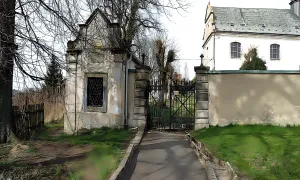
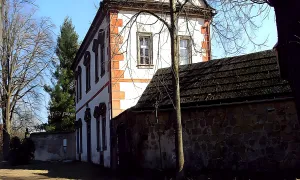
Kopicův statek, formerly known as Jirošova's express, is located approximately a kilometre east of Kacanovic in the Semily district. The current building was built in 1787 when it was built by the farmer Jiří Jiroš; However, the foundations of the estate are older. The ground plan of the building reflects the typical economic structure of its time: a residential storey house with a storey, to which the directly attached horticulture plant stands and against it economic buildings ground floor. The yard closes the stone gate, a wooden barn is nearby. The Kopicův statek is an example of the culture of folk architecture of the insurance type by this complex and independent location of individual buildings.
The farm was owned by the Jurošov family for a long time. The most famous member was František Jiroš (1824-1902), who in 1849 became the first mayor of Kacanovy.
The sandstone statue of Saint George Dracobijka built in 1806 before the farm increases the unique value. It is believed to be the work of Jan Chládek Jr.. In 1884, František Jiroš and his wife Petronila had her replenished with a new pedestal which they ordered from carpenter Josef Zeman from Tatobit. The Sokl is decorated with four reliefs depicting Christ in the Garden of Getseman, Saint Petronil and FeliciдProcessing, Maria Magdalen and Saint Anne. The original statue is located in the lobby of the Museum of Czech Paradise in Turnov.
A special chapter is made by an exceptional rock gallery created by Vojtěch Kopice in the rocks beneath the farm. He married to the building in 1932 and from the forties of his life until his death in 1978 he regularly came here and flowed into sandstone rocks a series of reliefs. He chose topics from Czech history and according to the list in the graphic definition of the protection zone I printed portraits of Jan Hus, Jan Žižek, Tomáš Garrigue Masaryk and Jiří from Poděbrad. In addition to historical figures he also created a depiction of Czech legends - Libuše, Horymír - and composition referring to natural motifs, believers and national values (from the Angel of the Keeper to the Scouts Lily to the Old Bloslary Paladium). One group consists of more distinctive iconographic elements such as guerrillas or reference to the bombing of Lidice. Overall, it is a unique testimony about the world of the creator - his religious beliefs, national values, and the desire to leave in the stone a memory of his time.
The rock reliefs of Vojtěv Kopice were submitted under monument protection in the form of a protection zone with effect from 25 November 2017. Kopicův statek, with its history, architecture and unusual rock gallery, remains a place where one can meet the individual's unique creative will, which decided to engrave its vision directly into natural material.
Then and now
Drag the slider to compare how the landmark may have looked when it was built with the view today.
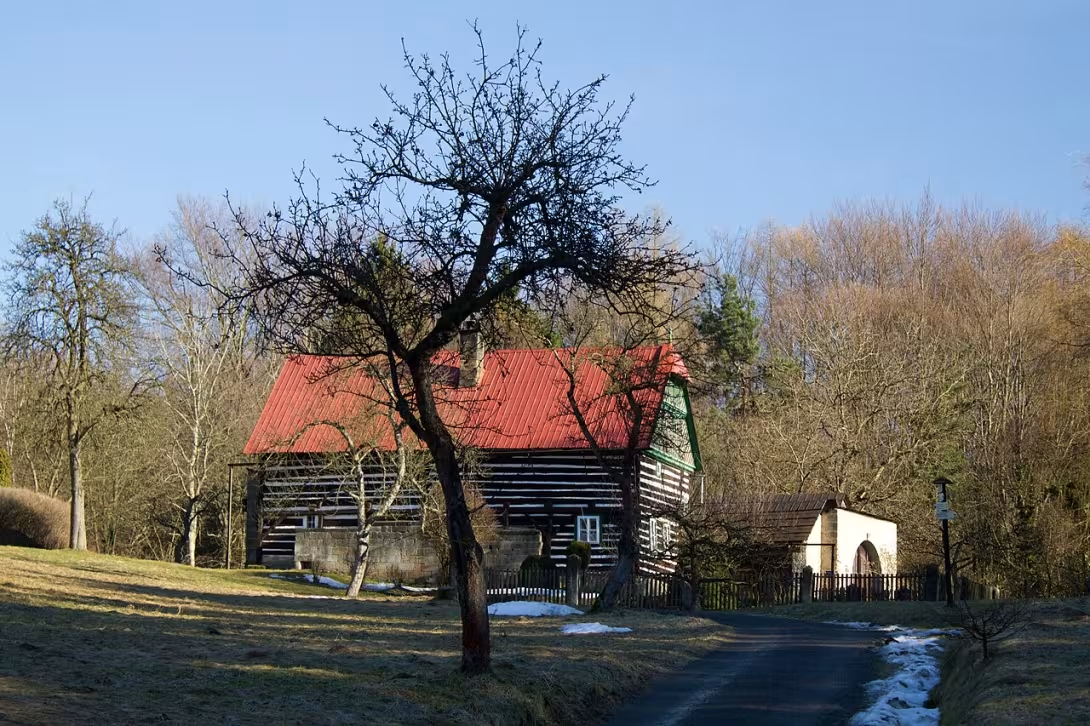
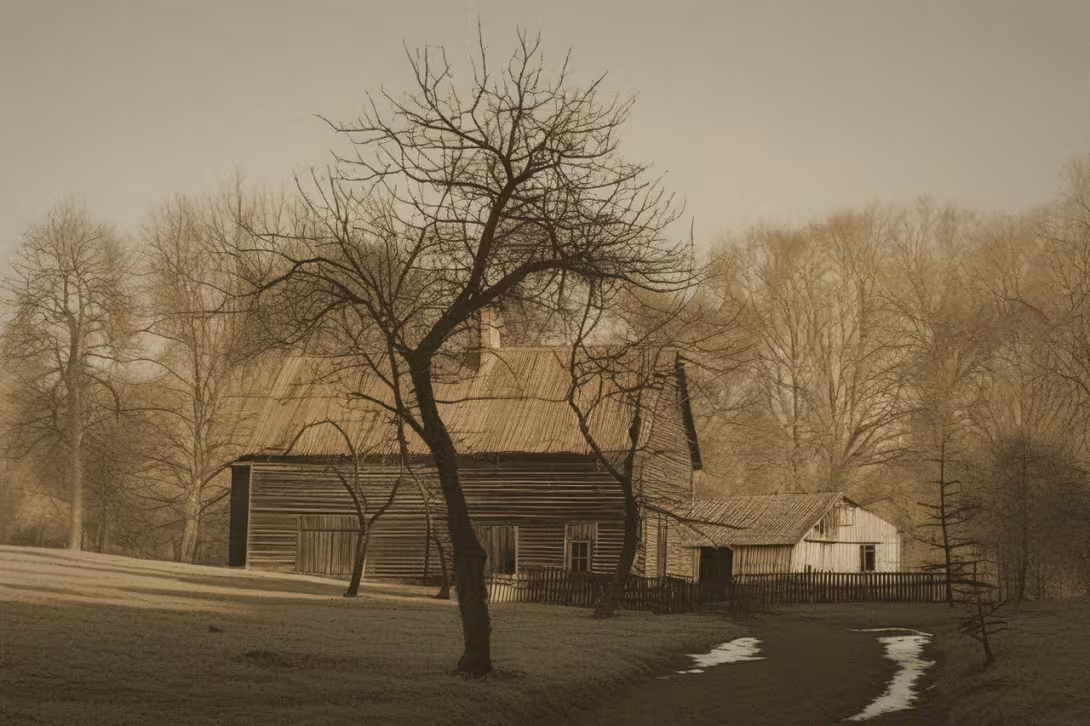
The historical appearance on the left is an AI-generated visualisation and serves as inspiration only.
Historical milestones
- 1787
- Establishment of the farm Jiří Jiroš
- 1806
- The creation of the statue of St. George
- 1884
- Making a new statue of the statue of St. George's family
- 1932
- Beginning of the production of the rock gallery Vojtěch Kopice
- 2017
- Announcement of the rock gallery protection zone
Architectural development
The estate was built around 1787 as a grafted two-room house with economic buildings. In the 19th century it was supplemented by a stone barn and a gate. In the 20th century, a rock gallery with reliefs carved by Vojtěch Kopice added. Materials: wood (grafted house), sandstone (statue, relief), stone (gate, economic objects).
Historical events
- 1787
- Built grafted estate Jiří Jiroš, foundations probably older
- 1806
- The creation of the statue of St. George, probably the work of John Chládek Jr
- 1932
- Vojtěch Kopic married into the estate and began to create rock reliefs
- 2017
- The rock gallery was protected by a cultural monument
Owners
The sequence of owners with years if available, otherwise zero.
Points of interest
- Construction of the Kopic estate was established in 1787, but the foundations of the estate are older.
- Kopicův statek is an example of folk architecture of the insurance type, with a typical economic structure: a residential house with a stoves, a horticulture and an economic building.
- There is a unique sandstone statue of St. George Dracobijan from 1806, originally the work of John Chládek Jr..
Guide
This guide is narrated by a synthetic voice generated by artificial intelligence.
Show guide text
This text was created by artificial intelligence and has not been editorially reviewed. It may contain inaccuracies.
Welcome to Kacanov. You've just stopped in front of a place that carries deep peace and a trail of ancient folk tradition. You are standing right in front of the Copic estate, a unique total, which is a living witness to the history of this region. Before your eyes, a harmonious set of structures spread out, which communicate quietly. Look at the beautiful wooden structure that forms the heart of this complex. You see a grafted storey house, whose walls tell stories of old crafts, and its characteristic stoves, which gives the building elegance and human dimension. The whole complex is complemented by economic buildings and acts as one integrated organism, which has been designed for centuries to serve man and his economic needs. Feel the atmosphere of a place where the practicality of agricultural life is combined with unexpected artistic depth.
To understand what you see today, we must return to a deep past. Although the main construction of the farm in its present form began to form in 1787 under the direction of Jiří Jiroš, the history of this place is much older. This means that people lived and worked here long before the first stone of today's storehouse was laid. The foundations on which this whole thing stands go even deeper into time. In 1787, Jiří Jiroš laid the foundation for what we now call the Copic estate. This estate has become a symbol of prosperity and stability in the insurance sector. Over the next generations, the Jiroš family has been taking care of our fertile region. For example, František Jiroš, who worked as Mayor of Kacanov in the second half of the Deveenth century, was one of the key figures to help shape the character of the site.
Now pay attention to the architecture itself that surrounds you. What you're looking at right now is a rare and highly authentic example of the insurance-type estate. Feel the specific structure that was typical of this region. You have a residential house in front of you, which, thanks to its storey grafted structure and the hovel, is a real unique one. Note how the buildings are arranged - the residential area, the horticulture and other economic buildings form a logical whole which was necessary for the operation of each successful farm. The whole area is then closed by a stone gate, which acts as a dignified entrance to this private world. Every detail, from wooden beams to stone elements, reflects the deep knowledge of the materials and traditions that have been passed down in this region from generation to generation.
Go now with your eyes on a character who stands as the silent guardian of the estate. In front of you stands the unique sandstone statue of St. George. It is the masterpiece of Jan Chládek younger from 1806. Note the details carved into sandstone that survived for more than two centuries. This statue is not only a religious symbol, but also an artistic pillar of the whole place. It is interesting that in 1884 the Jiroš family decided to make a new plinth for this statue, showing how important this monument was to them and how deeply connected to their family history. Saint George stands here as a link between folk faith and high art.
But Kopicův statek is not just about the history of agriculture and traditional architecture. It is also a place where, during the twentieth century, tradition met with an unexpected, modern artistic vision. Pay attention now to the rock gallery, which is one of the greatest treasures of this place. In 1932 Vojtěch Kopic began to create dozens of reliefs in the surrounding rocks, which gave this farm a unique character. The copy was an artist who could use nature as a canvas for his vision. His work, which lasted until 1978, turned this place into an informal open-air gallery. This rock gallery is such a fascinating dialogue between the human hand and the natural form. It is this combination of historical goods and modern artistic expression that makes the Kopic estate a place that cannot be compared to anything else. The importance of this creation was so great that in 2017 a protection zone was declared for this rock gallery.
If you're looking for the secrets of this place, think about how different time lines connect here. You have the foundations that are older than the actual construction from the late eighteenth century. You have a traditional folk architecture that was used to survive and manage. And then you have the art of Vojtěv Kopec, which has brought a spiritual and aesthetic dimension into this space that the original builders might not even dare imagine. It's a fascinating clash of pragmatism and inspiration.
I hope this brief insight into history has helped you to better perceive the beauty and depth of the Kopic farm. Do not let yourself be led away by looking at the main buildings, but continue to walk, look at the reliefs in the rock gallery in detail and see every trace left by the people before us. Every stone and every wooden plank here has a story waiting to be discovered. I wish you a beautiful and inspiring tour of this unique place. Goodbye.
Tips for visitors
{'paragraph': 'The best time to visit the Kopic farm is in spring or autumn, when nature is around the most beautiful and the traffic is lower. In summer there are often more people, but in sunny weather it is an ideal place for walking. In autumn you can admire the colorful leaves and calm atmosphere. Winter moons are suitable for lovers of snow and calm, but some parts of the area can be restricted.'}
{'paragraph': 'Kopicův statek is available by car, parking is possible near the property. It is recommended to arrive on your own vehicle because public transport does not directly lead here. You can find current connections and traffic options in the traffic search engine. If you arrive by car, look for local signs for parking near historical monuments.'}
{'paragraph': 'When visiting, wear comfortable shoes and clothes according to the weather. The area is partially outdoor, so prepare for various weather conditions. Children bring something to paint or write because there's plenty of space in the neighborhood for creative activities. Don't forget enough water and perhaps a picnic lunch, because there are no shops in the premises.'}
{'paragraph': 'Photography is permitted at the Copic farm, but the most beautiful pictures can be taken in sunny morning or evening. The best places for photos are a grafted house with a stonewall, stone gate and surrounding nature. When shooting the statue of St. George of Turnov (stored in the museum), follow the rules of the museum. Remember the stable tripod if you want to capture detailed shots.'}
{'paragraph': 'In the vicinity of the Kopic farm is worth visiting Dlask's farmhouse, which is also an example of insurer's folk architecture. It is only a few kilometres away and offers a similar atmosphere. Another interesting thing is the Museum of Czech Paradise in Turnov, located about ten kilometres from the Kopic farm. Here you can see the original statue of St. George, which was originally on the Kopic farm. It is interesting for children to explore historical buildings and educational boards.'}
{'paragraph': 'For families with children, Kopicův statek is ideal thanks to spacious areas and possibilities for movement. Children can view the grafted houses, explore economic buildings and have fun in nature. There is also plenty of room for games and exploring. It is recommended to bring some games or painting needs so that children can create and learn about history on their own experience. At the Museum in Turnov, children can see interesting exhibits and participate in interactive activities.'}
Frequently asked questions
Is Kopicův statek open to the public?
Yes, he's open to the public. You can visit it during the opening hours.
How do I get to the place by car / public transport?
The best thing is to drive in and park in front of the state. If you want to use public transport, the nearest bus stop is about 1 km from the location.
How much is the entrance fee and is it paid on the spot?
You pay right at the entrance.
Is the tour suitable for children and seniors?
Yes, the farm should be visited with children or seniors. The tour takes about 30 minutes and is not challenging.
How long does the tour take?
The tour takes about 30 minutes.
What are the opening times and booking is required?
Opening hours are 9: 00 to 5: 00. Reservation is not required, but we recommend you call the information line in advance.
What's interesting in the immediate vicinity?
In the immediate surroundings there is beautiful nature and other historical monuments. We recommend visiting a nearby forest where you can make a pleasant walk.
For kids
Imagine going back to when this country was still a wild and mysterious place. Kopicův statek was standing at the same time where it stands today. But back then, it wasn't a small country house, as you'd imagine.
At that time, there were people from the Sami tribe who were hunting and collecting. They were good hunters, and they made up clever tricks to hunt big animals like bears or deer. They also had their own language and traditions.
Businesses nearby
Do you run a restaurant, accommodation, shop, museum, rental, wellness or other visitor service near this monument? Show yourself directly to the people heading to it — this is how they will see you in the app and on the web:
Natáčelo se zde
- Princ Bajaja (1971) film
- Princ a Večernice (1979) film
- Nesmrtelná teta (1993) film
Zdroj: Wikidata (vlastnost „místo natáčení“) · Všechna filmová místa
Events nearby
Zdroj akcí: otevřená data měst a obcí ČR (Národní katalog otevřených dat) a kalendář akcí Národního památkového ústavu.
Nearby
- Another important example of insurer folk architecture
- Saves the original statue of St. George of the Kopic farm
- Natural landscape with sandstone rocks and forests
Accommodation nearby
Trips and activities nearby
Guided tours, tickets and activities nearby from GetYourGuide
Affiliate link: if you buy from the partner, we may receive a commission. The price for you does not change.
Search tours and activities →Themed route
Thematic cruise route: Zapozerská folk architecture and cultural treasures
1. Kopicův statek - * Insured folk architecture * A unique example of rural construction with rich decoration and historical statue of St. George. Its authentic interior and exterior reveal the traditions of the region and the life of the locals.
2. Dlaskova farmhouse - * Insurers folk architecture * Another pearl of the insured countryside, just a few kilometers from the Kopic farm, with typical elements such as shields, paintings and wooden sculptures. Ideal for comparing styles and details of both monuments.
3. Insurance spine - * Natural reservation * Beautiful forested area in the immediate vicinity of the farmhouses, suitable for a short walk with views of the landscape. Natural wealth complements cultural experience and offers peaceful moments.
4. Museum of Czech Paradise - * Museum * (Turnov, approx. 10 km) Home of the original statue of St. George of the Kopic estate, where you learn more about the history of the region and its art treasures. The exhibition links folk culture to artistic works.
Seasonal recommendations
Spring: In the spring season Kopicův statek offers a unique atmosphere where the sun's rays illuminate green meadows and flowering orchards. It blooms many different kinds of flowers, creating an attractive view for nature lovers. Visiting the farm is suitable in the early afternoon when temperatures are mild and the crowd is less than in the main summer season. It is recommended to wear clothes according to the weather because spring gloom can quickly bring rain.
Summer: Summer at the Kopic farm is ideal for visiting due to warm days and long lights. Nature offers full flowering sets that are comfortable for walks. The main summer season may increase the number of visitors, so it is advisable to come earlier in the afternoon or on Sunday when the crowd is usually less. Don't forget the sun protection and wear light clothes.
Autumn: In autumn, Kopicův statek offers beautiful experiences with a colourful appearance of leafy trees that vary from yellow to red and orange. The atmosphere is calm and quiet, allowing relaxed walks without too many crowds. The best time to visit is in the early afternoon when temperatures become mild and you may need to wear more clothes for colder evenings.
Winter: The winter visit to the Kopic farm offers a peaceful experience where nature is covered with snow and creates extraordinary views. The opening hours of the monument are usually shorter, so make sure you have an up-to-date schedule before visiting. In winter months it is important to wear warm clothes and suitable shoes for snow conditions. Despite the cold, the atmosphere around the farm is calm, allowing relaxed walks without obstacles to the crowd.
Visualizations and artistic views


The visualisations are generated by artificial intelligence and serve as inspiration.
Photos from the area
Real photos taken near the monument


Zdroj a licence jsou uvedeny u každého snímku.
Atmosphere of the place
This atmospheric visualisation of the place and period was generated by artificial intelligence. It is not real footage of the location.
Tips from visitors
No tips yet. Be the first!
Log in and add your tip.
Sources and literature
Fotografie: This image is a work by Miloslav Rejha (User:M.Rejha). When reusing, please credit me as: Miloslav Rejha, Wikimedia Comm / CC BY-SA 3.0, rozlišení zvýšeno umělou inteligencí — Wikimedia Commons. The author and licence also appear when you hover over the image.
Faktickým podkladem tohoto textu byl článek na Wikipedii, jehož autory jsou přispěvatelé Wikipedie. Článek je dostupný pod licencí CC BY-SA 4.0.
Location on the map

Příběhy a pověsti
Legendy, pověsti a příběhy spjaté s touto památkou
Fotografie návštěvníků
Zatím žádné fotografie. Buďte první, kdo přidá fotografii z návštěvy!
Přihlaste se a přidejte svou fotografii nebo hodnoťte.
Za ověřenou návštěvu v aplikaci získáte víc bodů — poznáme podle GPS, že jste na místě.
Reviews and comments