



kostel Nanebevzetí Panny Marie (Předklášteří) Church
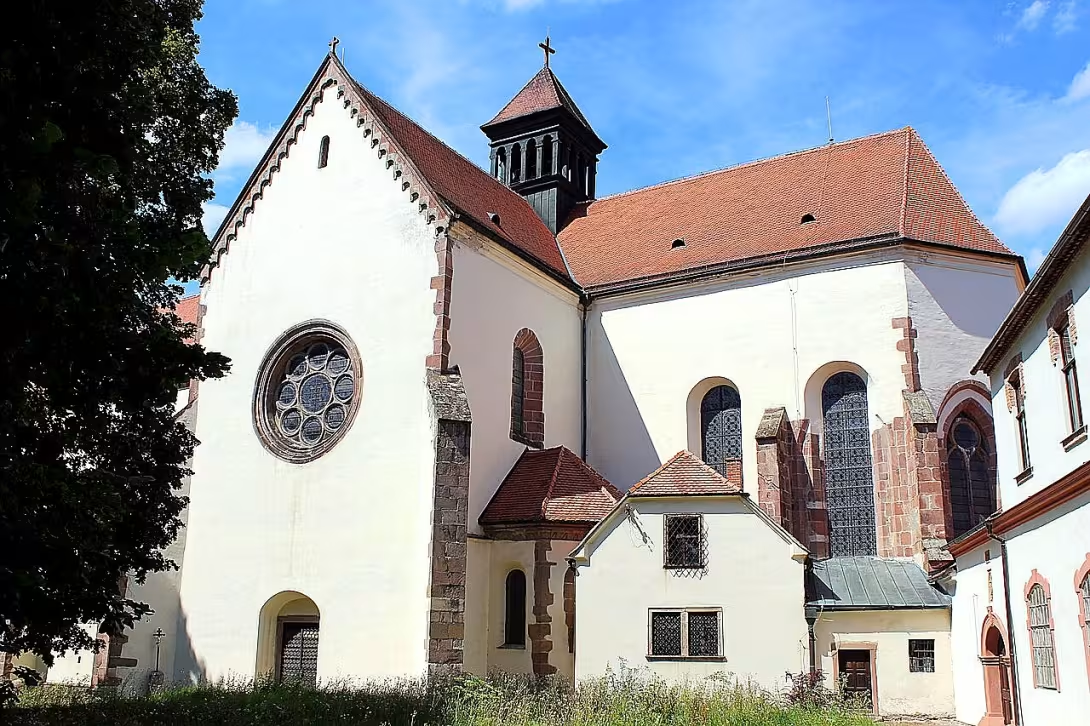
The Church of the Assumption of the Virgin Mary in Předklášteří is one of the great monuments of medieval tanker architecture. It is a parish church of the local parish and part of a protected area of the Porta Coeli monastery, which was declared a national cultural monument of the Czech Republic in 2010.
The church grew up shortly after the establishment of the monastery complex, between 1233 and 1240. The official founder was Konstancia Uherská, daughter of Hungarian King Béla III and widow of Czech King Přemysl Otakar I., who was behind the creation of the whole monastery complex. He was dedicated in 1239. Presbyterium later served as the tomb of the Queen, and there was buried also one of the co-founders - Margrave Přemysl, the king's son. During the war period, the whole complex faced many problems. The fundamental turning point was 1782, when on the basis of Joseph's 2nd patent on the dissolution of the monasteries the convention was closed, and the church has since been used only as a parish temple. Since 1901, after approximately a hundred years of separation, the monastery complex has been reactivated and the church has served again as conventional. Although world wars have brought about further changes, the main function of the temple has been preserved until today.
Architecturally, the church maintains a pattern of a non-uniform cross, typical of the tanker tradition. Three longitudinal ships, of which the main exceeds both sides, are connected by a transverse vessel. Presbyterium ends with a multi-angle conclusion, which is repeated in a simpler form even in the case of auxiliary ships. The construction is characterized by a massive, robust wall with undivided pillars - a experience of Romanesque sensations - which is overlapping by the already Gothic rib arches. The windows are highlighted with broken arches and decorated with stained windows. A special six-piece vault was used in the presbyterium, where six ribs fitted with vegetable bolts converge in each field. The original blue painting of heaven that we see today brought later Baroque times. Despite its richness of decoration, the construction appears strenuous and effective - in accordance with the principles of tanker construction.
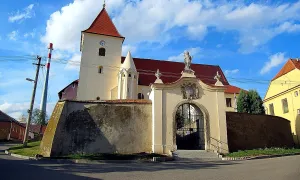
The strong contrast creates a Western portal, which is one of the unique memories of its kind in Central Europe. The honorary portal symbolizes the name of the monastery - "Porta Coeli," the Gate of Heaven. They're spread out in five degrees and guarded by lionesses. Stone decor shows the lace of acantos and wine leaves with grapes, interchanged columns with statues of apostles. However, the consoles framing broken archivores suggest that the portal should have originally been covered by an open hall, as in the Benedict Basilica in Trebic - the question remains whether the hall was actually demolished or only designed.
The church represents an interesting synthesis of Romanesque and Gothic elements and is one of the most important monuments of the governing period of Christian construction in the Czech Republic. Today's visitor here may perceive a unique atmosphere of medieval sanctity and archaic majesty.
Then and now
Drag the slider to compare how the landmark may have looked when it was built with the view today.
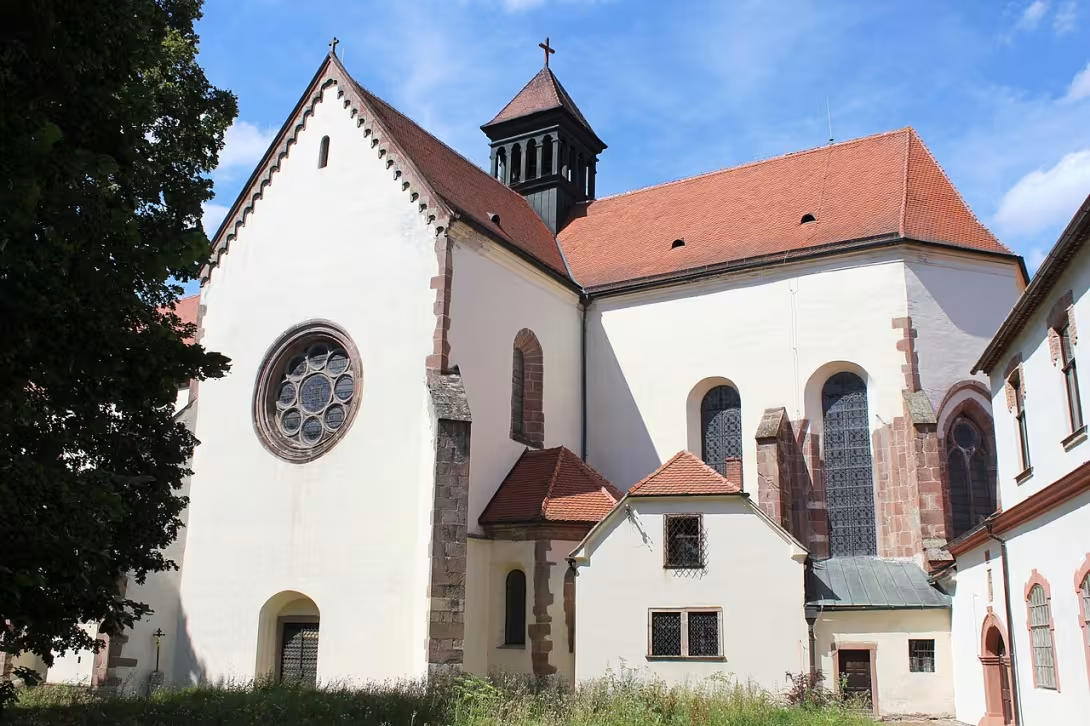

The historical appearance on the left is an AI-generated visualisation and serves as inspiration only.
Historical milestones
- 1233
- Beginning of construction of the church as part of the monastery Porta Coeli
- 1239
- The Church of the Assumption of the Virgin Mary
- 1782
- Cancellation of the monastery, the church went to the parish administration
- 2010
- Declaration of the monastery area for a national cultural monument
Architectural development
The church was built in two stages (1233-1240) in an early Gothic style with elements of Romanesque masonry. The floor plan consists of a non-uniform cross with a presbyterium ending with a multi-helical finish. The lining system is rib, in presbyterium six-piece with vegetable bolts. The Western Porta Coeli portal is a unique monument to Central Europe. Baroque painting from the 17th-18th century complements the interior.
Historical events
- 1239
- Official consecration of the church
- 1782
- Cancellation of the monastery based on Josefi's patent, the church went to the parish administration
- 2010
- Declaration of the whole monastery area for a national cultural monument
Points of interest
- The Church of the Assumption of the Virgin Mary was built between 1233 and 1240 shortly after the foundation of the monastery Porta Coeli.
- He was consecrated in 1239 and his official founder was Constantine of Hungary.
- Presbyterium served as the tomb of Queen Constantine and her son, Margrave Přemysl, was buried here.
- In 1782 the monastery convention was abolished based on the patent of Josef II and the church has since been used only as a parish temple.
- The Western portal of the church, called Porta Coeli, is a unique monument in Central Europe and symbolizes the name of the monastery.
Guide
This guide is narrated by a synthetic voice generated by artificial intelligence.
Show guide text
This text was created by artificial intelligence and has not been editorially reviewed. It may contain inaccuracies.
The Church of the Assumption of the Virgin Mary in Předklášteří near Tišnov is the parish church of the local parish. At the same time, it belongs to the complex of the Cistercian monastery Porta coeli, which was declared a national cultural monument in 2010.
The church was built in two stages between 1233 and 1240, shortly after the convent was founded, and was consecrated in 1239. Queen Konstancie of Hungary, daughter of the Hungarian King Béla the Third and widow of the Czech King Přemysl Otakar the First, is considered the founder of both the church and the entire monastery. She was later buried in the presbytery. Her son, the Margrave Přemysl, one of the co-founders of the monastery, also rests here.
In 1782, the monastery was dissolved based on the patent of Joseph the Second, and the church continued to serve as a parish church. From 1901, when life returned to the monastery after roughly a century of silence, it has also been a conventual church again. This function it has retained through many changes during the world wars to this day.
The ground plan has the shape of an unequal-armed cross, which was typical for the Cistercians. Between the chancel and the triple nave, a transept is inserted, and the main nave rises above both side aisles. Massive walls are supported by unadorned pillars. The emphasis on the mass of the wall apparently still echoes Romanesque sensibility and gives the building a stern, robust character. Rib vaults and buttresses are already Gothic. The keystones vary from vault to vault, and in some vaults they are completely missing. In the left aisle, at the triumphal arch, there is an extra rib. It may have been just a builder's error, though an impressive one.
The chancel is covered by a six-part vault, where in each section six ribs meet at a keystone with a plant motif. The capitals are decorated with berry ornaments. The windows are pointed and have stained glass. The sky-blue painted decoration representing the heavens dates from the Baroque period. Nevertheless, the whole effect is austere, in keeping with the practical Cistercian building tradition.
All the more striking is the ornate western portal, which is among rare monuments of its kind in Central Europe. It was meant to embody the very name of the monastery, Porta coeli, that is, the Gate of Heaven. The corbels indicate that it was originally meant to be covered by an open vestibule, similar to that of the Benedictine basilica in Třebíč. However, it is still unknown whether it was demolished or remained only in plans. The portal narrows in depth through five stages and is guarded on either side by reclining lions. From them unfolds a stone lacework of acanthus and vine leaves with grapes, interspersed with pillars bearing statues of apostles.
Frequently asked questions
Can the monument be visited?
Religious buildings are usually open mainly during services; at other times a visit is normally arranged with the parish or the operator. We have not verified specific times.
Where is the monument?
Location: Porta coeli 1001, Předklášteří, Jihomoravský kraj. The map on this page shows the exact spot.
Why is the monument protected?
It is listed in the Central List of Cultural Monuments of the Czech Republic as a national cultural monument (register no. 342). It is protected as part of a larger listed ensemble.
For kids
Imagine coming back 793 years, until this place looked so different! It was a big meadow where shepherds spent all day. But that's when the beautiful green tower began to grow and people came to build a new building - the Church of the Assumption of the Virgin Mary in Předklášteří.
Businesses nearby
Do you run a restaurant, accommodation, shop, museum, rental, wellness or other visitor service near this monument? Show yourself directly to the people heading to it — this is how they will see you in the app and on the web:
Events nearby
Zdroj akcí: otevřená data měst a obcí ČR (Národní katalog otevřených dat) a kalendář akcí Národního památkového ústavu.
Nearby
- Gothic Cistercian monastery with unique portal Porta Coeli
- Baroque chateau from 18th century with park
- The surrounding area is part of protected landscape areas and nature reserves
Accommodation nearby
Trips and activities nearby
Guided tours, tickets and activities nearby from GetYourGuide
Affiliate link: if you buy from the partner, we may receive a commission. The price for you does not change.
Search tours and activities →Themed route
Thematic cruise route: Gothic, Baroque beauty and natural treasures Předklášteří
1. Church of the Assumption of the Virgin Mary * Type: Sacral landmark * The unique Cistercian church with Gothic elements and a rare Porta Coeli portal is the centre of the entire complex. Its architecture and historical significance combine medieval spirituality with local tradition.
2. Porta Coeli Monastery * Type: National cultural monument * There is a Gothic monastery in the church area with a unique portal that symbolizes the "gate of heaven." Its preserved layout and artistic details represent the peak of the Tisteriac art in the region.
3. Castle Předklášteří * Type: Baroque residence * In the centre of the village there is an elegant Baroque chateau with a park offering a view of the surrounding countryside. Its interiors and landscapes reflect the life of the 18th century nobles.
4. Natural Reservations in the Around Předklášteří * Type: Protected area * Within ten kilometers the natural reserves of the South Moravian Region are decomposed, ideal for short walks or observations of local flora and fauna. Suitable for lovers of peace and nature.
Seasonal recommendations
Spring At this time, the Předklášteří shows the green force of nature, when the Church of the Assumption of the Virgin Mary lights up with fine sunlight, which highlights its architectural details. The surrounding area is covered with elements of first spring growth - flowering oak trees and willows that create a pleasant, airy atmosphere. It is convenient to visit the church early in the morning when there are fewer people and nature has not exhausted its color. It is recommended to dress lightly, but with the possibility of adding a layer to any rain that often occurs at this time. The best time to visit is in the prehistoric hours when the temperature is pleasant and nature still full of life.
---
Summer In the main summer season the church is lit directly by the sun, which emphasizes its historical beauty and alternating shadows. The surrounding area is full of warm sunlight and green, creating a pleasant, refreshing atmosphere. At this time, however, it is best to come in a timely time to avoid crowds that often gather around the main traffic. It is recommended to wear light, airy clothes, but with the possibility of adding a light coat to any evening cold. It is also advisable to carry water and sun protection to avoid overheating.
---
Autumn At this time, the church is illuminated by the mild light of autumn sun, which emphasizes its historical details and alternating shadows. The surrounding area is covered with leaves that begin to turn yellow and create a pleasant, warm atmosphere. It is convenient to visit the church in late afternoon, when there are fewer tourists and nature still full of color. It is recommended to dress warmer, with the possibility to add a layer to any cool wind. The best time to visit is from September to October when the weather is more stable and pleasant for walks.
--- Winter In advent time, the church is lit with bright candlesticks and Christmas light, which creates a magical atmosphere. The surrounding area is covered with snow, which gives the place soft, winter beauty. At this time it is best to visit the church in the foresaw hours when there are fewer tourists and it is advisable to dress warmer, with the possibility to add a layer to the cool weather. It is also advisable to check opening times which may be shorter in the winter months. It is recommended to bring warm drinks and ensure warm clothes to avoid overheating or cold.
Visualizations and artistic views


The visualisations are generated by artificial intelligence and serve as inspiration.
Photos from the area
Real photos taken near the monument


Zdroj a licence jsou uvedeny u každého snímku.
View from the area
This animation was generated by artificial intelligence from a real photograph of the surroundings. The motion and details are not real footage of the location.
Tips from visitors
No tips yet. Be the first!
Log in and add your tip.
Sources and literature
Photos: Harold / CC BY-SA 3.0 — Wikimedia Commons. The author and licence also appear when you hover over the image.
Faktickým podkladem tohoto textu byl článek na Wikipedii, jehož autory jsou přispěvatelé Wikipedie. Článek je dostupný pod licencí CC BY-SA 4.0.
Location on the map


Příběhy a pověsti
Legendy, pověsti a příběhy spjaté s touto památkou
Fotografie návštěvníků
Zatím žádné fotografie. Buďte první, kdo přidá fotografii z návštěvy!
Log in a přidejte svou fotografii nebo hodnoťte.
Za ověřenou návštěvu v aplikaci získáte víc bodů — poznáme podle GPS, že jste na místě.
Reviews and comments