



kostel Nanebevzetí Panny Marie (Soběchleby) Church
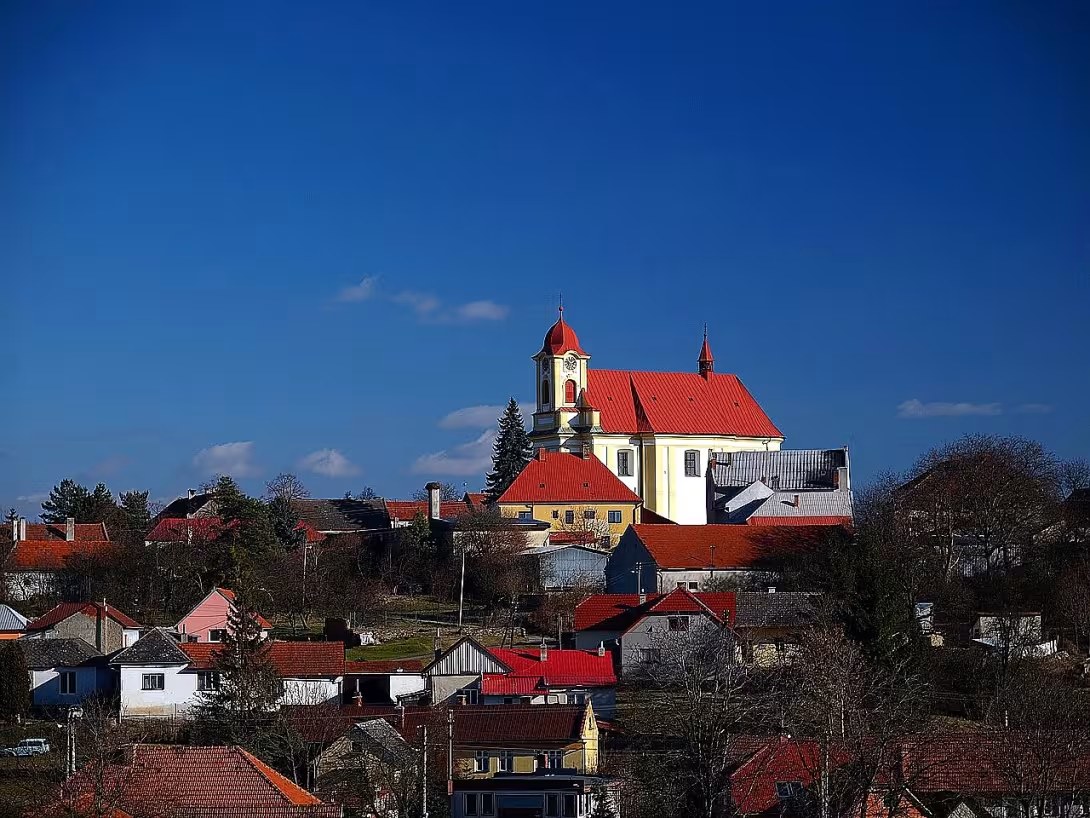
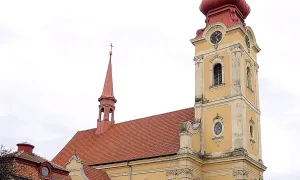
The Church of the Assumption of the Virgin Mary in Soběchleby is a Roman Catholic church with significant historical and architectural importance. Located near Hranice on Morava, it stands as a testament to the region's rich cultural heritage and religious history. Established around the 14th century, it has undergone several transformations reflecting various styles from Gothic to Baroque. The current structure was built between 1755-1769 under Karel Maxmilián Ditrichštejn, based on designs by František Antonín Grimm. Its historical significance is underscored by its inclusion in the state list of cultural monuments since 1963.
Historical records confirm a church and parish existed in Soběchleby as early as 1394. The origins are linked to Záhoří's colonization, likely initiated by Bishop Bruno ze Schauemburgu around a century earlier. Initially, there was a small wooden chapel surrounded by palisades, which later evolved into a Gothic structure in the late 14th century. This transformation occurred under Jan z Kravař, who held patronage over the church and oversaw the construction of a stone Gothic sanctuary. The church's history is marked by resilience; despite being destroyed by fire during conflicts, it was rebuilt as a stone edifice.
The architectural journey continued into the mid-18th century with its Baroque transformation. Between 1755 and 1769, Karel Maxmilián Ditrichštejn commissioned František Antonín Grimm to redesign the church, resulting in significant changes reflecting the Baroque style prevalent during Europe's Age of Enlightenment. This period also saw the construction of a new tower in 1770, adorned with three bells, although these were later melted down and replaced following a fire in 1832.
Throughout its history, the Church of the Assumption has been associated with notable figures such as Jan z Kravař and Karel Maxmilián Ditrichštejn. The church's fortunes have seen dramatic changes, from being plundered by Valachian bandits in 1710 to undergoing restoration after a major fire in 1832. Additionally, the establishment of a brotherly school in 1555 highlights its role as a community center.
Today, the Church of the Assumption stands as a well-preserved example of Baroque architecture and continues to serve as a place of worship for the local Roman Catholic parish. Its historical significance and architectural beauty make it a worthwhile destination for visitors interested in exploring Moravia's cultural heritage. The church's inclusion in the state list of cultural monuments ensures its preservation for future generations, inviting all who appreciate history and architecture to experience this remarkable site.
Then and now
Drag the slider to compare how the landmark may have looked when it was built with the view today.
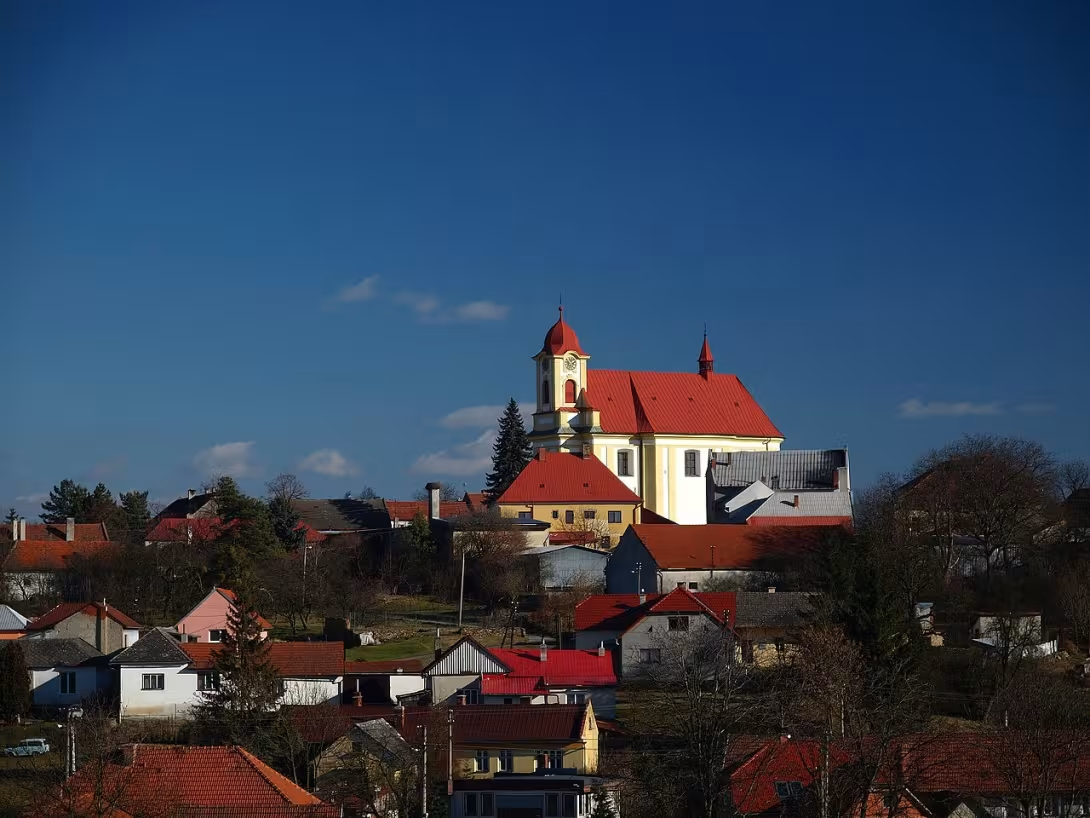
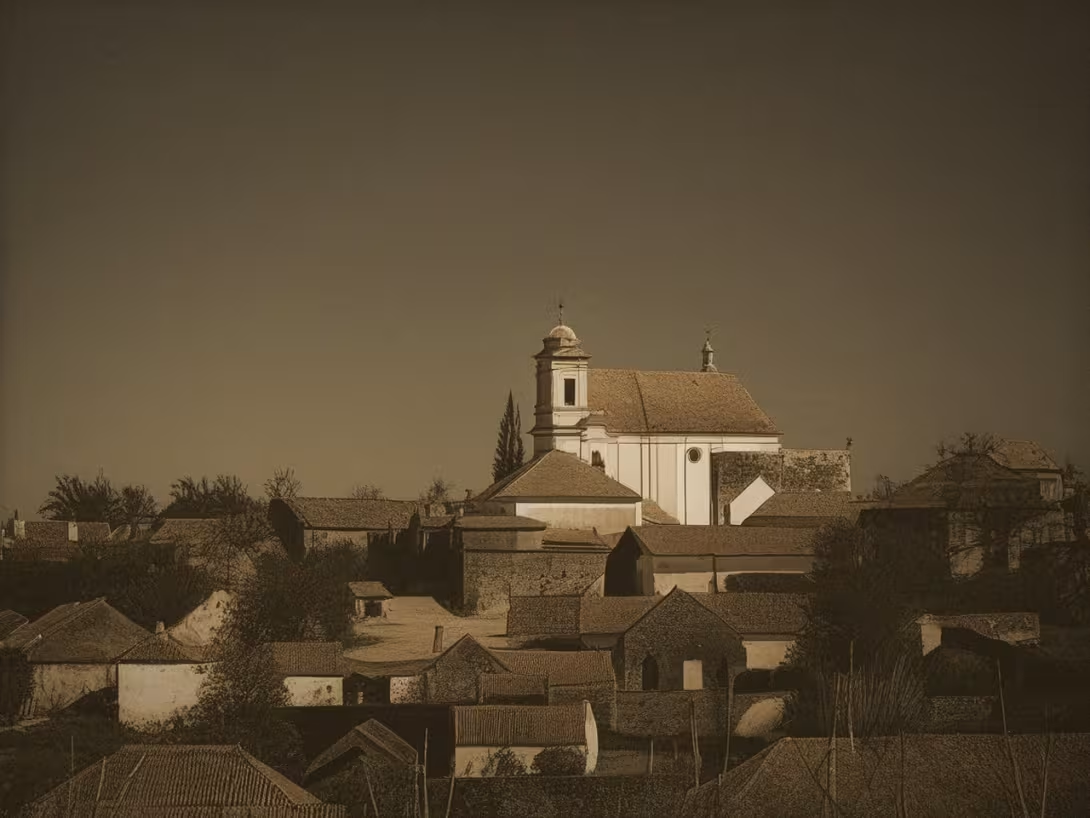
The historical appearance on the left is an AI-generated visualisation and serves as inspiration only.
Historical milestones
- 1394
- Existence of church and parish confirmed.
- kolem 1350
- Church origins linked to Záhoří's colonization by Bishop Bruno ze Schauemburgu.
- koncové 14. století
- Transformation into a Gothic structure under Jan z Kravař.
- 1755
- Baroque transformation of the church began.
- 1769
- Completion of Baroque redesign by František Antonín Grimm.
- 1770
- Construction of a new tower with three bells.
Architectural development
Initially a small wooden chapel surrounded by palisades, the church evolved into a Gothic structure in the late 14th century. After being destroyed by fire during conflicts, it was rebuilt as a stone edifice. The Baroque transformation between 1755-1769 introduced significant architectural changes under František Antonín Grimm's design.
Historical events
- 1394
- Historical records confirm the existence of a church and parish.
- 1555
- A brotherly school was established in Soběchleby.
- 1770
- The current tower was built, and three bells were installed.
Owners
The church has been associated with the holders of the Helfštýnské panství, notably Jan z Kravař in the early 14th century and later Karel Maxmilián Ditrichštejn who oversaw its Baroque reconstruction.
Points of interest
- The Church of the Assumption's initial structure was a modest wooden chapel surrounded by palisades, reflecting early medieval architectural practices and the region’s reliance on simple construction methods before transitioning to stone.
- In 1710, the church faced an unusual threat when it was plundered by Valachian bandits, showcasing the turbulent times during which local religious sites were vulnerable to raids beyond traditional military conflicts.
- The church's bells, added in 1770, have a tumultuous history; they were melted down and replaced after being destroyed by fire in 1832, demonstrating the resilience of the community in preserving their cultural artifacts despite repeated adversities.
- A significant educational role was played by the establishment of a brotherly school in 1555 within the church's precincts, highlighting its function as not just a religious center but also an intellectual hub during that era.
- Despite numerous reconstructions and restorations over centuries, including a major overhaul to Baroque style under Karel Maxmilián Ditrichštejn, the church has maintained its historical essence, illustrating the enduring legacy of architectural evolution in response to cultural and artistic trends.
Guide
This guide is narrated by a synthetic voice generated by artificial intelligence.
Show guide text
This text was created by artificial intelligence and has not been editorially reviewed. It may contain inaccuracies.
The Church of the Assumption of the Virgin Mary is a Roman Catholic church in the municipality of Soběchleby in the Přerov district. It is the parish church of the Soběchleby u Hranic parish in Moravia, which belongs to the Hranice deanery. Since 1963 it has been a cultural monument.
The church and rectory are documented in sources from the year 1394. However, experts assume that the church was founded a century earlier. It probably originated during the colonization of Záhoří at the initiative of Bishop Bruno of Schauenburg. According to contemporary reports, a wooden chapel surrounded by a palisade first stood here. It burned down after military skirmishes. A smaller Gothic chapel then stood in its place.
The holders of the Helfštýn estate held patronage over the Soběchleby church. In the first half of the fourteenth century, the estate was most likely held by Jan of Kravař. He was the one who had the brick Gothic sanctuary built. The first known clergyman can be documented at the end of the fourteenth century. He was Father Martin and after him his successor Matthew. In 1555 a brotherhood school was established in Soběchleby.
After the Battle of White Mountain, Záhoří returned to the Catholic faith and the local estate was taken over by the Ditrichstein family. Karel Maxmilián from this family had the present church built between 1755 and 1769 on the foundations of the original chapel. It was designed by the provincial architect František Antonín Grimm from Brno. A commemorative inscription on the portal of the main entrance recalls this. In 1770 the present tower was built and three bells were hung on it. In a major fire in 1832 the bells melted. The church was then repaired and new bells were obtained.
The rectory was initially very modest. In 1710 it was attacked by Wallachian outlaws and in 1776 it was renovated.
Frequently asked questions
Can the monument be visited?
Religious buildings are usually open mainly during services; at other times a visit is normally arranged with the parish or the operator. We have not verified specific times.
Where is the monument?
Location: Olomoucký kraj. The map on this page shows the exact spot.
Why is the monument protected?
It is listed in the Central List of Cultural Monuments of the Czech Republic as a cultural monument (register no. 1000137251).
Businesses nearby
Do you run a restaurant, accommodation, shop, museum, rental, wellness or other visitor service near this monument? Show yourself directly to the people heading to it — this is how they will see you in the app and on the web:
Nearby
The church is located in Soběchleby, near Hranice on Morava. The surrounding landscape includes typical Central European rural scenery with nearby natural features and historical sites within a 5 km radius.
Accommodation nearby
Trips and activities nearby
Guided tours, tickets and activities nearby from GetYourGuide
Affiliate link: if you buy from the partner, we may receive a commission. The price for you does not change.
Search tours and activities →Themed route
Trasa: Soběchleby and Surroundings
1. Church of the Assumption of the Virgin Mary (Soběchleby): This Gothic church is a dominant feature of the village of Soběchleby and is worth visiting for its unique architecture and history. It is one of the oldest churches in the region, with construction dating back to the 14th century. 2. Soběchlebský Cemetery: Located near the church, it offers a glimpse into the village's history. The cemetery is surrounded by trees and has a peaceful atmosphere. 3. Soběchlebská Garden: This site is surrounded by trees and offers a tranquil atmosphere. It is an ideal place for rest and relaxation. 4. Hranický Forest: This forest is about 2 km from the church and offers opportunities for walking and observing nature. It is an ideal spot for those who want to avoid crowds and find some peace. 5. Soběchlebská Chapel: Located in the center of the village, it offers a view into history and culture. It is a small but interesting chapel that is worth visiting.
Seasonal recommendations
Jaro: In the spring, the Church of the Assumption of the Virgin Mary in Soběchleby is surrounded by blooming trees and shrubs, creating a pleasant atmosphere. It's best to visit on quiet days when there aren't large groups of tourists. The ideal time for a visit is in the morning or late afternoon to avoid crowds.
Léto: During the summer season, the Church of the Assumption of the Virgin Mary in Soběchleby is surrounded by lush vegetation and is an ideal spot for relaxation. Due to large crowds, it's recommended to arrive before the start of the season to avoid long lines.
Podzim: In autumn, the Church of the Assumption of the Virgin Mary in Soběchleby is surrounded by colorful foliage, creating a pleasant atmosphere. Due to the cold weather, it's advised to wear warm clothing. It's best to visit on quiet days when there aren't large groups of tourists.
Zima: In winter, the Church of the Assumption of the Virgin Mary in Soběchleby is surrounded by snow and is an ideal spot for a winter walk. Don't forget to wear warm clothing and boots with good traction.
Visualizations and artistic views


The visualisations are generated by artificial intelligence and serve as inspiration.
Photos from the area
Real photos taken near the monument

Zdroj a licence jsou uvedeny u každého snímku.
Tips from visitors
No tips yet. Be the first!
Log in and add your tip.
Sources and literature
Photos: Milos Pospa / CC BY-SA 3.0 — Wikimedia Commons. The author and licence also appear when you hover over the image.
Faktickým podkladem tohoto textu byl článek na Wikipedii, jehož autory jsou přispěvatelé Wikipedie. Článek je dostupný pod licencí CC BY-SA 4.0.
Location on the map

Příběhy a pověsti
Legendy, pověsti a příběhy spjaté s touto památkou
Příběh: kostel Nanebevzetí Panny Marie (Soběchleby)
Bylo to v pondělí ráno, kdy Martin z Soběchlebů se snažil stáhnout své šaty, které byly mokré od deště, ke kterému nebylo možné uniknout. Kostel Nanebevzetí …
Číst příběh
Pověst: kostel Nanebevzetí Panny Marie (Soběchleby)
Traduje se, že kostel v Soběchlebech stojí na místě, které si samo vybralo, aby bylo posvátné — a že toto místo svou posvátnost nikdy nevzdalo, třebaže jej o…
Číst příběhFotografie návštěvníků
Zatím žádné fotografie. Buďte první, kdo přidá fotografii z návštěvy!
Log in a přidejte svou fotografii nebo hodnoťte.
Za ověřenou návštěvu v aplikaci získáte víc bodů — poznáme podle GPS, že jste na místě.
Reviews and comments