



Kostel Nanebevzetí Panny Marie ve Zlonicích Church
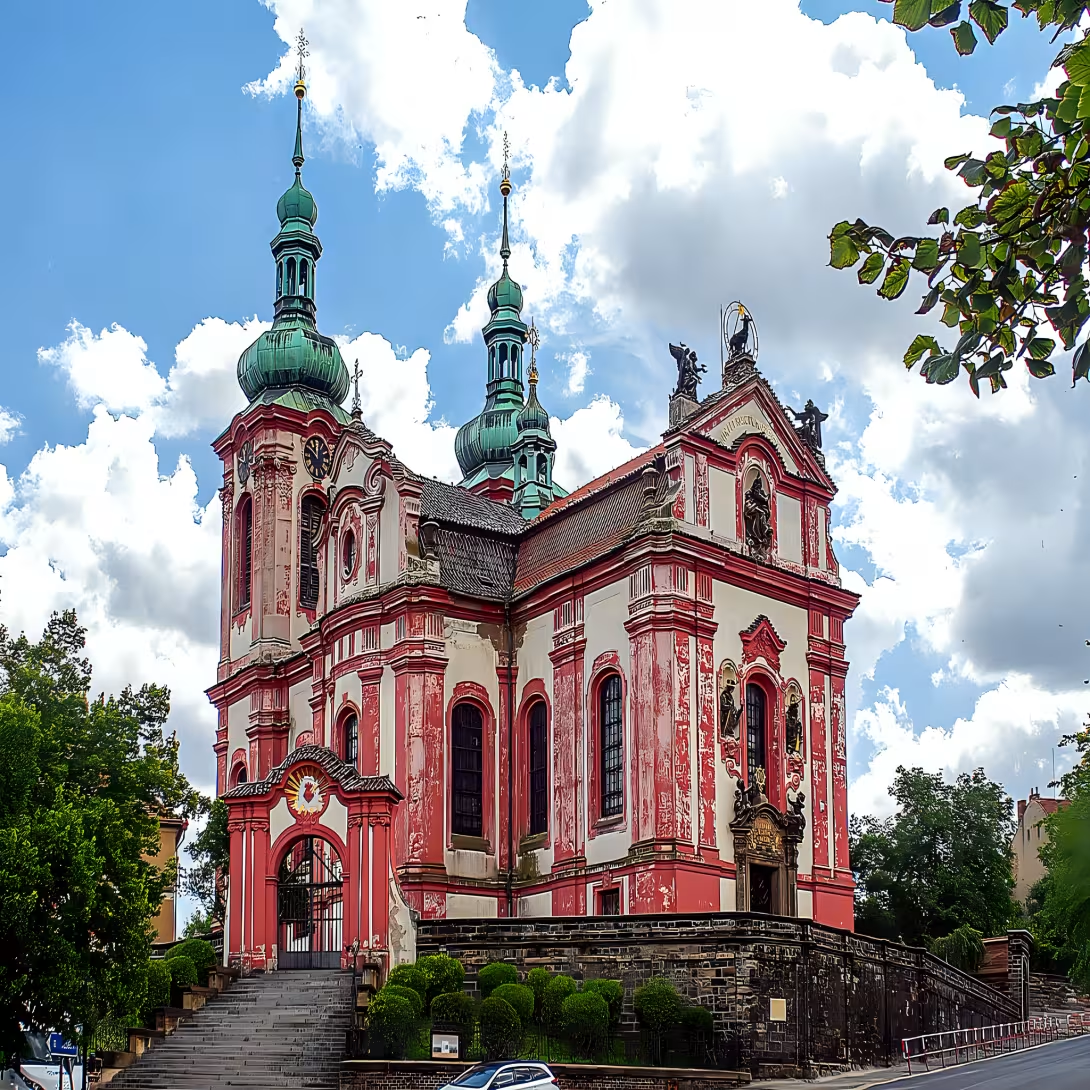
The Church of the Assumption of the Virgin Mary is among the most important realization of the Czech Baroque. The monumental building is situated in the centre of the village on the elevated terrace above the square and still acts as a dominant part of the town and its surroundings. It is a real-estate cultural monument of the Czech Republic, which can be enjoyed not only as a building but also as an expression of the long development of Czech architectural taste.
The original medieval church in the same place has been documented since 1352. The mobility of the older building has been preserved by liturgical property and portraits of members of the Valkouns family, patrons of the church. Among them stands the artistic painting of Bohushval Valkoun of Adlar from 1608. Not long before the demolishing of the older building, the former patron Count Norbert Leopold Libštejnský z Kolovrat gave the church a statue of the Virgin Mary, which he had delivered directly from the Italian Loreto.
When the construction needed to be restored, the initiators found themselves in the person of the new owner of Zlonic and patron of the church, Prince Philip Josef Kinski, and also in the person of the criminal dean John Adam Svoboda. The first mention of the intention of the new building dates back to April 1723. In the same year František Maximilián Kaňka, an important Czech architect, was present in Zlonice, whose authorship of the church is now undeniable. Construction work began in 1727 under the guidance of builder Ferdinand Hübner. The cornerstone was blessed on September 23, 1731. Parts of the construction were gradually completed: in 1738 the boat and presbytery stood, until 1744 the towers rose.
The original Kanyk design was later perceived as being too sober, so the church had a major recovery at the end of the 19th century. In 1892 the architect Friedrich Ohmann developed plans. The work began in 1895 by adjusting the facade; The original statues were replaced by new ones from Stanislav Succharda. The roof was repaired and a new tower was erected. The collapse was carried out on 16 October 1899. After 1900, the reconstruction continued according to the designs of architect Josef Fanta in a spirit beginning with the Art Nouveau. The modifications were definitely completed in summer months 1909-1911 by fresco under the direction of Adolf Liebscher, Professor of CVUT in Prague. The last exterior renewal took place in 1992- 1995.
It is an architectural construction of a single ship's cross layout with two towers with onion-shaped bans. The western facade is divided by the pilasters and culminates in a triangular shield. The characters of the national patrons - Saint Wenceslas and Saint Vojtěv, accompanied by kneeling angels, are placed in nothing on the sides of the window. The interior is glazed with a flat vault.
The church deserves a visit not only for its architecture, but also for its rich history - from medieval beginnings to the genius of the Kanyk Baroque to the Art Nouveau reconstruction of the early twentieth century.
Then and now
Drag the slider to compare how the landmark may have looked when it was built with the view today.
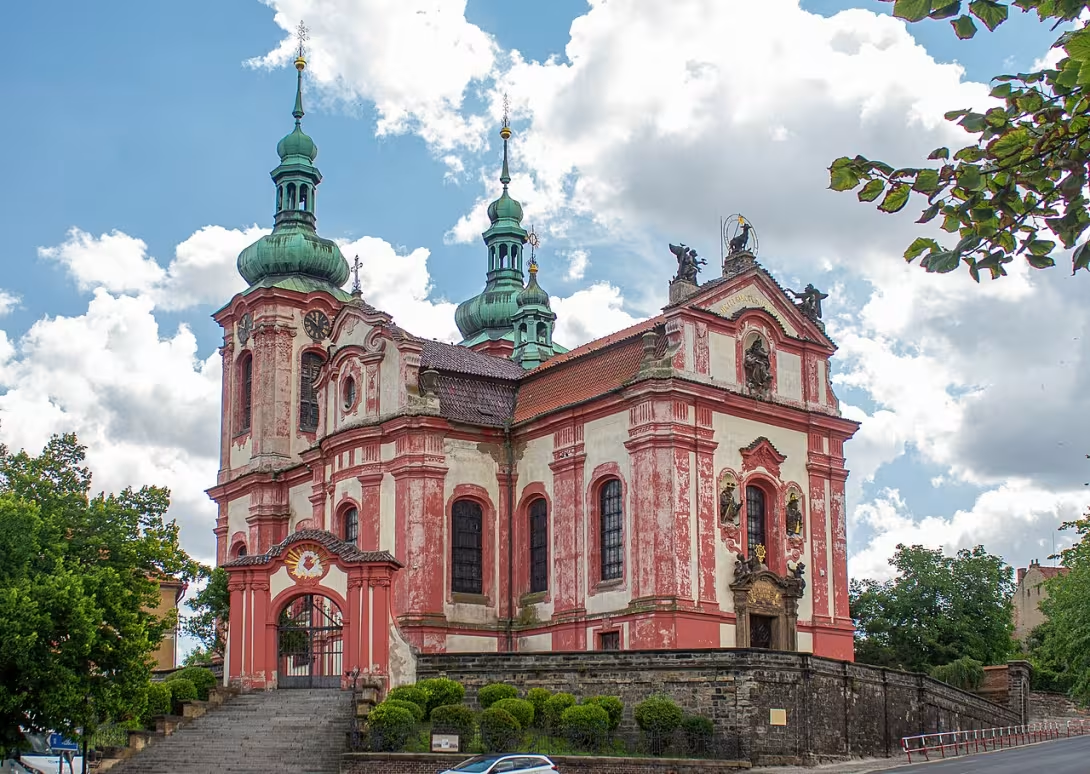
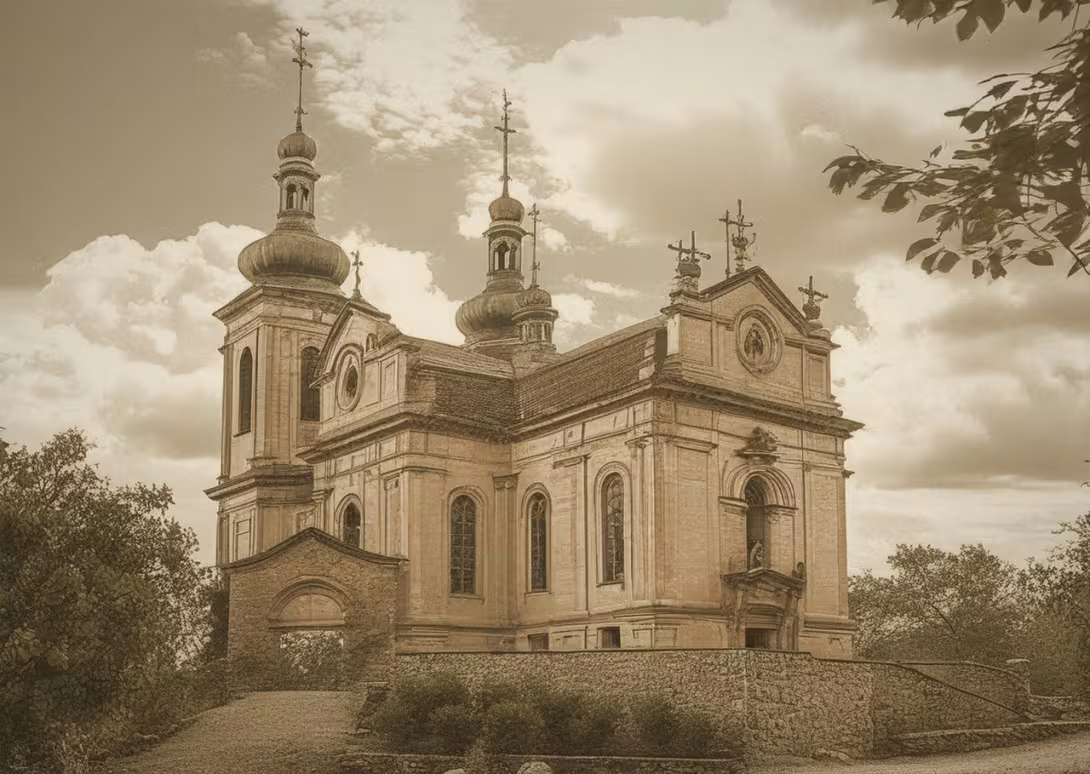
The historical appearance on the left is an AI-generated visualisation and serves as inspiration only.
Historical milestones
- 1352
- The first written mention of the church in Zlonice.
- 1723
- Initiated by the new church project by Prince Philip Joseph Kinski.
- 1731
- The blessing of the foundation stone of the new church.
- 1744
- Finish both towers of the church.
- 1892
- Opening of the Neo-Baroque reconstruction of the church according to the Friedrich Ohmann project.
- 1909-1911
- Finishing the fresco interior decoration under the direction of Adolf Liebscher.
Architectural development
The church replaced an older Gothic temple from the 14th century. The original Baroque building from 1727-1744 was built from quarry stone and bricks. In 1892-1911 the church underwent extensive modifications in the Neo-Baroque and Art Nouveau style, including fresco painting and new altars. The exterior was renovated in the years 1992- 1995.
Historical events
- 1352
- The first written mention of the church in Zlonice, probably Gothic construction.
- 1608
- The decoration of the church in Bohushval Valkoun of Adlar.
- 1727
- Opening of the Baroque church according to the design of František Maximilián Kaňka.
- 1899
- Completion of new Baroque adaptations of the church interior and exterior.
Points of interest
- Kostel Nanebevzetí Panny Marie ve Zlonicích is an important realization of the Czech Baroque and dominates the village on the elevated terrace above the square.
- The original medieval church in this place has been documented since 1352, from which it preserved liturgical property and portraits of members of the Valkouns family.
- The powerful painting of Bouchvalu Valkoun of Adlar, 1608, is one of the preserved objects of the original building.
- The church was restored in 1723-1744, when a new Baroque church was built under the leadership of František Maximilian Kaňka and Ferdinand Hübner.
- In 1892 there was a major Art Nouveau design of the church, including new sculptures from Stanislav Suchard and fresco decorations in 1909-1911.
Guide
This guide is narrated by a synthetic voice generated by artificial intelligence.
Show guide text
This text was created by artificial intelligence and has not been editorially reviewed. It may contain inaccuracies.
The Church of the Assumption of the Virgin Mary is a monumental Baroque landmark dominating the town of Zlonice and its entire surroundings. It was designed by the renowned Czech architect František Maxmilián Kaňka and built between 1727 and 1744.
A church dedicated to the Virgin Mary already stood here in the Middle Ages, with the first mention dating from 1352. From that period, liturgical objects and portraits of members of the Valkouni family, the church's patrons, have been preserved. Among them stands out a votive image of Bohuchval Valkouni of Adlare from 1608. Shortly before the demolition of the old building, Count Norbert Leopold Libštejnský of Kolovrat donated a statue of the Virgin Mary to the church, which he had brought directly from the Italian Loreto.
The effort to build the new church was led by Prince Filip Josef Kinský, the new owner of Zlonice, and the renowned Zlonice dean Jan Adam Svoboda. Kinský requested permission from the Prague consistory in April 1723. Work began in 1727 under the direction of Prague builder Ferdinand Hübner, though the foundation stone was blessed only on September 23, 1731. The nave and presbytery were completed in 1738, and both towers in 1744.
At the end of the nineteenth century, Kaňka's design was considered too austere, so the church underwent a Baroque revival renovation according to the plans of architect Friedrich Ohmann. Original sculptures by Josef Klein were removed from the façade and replaced with new ones by Stanislav Suchardt. A new sanctus tower rose above the crossing. In the interior, the gallery in the presbytery, which connected the oratories, disappeared, and the space became brighter. Stucco reliefs and fields for frescoes appeared on the vault. Ohmann wanted to renovate the surroundings too and build a Marian column in the square, but this was not carried out.
After 1900, architect Josef Fanta continued the renovation, now in the spirit of emerging Art Nouveau. He designed new fencing under the terrace, reconstruction of the staircase, and alterations to the altars. The frescoes in the prepared fields were painted between 1909 and 1911 by Adolf Liebscher, a professor at Prague Technical School, with his collaborators. The exterior was last renovated between 1992 and 1995.
The church stands on an elevated terrace above the square, which was already used by the medieval church. It is single-naved, with a cruciform floor plan and two towers with onion domes on either side of the chancel. The western façade is divided by pilasters and crowned with a triangular gable. In the niches are half-figures of Saint Wenceslaus and Saint Adalbert with kneeling angels by Stanislav Suchardt. Angels also accompany a statue of a lamb at the top. The interior is vaulted with a flat vault.
Tips for visitors
Best time to visit the Church of the Assumption of the Virgin Mary in Zlonice is during the morning hours after opening or late afternoon hours. In these times it is quieter in the interior and you can see the detailed decoration without disturbing crowd. Baroque architecture and artistic elements such as frescoes and statues are best visible in the natural light that penetrates the windows. If you want to experience the atmosphere of the church in the sun, it is recommended to visit in the morning when the rays fall on the facade and create interesting shadows.
It is recommended to use public transport where possible.
When visiting the church, wear comfortable clothes and shoes as there are several stairs in the interior and the floors can be slightly uneven. In the winter months it is advisable to wear warmer clothes because it can be cold in the church. Next, prepare your notebook and camera if you want to record details of the decoration. Don't forget about the hat or scarf, because in the church there are rules of decent behavior that include the headgear for women.
Photography in the church is permitted, but with regard to the sensitivity of works of art and religious tradition, care must be taken for respect. The best places for photos are the main ship of the church, where there is rich decoration, and around the main altar. For quality images it is advisable to use natural light that penetrates windows during morning or afternoon hours. When photographing the interior, avoid flashing lightning to avoid damage to the paintings.
In the vicinity of the church it is worth visiting Chateau Zlonice and Castle Park Zlonice, which are located just about 300 metres from the church. The chateau is a Baroque mansion of the Kinský family and offers rich history and architecture. Castle Park is an ideal place for walking, where you can admire historical trees and architectural elements from the 18th century. For families with children the park is a great place to relax and play in the open space.
Families with children will appreciate a visit to the church thanks to its historic atmosphere and the opportunity to explore rich decoration. Children can see statues and frescos and learn about the history of the place. It is possible to play around the church in Castle Park, where there is enough room for children's activities. For children of younger age groups it can also be interesting to visit Chateau Zlonice, where various cultural events and tours are often held.
Frequently asked questions
Can the monument be visited?
Religious buildings are usually open mainly during services; at other times a visit is normally arranged with the parish or the operator. We have not verified specific times.
Where is the monument?
Location: Zlonice, Středočeský kraj. The map on this page shows the exact spot.
Why is the monument protected?
It is listed in the Central List of Cultural Monuments of the Czech Republic as a cultural monument (register no. 20874/2-664).
For kids
Imagine going back to the past, when Zlonice was a small town surrounding the Church of the Assumption of the Virgin Mary. This place was like the center of a village where people gathered and discussed important things.
There were peasants, businessmen and craftsmen. The city was full of life and energy. The church was dominated by the city, its Baroque towers could be seen from far away. People met in front of the church at markets, weddings and other important events.
Businesses nearby
Do you run a restaurant, accommodation, shop, museum, rental, wellness or other visitor service near this monument? Show yourself directly to the people heading to it — this is how they will see you in the app and on the web:
Events nearby

Zdroj akcí: otevřená data měst a obcí ČR (Národní katalog otevřených dat) a kalendář akcí Národního památkového ústavu.
Nearby
- Baroque chateau from the 18th century, which was the seat of the Kinsky family.
- Park with historical trees and architectural elements from the 18th century.
- A square with a Marian column from the late 19th century.
- A pond with a rich water and bird fauna.
Accommodation nearby
Themed route
Thematic cruise route: Baroque Zlonice - church, chateau and park
1. Church of the Assumption of the Virgin Mary * Type: * Sacral building with rich Baroque decoration. * Why visit? * A unique example of folk architecture with valuable interior elements such as the late Baroque altar. The church is also connected to the local tradition of the Marian cult.
2. Chateau Zlonice * Type: * Baroque residence from the 18th century. * Why visit? * House of Kinský family with period disposition and representative halls. Its location in close proximity to the church creates a harmonious whole of historical monuments.
3. Castle Park Zlonice * Type: * Historical park with Baroque elements. * Why visit? * Includes grown trees, alleys and architectural details that complement the chateau atmosphere. Ideal place for a quiet walk overlooking the church.
4. Vývov Zlonice * Type: * Local square with Marian column. * Why visit? * The 18th century column symbolizes the Marian tradition and is part of the historical core of the village. The village connects all three main points of the route.
* The route is closed, approximately 1 km long. *
Seasonal recommendations
Spring: In spring the Kostel Nanebevzetí Panny Marie ve Zlonicích will turn into a living flower paradise when the surrounding gardens and forests begin to bloom. The sunny days bring warm light that emphasizes the architectural details of the church and its history. When visiting, it is advisable to keep in mind the possibility of rainy days; a durable shoe and sun cap would help you in case of unexpected weather. Visit the church in the early afternoon to avoid the first doses of tourists.
Summer: Summer is the perfect time to visit the Church of the Ascension of the Virgin Mary in Zlonice because of long sunny days that allow a full understanding of its beauty. The atmosphere is particularly lively in the main summer season when the church room is filled with tourists and visitors. It is recommended to come early in the morning or later in the afternoon to enjoy a quiet walk without unnecessary crowd pressure. Don't forget light clothes and protective sunglasses.
Autumn: In the autumn period, Kostel Nanebevzetí Panny Marie ve Zlonicích offers a unique atmosphere when tree leaves turn into living colors from gold to red. The sunny days are warm and pleasant, which is ideal for a relaxed visitor who enjoys quiet moments in the historic environment. When planning a visit, avoid the end of the week when the site may be more visited; The time is Wednesday or Thursday in the early afternoon.
Winter: Winter brings peaceful and quiet moments to the Church of the Assumption of the Virgin Mary in the Kránice. Freezing air and snow cover can give the church its surroundings a romantic touch, especially in advent time. When visiting, avoid the coldest hours of the day and ensure warm clothes such as hat, cups and fat shoes.
Visualizations and artistic views


The visualisations are generated by artificial intelligence and serve as inspiration.
Photos from the area
Real photos taken near the monument


Zdroj a licence jsou uvedeny u každého snímku.
Tips from visitors
No tips yet. Be the first!
Log in and add your tip.
Sources and literature
Photos: VitVit / CC BY-SA 4.0, rozlišení zvýšeno umělou inteligencí — Wikimedia Commons. The author and licence also appear when you hover over the image.
Faktickým podkladem tohoto textu byl článek na Wikipedii, jehož autory jsou přispěvatelé Wikipedie. Článek je dostupný pod licencí CC BY-SA 4.0.
Location on the map






Příběhy a pověsti
Legendy, pověsti a příběhy spjaté s touto památkou
Fotografie návštěvníků
Zatím žádné fotografie. Buďte první, kdo přidá fotografii z návštěvy!
Log in a přidejte svou fotografii nebo hodnoťte.
Za ověřenou návštěvu v aplikaci získáte víc bodů — poznáme podle GPS, že jste na místě.
Reviews and comments