



Kostel Nejsvětější Trojice ve Fulneku Church
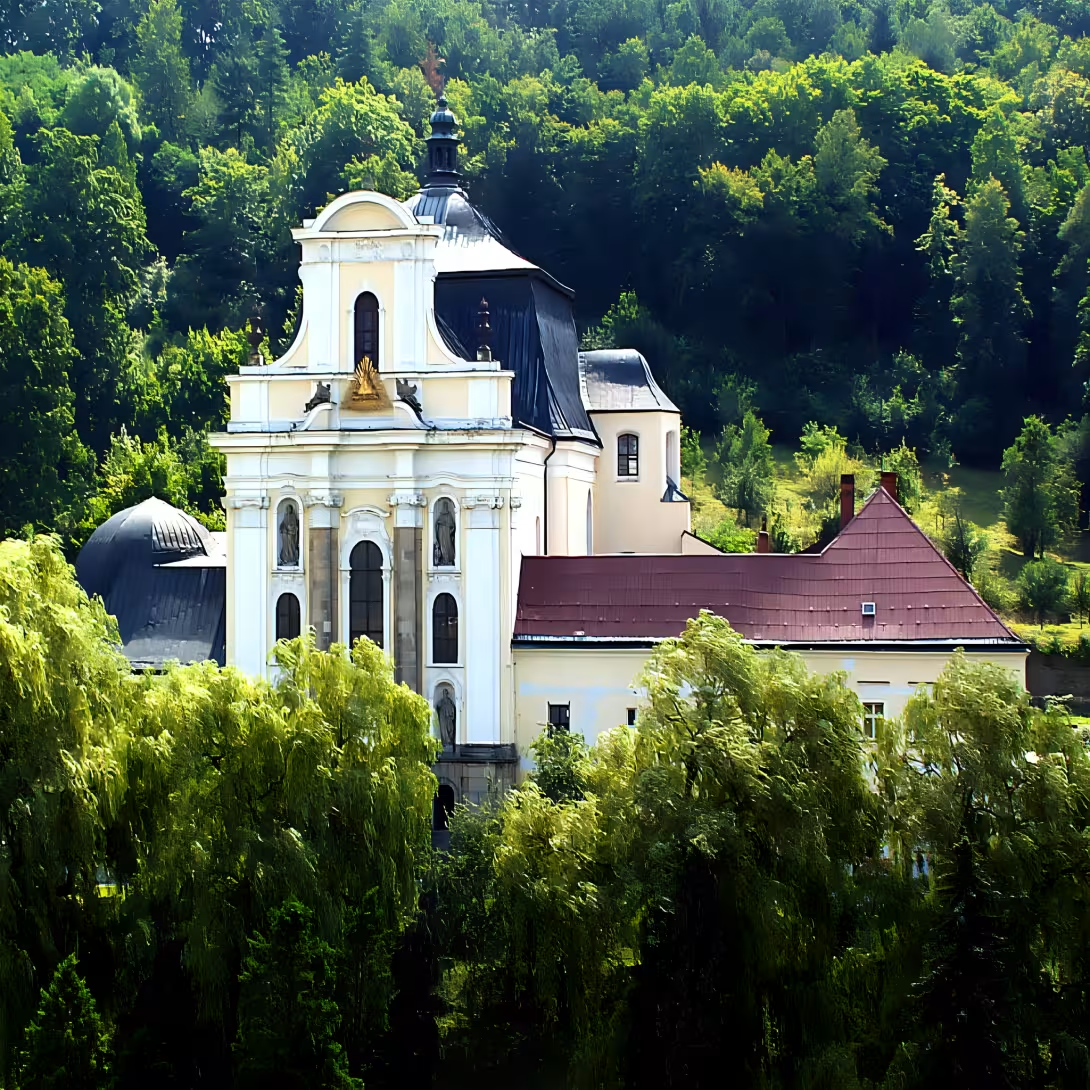
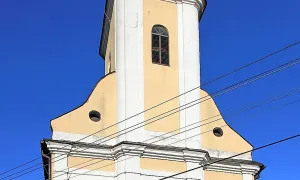
The Church of the Holy Trinity in Fulnek is a remarkable example of baroque architecture and religious devotion in northeast Moravia. Located in Fulnek, in the Moravskoslezský kraj region, this Roman Catholic parish church was built between 1750 and 1760. It replaced an earlier Gothic structure that served the community since at least the 13th century. Its architectural beauty and cultural importance make it a valuable heritage.
The origin of the Church is deeply rooted in the history of Fulnek. The original parish church at this place dates back to the 13th century, first documented in 1293, when Oldřich of Lichtenburg sold the mayor's office to Čílovci Čílovci. Over time, it merged with an Augustinian monastery founded by Nicolas of Rýzmburg in 1389. The church faced many advertisements, including fires and destruction, especially during conflicts involving Jan Tovačov and the Swedish army.
The construction of the new church was inspired by the dedication of the local portrait of the Virgin Mary, which some believed had miraculous properties such as shed tears. This faith began to form around 1746 and gained momentum after 1769 when reports of miracles associated with the painting spread widely. The increasing number of pilgrims required more prayer space, which led to plans for a new church designed by architect Mikuláš Thalherr.
Thalherr's design reflects the magnificence of baroque architecture, characterized by dramatic use of space and decorative details. Between 1750 and 1760 the church replaced the older Gothic structure in the same place. The base stone was laid in 1750, ten years later sanctified by John of Schärffenberg, the assistant Bishop of Olomouc. Significant artistic contributions include Joseph Ignatz Sadler's ceiling frescoes and the painting of Ignatius Victoria Raab and Felix Ivo Leicher.
The interior of the church is particularly remarkable for its artistic elements. The miraculous portrait of the Virgin Mary of Fulnek, which is believed to have tears and makes healing easier, is clearly displayed above the main altar. Originally located in a wooden chapel, it was moved to a new church. In the interior you will also find Sadler frescos and paintings of Raab and Leicher.
During its history, the church underwent renovation, but remains largely unchanged from its original building. A significant period of renovation took place between 1900-1903 and 1950-1983, thereby ensuring its preservation for future generations.
The Holy Church The Trinity is today a cultural and architectural monument in Fulnek, which attracts visitors who are interested in baroque art and religious history. Its rich artistic heritage and historical importance make it a valuable destination for those who explore northeast Moravia. Visitors can experience Thalherr's design and spiritual legacy of a miraculous painting that continues to attract pilgrims around the world.
Then and now
Drag the slider to compare how the landmark may have looked when it was built with the view today.
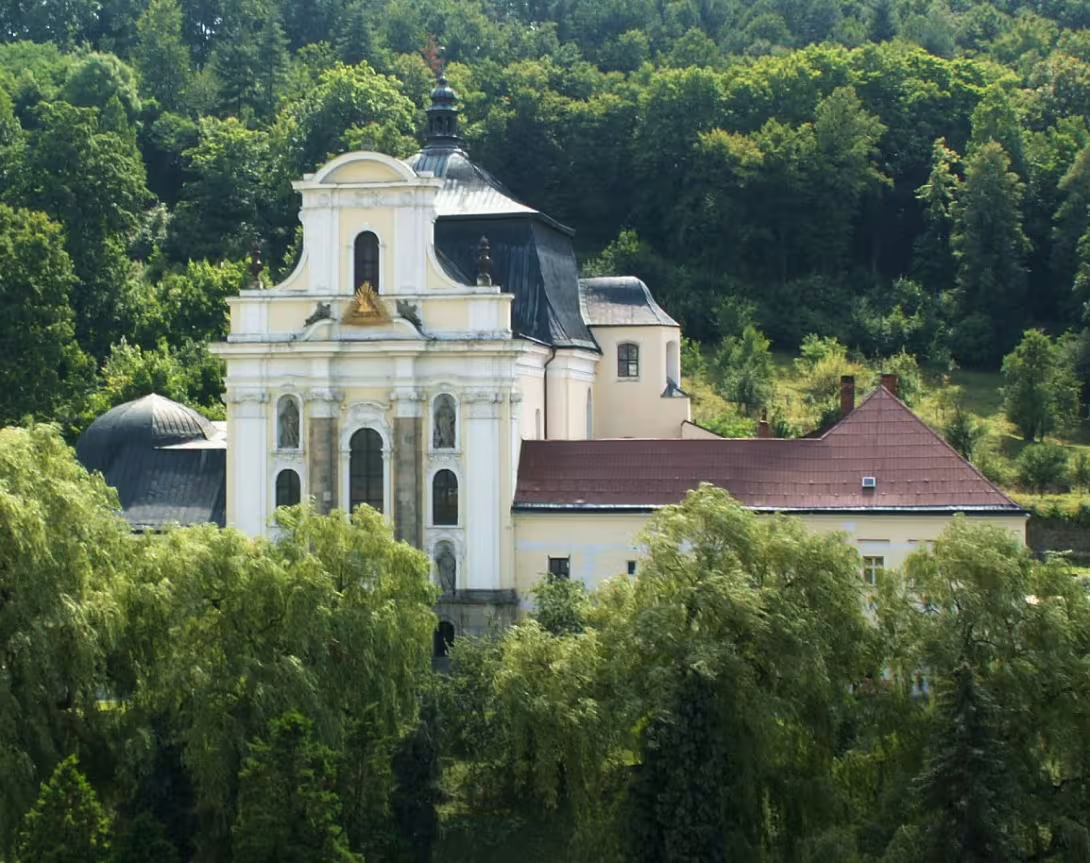
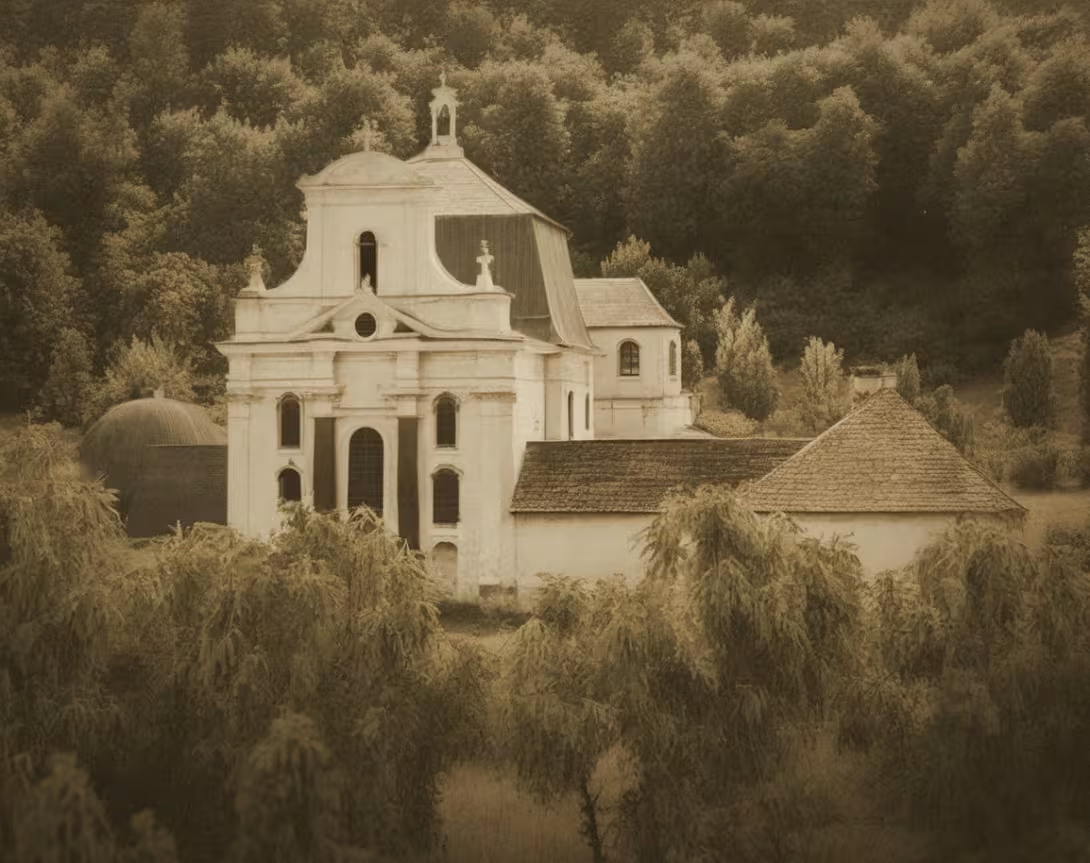
The historical appearance on the left is an AI-generated visualisation and serves as inspiration only.
Historical milestones
- 1293
- Initial document of the church in Fulnek.
- 1389
- Establishing an Augustinian monastery in Fulnek.
- 1750
- The significant stone of the new skeleton laid.
- 1760
- Documentation of the building of the baroque cube.
- 1769
- Extended information on the guarantee device of the Virgin Mary.
Architectural development
the church was designed between 1750 and 1760. It stands at the site of an earlier parish church dedicated to St. Philip and James, which was part of a monastery founded in 1389. Baroque style is visible in its architectural design and interior decoration.
Historical events
In 1746, a cult surrounding the painting of the Virgin Mary helped began in the church, believing to cry tears. This led to increased pilgrimage activity.
The original wooden chapel built around this miraculous painting was replaced with plans for larger stone building thanks to increasing demand and support from local authorities.
Points of interest
- Holy Church The Trinity was built in a place with a long history dating back to at least 1293, when Oldřich of Lichtenburg sold the mayor's office, highlighting its profound importance in the life of Fulnek.
- The local legend surrounding the church includes a portrait of the Virgin Mary, who allegedly wept and performed miracles. This faith began around 1746 and contributed to the decision to build a larger church to settle for an increasing number of pilgrims.
- The original Gothic structure in this place was replaced by a baroque masterpiece designed by Mikuláš Thalherr, which inspired its design by dramatic spatial use and decorative details typical of Baroque architecture.
- the church recorded several renovations but remains largely unchanged from the original construction. Significant reconstruction efforts took place in the years 1900-1903 and again from 1950-1983 in order to preserve its historical and architectural integrity.
- The interior of the church is equipped with artistic contributions of important artists such as Joseph Ignatz Sadler, who painted ceiling frescoes, and painters Ignac Viktorin Raab and Felix Ivo Leicher, whose works increase the spiritual and aesthetic attractiveness of the church.
Guide
This guide is narrated by a synthetic voice generated by artificial intelligence.
Show guide text
This text was created by artificial intelligence and has not been editorially reviewed. It may contain inaccuracies.
The Church of the Most Holy Trinity is the main landmark of Fulnek after the castle. It dates from the middle of the eighteenth century and ranks among the most artistically significant Baroque structures of the entire northeastern Moravia. It was designed by builder Mikuláš Thalherr, who settled in Fulnek. Churches in Budišov nad Budišovkou and in Šternberk are also attributed to him. The interior is decorated with wall paintings by Josef Ignác Sadler and paintings by Ignác Viktarin Raab and Felix Ivo Leicher.
A parish church of Saint Philip and James stood on this site as early as the thirteenth century. It is first documented in a charter from February twenty-sixth, twelve ninety-three. It was issued by Oldřich of Lichtenburg, a descendant of the powerful Ronov family and owner of Fulnek. In thirteen eighty-nine, an Augustinian canonry monastery was established at the church and the cathedral was rededicated to the Most Holy Trinity. In fourteen sixteen, Lacek of Kravař, the first Moravian captain appointed by King Václav the Fourth, was buried here.
The old church was repeatedly destroyed by fires. It burned in fourteen twenty-nine when Jan of Tovačov set fire to Fulnek. It was also damaged by a great fire in fifteen fifty-nine and in sixteen fifty-seven it was devastated and burned by Swedish troops. Another fire in sixteen seventy-six engulfed the city along with the church. The Augustinians repaired the cathedral in sixteen ninety-three, but two years later their monastery burned down. The monastery ceased to exist in seventeen eighty-four during the Josephine reforms and the convent building became a municipal rectory.
The new church owes its existence to an image of Our Lady of Help, which today hangs above the tabernacle of the main altar. From seventeen forty-nine onwards, belief spread that the Virgin Mary in the image was shedding tears, and crowds of pilgrims began flowing to the image. Following prayer before it, several healings reportedly occurred. First, a small wooden chapel was built around the image and the people of Fulnek then proposed organizing a collection to build a stone chapel. In December they began excavating a rocky slope. In January seventeen fifty, the image was ceremoniously transferred to the chapel of Saint Anne and according to witnesses, the Mother of God shed many tears in the process.
When the slope was successfully excavated with great effort and expense, the plan changed. Instead of a chapel, they began building a large new church directly. Fifty to sixty people worked on the hillside daily and the foundation stone was laid on May fifth, seventeen fifty.
Frequently asked questions
Can the monument be visited?
Religious buildings are usually open mainly during services; at other times a visit is normally arranged with the parish or the operator. We have not verified specific times.
Where is the monument?
Location: Kostelní, Fulnek, Moravskoslezský kraj. The map on this page shows the exact spot.
Why is the monument protected?
It is listed in the Central List of Cultural Monuments of the Czech Republic as a cultural monument (register no. 21391/8-1557). It is protected as part of a larger listed ensemble.
Businesses nearby
Do you run a restaurant, accommodation, shop, museum, rental, wellness or other visitor service near this monument? Show yourself directly to the people heading to it — this is how they will see you in the app and on the web:
Nearby
ITEX Show interactive overview of the surroundings - restaurants, accommodation, rentals and other places within a 15 km radius.
Data: OpenStreetMap contributors, 15 km radius.
‡ Historical monuments
- J. A. Komenský Memorial (0.1 km)
- sv Jan Nepomucký (0.1 km)
- J. A. Komenské (0.2 km)
- J. A. Komenské (0.4 km)
- František Palacky (0.5 km)
- Museum of Moravian Brothers (7.5 km)
- Museum of Military History (7.5 km)
- Katovna (7.8 km - Circular 83 / 32)
Restaurant and catering
- Municipal pub (7.1 km - 2)
- Restaurant Centrum (7.4 km)
- Pizzeria Toscana (7.7 km - Masaryk Square 8)
- Workshop house Odry (7.8 km)
- Nonstop (8.2 km)
- Bartoncity (8.2 km)
- Manor on the road (9.8 km - 257)
- Restaurant HOLUB PETR (9.9 km)
Accommodation
- Hotel Heipark Tošovice (5.1 km)
- Guesthouse Poodři (7.5 km - Komenský 260)
- Water mill Wesselsky (8.2 km)
- Water mill Wesselsky (8.2 km)
- Guesthouse U bell tower (8.6 km)
- Agility kemp (9.0 km - ev.10)
- Hotel Holub (9.9 km)
- Hotel Vagónka (10.5 km)
› Rental and sports
- TJ Romo Fulnek (0.4 km)
- Sport hala (7.7 km)
- Scodok (8.2 km)
- Bowling (8.2 km)
- Sport centre Jakubčovice above odrou (9.1 km)
- mTenis.cz - Tennis, badminton, squash, weaving servis (9.9 km - Ostravská 699 / 26)
- Tennis courts (10.5 km)
- Football Stadium (10.6 km)
© Tourism and nature
- Pod Hubleskou (7.6 km)
- Bílov (at the observation tower) (7.9 km)
- View Kanihrora (8.0 km)
- Bílok (zst, bus) (9.2 km)
- Valley Young (11.0 km)
- Lawns (11.3 km)
- Large Albrechtice (11.5 km)
- Study (train fork) (12.0 km)
Accommodation nearby
Themed route
Thematic cruise route: Kostel Nejsvětější Trojice ve Fulneku
1. Church of the Holy Trinity - * Type: * Historical church - * Why is it worth visiting: * This Baroque church is an icon of architecture in Fulnek and a famous world rich historical background. It should be remembered that these are internal frescos and other services for smaller companies.
2. Memorial to War Victims - * Type: * Memorial - * Why is it worth visiting: * This monument admits goods from war that have affected the region. It's a place for reflection and worship, hired liquid products to prove historical status.
3. Local Museum - * Type: * Museum - * Why is it worth visiting: * The local museum offers cultural and historical aspects of Fulneka, including exponents about places of tradition and history. It's the perfect place to determine thinner areas.
4. Church Park - * Type: * Park - * Why is it worth a visit: * This park provides a quiet and beautiful opportunity for relaxation and walking around the skeleton. It's an ideal place to put it down to preliminary historical places.
5. Traditional Market - * Type: * Market - * Why is it worth visiting: * Local cane offers authentic experience with regional food and land products. It should be noted that as referred to in Article 2 of Council Regulation (EC) No 659 / 1999 of 22 March 1999 laying down detailed rules for the application of Article 93 of the EC Treaty (OJ L 93, 29.3.1999, p.
This route offers a comprehensive use of the cultural and historical richness of Fulneka, enchanted hematocrit and support in surrounding overseas cities.
Seasonal recommendations
Spring: In spring Fulnek offers Church of the Heavenly Trinity A beautiful view of the greenening surroundings, which shrub and trees pass ordinary colors into the panorama. The sunny world illuminates the skeletal architecture, which has a magical effect that is ideal for photography. This Decision is addressed to the Member States which are authorised to provide the services which are addressed to the Member States. Despite the possible rain, it is difficult at this time of usually moderation, not throughout the whole range of summer seasons, with locked shorter queues and quiet products.
Summer: Summer recalculating heavy sunny days and a warm source that is ideal for the people of the Church of the Heavenly Trinity in Fulnek. Full cancellation of the green greenery of the acquisition of beautiful backgrounds for the church and its surrounding parks, which makes ideal support for photographers or expired. However, summer is also the main season of tourists, which means high-rise offers. They should survive early in the morning or later in the evening in order to avoid the outreach of both the time and the crowd. The dark round is recommended, as a bottled drinking water and sun protection.
Autumn: Autumn offers a uniform atmosphere with fine coloured pallets of leaves on trees around the Church of the Most Deprived Trinity in Fulnek. The sunny world at this time involves the church facades, which enjoy a visual effect. Autumn is a slightly intrusive nature, not spring and summer, which is a localized peace of mind. However, temperatures are falling, so it is important for my memory to be warmer round and perhaps even an umbrella in a line of lying rain. Short sunny specimens designed to cover the opening ship, so it is advisable to set soon.
Winter: Winter Fulnek offers a peaceful and quiet atmosphere around the Church of the Heavenly Trinity. Although the trees are getting rid of the leaves, the church remains a significant element of landscape painting, especially during sunny days or when the surrounding area is covered with snow. The remaining amount must be paid and paid. They should be adjusted to cool temperatures with warm clothes, including hats and gloves, and if they are measures to be taken. Profitability is ideal for those with quiet products without crowd.
Visualizations and artistic views


The visualisations are generated by artificial intelligence and serve as inspiration.
Photos from the area
Real photos taken near the monument


Zdroj a licence jsou uvedeny u každého snímku.
Tips from visitors
No tips yet. Be the first!
Log in and add your tip.
Sources and literature
Photos: P. ŠÍRA / CC BY-SA 3.0 cz, rozlišení zvýšeno umělou inteligencí — Wikimedia Commons. The author and licence also appear when you hover over the image.
Faktickým podkladem tohoto textu byl článek na Wikipedii, jehož autory jsou přispěvatelé Wikipedie. Článek je dostupný pod licencí CC BY-SA 4.0.
Location on the map



Příběhy a pověsti
Legendy, pověsti a příběhy spjaté s touto památkou

Příběh: Kostel Nejsvětější Trojice ve Fulneku
Bylo to v pondělí ráno, kdy Martin ze Závad slyšel stopy svého koně hýkajících na mokrém kamenném chodníku, který vedl přímo k kostelu Nejsvětější Trojice ve…
Číst příběh
Pověst: Kostel Nejsvětější Trojice ve Fulneku
Traduje se, že v polovině osmnáctého století, kdy fulnecký kraj zápasil s jizvami po letitých válkách a morových ranách, přihodilo se v augustiniánském klášt…
Číst příběhFotografie návštěvníků
Zatím žádné fotografie. Buďte první, kdo přidá fotografii z návštěvy!
Log in a přidejte svou fotografii nebo hodnoťte.
Za ověřenou návštěvu v aplikaci získáte víc bodů — poznáme podle GPS, že jste na místě.
Reviews and comments