



Kostel Nejsvětější Trojice (Verneřice) Church
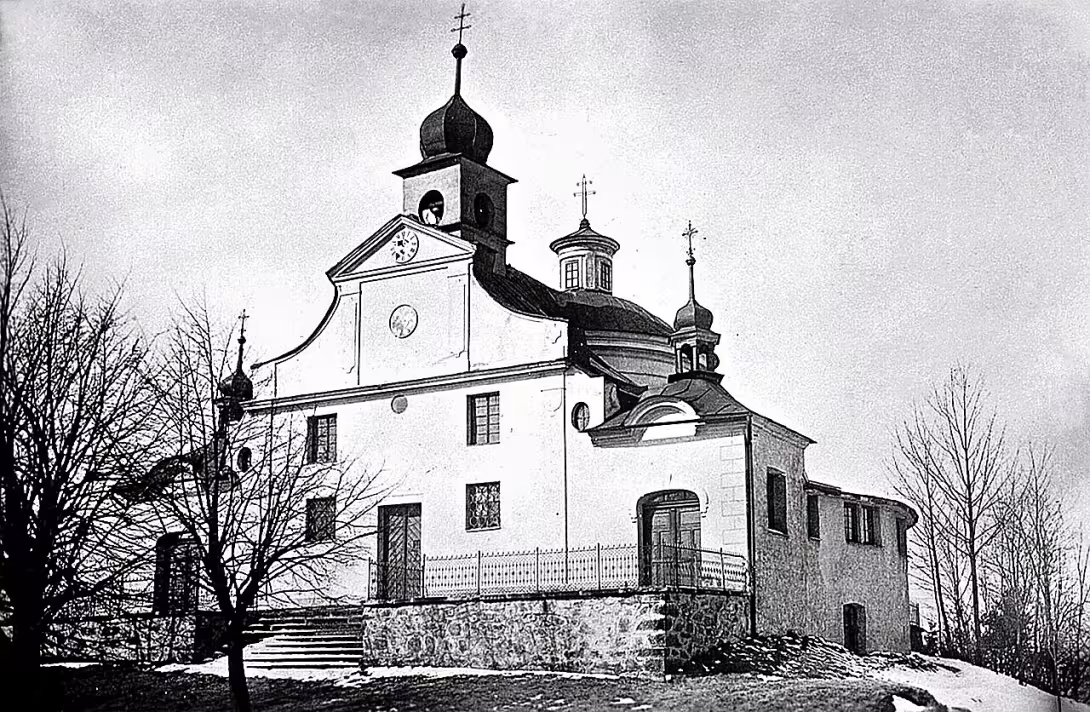
Objekt se nedochoval — na místě dnes nestojí. Následující text popisuje jeho historii, ne současnou návštěvu.
The Pilgrimage Church of the Holy Trinity in Verneřice is a former Baroque church situated on Gottesberg Hill above the village of Verneřice in the Ústecký kraj region of the Czech Republic. Built in the early 18th century, this church was a popular pilgrimage site, attracting thousands of visitors each year. Its significance lies in its well-preserved Baroque architecture and valuable artwork.
The church was built as a chapel in 1732. It was consecrated in 1733 by Canon Zikmund Weis of Litoměřice. The chapel was expanded in 1735 with a vestibule and two rooms at the entrance to the gallery. A covered gallery with a crosswalk was built near the chapel in 1737, and a cross was erected on the hill. Pilgrimages from the surrounding area began in 1740.
The church's architecture is characteristic of the Baroque style, featuring a vaulted interior with four pillars and a dome. The building was designed as a central structure with a lower, circular gallery and a wide entrance hall. The interior was adorned with valuable Baroque sculptures, including a crucifix and a Rococo pulpit, which were unfortunately destroyed during demolition.
The church was a significant pilgrimage site, attracting thousands of visitors each year. Its popularity peaked in the 18th century, with over 10,000 pilgrims visiting in 1741. However, the church's fortunes declined after World War II, and it was demolished in 1975.
Today, the site remains a significant historical landmark, offering a glimpse into the region's rich cultural heritage. Although the church no longer stands, its legacy lives on in the valuable artwork and architecture that once adorned its interior. Visitors can still explore the surrounding area, which offers stunning views of the countryside.
Then and now
Drag the slider to compare how the landmark may have looked when it was built with the view today.
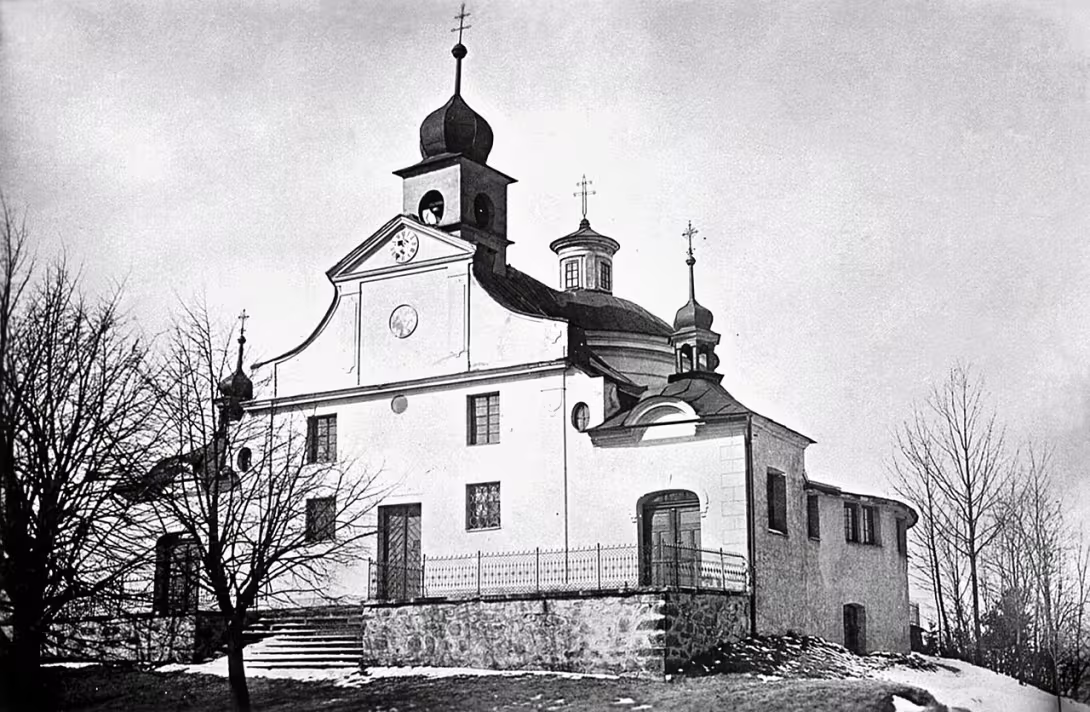
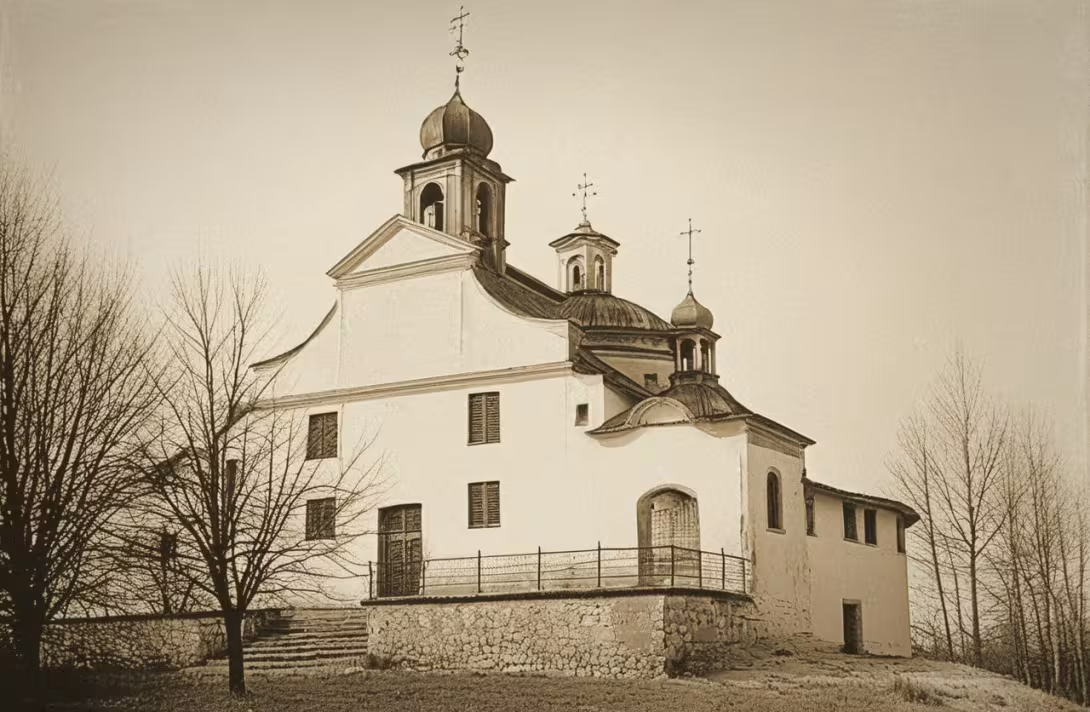
The historical appearance on the left is an AI-generated visualisation and serves as inspiration only.
Historical milestones
- 1732
- Built as a chapel
- 1733
- Consecrated by Canon Zikmund Weis of Litoměřice
- 1735
- Expanded with a vestibule and two rooms at the entrance to the gallery
- 1737
- Built a covered gallery with a crosswalk
- 1740
- Pilgrimages from the surrounding area began
- 1741
- Over 10,000 pilgrims visited
- 1975
- Demolished
Architectural development
The church was built as a central building with a lower, circular gallery and a wide entrance hall. The building was designed in the Baroque style and featured a vaulted interior with four pillars and a dome. The church was later expanded with a vestibule and two rooms at the entrance to the gallery.
Historical events
- 1732
- The chapel was built.
- 1733
- The chapel was consecrated.
- 1735
- The chapel was expanded with a vestibule and two rooms at the entrance to the gallery.
- 1737
- A covered gallery with a crosswalk was built near the chapel, and a cross was erected on the hill.
- 1740
- Pilgrimages from the surrounding area began to take place at the chapel.
- 1975
- The church was demolished.
Points of interest
– The church was built on a site where a pagan altar once stood, which was later dedicated to the Holy Trinity.
– A unique feature of the church is its location, which is situated on a hill with a natural spring, believed to have healing properties.
– The church's architecture is said to have been influenced by the designs of Italian architect Giovanni Battista Alliprandi.
– The church's popularity as a pilgrimage site was not limited to the local population, but also attracted visitors from as far away as Germany and Poland.
– The church's interior was adorned with a valuable Baroque organ, which unfortunately does not survive to this day.
Guide
This guide is narrated by a synthetic voice generated by artificial intelligence.
Show guide text
This text was created by artificial intelligence and has not been editorially reviewed. It may contain inaccuracies.
Welcome to the Church of the Most Holy Trinity in Verneřice. You stand before one of the most significant historical landmarks in this region. Before you is a unique complex that combines religious and cultural traditions. The church stands on Gottesberg Hill above the town of Verneřice, at a site where once stood a pagan shrine later consecrated to the Holy Trinity.
Let's move through time and discover how this beautiful church came into being. It was built in the early 18th century as a chapel and later expanded with a lower, circular gallery and a wide entrance hall. The church became a popular pilgrimage site that annually attracted thousands of visitors. And here we are, at the heart of this pilgrimage destination.
Take note of the church's façade, which is modestly yet impressively designed. Now pay attention to the details that greet us inside. Take a deep breath and feel the atmosphere of this place. The church is linked with a story that accompanies us from pagan cults to the present day. And here, at this site, lies a unique combination of nature and architecture.
Let's reflect on what captivated us. The church was built on a site where there was a natural spring considered healing. It is this natural energy that is reflected in the church's architecture. Take a look at the entrance hall, where two rooms added in 1735 are located. Now you can ponder what brought you to this place and reflect on how people prayed and lived here in the past.
A key figure associated with this site is Canon Zikmund Weis from Litoměřice. He was the one who consecrated this church in 1733, and it is his wings that now accompany us on our journey into the past.
An interesting aspect of this place is that the church was built where a pagan shrine once stood. And it is this past that is reflected in the church's architecture. Take a look at the circular gallery, which is part of the church. It is a unique element that brings us to the idea that every place has its own history and story.
Allow me to invite you to further explore this site. The Church of the Most Holy Trinity in Verneřice is a place where we meet with both the past and present. It is a place where we can rest and pay homage to historical figures associated with it. And here, at this site, we can reflect on what connects us to the past and what accompanies us today.
Businesses nearby
Do you run a restaurant, accommodation, shop, museum, rental, wellness or other visitor service near this monument? Show yourself directly to the people heading to it — this is how they will see you in the app and on the web:
Events nearby




Zdroj akcí: otevřená data měst a obcí ČR (Národní katalog otevřených dat) a kalendář akcí Národního památkového ústavu.
Nearby
The church is located on a hill above the village of Verneřice, in the Ústecký kraj region of the Czech Republic.
Visualizations and artistic views


The visualisations are generated by artificial intelligence and serve as inspiration.
Tips from visitors
No tips yet. Be the first!
Log in and add your tip.
Sources and literature
Photos: autor neuveden / Public domain — Wikimedia Commons. The author and licence also appear when you hover over the image.
Faktickým podkladem tohoto textu byl článek na Wikipedii, jehož autory jsou přispěvatelé Wikipedie. Článek je dostupný pod licencí CC BY-SA 4.0.
Location on the map

Příběhy a pověsti
Legendy, pověsti a příběhy spjaté s touto památkou

Příběh: Kostel Nejsvětější Trojice (Verneřice)
Krvavý otisk dlaně na bílé krajce košile pálil jako žhavé uhlí, ale Matyáš se na něj nedíval. V dlani svíral těžký stříbrný kříž, který ukradl z domova svého…
Číst příběh
Pověst: Kostel Nejsvětější Trojice (Verneřice)
Podle místní pověsti stávalo na temeni kopce, jemuž Němci říkali Gottesberg a Češi Boží hora, od nepaměti místo, kde se člověk cítil blíže nebesům než zemi. …
Číst příběhFotografie návštěvníků
Zatím žádné fotografie. Buďte první, kdo přidá fotografii z návštěvy!
Log in a přidejte svou fotografii nebo hodnoťte.
Za ověřenou návštěvu v aplikaci získáte víc bodů — poznáme podle GPS, že jste na místě.
Reviews and comments