



kostel Obrácení svatého Pavla Parish church
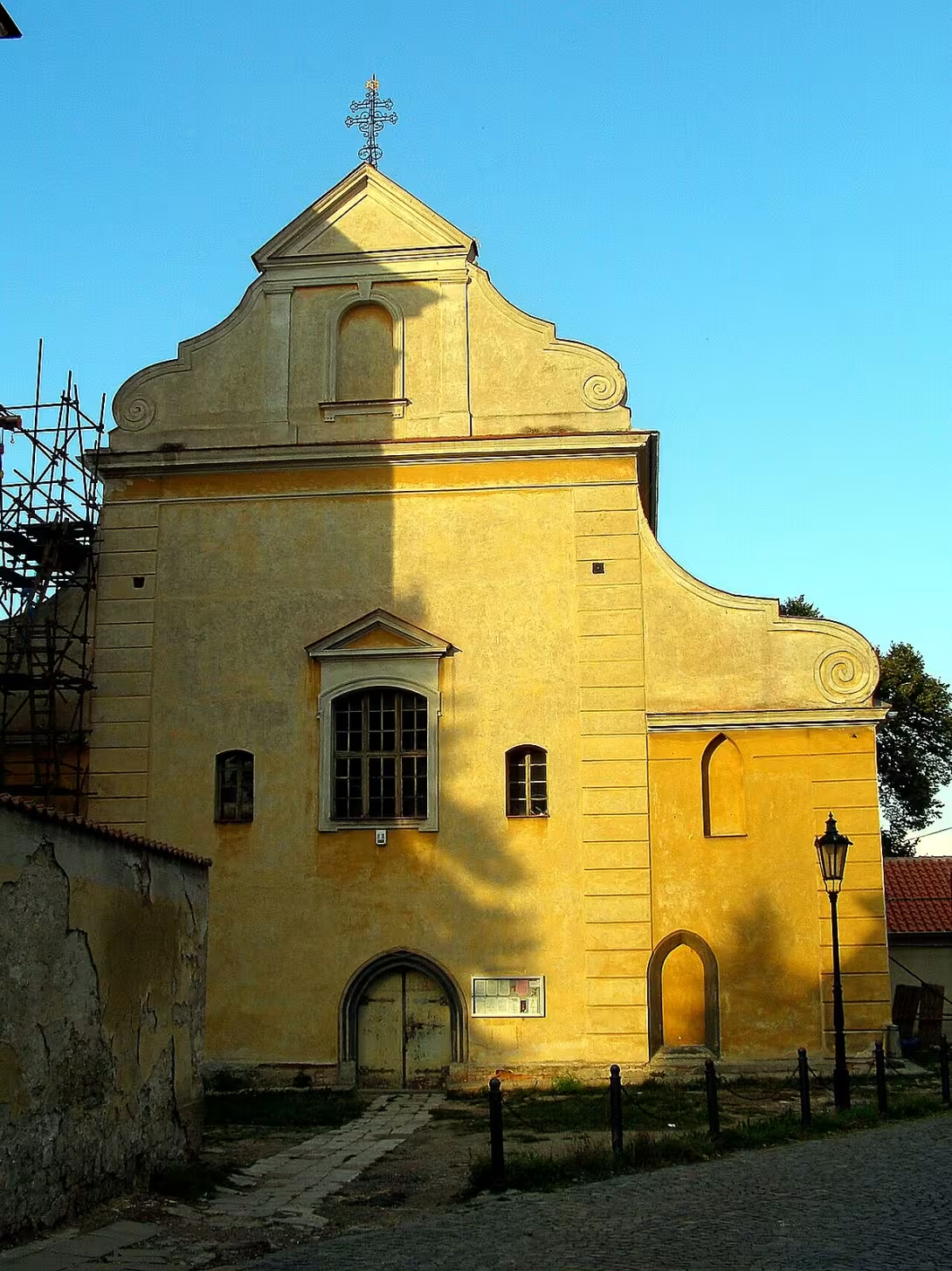
The Church of the Reverse of St. Paul in Brandýse nad Labem is a Roman Catholic parish temple situated in the city centre, northeast of Masaryk Square. This Renaissance building from 1541-1542 is one of the first free churches of this style north of the Alps. The original Renaissance core was preserved despite subsequent baroque modifications.
The building was founded by Arnošt Krajíř z Krajku and the builder Matteo Borgorelli participated in its construction. Originally, the sanctuary served as a corps of fraternity to which the founder applied. After 1547, the church was taken from the church in a uniform manner and handed over to the parties; Brother priest Jan Černý and other members of the church had to leave the country. During the period of religious tolerance around 1600, the building was briefly managed by a brother preacher. But after the battle on the White Mountain, the brothers were banished and the building became a Catholic dean.
The construction is a walled tripod with a semi-circular end of a presbytery and square sacristy. The church is not oriented, its longitudinal axis goes from northeast to southwest. The south side ship is closed by a straight wall while the main ship culminates in a semi-circular apside. The interior is divided by three pairs of prism pillars with gouged corners, which connects a semi-circular arcade. The main ship is a glass of valen with lunettes and stucco nails imitating the mains vault. Side-boat and underwing lofts are cross, no ribs. The facade is smooth, decorated with a thick profile portal and a volute shield. In the 1970s, a tower was added, a new pseudogotic portal was added to the facade in the early 20th century.
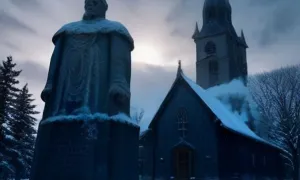
The area is protected as a real-estate cultural monument of the Czech Republic. In addition to the church itself, it includes a bell tower, a former skeleton, a statue of St. John Nepomuk, a fenced wall with a staircase and adjacent grounds. The two-storey bell tower in the west corner in front of the front face dates back to 1753 and ends with an onion tin roof. The Baroque sculpture of St. John Nepomuk from 1757 was carried to its present place before the bell tower from the square only after World War I.
The Church of the Reverse of St. Paul is a valuable proof of Renaissance architecture and religious changes in Czech countries in the 16th and 17th centuries. Visitors of Brandýsa nad Labem can admire this historic area in F. X Street. Walk where they complete the historical character of the city centre near the castle and Masaryk Square.
Historical milestones
- 1541
- Opening of the church building by Arnošt Landscape.
- 1753
- Complete the new two-story bell tower.
- 1757
- The creation of the Baroque sculpture of St. John Nepomuk.
Architectural development
The original Renaissance core was supplemented by a tower in the 1970s. In the Baroque period there were modifications to the interior and exterior, including construction of a new bell tower in 1753. In the early 20th century, a new pseudo-gothic portal was mounted on the facade.
Historical events
1541-1542 the establishment of the church by Arnošt Krajíř z Krajk, 1547 the withdrawal of the church by one brother, 1753 the construction of a new two-storey bell tower.
Owners
Originally the unity of the brotherly, after 1547, the Utraquist Church, after the Battle of the White Mountain Catholic Church.
Points of interest
- This Renaissance building from 1541 to 1542 belongs to the first free churches of this style north of the Alps. - Originally a shrine served as a corps of fraternity, to which his founder Arnošt Krajíř z Krajku applied. - The church is not oriented because its longitudinal axis goes from northeast to southwest. - The main ship is a glass of valen with lunettes and stucco nails that mimic the mains vault. - In addition to the church, there is a bell tower, a former skeleton, a statue of St. John Nepomuk and a wall with a staircase.
Guide
Show guide text
This text was created by artificial intelligence and has not been editorially reviewed. It may contain inaccuracies.
Welcome to the beautiful city of Brandýs nad Labem. Right now, they have stopped at one of the most important and rare places in the entire region. You're standing right in front of the Church of the Reverse of St. Paul. Before you take another tour, try to stop for a while, soak up the atmosphere of this place and perceive its presence. Before your eyes is a building that is not just a regular house for prayer, but is a living witness to the centuries that have been going on here. Feel the weight of history that radiates from every stone and every face of this building. It is a place where human efforts for eternity meet with the relentless gas of time.
Let us now go back together deep into the past to understand why this building is so special. Imagine 1541. Europe was changing then, the old order trembled in the foundations, and new ideas began to flow like an unsustainable river. It was these years, between 1541 and 1542, that this important monument began to be born here. Her visionary and founder was Arnošt Krajíř z Krajku. This man was not just an ordinary builder, but a figure with deep conviction. The church was not built for any congregation, but it was designated as a place for the unity of the brotherly. It was the choir that at that time sought its own path, its own purity and its own form of faith. This spiritual group carried a strong impetus for change, which was reflected in how it started to build here.
Now pay attention to the architecture itself that you are currently observing. If you look at the overall shape of the church, you will see clear signs of Renaissance style. And here comes something that must fascinate you. This building belongs to the very first free-standing churches of this style, which were built north of the Alps. This is absolutely extraordinary on a European scale. While this style has already settled firmly in southern countries, here, in our regions, it represents a breakthrough, courage and total novelty. This extraordinary work was carried out by master Matteo Borgorelli, who brought the right balance and harmony that is so typical of this style.
When you look at the whole, however, notice that the church is not the only element of this place. The whole complex is a harmonious whole, which includes not only the sanctuary itself, but also the bell tower, the former skeleton and the beautiful statue of St. John Nepomuk. At a time when the Renaissance face began to change, the building also underwent a Baroque reconstruction. This change has brought new character to the building and new details that you see in it today. One of the most significant signs of this later period is a new bell tower, whose construction was completed in 1753. This bell tower gives the whole place vertical emphasis and becomes a clear point in the landscape. And if you look at the statue of St. John Nepomuk, realize that it was created in 1757, that is, in a period when the Baroque style had already fully mastered artistic expression and sought emotion and movement.
In order to fully understand the importance of this place, we need to think about the people who left their mark. The Arnošt Krajíř z Krajku we talked about was the man who changed the face of this city with his vision. His legacy here lives in every detail of this building. Next to it is also a character like Jan Černý, which is closely connected to this place. These people were not just names in chronicles, but they were people with hot blood and firm opinions who believed that through architecture and place of meeting they could affect the world around them. When you look at these walls, look at them as a monument to their will and their efforts to create something lasting.
But now I want to tell you one thing that may surprise you and that carries a hint of mystery. Notice how the church is located in space. If you try to determine its direction according to religious traditions, which requires the sanctuary to be oriented east, you will encounter a surprise. This church is not oriented. Its main, longitudinal axis does not stand as it would be customary, but it is heading towards the northeast. Why is that? Why did the creators choose this unusual direction? Maybe it was dictated by the terrain, maybe it was a deliberate act of courage to emphasize the novelty and independence of this Renaissance work. This deviation from tradition is precisely what makes this church so unique and what makes it feel unexpected and fascinating.
Now that you know the story of this place, its creator and its unusual properties, I suggest you continue your search. Take a look at the surrounding area, pay attention to the bell tower and stop by the statue of St. John Nepomuk. Feel how different centuries intertwine in this place and how Renaissance calm meets baroque dynamics. Every step you take in this space can lead you to new knowledge. Thank you for spending this moment with us and for choosing to discover the secrets of the Church of the Reverse of St. Paul. We wish you a beautiful and inspiring walk in history.
Tips for visitors
The best time to visit is in the morning on working days, where there is a quieter operation in the surroundings and the sunlight beautifully highlights the Renaissance details of the facade. Weekends get busier because of the locals in the square.
Brandýsa nad Labem can be easily reached by car or public transport. Search for precise links in internet search engines.
For photography I recommend using the morning clock when the sun illuminates the facade of the church. Great shots will be taken directly from the square, where the architecture of the building will stand out in the context of the surrounding building.
In the immediate vicinity I recommend a walk to the nearby Elbe River or a visit to the castle Brandýs nad Labem, which is only a short walk away from the church. These places offer a pleasant environment for relaxation.
For families with children, the location is suitable thanks to the proximity of the square and the castle, where there is enough room for movement. Take your comfortable shoes with you, because the historic center has paved roads, and don't forget the snack you can enjoy by the river.
Frequently asked questions
Can the monument be visited?
Religious buildings are usually open mainly during services; at other times a visit is normally arranged with the parish or the operator. We have not verified specific times.
Where is the monument?
Location: Brandýs nad Labem, Středočeský kraj. The map on this page shows the exact spot.
Why is the monument protected?
It is listed in the Central List of Cultural Monuments of the Czech Republic as a cultural monument (register no. 1000146115).
Businesses nearby
Do you run a restaurant, accommodation, shop, museum, rental, wellness or other visitor service near this monument? Show yourself directly to the people heading to it — this is how they will see you in the app and on the web:
Nearby
Masarykovo náměstí v Brandýse nad Labem, řeka Labe, zámek Brandýs nad Labem.
Accommodation nearby
Trips and activities nearby
Guided tours, tickets and activities nearby from GetYourGuide
Affiliate link: if you buy from the partner, we may receive a commission. The price for you does not change.
Search tours and activities →Themed route
Thematic cruise route from Brandýsa nad Labem
1. Church of the Reverse of St. Paul (Church) This church is the main destination of our route and is worth visiting thanks to its historical significance and architectural features. The church, built in the 14th century, represents Gothic architecture with later Baroque adaptations. It's a place of peace and sight of the history of local religious life.
2. Masaryk Square (Square) After visiting the church, we move to Masaryk Square, which is an ideal place to relax and see the surrounding countryside. The square offers a beautiful view of the Elbe River and is the centre of local life with a diverse architecture that resembles the history of Brandýs.
3. Elbe River (Natural Service) Near Masaryk Square it is possible to walk along the Elbe River, which gives the place peace and beauty. A view of the water flow and natural landscape offers relief after exploring historical monuments. This part of the route is ideal for relaxation while looking at the city panoramic views.
4. Castle Brandýs nad Labem (Castle) We welcome the castle, which is another key historical and architectural milestone in Brandys. The castle offers a view of its beautiful building with a rich history dating back to the Middle Ages. It's a place full of culture and history, perfect for understanding the past of this area.
This route offers a combination of historical monuments and natural beauty, which allows deep integration into the history and present life of Brandýs nad Labem.
Seasonal recommendations
Spring: During spring kostel Obrácení svatého Pavla is surrounded by flowering gardens that bring a vivid and colorful impression. The sun rays illuminating the roofs and facades of the church create a beautiful visual effect. It is advisable to visit a monument at the end of spring when flowering gardens reach their peak. Visitors should be prepared for a possible increase in crowds, especially on Saturday and Sunday morning, so it is good to visit the church early in the morning or later in the evening. Good shoes are useful for walking around gardens.
Summer: In summer, kostel Obrácení svatého Pavla provides shelter from the sun, where visitors can enjoy shadows and cold. The atmosphere is full of life, especially in the main summer season when the gardens are open for visitors. Visitors should come early in the morning or later in the evening to avoid large crowds and severe heat stress. It is advisable to take with you the sun jewels and plenty of drinking water.
Autumn: During autumn, the church is surrounded by colorful leaves, adding a melancholy but beautiful impression. Sun rays passing through the tree vault create an exciting effect of lighting on the facades of the church. In this period it is especially convenient to visit the memory because the crowds are not many and opening times are often longer than in other seasons. Good shoes are useful for walking on a dry autumn surface.
Winter: In winter, the church offers a calm and quiet atmosphere, surrounded by snow or ice. Sunbeams illuminating roofs and facades create beautiful winter effects. Hot clothes, protective glasses and boots with slide are necessary for a comfortable visit.
Visualizations and artistic views


The visualisations are generated by artificial intelligence and serve as inspiration.
Photos from the area
Real photos taken near the monument


Zdroj a licence jsou uvedeny u každého snímku.
Tips from visitors
No tips yet. Be the first!
Log in and add your tip.
Sources and literature
Photos: Michal Kmínek / CC BY-SA 3.0 — Wikimedia Commons. The author and licence also appear when you hover over the image.
Faktickým podkladem tohoto textu byl článek na Wikipedii, jehož autory jsou přispěvatelé Wikipedie. Článek je dostupný pod licencí CC BY-SA 4.0.
Location on the map



Příběhy a pověsti
Legendy, pověsti a příběhy spjaté s touto památkou
Fotografie návštěvníků
Zatím žádné fotografie. Buďte první, kdo přidá fotografii z návštěvy!
Log in a přidejte svou fotografii nebo hodnoťte.
Za ověřenou návštěvu v aplikaci získáte víc bodů — poznáme podle GPS, že jste na místě.
Reviews and comments