



Vodní mlýn čp. 389 Water mill
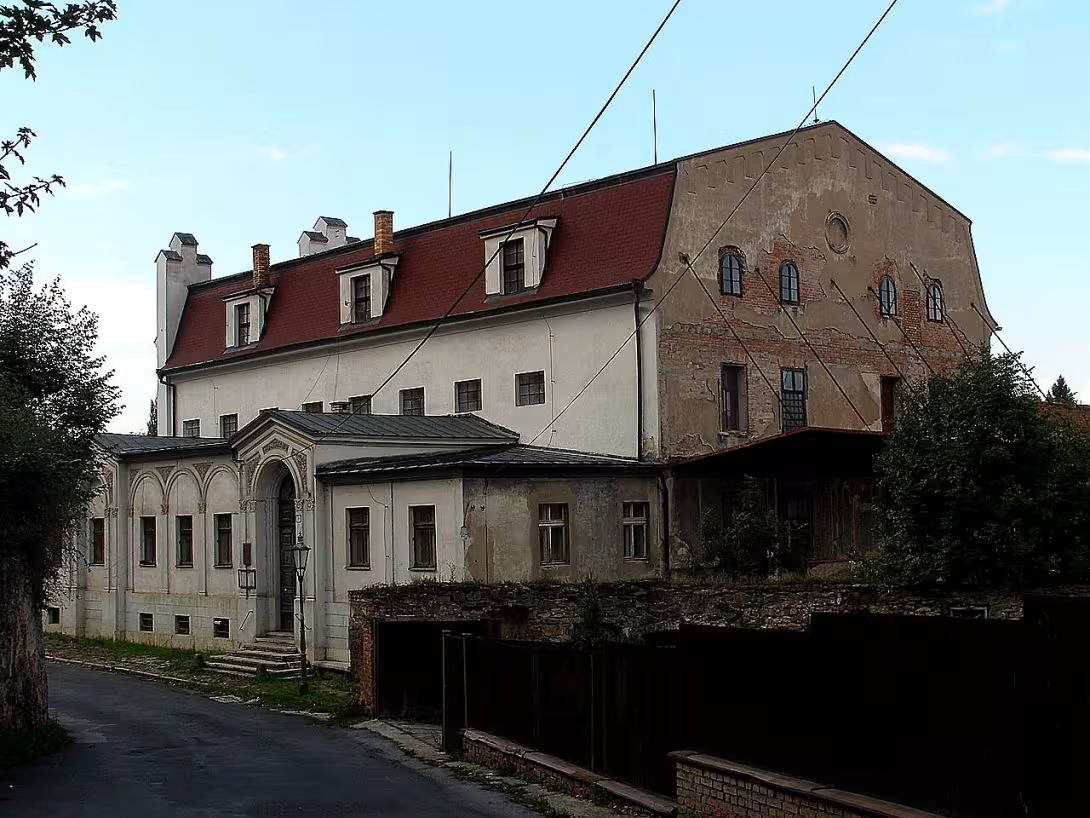
The Undercastle Mill in Brandýse nad Labem is a historic water mill with a Renaissance core. Located in the street Na Celné near the stone bridge and the lockers on the Elbe River. The building has been protected as a real-estate cultural monument since 1993. It represents an important technical construction, which was the largest mill in Bohemia in the 17th century and is still in operation today.
The first written mention of the mill dates back to 1603, when it had ten flour wheels. The Czech countries were then in a period of late Renaissance under the rule of the Habsburgs, in a politically tense period prior to the 30-year war. The mill grew on the site of the older building and its capacity increased gradually by six more wheels and elevations.
The current form of the construction is based on a large reconstruction between 1850 and 1860. At that time a new part was added closer to the river, which follows the building of the former customs office. The building has a basilical arrangement with a mansard roof and a counter skylight. The facades break down the Lizenas and the historical elements of the neo-Romanesque and neo-Gothic styles. The central two-storey tract has preserved the late Renaissance elements in the structures and is completed by a shield with an arch ledge. The windows are combined, segmentally arched and equipped with mantelpiece.
In 1848, a semi-precious stones grinding mill was set up at the mill. After the flood in 1933, which required the strengthening of the foundations with a concrete block, the technological facility underwent modernization to perform 600 metric cents of grain per day. In 1946 the mill employed 46 workers. On 1 August 1948 the building was nationalized and incorporated into the company Odkolek Praha. In the 1970s, part of the mill by the river burned down and in 1980 the drain channel was converted into an artificial slalom track for kayaks.
The technological equipment of the mill included two turbines in 1930. The Francis turbine with 91,71 HP output and 1.7 meter drop has survived to this day, while the Johnval turbine with 32,20 HP output and 1.8 meter drop were complementary to the operation at the time. The original water wheels for the underwater have not been preserved until today.
The castle mill is a valuable proof of the development of miller technology and industrial architecture in the Czech environment. Visiting this place offers the opportunity to see the historical building in close proximity to the Brandé Castle and the Elbe River, which remains a functional part of urban infrastructure even after centuries.
Historical milestones
- 1603
- First written mention of a mill with ten wheels.
- 1850
- The launch of a large reconstruction of the mill into the current form.
- 1980
- The drain channel was converted into an artificial slalom track.
- 1993
- The object declared a cultural monument.
Architectural development
The original Renaissance core was supplemented in the middle of the 19th century by a new part connecting to the customs building. The building has a basilical arrangement with a mansard roof and facades divided by lizenas. After the flood in 1933, the foundations of the building were reinforced with a concrete block.
Historical events
In 1848, a semi-precious stones grinding mill was set up at the mill. In 1933 the technological facility was modernised after the flood. In 1948 the mill was nationalized and part of the building burned down in the 1970s.
Owners
Since 1948 the company Odkolek Praha.
Points of interest
- In the seventeenth century it was the largest mill in all Bohemia and the building is still in operation today. - The first written mention dates back to 1603, when the mill had ten wheels for grinding flour. - In 1848 a workshop for grinding semi-precious stones was set up at the mill. - In 1980, the drain channel was converted into an artificial track for sports on small boats. In 1946, there were 46 people working at the mill.
Guide
Show guide text
This text was created by artificial intelligence and has not been editorially reviewed. It may contain inaccuracies.
Welcome to the beautiful city of Brandýs nad Labem. Right now, when they put on their headphones, you're facing one of the most important and oldest water objects in the area. Stop for a moment, relax and feel the atmosphere. In front of your eyes is water mill number three eight nine. Before we go into his history, pay attention to what you're seeing right now. You stand at the heart of the Elbe River. Look at the stone bridge that crosses the water here, and the lock that controls the flow of the river. Do you hear that constant, soothing noise of water? That sound has been connected to this place for centuries. The water here is not just a set, it is the very force that has driven the life of this mill and it is flowing here as tirelessly.
Now let's go back deep into the past together to understand why this object is so special. To truly understand its meaning, we must look far beyond the horizon of our present day. The first paper trail to inform us of this place dates back to the year of the thousand six hundred and three. Imagine the landscape back then and the incredible power this mill represented. According to the records at the time it was the largest mill in all Czech countries. This is not just a simple fact, it is proof of the great importance of this place for the then economy and the lives of the people. Imagine the technical advantage and scope of the work, where this object had a total of ten wheels for grinding flour. Ten laps in the same building! That must have been a sight that brought out both wonder and respect for anyone who passed the Elbe. This mill was not just an ordinary booth, it was an engine of the entire area, a place where grain was processed for thousands of people.
Now pay attention to the construction itself, which now appears to you in its present form. Even though its roots go deep into the seventeenth century, what you see is the result of a large and thorough transformation that took place in the middle of the nineteenth century. In particular, between a thousand and eight hundred fifty and a thousand eight hundred sixty, the mill was subjected to an extensive reconstruction which breathed into its present face. If you look now at the facade details and the overall structure of the building, you can see in them the elements that are trying to build on older, historical styles. The architecture of this building meets the neo-Romanesque style with neo-gothic elements. Feel the harmony between the robustness of the mill building and these decorative, historical shapes. Although we cannot speak of the particular names of architects, we can clearly see that the work of the masters at the time was very precise and aimed at creating a building that looks noble and permanent. This reconstruction of the mill gave him character that distinguishes him from simple economic buildings in the surroundings.
When you look at this object, you might think what other lives have been lived here. Even if we don't keep the names of all the people who worked here, the history of this place is full of interesting events that give him the mystery. I want to bring you closer to one particular thing that took place here in the middle of the nineteenth century. In the year one thousand eight hundred and fourscore eight, just before the big reconstruction, a workshop was set up at this mill. But it wasn't an ordinary workshop for craftsmen. People here have worked on something much softer and rarer - the grinding of semi-precious stones. Imagine the unusual combination: on the one hand hard work with the circulation of huge wheels and grinding grain, and on the other hand the fragile, precise work with precious stones in quiet corners of the mill. This workshop gives the place a touch of nobility and shows that the mill was part of a much wider world of crafts and valuable materials.
And perhaps the most fascinating thing is how this place changed in modern times and how it managed to go from old crafts to today's. Look at the drain channel that leads from the mill. You may only see him as part of the water system today, but in the year one thousand nine hundred and eighty there was a big change. It was rebuilt into an artificial slalom track. That's a fascinating contrast! The place where earlier only water was poured out of the ground became a place for sport, movement and entertainment. It is an example of how people can adapt to a changing world and use old structures for new purposes. And yet, despite all the changes, modernization and new functions, this mill still plays its original, historical role. It's still up and running! This is the true miracle of continuity. From the year one thousand six hundred and three to today, this object still uses the power of the Elbe and still serves the people. Its importance was then officially confirmed in the year one thousand nine trăm ninety-three by being declared a cultural monument.
Now that you've learned the basics and stories of this place, I suggest you continue your walk around the river. Feel the atmosphere of this place, listen to the noise of water and look at the details you may have missed at first glance. Brandýs nad Labem has many other secrets and beautiful views waiting for you. Thank you for spending this moment with us and for being interested in the history of this important water mill. I wish you a beautiful and inspiring next part of your journey.
Tips for visitors
The best time to visit is in the morning on working days when you avoid crowds and enjoy a quiet atmosphere by the river. In the morning, the stone bridge mill looks very photogenic.
When visiting, wear comfortable shoes for walks around the Elbe River. The best place for photographers is around the stone bridge, where you can get a beautiful view of the mill and the lock, especially with soft light during the golden watch.
In the vicinity of the mill you can visit the castle Brandýs nad Labem, which is only a short walk away. The whole area of the historical centre offers a pleasant environment for walking trips along the river bank.
For families with children, the location is ideal thanks to the proximity of the river and the possibility of observing the technical equipment of the locks. Walk from the mill to the castle is easy and suitable for smaller children who appreciate the space around historical buildings.
Frequently asked questions
Can the monument be visited?
This is a technical monument. Some are open as exhibitions, others are out of use or on private land. We have not verified whether this one is accessible.
What are the opening hours and admission?
We have not verified the opening hours or admission. Current information is published by the operator.
Where is the monument?
Location: Brandýs nad Labem, Středočeský kraj. The map on this page shows the exact spot.
Why is the monument protected?
It is listed in the Central List of Cultural Monuments of the Czech Republic as a cultural monument (register no. 1000119664).
Businesses nearby
Do you run a restaurant, accommodation, shop, museum, rental, wellness or other visitor service near this monument? Show yourself directly to the people heading to it — this is how they will see you in the app and on the web:
Nearby
Zámek Brandýs nad Labem, řeka Labe, historické centrum města.
Accommodation nearby
Trips and activities nearby
Guided tours, tickets and activities nearby from GetYourGuide
Affiliate link: if you buy from the partner, we may receive a commission. The price for you does not change.
Search tours and activities →Themed route
1. Historical Center of the city , the urban part, a walk through the old streets allows you to soak up the atmosphere of this place. 2. Castle Brandýs nad Labem, castle, tour of this important building is a cultural experience. 3. River Labe, the river, the beach stay offers peace and beautiful views. 4. Vodní mlýn čp. 389, mill, the main destination of the trip which shows the historical use of water.
Seasonal recommendations
Spring: In spring, the surroundings of the mill awaken to a new life. The trees at the water start to green and the air smells fresh. The light is bright and clean in this period. For a visit I recommend to choose the morning hours when it is still quiet and nature is not so busy. Dress well, because the morning cold at the water stream can be unpleasant.
Summer: In the summer months, the surrounding area overgrown by dense greenery and the sun shines strongly to the surface of the river. The atmosphere is alive and hot. Due to the larger crowds of visitors, it is best to arrive immediately after opening so that you can enjoy peace in a cooler shade. Don't forget the light clothes and enough fluid to drink.
Autumn: Autumn brings gold and brown to the landscape. There is often fog above the water, which gives the mill a mysterious form. The light is soft and ideal for observing the details of the construction. It is advisable to carry a waterproof jacket and shoes because the humidity in the area is usually high. The best time for a walk is early afternoon.
Winter: Zimą is quiet at the mill and the landscape can be covered with snow. The day is short and the light quickly disappears, so plan to visit in the early morning. In advent time, the atmosphere is calm, but the freezing weather requires very warm clothes and solid shoes. Watch out for slippery roads near the water.
Visualizations and artistic views


The visualisations are generated by artificial intelligence and serve as inspiration.
Photos from the area
Real photos taken near the monument

Zdroj a licence jsou uvedeny u každého snímku.
Tips from visitors
No tips yet. Be the first!
Log in and add your tip.
Sources and literature
Photos: Michal Kmínek / CC BY-SA 3.0 — Wikimedia Commons. The author and licence also appear when you hover over the image.
Faktickým podkladem tohoto textu byl článek na Wikipedii, jehož autory jsou přispěvatelé Wikipedie. Článek je dostupný pod licencí CC BY-SA 4.0.
Location on the map



Příběhy a pověsti
Legendy, pověsti a příběhy spjaté s touto památkou

Fotografie návštěvníků
Zatím žádné fotografie. Buďte první, kdo přidá fotografii z návštěvy!
Log in a přidejte svou fotografii nebo hodnoťte.
Za ověřenou návštěvu v aplikaci získáte víc bodů — poznáme podle GPS, že jste na místě.
Reviews and comments