



Kostel Panny Marie Vítězné na Bílé Hoře Church
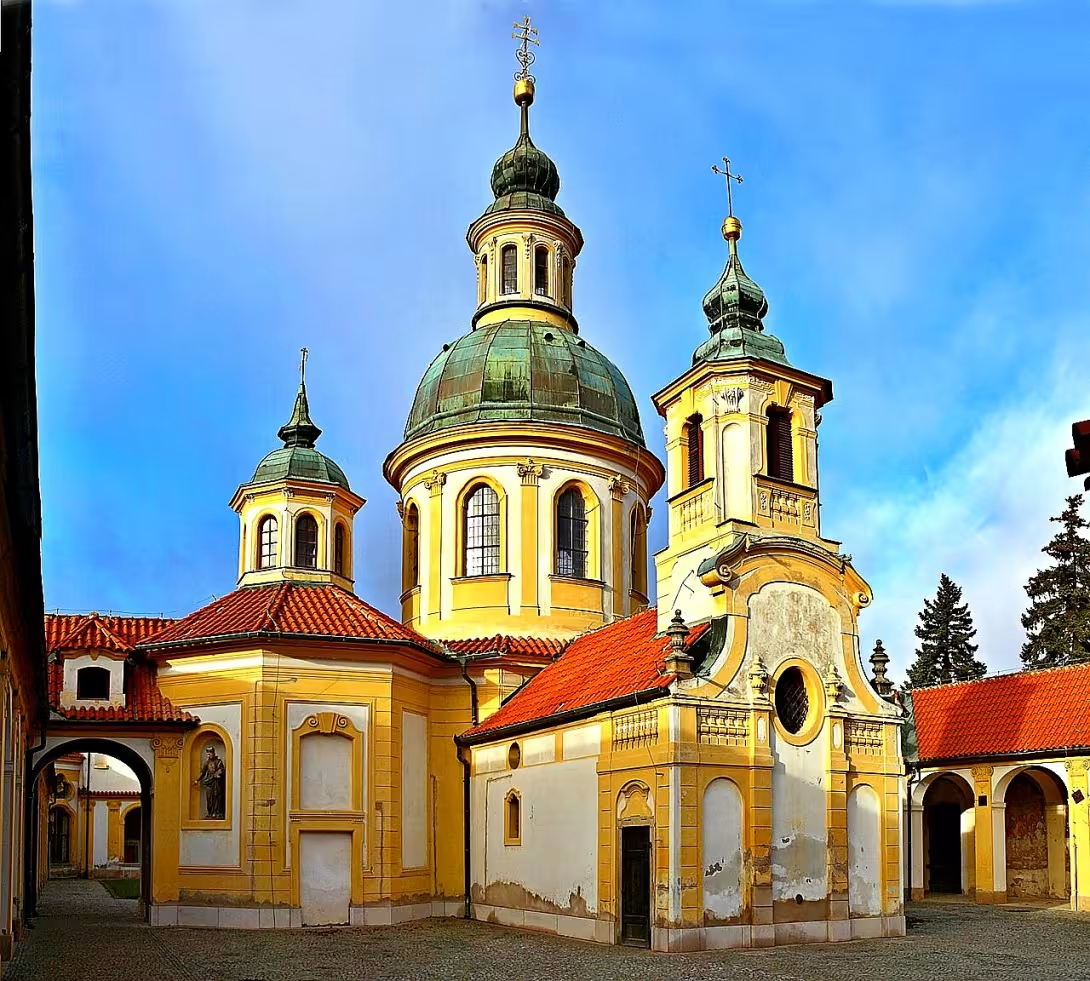
The church is located north of Karlovy Vary Street near the tram loop and southeast of the White Mountain itself on the cadastral territory of Řep. Its beginnings date back to the years immediately following the Battle of White Mountain. Between 1622 and 1624 there was a simple chapel of a rectangular plan, the author of which remains unknown. The building served a sad purpose - it was a place where they stored the remains of soldiers from battle who had no proper burial and their bodies remained in the vicinity long after the fight was over.
The breakthrough in his development came in 1628. According to the order of Emperor Ferdinand II, a monastery of services began to be built at the chapel. The monastery church was to be praised for the victory of the Catholic Church. The ceremonial laying of the foundation stone took place on 25 April 1628 and was attended by Emperor Ferdinand II himself with his spouse Eleonora and son Ferdinand III. A memorial medal depicting the planned form of the monastery was symbolically inserted into the foundations. But the monastery remained unfinished and its buildings travelled for a different use. The chapel met with some historical events - in the Swedish invasion of 1634 it was damaged and then transformed into a skeleton.
New life was built in 1704, when Bavarian bricklayer Michael Hagen significantly rebuilt it. She was dedicated to St. Wenceslas and the papal card allowed her to serve mass. The date of the ordination, December 8, 1704, is carved in the front door. Thus began a long period of expansion of the premises. Probably between 1705 and 1706 it was created by an eight-sided presbytery with a low dome and lantern. A new sanctuary dedicated to Our Lady of Victory was created, which was consecrated by Bishop Vít Seipl of Prague on 8 August 1706.
Since then, the site has been systematically expanding. In the following years, sacristy, bark, and above all a series of small chapels dedicated to various saints - St. Rozál (later St. Felicia), Saint Vojtěch, Saint Hilar, Saint John the Nepomuk, Holy Trinity and Saint Wenceslas. Their construction took place gradually between 1708 and 1714. In 1714 the original dome was also torn down and replaced by a new, higher dome, which they completed in 1715. Since 1720 it began to build around the entire complex columns with arcades, which was completed in 1729.
The monastery which was destroyed by Emperor Josef II later took over religious matrices. In 1786 he made an inventory of property and pilgrimage grounds sold to Josef Ulrich, the lover of Motol. The situation plan of 1793 already shows that there was another building - the chapel of God's tomb on the north side of the ambition, which apparently arose between 1750 and 1785. It is believed to have been inspired by the construction of cruisers in the New Town of Prague.
The churches and chapel, which today pass through thousands of pilgrims per year, are a rare testament to architectural development since the beginning of the 17th century and an unforgettable reminder of one of the most important events of Czech history.
Then and now
Drag the slider to compare how the landmark may have looked when it was built with the view today.
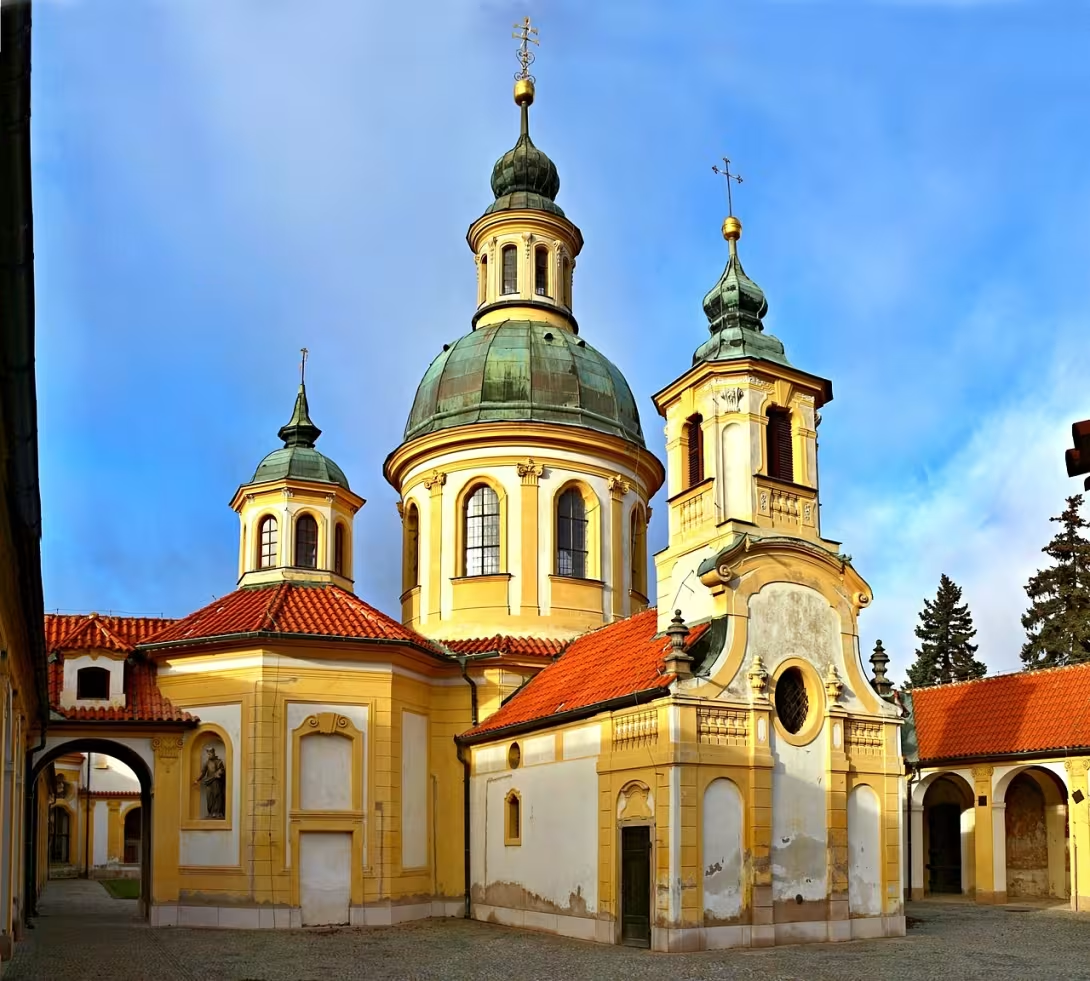

The historical appearance on the left is an AI-generated visualisation and serves as inspiration only.
Historical milestones
- 1622-1624
- The origin of the original chapel at the site of the outstanding military remains from the Battle of White Mountain.
- 1628
- The foundation stone of the monastery of servitude with the participation of Emperor Ferdinand II.
- 1704
- The conversion of the chapel to the church of St. Wenceslas and the permission to serve in it.
- 1706
- The consecration of the Church of Our Lady of Victory after reconstruction.
- 1729
- Finishing ambitions and connecting wings.
- 1786
- Cancellation of the monastery services and transition of the premises into the property of a religious matrix.
- 2018
- Declaration of the site as a national cultural monument.
Architectural development
The original chapel from 1622-1624 was damaged by the Swedes in 1634 and served as a skeleton. In 1704-1706 it was rebuilt by Michal Hagen to the chapel of St. Wenceslas, which was subsequently extended by an ocular presbytery and chapel (St. Rosalie, St. Vojtěv, St. Hilaria, Holy Trinity, St. Wenceslas). In 1710-1729 the ambitions and chapel of God's grave (probably 1750-1785) were completed. The construction is made of brick wall with plaster, baroque elements and classicist accessories.
Historical events
- 1622-1624
- Built by the original simple chapel in place of the outstanding military remains from the Battle of White Mountain.
- 1628
- The foundation of the monastery of servitude and the laying of the foundation stone with a medal with a plan of the monastery in which Emperor Ferdinand II participated.
- 1704-1730
- The gradual reconstruction of the original chapel into the present Baroque church with ambition and chapel.
- 2018
- Area declared a national cultural monument.
Owners
- 1628-1786
- 1786-1793
- from 1793
Points of interest
- The church was created immediately after the Battle of White Mountain, between 1622 and 1624, as a simple chapel serving as a skeleton for soldiers without proper burial.
- In 1628 Emperor Ferdinand II ordered in the chapel to establish a monastery of services- laying the foundation stone on April 25, 1628.
- A memorial medal depicting the planned form of the whole complex was inserted into the foundations of the monastery.
- The chapel was damaged during the Swedish invasion of 1634 and subsequently transformed into a skeleton.
- In 1704, Bavarian bricklayer Michael Hagen rebuilt it and dedicated it to St. Wenceslas, the date of the consecration on December 8, 1704 being carved above the entrance.
Guide
This guide is narrated by a synthetic voice generated by artificial intelligence.
Show guide text
This text was created by artificial intelligence and has not been editorially reviewed. It may contain inaccuracies.
Church of Our Lady Victorious is a pilgrimage site in Prague's Řepy district, not far from the battlefield of the Battle of White Mountain. It belongs to the most important monuments of this neighborhood, and since 2018 the entire pilgrimage complex has been a national cultural monument.
At the beginning there stood a simple rectangular chapel, built after the battle between 1622 and 1624. We do not know its builder, but its masonry is hidden to this day in the western part of the church. The chapel served to store the remains of soldiers who were not properly buried and remained in the area around White Mountain long after the battle.
In 1628, at the instigation of Emperor Ferdinand the Second, construction of the Servite monastery began. The monastery church was meant to commemorate the victory of the imperial troops and the Catholic Church. The foundation stone was laid on April 25, 1628 in the presence of the emperor, his wife Eleanor, and his son Ferdinand the Third. A commemorative medal with the planned appearance of the monastery was placed in the foundations at that time. However, the monastery was not completed and the buildings were used differently.
The original chapel suffered during the Swedish invasion in 1634 and subsequently became an ossuary. In 1704 it was rebuilt while dilapidated by Bavarian mason Michael Hagen. The chapel was dedicated to Saint Wenceslas and the date of consecration, December 8, 1704, is carved above the entrance to this day. Probably in the years 1705 and 1706 an octagonal presbytery with a low dome and lantern was added. The expanded sanctuary, newly dedicated to Our Lady Victorious, was consecrated on August 8, 1706 by Prague Bishop Vít Seipel.
Then building continued almost without interruption. A sacristy and choir were added, chapels attached to the presbytery, and four chapels in the corners of the future ambulatory, dedicated to Saint Adalbert, Saint John of Nepomuk, the Holy Trinity, and Saint Wenceslas. In the years 1714 and 1715 a new, higher dome replaced the old one. Construction of the arcade of the ambulatory began in 1720 and the ambulatories were completed in 1729.
On the northern side of the ambulatories stands the Chapel of the Holy Sepulchre, imitating the chapel in the Church of the Holy Sepulchre in Jerusalem. It was created apparently between 1750 and 1785, probably according to Santini's building at the Crusaders' chapel on Nové Město. It is divided into a front Chapel of Angels and a burial chamber, and on the west the Mount of Olives adjoins it.
Joseph the Second abolished the monastery. The Religious Registry documented its property in 1786 and the complex was then sold at auction to Joseph Ulrich, a brewer from Motol.
Tips for visitors
The best time to visit the Church of Our Lady of Victory is in spring or autumn when there is pleasant weather and fewer tourists. In summer, the place is often visited by a large number of people, especially on Sundays when services are held. In spring you can enjoy the blooming surroundings and in autumn you can enjoy beautiful autumn colors. In winter the church is interesting with its atmospheric light and the possibility to visit it at holidays like Christmas or Easter.
Transport by public transport is also possible; the nearest stop is near the location. Check current connections and traffic options in the traffic search engine or on the official website of Prague.
When visiting, take comfortable clothes and shoes, because the church area is on the hill and includes a corridor down the stairs. Further prepare your camera or mobile phone, but remember that some places in the church can be protected and photography can be limited here. It is also recommended to take a map or navigation with you if you want to look around.
The best places for photography are the interiors of the church, especially baroque altars and frescoes on the ceiling. External photographs are particularly interesting at sunset, when lighting highlights architectural details. The entrance gate and surrounding church also offers beautiful views of the surrounding landscape. In the interior it is advisable to photograph in daylight to capture the colours and details best possible.
In the vicinity of the church is worth visiting a memorable stone reminiscent of the Battle of White Mountain, located near the church. Another interesting destination is the pilgrimage church of St. John Nepomucký on Green Mountain, located approximately three kilometres from the place. Both of these places are easily accessible by foot or car and offer rich history and beautiful surroundings.
For families with children, the visit to the Church of Our Lady of Victory is interesting thanks to its historical importance and the opportunity to explore the surrounding nature. Children can see the monument stone and listen to the stories of the Battle of White Mountain. There is also an opportunity to walk around the church and discover the surrounding landscape. It is also recommended to visit the pilgrimage church on Green Mountain where children can see unique statues and frescoes.
Frequently asked questions
Can the monument be visited?
Religious buildings are usually open mainly during services; at other times a visit is normally arranged with the parish or the operator. We have not verified specific times.
Where is the monument?
Location: Karlovarská, Řepy, Praha, Hlavní město Praha. The map on this page shows the exact spot.
Why is the monument protected?
It is listed in the Central List of Cultural Monuments of the Czech Republic as a national cultural monument (register no. 424).
For kids
Imagine going back into the past to the old Czechs. What would our beautiful Praha look like? It would be a city of stone and bricks with high walls and gates. Where would we see modern buildings and cars today?
People lived here who believed in the gods of the sun and the moon, and who made their own altars. It was farmers who took care of their fields and shepherds who guarded animals in the meadows.
Businesses nearby
Do you run a restaurant, accommodation, shop, museum, rental, wellness or other visitor service near this monument? Show yourself directly to the people heading to it — this is how they will see you in the app and on the web:
Events nearby

Zdroj akcí: otevřená data měst a obcí ČR (Národní katalog otevřených dat) a kalendář akcí Národního památkového ústavu.
Nearby
🏰 Historic sites (1717)
- Památník bitvy na Bílé hoře 0.3 km
- Míčovna 0.8 km
- Letohrádek Hvězda 0.9 km
- Tomáš Garrigue Masaryk 0.9 km
- Husitská žena 0.9 km
- Na Kalvárii 1.2 km
- Archeologický park Liboc 1.4 km +420 224 314 978 web
- Jan Roháč z Dubé 1.4 km
- Otto Wichterle 1.6 km
- František Peřina 1.9 km
- Trabant muzeum Praha Motol 2.1 km Plzeňská 290/215b +420 725555149 web
- Šárecké hradiště 2.3 km
- Rudá armáda 2.3 km
- svatý Jan Nepomucký 2.4 km
- Robert B. Holmes 2.4 km
- Socha Dia (Zeus) 2.5 km
- svatý Jan Nepomucký 2.6 km
- Břevnovský klášter 2.7 km +420 220 406 111 web
- Galerie Entrance 2.7 km web
- Hynečkovi 2.7 km
🍽️ Restaurants and dining (5253)
- Boží kavárna 0.0 km Karlovarská 3/6 web
- Pivnice Darda 0.1 km
- Bistro u Daltnů 0.2 km
- Gril na Bílé Hoře 0.2 km
- U gruzina 0.2 km
- Kulturáček na Bílé Hoře 0.5 km +420 777 320 390 web
- Formanská hospůdka 0.5 km Karlovarská 59 +420 775 611 912
- U Čechů 0.5 km
- Restaurace Na Hřišti 0.7 km Moravanů +420 776 594 088
- Villa St. Tropez 0.9 km web
- Café Letohrádek 0.9 km Obora Hvězda
- U Rychtáře 1.0 km Staré náměstí 15/9 +420 235 007 766 web
- TJ Ruzyně 1.2 km
- U Bedřicha 1.2 km U Prioru 4 +420 605 012 924 web
- KFC 1.2 km
- Icy Smile 1.3 km
- Pai Thai 1.3 km
- Maso a Kouř 1.3 km +420 774 430 530 web
- Libocká studna 1.4 km +420 774 673 964 web
- Kaufland Bistro 1.4 km
🏨 Accommodation (787)
- Hotel Wertheim 0.3 km Karlovarská 51 +420 235 325 832 web
- Villa St.Tropez 0.8 km web
- Pension Větrný mlýn 0.9 km Ruzyňská 96/3 +420 235 30 16 86 web
- Meritum 0.9 km Staré náměstí 14/8 +420 235 007 711 web
- Hotel Energie 1.1 km +420 257 282 257 web
- Skyhotel Prague 1.1 km
- Sporthostel Scandinavia 1.2 km Ztracená 737
- Starý pivovar 1.2 km
- Fortuna West 1.2 km
- Hotel Golf 1.9 km Plzeňská 103/215c +420 222 993 101
- Krystal 2.4 km José Martího 2 +420 220 563 411 web
- Adalbert 2.6 km +420 220 406 170 web
- Džbán 2.7 km Nad Lávkou 672/5 +420 725 956 457 web
- Spartakiáda 2.8 km Nad Lávkou 105/6 +420 235 311 222
- SK Aritma Praha 2.8 km +420 235 358 551 web
- Aparthotel Nitsch 2.9 km
- Rooms 5 2.9 km
- Hotel U Sládků 3.1 km
- Hotel Avion 3.1 km KLADENSKÁ 115 +420220188800 web
- Avion 3.1 km
🚲 Rentals and sport (491)
- Armyshop e-ArmyShop.cz 0.2 km Čistovická 15 +420 776290619 web
- Velo Fiala 0.3 km
- BMX aréna Řepy 0.5 km
- Stěna Ruzyně 1.2 km web
- TJ Sokol Liboc 1.3 km
- JamJam 1.5 km web
- Sportcentrum Evropská 2.0 km web
- C.A.P. 2.1 km
- Sportovní centrum Řepy 2.1 km
- Cap-prodejna.cz 2.1 km José Martího 31
- Stadion Markéta 2.2 km
- Cykloservis Calabrone 2.3 km Tvrdonická 480/20
- KOLOFIX 2.5 km Do Blatin 800010101 web
- Max Fitness Evropská 2.5 km Evropská 178 web
- InlineCentrum 2.5 km +420 601 584 223 web
- Koupaliště Divoká Šárka 2.5 km
- Koupaliště Divoká Šárka 2.5 km
- CMKarting 2.7 km Ringhofferova 115/1 +420 602 501 111 web
- SK Aritma Praha 2.7 km +420 725 956 456 web
- FK Sparta Košíře 2.8 km
🥾 Hiking and nature (472)
- Bílá hora 0.3 km
- Motolská navážka 0.6 km
- Střed průsečíků extrémních bodů ČR 1.1 km
- Vyhlídka na Kalvárii 1.1 km
- Původní Šestákova studánka 2.0 km
- Šestákova studánka 2.0 km
- Březinka 2.2 km web
- Hliník 2.2 km
- Ovčí 2.2 km web
- Kuliška 2.2 km
- Džbán 2.2 km
- Rozhledna Šiška 2.5 km
- Šárecká Habrovka 2.6 km web
- Vojtěška 2.6 km web
- Poustevna 2.6 km
- Šárka 2.6 km web
- Horní zlodějka 2.7 km
- Vidoule 2.7 km
- Klášterní zahrada 2.7 km web
- Dívčí skok 2.7 km
Accommodation nearby
Trips and activities nearby
Guided tours, tickets and activities nearby from GetYourGuide
Affiliate link: if you buy from the partner, we may receive a commission. The price for you does not change.
Search tours and activities →Themed route
Thematic cruise route to Kostel Panny Marie Vítězné na Bílé Hoře in the village Řepy
1.Kostel Panny Marie Vítězné na Bílé Hoře * * This Baroque church is an important monument from the 18th century, connected with the Battle of White Mountain from 1620. It is one of the few temples in the Czech Republic which have preserved the original Baroque decoration and are associated with the victory of the Czech National Defence over Catholic nobility. There is also a memorial stone commemorating the battle, which makes it an interesting historical place.
2. Memorial Stone on White Mountain Near the church there is a memorable stone that resembles the battle of 1620. This stone obelisk is an important historical symbol that resembles the fight for freedom and Czech national identity. It is interesting for historically interesting visitors.
3. The pilgrimage church of St. John Nepomuk on Green Mountain (approximately 3 km) On the way back from the Church of Our Lady of Victory there is a pilgrimage church of St. John Nepomuk on Green Mountain, which is an important pilgrimage place. The church is famous for its baroque frescos and is surrounded by nature, making it a quiet place to rest and pray. It's interesting for lovers of religious history and nature.
Recommended routes: - Basic circuit: Church → Memorial stone → Green Mountain (approximately 3 km back). - Long variants: visit the Green Mountain even during a day trip with a visit to nearby forests and views of Prague.
Tips: It is convenient to visit the church in the morning when there are fewer visitors. On the Green Mountain is the possibility to relax in nature or visit the local chapel.
Seasonal recommendations
Spring At this time, the green power of nature is manifested on White Mountain - the trees are beginning to bloom, and the Church of Our Lady of Victory becomes a living symbol of spring excitement. In the morning, the atmosphere is calm when the crowd's tourists are not awake yet, and the sun's light creates magical shadows on the facade. It is suitable for clothing that protects against sudden temperature changes, whether it is a light layer under the cloak or a warm shirt. The best time to visit is early morning when the church is still quiet and visitors are rare. Watch out for rainy days when nature becomes moist and the visit can be less pleasant.
Summer In the main summer season, the Church of the Virgin Mary Victory becomes the center of summer energy - the surrounding area is full of sun, hot air and lively colors. In the morning it is the hottest, but also the least people. It is recommended to come before 11 hours to avoid crowds, and dress lightly, but with protection from the sun. Also suitable is wearing a hat or scarf that protects from direct sun. During the afternoon hot hours the visit can become unpleasant, so it is better to look for cooler morning or evening times.
Autumn Autumn brings a quiet atmosphere around the church, where leaves begin to change into golden and red tones. In the morning the air is pleasantly cold, and the church becomes an ideal place for a peaceful walk. It is appropriate to dress warmer, but not too much to make it uncomfortable. The best time to visit is in the morning, when nature is still full of colours, and visitors are rare. Watch out for rainy days when nature becomes moist, but the visit can still be pleasant if you avoid excessive moisture.
Winter In winter, the Church of Our Lady of Victory becomes a mysterious and peaceful place where the surrounding area is surrounded by snow and freeze. It is convenient to come in the prehistoric hours when the visit is still quiet and the atmosphere is magical. It is recommended to dress warm, with multiple layers, and avoid long stays outside. Opening the church is shorter, so it is good to know about the current times. In winter, it is also possible to visit the surrounding forests, where nature seems even more beautiful, while avoiding crowds.
Visualizations and artistic views


The visualisations are generated by artificial intelligence and serve as inspiration.
Photos from the area
Real photos taken near the monument

Zdroj a licence jsou uvedeny u každého snímku.
Tips from visitors
No tips yet. Be the first!
Log in and add your tip.
Sources and literature
Photos: VitVit / CC BY-SA 4.0 — Wikimedia Commons. The author and licence also appear when you hover over the image.
Faktickým podkladem tohoto textu byl článek na Wikipedii, jehož autory jsou přispěvatelé Wikipedie. Článek je dostupný pod licencí CC BY-SA 4.0.
Location on the map
Příběhy a pověsti
Legendy, pověsti a příběhy spjaté s touto památkou

Fotografie návštěvníků
Zatím žádné fotografie. Buďte první, kdo přidá fotografii z návštěvy!
Log in a přidejte svou fotografii nebo hodnoťte.
Za ověřenou návštěvu v aplikaci získáte víc bodů — poznáme podle GPS, že jste na místě.
Reviews and comments