



Kostel Povýšení svatého Kříže (Vrbno) Church
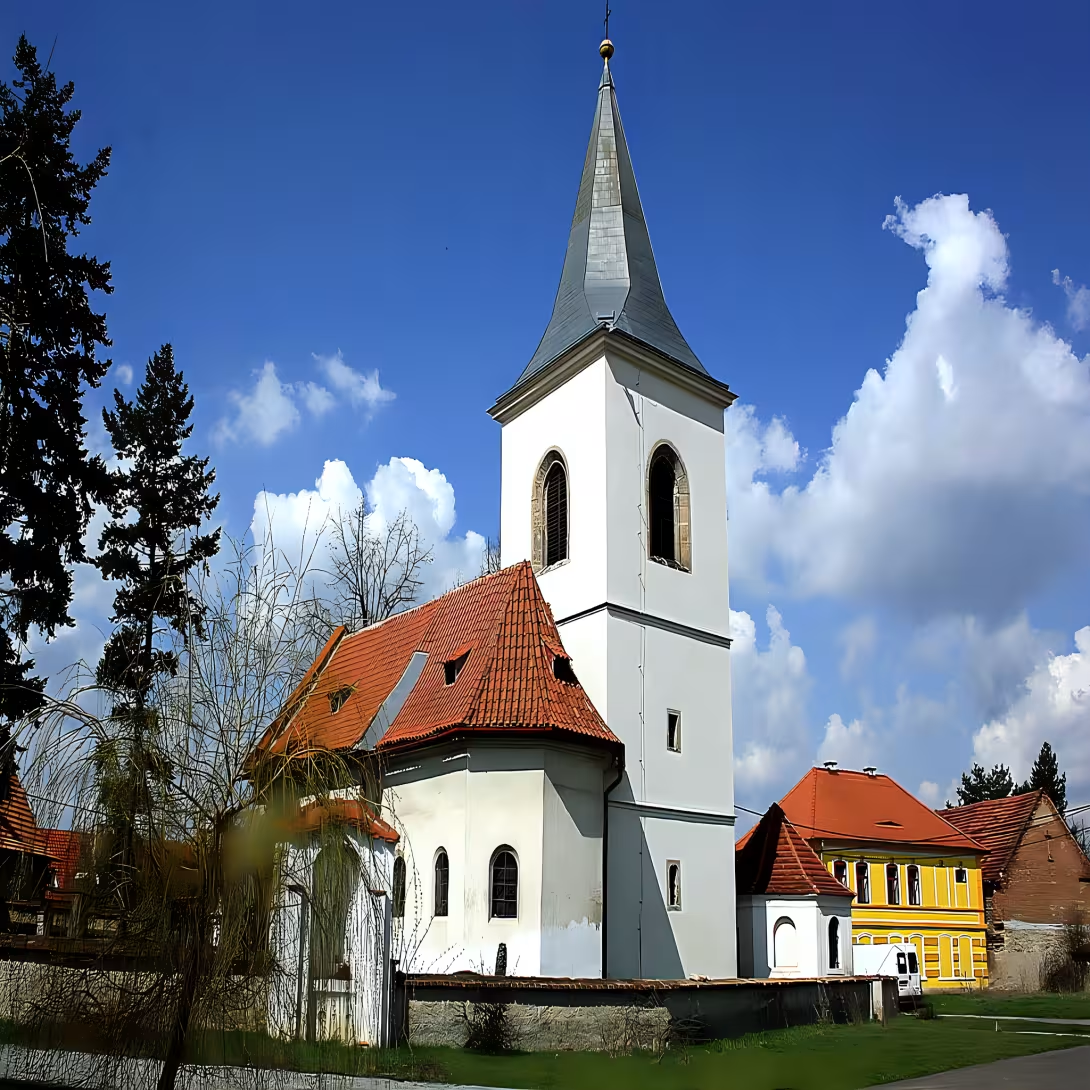
Since the 12th century, the Church of the Elevation of the Holy Cross has been dominated by Vrbna near Mělníka and is one of the protected cultural monuments of the Czech Republic. Its position in the landscape reflects the long-term role of the headquarters with both церковными and defence functions.
According to tradition, Queen Kunhuta Štaufská, the wife of King Václav I., entrusted the church to the administration of the hospital brotherhood of St. Francis, who later grew up in the Knight Order of the Crusaders with a red star. As owner of the nearby Mělník, the Queen has retained patronage. At the beginning of the 14th century, the property was transferred to the local family of the Dwarves of Vrbno, who sold it in 1352 to the already mentioned Knights Order with a red star, which took care of the church for centuries to come.
The gradual transformation of the church reflects changing needs and stylish predecessors. Originally, it was a rectangular Romanesque boat with a bleachers. In the 14th century, the eastern five-sided priesthood with Gothic vaults and wall paintings, which gradually transformed the Romanesque character of the building. The original Romanesque portal in the south wall replaced the Gothic profiled lining - it was rediscovered after the floods of 2002. In the first half of the 16th century, the church was extended by a late Gothic bell tower with a treasury serving as a sacristy, giving it the appearance of the last refuge for the locals in hostile attacks. The church hall and the cemetery (1790), which covered older Gothic elements, came from the Baroque era.
The most valuable finding took place in 2004, when rare Gothic wall paintings with a Pashian cycle - paintings of decades or centuries hidden from the perspective of the believers - were discovered under layers of baroque and historic overpaintings (last from 1903).
The cemetery surrounding the church since its inception bears traces of a rich past. The dominant is the tomb of the House of Plac with the statue of an angel. In archaeological works in 1969, a grave was discovered with the depot of the premoniac denarii. There are two chapels in the fenced wall: the Ostrobok Baroque Chapel of St. Barbara, which until the abolition of the cemetery in 1880 served as a morgue and was decorated with paintings of birth, life, death and last court, and a simple niche chapel from 1828 with a statue of St. John Nepomuk.
The church is today under the administration of the Archbishop of Prague and belongs to the parish Roudnice nad Labem (since 2006). All valuable equipment has been taken to depositories since the 1990s. Ordinary services are no longer held; the church is the only pilgrimage holy mass in the middle of September, which is associated with commented tours. The public is a monument accessible within the European Heritage Days, possibly on other dates.
Then and now
Drag the slider to compare how the landmark may have looked when it was built with the view today.
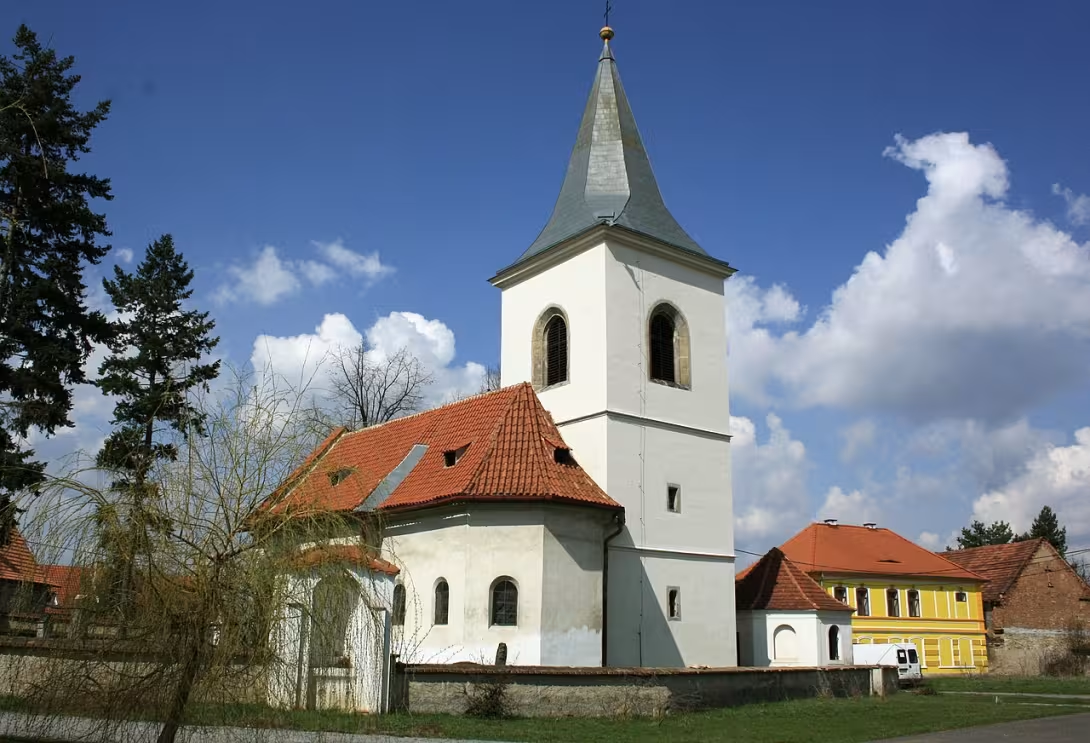

The historical appearance on the left is an AI-generated visualisation and serves as inspiration only.
Historical milestones
- 1236
- The church was entrusted to the administration of the hospital brotherhood of St. Francis by order of Queen Kunhuta Štaufskaya.
- 1352
- The church bought the Knight Order of the Crossroads with a red star.
- 14th Century
- Gothic reconstruction with addition of five-sided presbytery and wall paintings.
- 2004
- Exposing hidden Gothic wall paintings of the Pashian cycle.
Architectural development
The original Romanesque single-boat church with a bleachers was extended in the 14th century by a Gothic priesthood with arches and paintings. In the 16th century, a late Gothic bell tower serving as a sacristy was added. In the 18th century, the church was adapted baroque, including the addition of a hall and a circle. Baroque plaster covered the original Gothic paintings, which were uncovered only in 2004. The cemetery with chaples and statues is part of the complex since the Middle Ages.
Historical events
- 1236
- The church was entrusted to the administration of the hospital brotherhood of St. Francis by order of Queen Kunhuta Štaufskaya.
- 14th Century
- Rebuilding to Gothic church with five-sided presbytery and wall paintings.
- 2004
- Exposing hidden Gothic wall paintings of the Pashian cycle.
Owners
- 1236
- beginning of the 14th century
- 1352
- since 2006
Points of interest
- Since the 12th century, the Church of the Elevation of the Holy Cross has been dominated by Vrbna and is one of the protected cultural monuments.
- According to tradition, the church in 1236 was entrusted by Queen Kunhuta Štauf to St. Francis's Hospital Brotherhood, which later went to the Knight's Order of Crossroads with a red star.
- In 2002, original Gothic elements were rediscovered after the flood, as a gothic profiled lining, which replaced the Romanesque portal.
- In 2004, rare Gothic wall paintings with a Pashian cycle were unveiled under baroque overpaintings.
- The cemetery at the church contains the tomb of the House of Plaček with an angel and the grave with the depot of the imaginary denarii discovered in 1969.
Guide
This guide is narrated by a synthetic voice generated by artificial intelligence.
Show guide text
This text was created by artificial intelligence and has not been editorially reviewed. It may contain inaccuracies.
The Church of the Elevation of the Holy Cross is the landmark of Vrbna near Mělník since the 12th century. For much of its history, it belonged to the knightly order of the Knights of the Cross with a Red Star. Today it is protected as a cultural monument.
Around the year 1236, the Czech queen Kunhuta Štaufská, wife of King Václav the First, entrusted the church to the care of the hospital brotherhood of Saint Francis. From this, the order of the Knights of the Cross with a Red Star later emerged. However, the queen retained the patronage rights as the owner of nearby Mělník. At the beginning of the 14th century, these passed to the local noble family Mléčků z Vrbna, and in 1352 the knights bought it from them.
The church originally had a rectangular Romanesque nave with a gallery. In the 14th century, an eastern five-sided chancel with Gothic vaults and wall paintings was added to it. The Romanesque portal in the southern wall of the nave was then replaced by a Gothic profiled frame. It was only revealed again by the floods in 2002. In the first half of the 16th century, a late Gothic bell tower with a treasury was built, which serves as a sacristy. The church thus became the last refuge for villagers in case of an enemy attack. The Baroque period brought a vestibule, and in 1790 also a choir loft.
The most precious discovery is the Gothic wall paintings with a Passion cycle. For centuries, they were covered by Baroque and historicizing overpaints, the last one from 1903. They were only uncovered in 2004.
The church has always been surrounded by a cemetery. Once it was more extensive than it is today. In 1969, a treasure of Premyslid denars was found in one of the graves. Today the cemetery is dominated by the tomb of the Plačků family with a statue of an angel. Remnants of Renaissance sgraffito are set into the Baroque enclosure wall, and there are two chapels in it as well. The octagonal Baroque Chapel of Saint Barbara served as a mortuary until the cemetery was closed in 1880. It is decorated with Baroque paintings with motifs of the Nativity, Life, Death, and the Last Judgment. The second, simple niche chapel from 1828 bears a statue of Saint John of Nepomuk.
The valuable furnishings of the church were already removed to storage facilities in the 1990s. Only a pulpit and altars from 1903 without paintings remain inside. There are also the organ, whose pipes were destroyed in the 1980s, and a few cupboards. The church is administered by the Prague Archbishopric. Until the end of 2005 it was a parish church, and from 2006 it has belonged to the parish of Roudnice nad Labem.
Tips for visitors
The best time to visit the Church of the Holy Cross is in the morning or autumn when there is a pleasant light in the interior and there are fewer crowds outside. It is often hot in the church during the summer months, so wear light clothes and possibly a fan if available on the premises. In winter you can visit the church in the snow when its Gothic elements and surrounding nature appear in new light.
The location is also accessible by public transport; the current connection can be found in the traffic search engine.
When visiting, wear comfortable shoes because the church and the surrounding cemetery have some parts with uneven surface. I also recommend you take a small laptop or a map so you can make notes about the interesting things that you find in church and cemetery. If you are interested in history, bring a camera or mobile phone with a high-quality lens.
The best places for photography are the exterior facade of the church, especially gothic windows and portals, as well as baroque sculptures in the cemetery. For quality images is the ideal time early morning or sunset when light falls favourably and creates interesting shadows. In the interior, I recommend taking pictures with less lighting to better show details of painting and sculpture.
The historical city of Mělník is worth visiting around the church, which is only a few kilometres away. Here you will find the chateau, which is one of the most important monuments of Central Povltaví, as well as many other cultural objects. Another interesting place is the Baroque cemetery right in the church area, where there is a tomb of House Plaček and a statue of an angel, which is suitable for lovers of sculpture art.
For families with children it is advisable to visit the church in combination with a walk around the nearby cemetery where children can observe statues and talk about history. It is also possible to visit Mělník where the children appreciate the visit of the chateau and the opportunity to walk around the historic centre with its picturesque streets. If you are interested in nature, you can take a short walk around Vrbna and observe the surrounding countryside.
Frequently asked questions
Can the monument be visited?
Religious buildings are usually open mainly during services; at other times a visit is normally arranged with the parish or the operator. We have not verified specific times.
Where is the monument?
Location: Vrbno, Středočeský kraj. The map on this page shows the exact spot.
Why is the monument protected?
It is listed in the Central List of Cultural Monuments of the Czech Republic as a cultural monument (register no. 34239/2-1309).
For kids
Imagine going back to the Middle Ages and finding yourself in a small village of Vrbno in Moravia. It was a small settlement with wooden cottages and fields full of crops.
How would it look here? Who lived here? What happened here? The village was densely populated, the people here lived in peace, but also in a constant struggle for existence. They liked music, dances and stories told around the fire.
Businesses nearby
Do you run a restaurant, accommodation, shop, museum, rental, wellness or other visitor service near this monument? Show yourself directly to the people heading to it — this is how they will see you in the app and on the web:
Events nearby
Zdroj akcí: otevřená data měst a obcí ČR (Národní katalog otevřených dat) a kalendář akcí Národního památkového ústavu.
Nearby
- Historical town with chateau and a variety of cultural monuments.
- Baroque cemetery with chapels and statues, including morgue and niche chapel with statue of St. John Nepomucký.
- Flat landscape with field formations and woods.
Accommodation nearby
Trips and activities nearby
Guided tours, tickets and activities nearby from GetYourGuide
Affiliate link: if you buy from the partner, we may receive a commission. The price for you does not change.
Search tours and activities →Themed route
Thematic cruise route: Baroque Vrbno and its spiritual heritage
1. Church of the Elevation of the Holy Cross * The main monument of the village * - Here it is worth visiting not only its Baroque architecture, but also exceptional painting and historical tombstones. The church is connected with local tradition and offers peace for contemplation.
2. The cemetery with the tomb of the House of Plaček * Access to the church * - Baroque cemetery with morgue and statue of angel is a picturesque place full of symbols. The niche chapel with the statue of St. John Nepomuk gives the place spiritual depth.
3. Walk through the Elbe lowland * Natural surroundings * - After visiting the church take a short walk through the surrounding field roads and forests. The flat landscape offers peace and the possibility to observe local flora and fauna.
4. City Mělník (approx. 5 km) * Historical centre * - The integration into the route is logical since Mělník is only five kilometers from Vrbna. Here it is worth visiting his chateau and other cultural monuments that will complement the impression of the baroque environment of Vrbna.
The route is designed to combine spiritual and historical elements with the natural environment, with all points interconnected and distances minimized.
Seasonal recommendations
Spring Spring in the Church of Holy Cross Ascension offers a unique atmosphere of awakening nature. Sun rays penetrate the church windows and illuminate historical paintings that seem even more vivid after the winter shadow. Spring flowers and green leaves in the trees form a contrast with stone architecture. The atmosphere is quiet but not completely empty - visitors come with enthusiasm for spring walks and discoveries. It is appropriate to dress light, but the cover on the head, because the sun can be direct. The best time to visit is in the morning, when the church is still clean from the crowds that begin to accumulate after lunch. If you like photography, use the golden hours before noon when the light is ideal for capturing details.
Summer In the summer months, the Church of the Ascension of the Holy Cross comes to life under the sunny sky, but also with the challenges of the main visiting season. The warm, sunny days create playful shadows on the stone walls of the church and illuminate frescoes so that they seem to come to life. Nature around is lush - green meadows and trees create a pleasant contrast with historical construction. However, in summer it is necessary to count on crowds - the church is a popular tourist stop. I suggest you come as soon as possible after opening, ideally before 10 o'clock to enjoy your peace and avoid the queues. Don't forget sunscreen and light, airy shoes, because walking around the church can be longer. Also, on hot days, take plenty of water.
Autumn Autumn visit to the Holy Cross Church is like a return to a calmer, introspective world. The golden and red leaves on the trees are reflected in the windows of the church and create a magical atmosphere that seems to be connected to the historical monument. The sun no longer falls so intensely, but its rays illuminate the church quite differently - shadows are longer and light softer, which gives the paintings and statues depth. Nature around is quiet, only scattered visitors come for autumn walks. It is advisable to wear warmer clothes because the morning and evening cold can be pronounced. The best time to visit is in the afternoon when the outside is pleasant and the church is not as crowded as in the summer months. If you like photography, take the time around 15 hours when the light is ideal for catching autumn colors.
Winter Winter visit to the Holy Cross Church offers a unique atmosphere of peace and quiet, which is typical of this time of year. The church, surrounded by snow, appears to be a fortified pearl in the winter landscape. The sun, which appears only briefly, illuminates its stone walls and creates shadows on the snow that give the place mysterious beauty. The inside of the church is warm and cosy, which is suitable after an outdoor walk. In winter it is necessary to count on shorter opening times, so prepare to visit and leave in time. I recommend to dress warm but comfortable clothes because outside can be cold and windy. The best time to visit is in the afternoon when the light is out and the church is still open. If you like the winter atmosphere, enjoy the time around 14 hours when the outdoors is pleasant and you can enjoy a quiet walk without crowds.
Visualizations and artistic views


The visualisations are generated by artificial intelligence and serve as inspiration.
Photos from the area
Real photos taken near the monument


Zdroj a licence jsou uvedeny u každého snímku.
Atmosphere of the place
This atmospheric visualisation of the place and period was generated by artificial intelligence. It is not real footage of the location.
Tips from visitors
No tips yet. Be the first!
Log in and add your tip.
Sources and literature
Photos: I would appreciate being notified if you use my work outside Wikimedia. More of my work can be found in my personal gall / CC BY 3.0, rozlišení zvýšeno umělou inteligencí — Wikimedia Commons. The author and licence also appear when you hover over the image.
Faktickým podkladem tohoto textu byl článek na Wikipedii, jehož autory jsou přispěvatelé Wikipedie. Článek je dostupný pod licencí CC BY-SA 4.0.
Location on the map





Příběhy a pověsti
Legendy, pověsti a příběhy spjaté s touto památkou
Fotografie návštěvníků
Zatím žádné fotografie. Buďte první, kdo přidá fotografii z návštěvy!
Log in a přidejte svou fotografii nebo hodnoťte.
Za ověřenou návštěvu v aplikaci získáte víc bodů — poznáme podle GPS, že jste na místě.
Reviews and comments