



kostel sv. Jiří (Nemanice) Church
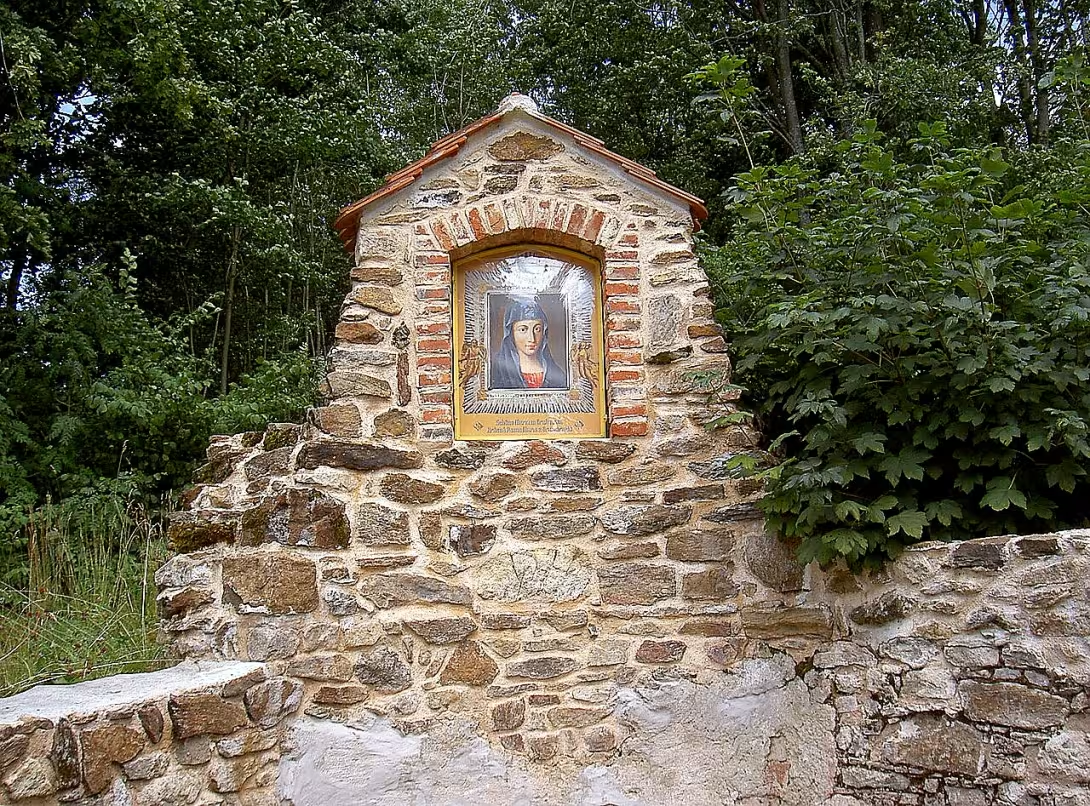
Objekt se nedochoval — na místě dnes nestojí. Následující text popisuje jeho historii, ne současnou návštěvu.
St. George's Church in Lucina is the story of a forgotten place. The extinct parish church stood in a small village of Lucina west of Nemanic on the border with Germany. After 1945 and especially with the creation of a strictly guarded border zone, from which the population had to leave, the church was gradually abandoned and shot down in the 1970s. Today, his demolished remains, partially restored and consecrated, are the place of memory.
The story of the church goes deep into the past. At least since 1688 there was a chateau chapel dedicated to St. George in Lucina. Lučina belonged to the German diocese for a long time - until 1782 she was joined to the Waldmünchen parish, then she became part of the parish non-manic. A new church was built on the site of the old chapel in 1786. The tower was to be built gradually: it was built in 1753 and completed in 1775. In the same year 1786 a parish was established in Lucina, which was managed in addition to the village itself by the neighbouring villages of the Pípor, Pila and Liskovec. In 1906 the church was newly painted and served its parish until the second half of the twentieth century.
Fate changed after World War II. In the early 1950s, the entire population of Lucina had to leave due to the creation of a border zone. Between 1951 and 1964, a border unit was dislocated here. In February 1956 came heavy military technology, the houses were demolished. The church remained "looted and damaged," and later was shot - the exact date is not certain, sources indicate the years 1959 to 1975.
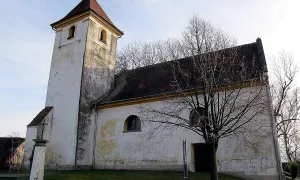
The building was a one-boat church, a baroque on a rectangular floor plan, crowned by a prism tower with an onion beating and a cross. The ship was seven to eleven meters with a flat ceiling. The presbytery closed with square sacristy on the sides. Eight high stained windows illuminated the interior. The church had three entrances: the main to the boat to the village, the lateral to the Czech and Bavarian sacristy - a division that reflected the language composition of the parish.
The main altar was decorated by the painting of St. George by the domestic painter Wimmer, who preserved himself and is located in the church in Nemanika. It was also possible to save the image of the Mother of God with Jesus (also in Nemanice) and a copy of the painting of the Beautiful Virgin Mary Grafenriedska from the first quarter of the 13th century (now at the Waldmünchen Museum).
After decades of oblivion, in 2000 a association dedicated to the restoration of the church was founded. The project "Rebirth of St. George's Church in Lucina - Grafenried" took place in 2002 on the initiative of Hans Laubmeiера, a native of the nearby Pila baptized in the church. The funding was provided by the disposal fund of the Euroregion "Objective 3 ', the investor was the municipality Nemanice. The ruins were discovered and constructed in 2011. During the unveiling was found the foundation stone of the tower with the year 1775, three crosses and a glass cup with seven coins from the time of Marie Theresa. The exposed masonry has been partially supplemented, a new muse of stone blocks from the ruins has been inserted in the broken altar mensa. A copy of the beautiful Virgin Mary image is placed in the altar niche. The remains were consecrated on the 28th April 2012.
Today, the ruins of the church stand as a commemorative place of the extinct world. It is an important story for experts in the history of the border area, which is affected by the fate of the tens of thousands of people who have been directly touched by the Central European border.
Then and now
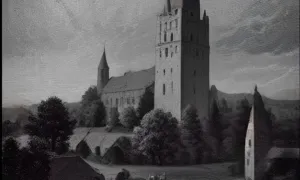
Drag the slider to compare how the landmark may have looked when it was built with the view today.
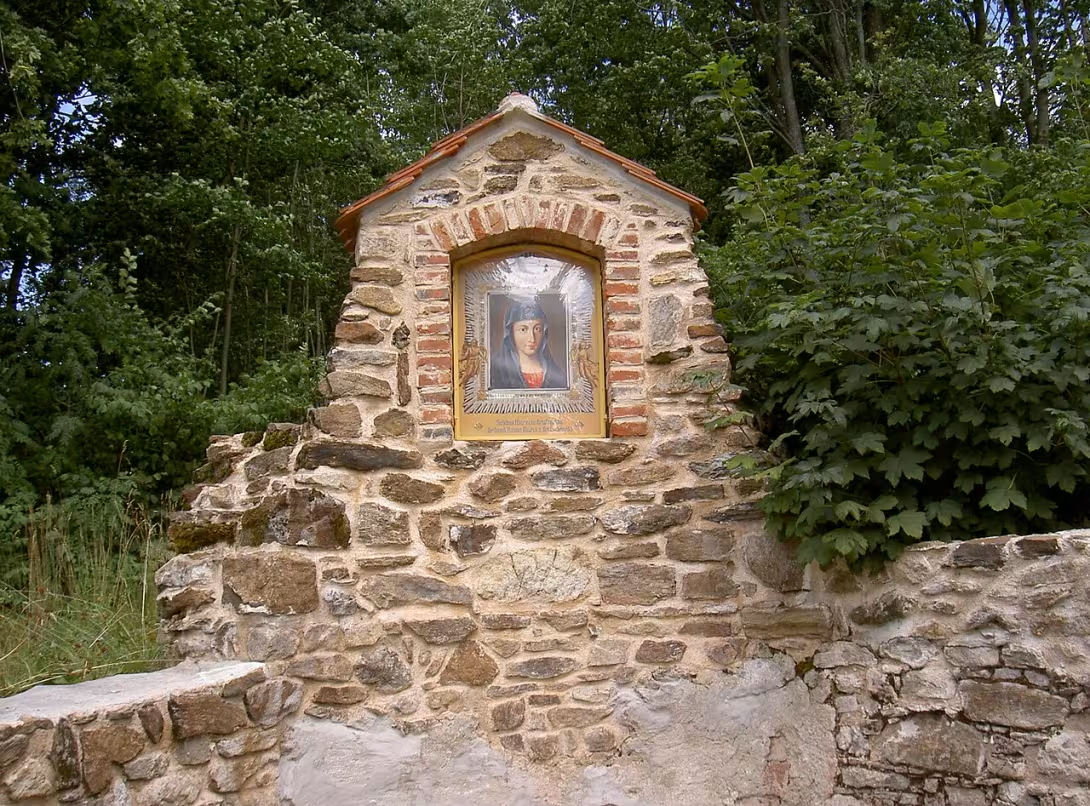

The historical appearance on the left is an AI-generated visualisation and serves as inspiration only.
Historical milestones
- 1688
- The first written mention of St. George's chapel in Lucina, which served as a chateau chapel.
- 1786
- The establishment of the parish and the construction of a new church at the site of the chapel, which became a presbytery.
- 1956
- The demolition of houses in Luka's heavy military technology, the church and cemetery left damaged.
- 1975
- The shooting of St. George's Church as a result of the disappearance of the village.
Architectural development
The church was built gradually: first as a chateau chapel (1688), later rebuilt into presbytery (1753-1775) with an attached tower. The main church building was completed in 1786. The ship was flat-ceiling, presbytery glass cross with lunnets. The roof was originally covered with shingles and later topped. The interior was painted in the 19th century (1906).
Historical events
1688 - The mentioned chateau chapel of St. George in Lucina, the predecessor of a later church.
1786 - Establishing a parish and building a new church on the site of the chapel.
1951-1964 - The village of Lučina was vacated and the church was left to the destitute as a result of the border zone.
2011 - The stabilisation and discovery of the remains of the church after decades of oblivion.
Points of interest
- St. George's Church in Lucina was built on the site of an older chateau chapel dedicated to this saint, which existed here since 1688.
- The church tower was built gradually - the first part was built in 1753 and was completed only in 1775.
- The church served as a parish for Lucina and the neighbouring villages of Úpor, Pila and Liskovec, with three entrances, two of which led to sacristy, which reflected the German and Czech population.
- In the reconstruction of the ruins of 2011, the foundation stone of the tower was found with 1775 years, three crosses and a glass cup with seven coins from the time of Marie Theresa.
- The church preserved the painting of St. George by the painter Wimmer, who is now in the church in Nemanika.
Guide
This guide is narrated by a synthetic voice generated by artificial intelligence.
Show guide text
This text was created by artificial intelligence and has not been editorially reviewed. It may contain inaccuracies.
The Church of Saint George stood in Lučina, a village that has since disappeared, near the border with Germany, west of Nemanice in the Domažlice district. All that remains of this former parish church are restored foundations and fragments of walls.
The church was built gradually. From 1688 onwards, a castle chapel dedicated to Saint George is mentioned in Lučina. Until 1782, Lučina belonged to the parish in Waldmünchen in the Regensburg diocese, and then to the parish in Nemanice. According to one source, a church was built on the site of the chapel in 1786. According to another source, the chapel later formed its presbytery, and in 1753 a tower began to be constructed next to it, completed in 1775. In the same year, 1786, a rectory was established, which also served the surrounding villages of Úpor, Pilu, and Lískovec.
It was a Baroque single-nave church with a flat ceiling in the nave, measuring seven by eleven metres. It was completed by a prismatic tower with an onion dome and a cross. Two sacristies, one Czech and one Bavarian, adjoined the narrow presbytery. Eight tall stained glass windows let light inside. The image of Saint George fighting the dragon from the main altar was painted by Domažlice painter Wimmer. It has been preserved and is now in the church in Nemanice. A copy of the image of the Beautiful Virgin Mary of Grafenried, whose original dates from the first quarter of the thirteenth century, also survived and is displayed in the museum in Waldmünchen.
At the beginning of the nineteen fifties, inhabitants had to leave because a strictly guarded border zone was being established here. A platoon of the Border Guard was stationed in the village, and in 1956 the houses were demolished. The plundered church remained standing and fell into decay. When it was shot down is uncertain. It is most commonly stated to be the early seventies, though according to a local witness, it was around 1975.
In the year 2000, an association was founded to restore the church foundations. The initiator was Hans Laubmeier, a native of Pilu, who was baptised in this church. The investor was the municipality of Nemanice, and the project was also supported by the mayors of Klenčí pod Čerchovem and Waldmünchen. The remains of the church were uncovered and secured. During the excavation, a foundation stone of the tower with the date 1775 was found. Seven coins from the time of Maria Theresa were placed inside it in a glass vessel. In the place of the destroyed altar, a new mensa was created from stones from the ruins of one of the houses, and above it a copy of the image of the Beautiful Virgin Mary of Grafenried was returned. The restored remains of the church were consecrated on April twenty-eighth, 2012.
For kids
Imagine going back to the past. The town Nemanice was a small village where people and their families lived. St. George's Church was the heart of the village where important events took place and people prayed for protection.
How did it look here? The church stood in the middle of the square, its towers reached the sky and its bells echoed all around. People were meeting at church announcements to pray and celebrate their family anniversary.
Businesses nearby
Do you run a restaurant, accommodation, shop, museum, rental, wellness or other visitor service near this monument? Show yourself directly to the people heading to it — this is how they will see you in the app and on the web:
Nearby
- The neighboring village where the remains of the church are today. In Nemanice is also the church of St. George with a transferred painting from Lucina.
- Lučina was cleared out for military purposes in the 1950s and became part of a strictly guarded border zone.
- Another defunct village in the neighbourhood, which was part of Lučina parish. Today there is a memorial and information about the history of the region.
Visualizations and artistic views


The visualisations are generated by artificial intelligence and serve as inspiration.
Photos from the area
Real photos taken near the monument


Zdroj a licence jsou uvedeny u každého snímku.
Atmosphere of the place
This atmospheric visualisation of the place and period was generated by artificial intelligence. It is not real footage of the location.
Tips from visitors
No tips yet. Be the first!
Log in and add your tip.
Sources and literature
Photos: Allexkoch / CC BY-SA 4.0 — Wikimedia Commons. The author and licence also appear when you hover over the image.
Faktickým podkladem tohoto textu byl článek na Wikipedii, jehož autory jsou přispěvatelé Wikipedie. Článek je dostupný pod licencí CC BY-SA 4.0.
Location on the map
More monuments – Nemanice
Show all in the municipality

Příběhy a pověsti
Legendy, pověsti a příběhy spjaté s touto památkou
Fotografie návštěvníků
Zatím žádné fotografie. Buďte první, kdo přidá fotografii z návštěvy!
Log in a přidejte svou fotografii nebo hodnoťte.
Za ověřenou návštěvu v aplikaci získáte víc bodů — poznáme podle GPS, že jste na místě.
Reviews and comments