



kostel sv. Matouše Church
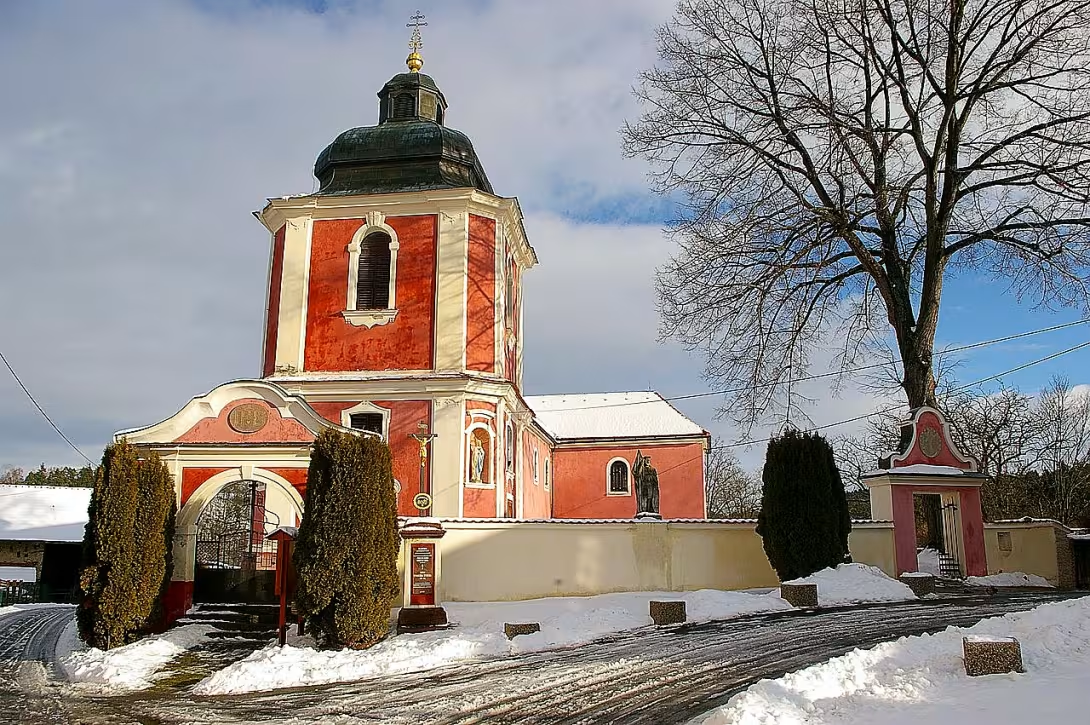
The church of St. Matthew the Apostle in Hrádek near Ačebor belongs to the parish church of the territorial subordinate Prague Archdiocese. It lies on the island of Hradec above the meander of the river Blanice, originally in the neighbourhood of the fortress, which is now completely surrounded by the village. Since 1958 it has been protected as a cultural monument of the Czech Republic along with the cemetery wall, the statue of St. Wenceslas, the morgue and crosses at the gate of the cemetery.
The church was built in the first half of the 13th century. The written mention of him as a parish temple dates back to 1350. During the Hussite wars, the rectory was lost, and in 1467 a local fortress was burned. After 1547, the townspeople of Vlashimi initiated the restoration of the church, as Hrádek became part of the Hlashim household. Since the 17th century there have been pilgrims to the love statue of the throne of the Virgin Mary with Jesus, which has become the center of the religion of the believers.
The preserved building changes have shown the transformation of the building over centuries. Side chapel was added to the temple at the end of the 17th century. In 1765 the church received a higher floor tower with baroque fighting and lantern, while it was also close to the building for the priest. The year 1780 brought a ban on deserts, the statue was officially secured, but already in 1790 the pilgrims were allowed again. In 1787 a locality was established, which was promoted to parish in 1855. The first two priests served here since 1844 the regional historian Antonín Norbert Vlasák and František Dobromil Kamarýt. In 2001, the rectory was entrusted to the Congregation of the priests of the Marines.
The building is a one-ship building of medieval origin. On the west side dominates the prism tower with baroque dancing and lantern; The baroque noche with the statue of Our Lady of Lourdva is found in its roasting. The boat is illuminated by rectangular windows with semi-circular or segmented enchantments, presbytery is encapsulated by a gothic vault. The church is surrounded by a cemetery wall with two gates with baroque volute shield.
The interior bears traces of different times. The main altar with Baroque architecture from the first half of the 18th century features a modern picture of St. Matthew from 1902 in the development frame; The side goals are decorated with Baroque statues of the apostles Peter and Paul. The greatest treasures, however, are the Gothic statue of the Virgin Mary Hradec. Cut from lime wood to a height of 71,5 cm, formed between 1370-1380 in the same workshop as Madonna from Bečov nad heat. The statue shows all the signs of the beginning of a beautiful style: an esnately bent figure in a richly painted coat, a crown on his head. Santa Claus is in a live motion with his arms stretched out. This statue has become a target for the desert of the believers. The North Side Chapel of St. Joseph has equipment from 1896 with the statues of St. Joseph with Jesus, St. Ludmila and St. Elizabeth. There are three bells in the tower; the eldest is 1555.
The special feature is also the Chapel of the Virgin Mary Hradec, built in 1826 about 300 meters southwest of the church above the supposedly miraculous well. In 1904 it was rebuilt and its facade was decorated with two relief angels. Inside the chapel is a mosaic made of glazed ceramic fittings according to Jan Beneš's design, made in RAKO ceramic plants. Displays the apparitions of the Virgin Mary Hradec in the cloud and the view of the village.
The church is therefore worth a visit mainly due to its Gothic statue of the Virgin Mary, a unique monument item from the beginning of the 15th century, and the своей rich layered history from the Middle Ages to the present.
Then and now
Drag the slider to compare how the landmark may have looked when it was built with the view today.
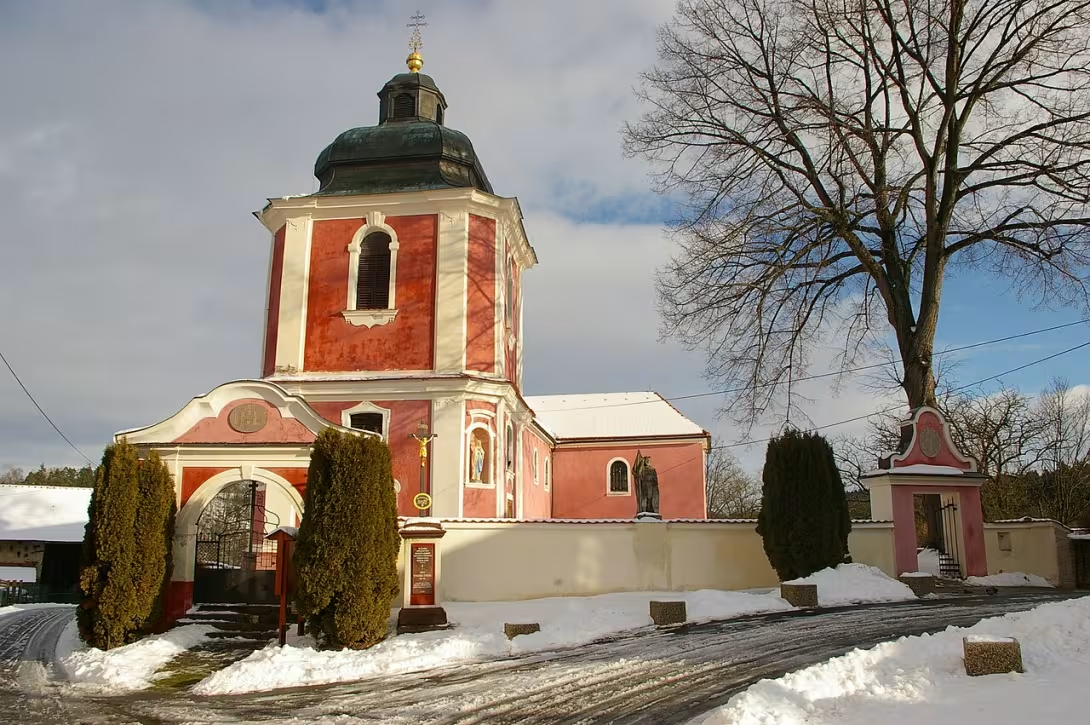
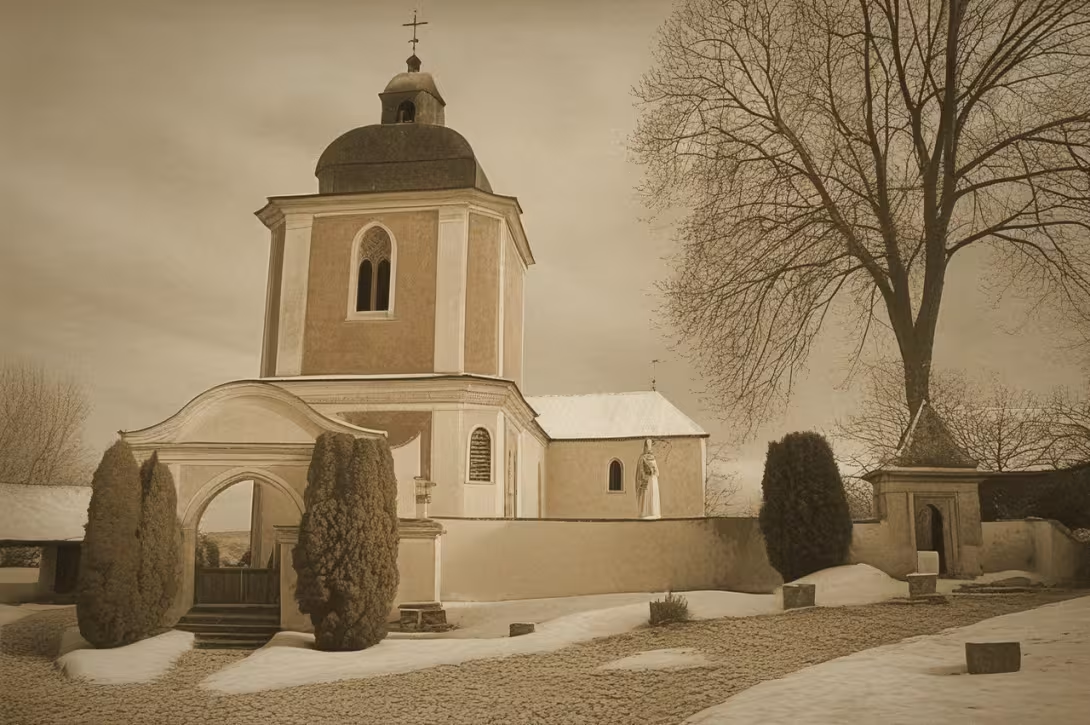
The historical appearance on the left is an AI-generated visualisation and serves as inspiration only.
Historical milestones
- 1350
- Written mention of the church as a parish.
- 1467
- Burning the fort during Hussite wars.
- 1765
- Building the upper floor of the tower with baroque fighting.
- 1855
- The promotion of the location on the rectory.
Architectural development
The building has medieval origins with thick walls and presbytery with Gothic cross vault. At the end of the 17th century the side chapel was added and in 1765 the upper floor of the tower with baroque fighting was completed. The interior contains a Baroque main altar from the first half of the 18th century.
Historical events
In 1350, the church is mentioned in writing as a parish. In 1467, a fortress was burned during the Hussite wars. In 1787 a locale was established at Hradek, which was promoted to rectory in 1855.
Points of interest
The church was built in the first half of the 13th century. - Since 1958 it has been protected as a cultural monument of the Czech Republic. - The greatest treasure is the Gothic statue of the Virgin Mary Hradec, which was created between 1370-1380. - There are three bells in the tower, the oldest one bearing 1555. - About 300 metres southwest of the church is the Chapel of the Virgin Mary Hradec, built above the supposedly miraculous well.
Guide
This guide is narrated by a synthetic voice generated by artificial intelligence.
Show guide text
This text was created by artificial intelligence and has not been editorially reviewed. It may contain inaccuracies.
The Church of Saint Matthew the Apostle in Hrádek u Ctiboře in the Benešov district was built in the first half of the 13th century. It was built on a promontory above a meander of the Blanice River, next to the local stronghold. Today it stands in the middle of the village.
In 1350, the church is first mentioned in writing as a parish church. During the Hussite Wars, the parish ceased to exist and in 1467 the stronghold burned down as well. After 1547, the village became part of the Vlašim estate and the church was renovated by Vlašim townspeople. From the 17th century, pilgrims came here to venerate a miraculous statue of the Virgin Mary. At the end of that century, side chapels were added and in 1765 the upper floor of the tower with a baroque cupola. In 1780, pilgrimages were forbidden and the statue was officially secured, but ten years later they were permitted again. In 1787, a chaplaincy was established here and in 1855 a parish. Among the first parish priests were the regional historian Antonín Norbert Vlasák and František Dobromil Kamarýt. Since 2001, the parish has been administered by the Congregation of the Marian Priests.
The single-nave building is of medieval origin according to the thickness of its walls. On the western side rises a prismatic tower with a baroque cupola and a lantern. In its corner stands a modern copy of the statue of Our Lady of Lourdes in a baroque niche. Three bells hang in the tower and the oldest one bears the date 1555. The nave and side chapels have flat ceilings, while the presbytery is vaulted with a gothic cross vault.
The baroque main altar dates from the first half of the 18th century. The painting of Saint Matthew on it is from 1902, and on either side stand baroque statues of the Apostles Peter and Paul. The original baroque painting of Saint Matthew hangs in the northern side aisle.
The greatest treasure of the church is the pilgrimage statue of Our Lady of Hrádek in the southern chapel. It is carved from linden wood and measures 71 and a half centimeters. The enthroned Virgin Mary holds the Christ Child on her left arm and places her right hand under his chin. The Christ Child is captured in a lively movement, with an inclined head and outstretched arms. The statue was created between 1370 and 1380 in the same workshop as the Madonna from Bečov nad Teplou and belongs to the important gothic works of the beautiful style. The opposite chapel of Saint Joseph has furnishings from 1896.
The church is surrounded by a wall of a defunct cemetery with two baroque gates. Together with the statue of Saint Wenceslas, a mortuary chapel, and a cross in front of the cemetery gate, it has been a cultural monument since 1958.
About 300 meters southwest of the church stands a niche chapel from 1826. It was built above a spring, whose water was said to be miraculous. In 1904, it was reconstructed and a mosaic was created inside according to a design by Jan Beneš. It depicts the apparition of Our Lady of Hrádek in a cloud and below it the village of Hrádek.
Tips for visitors
The best time to visit is in the morning or late afternoon, when sunlight gently illuminates the architecture of the church and its characteristic prism tower. In these hours, the light is most suitable for capturing details of the historic building without hard shadows.
Take with you comfortable shoes suitable for nature walks and plenty of drinking water. For the best photos we recommend to focus on the view of the church from the surrounding terrain, especially in the soft light that highlights its shapes.
For families with children it is ideal to combine a visit with a nature walk. Near is the river Blanice and the chapel of the Virgin Mary Hradec near the well, which offers a quiet environment for family rest.
Frequently asked questions
Can the monument be visited?
Religious buildings are usually open mainly during services; at other times a visit is normally arranged with the parish or the operator. We have not verified specific times.
Where is the monument?
Location: Hrádek, Středočeský kraj. The map on this page shows the exact spot.
Why is the monument protected?
It is listed in the Central List of Cultural Monuments of the Czech Republic as a cultural monument. It is protected as part of a larger listed ensemble.
For kids
Hello, little adventurers! Surely you imagine that sometimes people like you were eager to travel and discover new places. And what if I told you there's a place around here full of stories from ancient times? It is the church of St. Matthew in Hrádek near Atwar. In order to begin our journey, we must remember the time when people built magnificent chateaux and churches.
Businesses nearby
Do you run a restaurant, accommodation, shop, museum, rental, wellness or other visitor service near this monument? Show yourself directly to the people heading to it — this is how they will see you in the app and on the web:
Nearby
The River Blanice, the Chapel of the Virgin Mary Hradec by the well.
Accommodation nearby
Themed route
Thematic cruise route around St. Matthew's Church
1. Church of St. Matthew - * Type: * Church - * Why is it worth visiting: * This Baroque church is not only the spiritual centre of the village Hrádek, but also an architectural treasure. Its beautiful interior decorations and history attract visitors from all over the region.
2. Blanice River - * Type: * River - * Why is it worth visiting: * After exploring the church take a look at the Blanice River, which running around the village adds a calm and natural character to the trip. It is an ideal place for relaxing or short walks along the shores.
3. Chapel of the Virgin Mary Hradec by the well - * Type: * Chapel - * Why is it worth visiting: * This picturesque chapel is located at an ancient well and serves as a place of prayer and peace. Its history and beautiful surroundings attract visitors seeking refuge in nature.
4. Tanks of St. Matthew's Church - * Type: * Tanks - * Why is it worth visiting: * After exploring the chapel, go back to the church and look at its courtyard. This place is ideal for relaxation, photos or a simple view of the surrounding landscape.
5. Tower of St. Matthew's Church - * Type: * Tower - * Why is it worth a visit: * If possible, try the rise on the church tower for an unforgettable view of the surrounding landscape. It is a unique opportunity to see the village Hrádek and its surroundings from a higher perspective.
This route offers you a mixture of cultural, historical and natural experiences in the centre of the Central Bohemia Region.
Seasonal recommendations
Spring in Hrádek brings an awakening landscape that contrasts with the stone statics of St. Matthew's Church. In this period the air is fresh and the surrounding vegetables gradually come to life, creating a calm and meditating atmosphere ideal for separate tours. The lighting is soft and scattered, often enhanced by spring sun piercing windows. In practice, spring is a great choice for those who want to avoid summer crowds. We recommend bringing laminated clothing because temperatures may vary significantly during the day. The most appropriate time is the late morning when the temperatures rise and the light is the most pronounced, but before the first groups of tourists start gathering.
Summer offers the longest days and brightest light, which illustrates the architectural details of the church. Natural lighting is intense and creates strong shadows, which can be photographically interesting, but requires caution when looking into the interior. The atmosphere is more lively because larger groups of visitors and families with children are coming here. For a comfortable visit it is crucial to come as early as possible in the morning, ideally right after opening to avoid noise and crowd pressure. Clothes should be light, breathable and suitable for higher temperatures, which often reach extremes in the summer months. Don't forget enough drinking and sunscreen if you plan to walk around the sights.
Autumn brings a rich variety of colors in the surrounding nature, which forms a wonderful framework for historical construction. The lighting is lower and warmer, which gives the church an intimate and mysterious character. The atmosphere is calm and thoughtful, ideal for those who seek rest from the daily rush. The flow rate of visitors is falling, which allows a slower and more thorough tour without rush. Practical advice includes layered clothing with a wind layer, because the underlying winds can be unpleasant. The best time to visit is the prehistoric time when light is still sufficient for orientation, but temperatures are no longer as low as evening.
Winter brings the church of St. Matthew a specific, quiet and almost mystical atmosphere. Short days and low sun create dramatic light effects, while the outdoor area is often covered with snow, which adds scene peace and cleanliness. The atmosphere is cold and quiet, ideal for introspection. Due to the cold and shorter day, the visit is shorter and more intense. Clothes must be warm, laminated and waterproof, especially if there is snow. The best time is the late morning, when temperatures rise slightly and the light is brightest.
Visualizations and artistic views


The visualisations are generated by artificial intelligence and serve as inspiration.
Photos from the area
Real photos taken near the monument


Zdroj a licence jsou uvedeny u každého snímku.
Atmosphere of the place
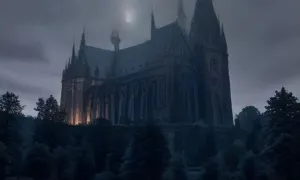
This atmospheric visualisation of the place and period was generated by artificial intelligence. It is not real footage of the location.
Tips from visitors
No tips yet. Be the first!
Log in and add your tip.
Sources and literature
Photos: Vít Švajcr Dobré světlo.com / CC BY-SA 3.0 — Wikimedia Commons. The author and licence also appear when you hover over the image.
Faktickým podkladem tohoto textu byl článek na Wikipedii, jehož autory jsou přispěvatelé Wikipedie. Článek je dostupný pod licencí CC BY-SA 4.0.
Location on the map





Příběhy a pověsti
Legendy, pověsti a příběhy spjaté s touto památkou
Fotografie návštěvníků
Zatím žádné fotografie. Buďte první, kdo přidá fotografii z návštěvy!
Log in a přidejte svou fotografii nebo hodnoťte.
Za ověřenou návštěvu v aplikaci získáte víc bodů — poznáme podle GPS, že jste na místě.
Reviews and comments