



Kostel svaté Heleny Church
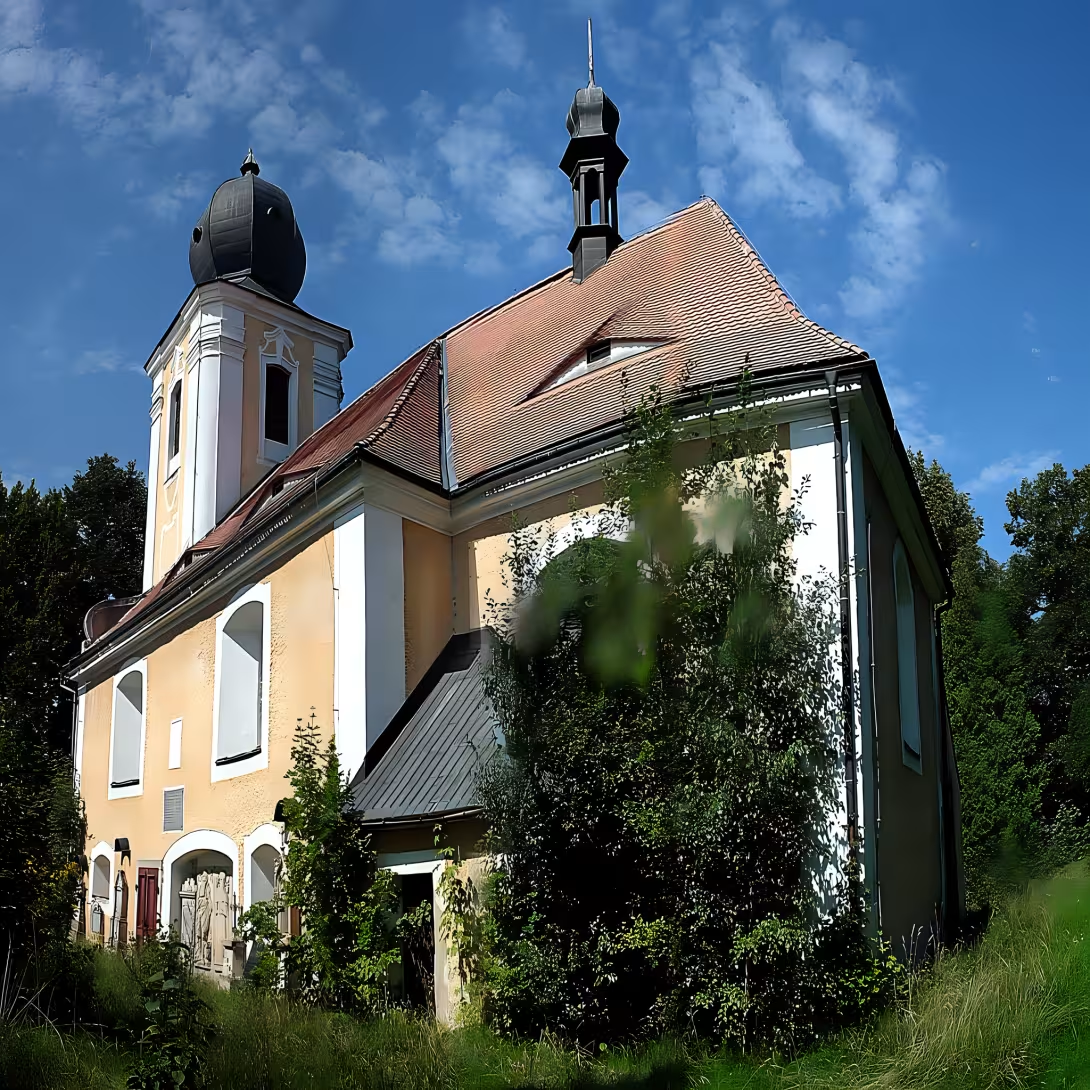
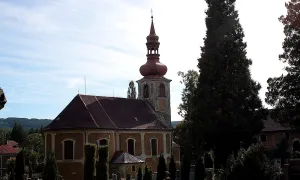
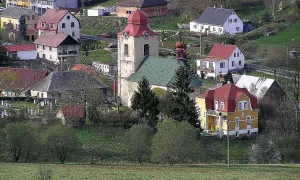
Kostel svaté Heleny in Beautiful Forest is the only church dedicated to this saint in the Czech Republic. It stands in a village in the north of the Republic in the Frýdlantý way and forms together with the neighbouring rectory and cemetery a protected collection of cultural monuments.
The construction was built in Gothic style before 1346 and it went through a long and varied history. Between 1769 and 1771 she underwent significant baroque changes, which were carried out by J. Thun according to the designs of Johann Josef Kuntz. During the 19th century the church was repaired several times - in 1840, 1881 and again between 1895 and 1897. In 1992 he was hit by a fire, but the subsequent reconstruction restored him. Today it is managed by the Roman Catholic parish Krásný Les.
It is an architectural building with a rectangular plan, supplemented by a square presbytery. On the north side is added rectangular sacristy, on the south side of the presbytery then space with square ground plan. The French tower was built in 1725 on the west side. Its lower part is decorated with a semi-circular portal with a window with a segmental wedge and a ledge. The volume appears lizens in the corners and rectangular windows, also with segment enchantments. The tower closes the onion pit. The presbytery closes the vault while the church's ship has a flat ceiling and the space under the tower is covered with a beam ceiling. The crust is three-arm and wooden, supported by wooden pillars.
The interior comes mainly from the 19th century. The main altar is a pseudo-Romanesque, dating back to 1895, and it is dominated by a painting of St. Helena painted in 1841 by Johann Gruss of Litoměřice. There are two side altars beside him. Attention is due to the 1787 Rococo pulpit created by Anton Suske with the rich decoration of angels and the relief of Good Shepherd. The front organ cabinet is also rococo, decorated with angels and musical instruments. In the interior there are pictures with scenes from the life of Jesus Christ from the first half of the 19th century and there is also a baptist from 1824.
The organ instrument of the church has an interesting history. In 1803, the organist Ambroz Augustine Tauchman built a two-manual organ with a positive position in the front of the circle for 750 gold. A hundred years later, in 1904, the tool was repaired by A. Schuster for 202 crowns. During World War II, around 1940, the Liberec branch of Schuster und Sohn built a new organ using the original Tauchman positives, which now serve as a set.
Then and now
Drag the slider to compare how the landmark may have looked when it was built with the view today.
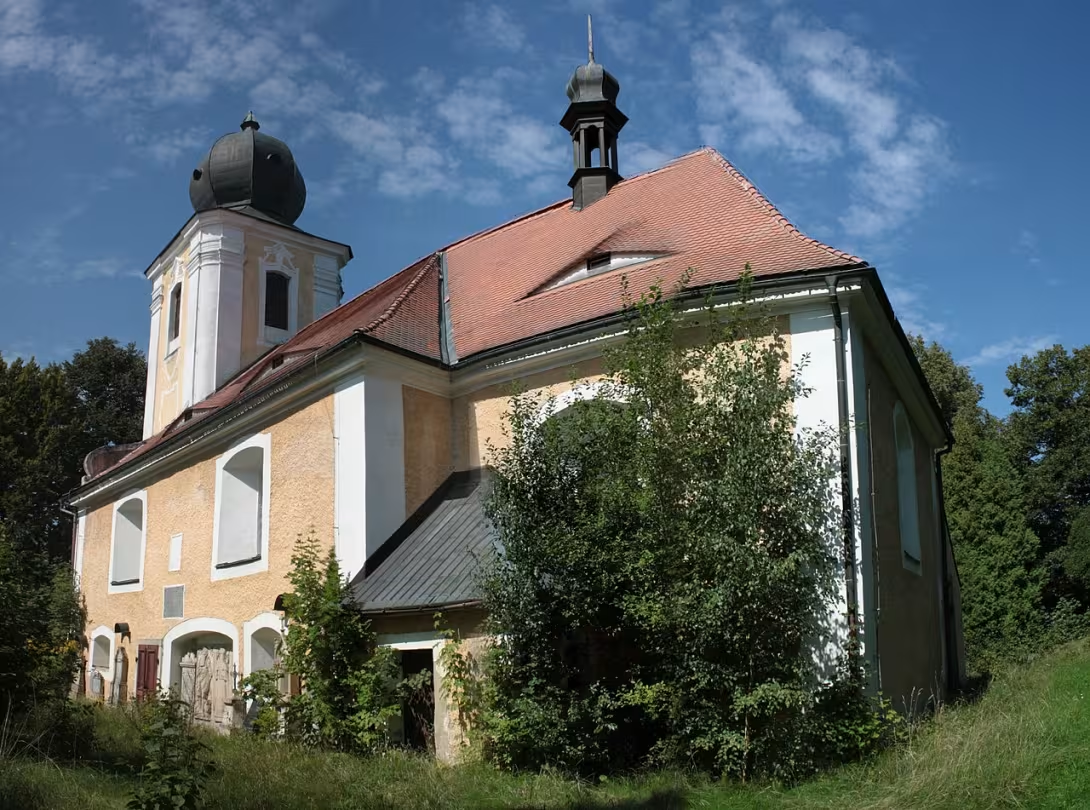
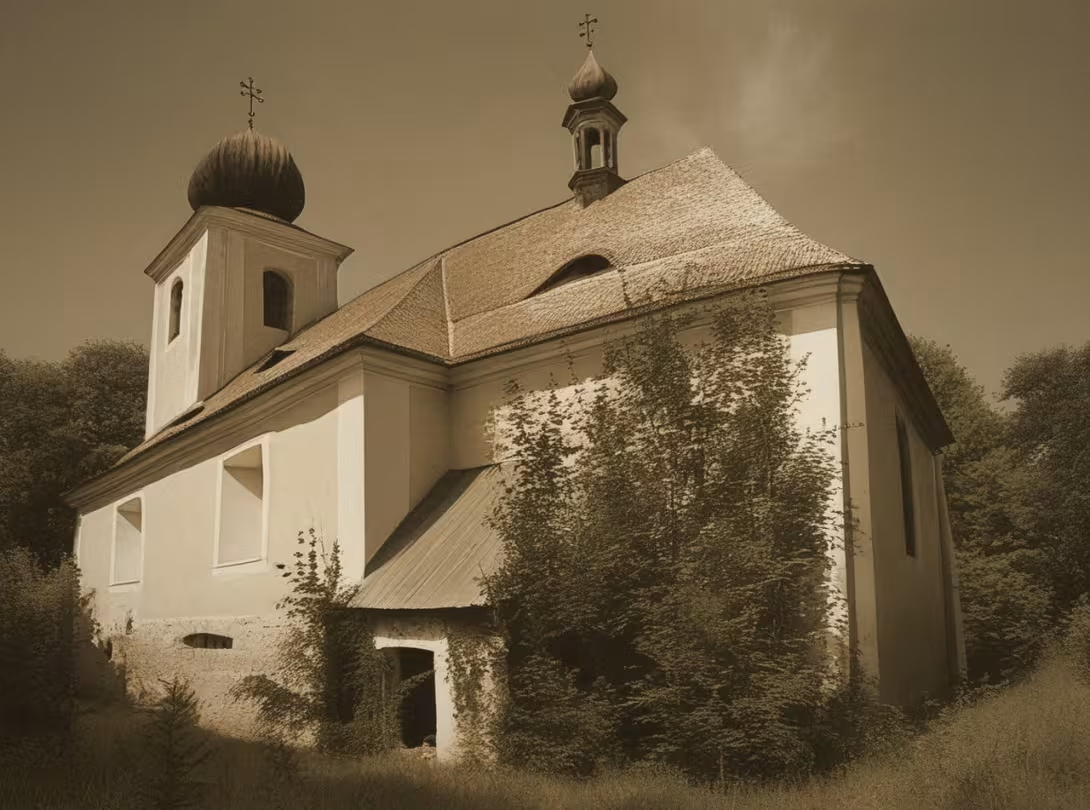
The historical appearance on the left is an AI-generated visualisation and serves as inspiration only.
Historical milestones
- before 1346
- Establishing St. Helena's Church in Gothic style
- 1769-1771
- Baroque reconstruction according to the design of Johann Josef Kuntz
- 1895
- Replacing the main altar for pseudo-Romanesque with the image of St. Helena
- 1904
- Repair of organ by Schuster und Sohn
Architectural development
The original Gothic single-boat structure with rectangular plan and presbytery was extended with sacristy and other spaces. In 1725, a prism tower was built with onion dancing. The interior was modified in the 19th century with new altars and organas. The emblem of the presbytery is cross, the ship has a flat ceiling and the circle is wooden.
Historical events
- before 1346
- Establishing a church in Gothic style
- 1769-1771
- Baroque reconstruction according to designs by Johann Josef Kuntz
- 1992
- Church fire and subsequent reconstruction
Points of interest
- The only church in the Czech Republic dedicated to St. Helena.
- The Gothic original building was built before 1346, later in 1769-1771 it underwent Baroque reconstruction according to the designs of Johann Josef Kuntz.
- The granola tower with onion fighting was not built until 1725.
- The interior dominates the pseudo-Romanesque main altar from 1895 with the image of St. Helena by Johann Grusso from 1841.
- The organ of 1803 from Ambroz August Tauchman was repaired in 1904 and expanded during World War II, the original positive still serving as a set.
Guide
This guide is narrated by a synthetic voice generated by artificial intelligence.
Show guide text
This text was created by artificial intelligence and has not been editorially reviewed. It may contain inaccuracies.
The Church of Saint Helena stands in Krásný Les, a village in the Frýdlant protrusion in the north of the Czech Republic. It is the only church dedicated to this saint in the Czech Republic. It is a cultural monument together with the neighboring rectory and the adjoining cemetery.
The church was built in Gothic style, already before the year 1346. Between 1769 and 1771 it underwent Baroque modifications. These were carried out by Thun according to designs by Johann Josef Kuntz. Later the church was repaired several times, in 1840, 1881, and then between 1895 and 1897. In 1992 it was struck by fire, after which it underwent reconstruction.
It is a single-nave structure with a rectangular floor plan and a square presbytery. From the north side it is adjoined by a rectangular sacristy, and from the south side of the presbytery there is another space with a square floor plan. On the west side stands a prismatic tower from 1725. In its lower part there is a semicircular portal and a window with a segmental arch and a cornice. The upper part is decorated at the corners with pilasters and rectangular windows, again with segmental arches. The tower is topped with a bulbous cupola.
Inside, the presbytery has a cross vault, while the nave has a flat ceiling. The space under the tower is covered by a wooden beam ceiling. The gallery is wooden, with three arms, and is supported by wooden pillars.
The interior furnishings date mostly from the nineteenth century. Apart from two side altars, there is a pseudo-Romanesque main altar from 1895. On it is a painting of Saint Helena, which Johann Gruss from Litoměřice painted in 1841. Older is the Rococo pulpit from 1787. It was created by Anton Suske and decorated with cherubs and a relief of the Good Shepherd. On the walls hang paintings with scenes from the life of Jesus Christ from the first half of the nineteenth century. The baptismal font dates from 1824.
The organ has an interesting history. In 1803 the organ builder Ambrož Augustin Tauchman built a two-manual instrument with a positive in the front of the gallery, and received 750 gold for it. In 1904 Schuster repaired the instrument for 202 crowns. Around 1940 the Liberec branch of the firm Schuster und Sohn built new organs. The original Tauchman positive was preserved in the process and today serves as a backdrop. The front organ case is Rococo and is decorated with cherubs with musical instruments. The rear case was altered later.
Frequently asked questions
Can the monument be visited?
Religious buildings are usually open mainly during services; at other times a visit is normally arranged with the parish or the operator. We have not verified specific times.
Where is the monument?
Location: Krásný Les, Liberecký kraj. The map on this page shows the exact spot.
Why is the monument protected?
It is listed in the Central List of Cultural Monuments of the Czech Republic as a cultural monument (register no. 15124/5-4343).
For kids
Imagine going back to the past, until the Czech Republic was not yet a separate country. It was a time when the Czech countries were part of Austria and when you went on your way to the city where the church of St. Helena stands today, you had to walk through narrow streets and spas.
At the time, there were people who lived here for a living in agriculture and trade. Kostel svaté Heleny was their last stop before leaving for the next town or village. It was a time when people were close to nature and God.
Businesses nearby
Do you run a restaurant, accommodation, shop, museum, rental, wellness or other visitor service near this monument? Show yourself directly to the people heading to it — this is how they will see you in the app and on the web:
Events nearby
Zdroj akcí: otevřená data měst a obcí ČR (Národní katalog otevřených dat) a kalendář akcí Národního památkového ústavu.
Accommodation nearby
Trips and activities nearby
Guided tours, tickets and activities nearby from GetYourGuide
Affiliate link: if you buy from the partner, we may receive a commission. The price for you does not change.
Search tours and activities →Themed route
Thematic cruise route: Krásný Les - spiritual and historical treasures
1.Kostel svaté Heleny The Baroque church of the 18th century, dedicated to St. Helena, is the heart of the village. Its interior with original painting and historical furniture is worth visiting for an authentic religious and artistic impression. Around the cemetery with a fenced wall, which is part of the complex, you can walk around and enjoy a quiet atmosphere.
2. Fara in Beautiful Forest The adjacent Baroque rectory from 1716 is an excellent example of rural architecture. Visit it for its historical value and the opportunity to look at the original interiors that preserve the original character. It's an ideal stop after visiting the church because it's just a short walk away.
3. Classicist Chapel A small but aesthetically impressive chapel from the end of the 18th century is an example of the classical style in the region. Its simple but elegant architecture and quiet environment offers an opportunity to relax and reflex. It is also close to the church and the rectory.
4. Walk around the cemetery with a wall The cemetery, which is part of the church area, is old and has an original fenced wall. The walk around it offers the opportunity to learn local history and tradition of burial. It is also an opportunity to relax and enjoy a quiet environment that is typical of this area.
The route is designed to be logical and allow visitors to know the main sights of the village and their interconnections.
Seasonal recommendations
Spring Kostel svaté Heleny in Beautiful Forest turns into a picturesque oasis in spring, when its stone walls are reflected in blooming trees and bushes around it. The light of the sun, which begins to remain longer in the sky, creates playful shadows on frescoes inside, while cherries and apple trees bloom outside in the surrounding gardens. The atmosphere is quiet, almost intimate, because tourists have not yet started coming in such numbers as in summer. It is recommended to visit the church in March or April, when nature is still fresh and warm. The clothes are suitable for layered wear - it is cold in the morning, but the sun heats up after noon. The ideal time is the afternoon when the sun shines directly into the interior and reveals details of the painting decoration. Avoid weekends where local families take trips.
Summer In the main summer season, St. Helena's church becomes a popular destination for tourists who come here not only for its historical value, but also for surrounding nature. Warm sunny days and long evenings create a pleasant atmosphere, but they also mean greater attendance, especially in July and August. The inside of the church is lit directly by the sun, which creates dramatic effects on the stained glass and altar. It is recommended to arrive early in the morning to avoid crowds, or in late afternoon hours when visitors begin to return home. Suitable is light but sun protective clothing, hat and water. In the vicinity of the church you can relax on benches or see the surrounding forests that are green and full of life in the summer.
Autumn Autumn brings golden leaves and a calm atmosphere to the Beautiful Forest, which is ideal for romantic walks or photography. Kostel svaté Heleny at this time seems mysterious and nostalgic, when its shadows extend and the light of the sun illuminates it from the side. In November, when leaves start to change, the visit is particularly picturesque. It is recommended to visit the church in October or November, when the weather is still stable and the temperatures are pleasant. Suitable is warm but not too heavy clothing because the weather can change quickly. The best time is the afternoon when the sun shines enough, but not too strong. Avoid rainy days when the roads to the church can become muddy.
Winter The winter visit to St. Helena's church offers a unique atmosphere where the white snow blanket reflects on its stone walls and creates a fairy tale impression. Freezing air and a quiet environment give the church a mysterious character, especially in advent time, when candles and Christmas decorations light up in the surroundings. The interior of the church is warm and cosy, which is ideal for relaxation from winter cold. It is recommended to visit the church in December or January when the snow cover is the densest and most beautiful landscape. Suitable is warm but comfortable clothes that protect against freeze but do not restrict movement. The best time is this afternoon when there's enough light outside, but the inside is already lit.
Visualizations and artistic views


The visualisations are generated by artificial intelligence and serve as inspiration.
Photos from the area
Real photos taken near the monument


Zdroj a licence jsou uvedeny u každého snímku.
Atmosphere of the place
This atmospheric visualisation of the place and period was generated by artificial intelligence. It is not real footage of the location.
Tips from visitors
No tips yet. Be the first!
Log in and add your tip.
Sources and literature
Photos: Jan Polák / CC BY-SA 3.0, rozlišení zvýšeno umělou inteligencí — Wikimedia Commons. The author and licence also appear when you hover over the image.
Faktickým podkladem tohoto textu byl článek na Wikipedii, jehož autory jsou přispěvatelé Wikipedie. Článek je dostupný pod licencí CC BY-SA 4.0.
Location on the map
Příběhy a pověsti
Legendy, pověsti a příběhy spjaté s touto památkou
Fotografie návštěvníků
Zatím žádné fotografie. Buďte první, kdo přidá fotografii z návštěvy!
Log in a přidejte svou fotografii nebo hodnoťte.
Za ověřenou návštěvu v aplikaci získáte víc bodů — poznáme podle GPS, že jste na místě.
Reviews and comments