






Kostel svaté Kunhuty (Kostelec) Church
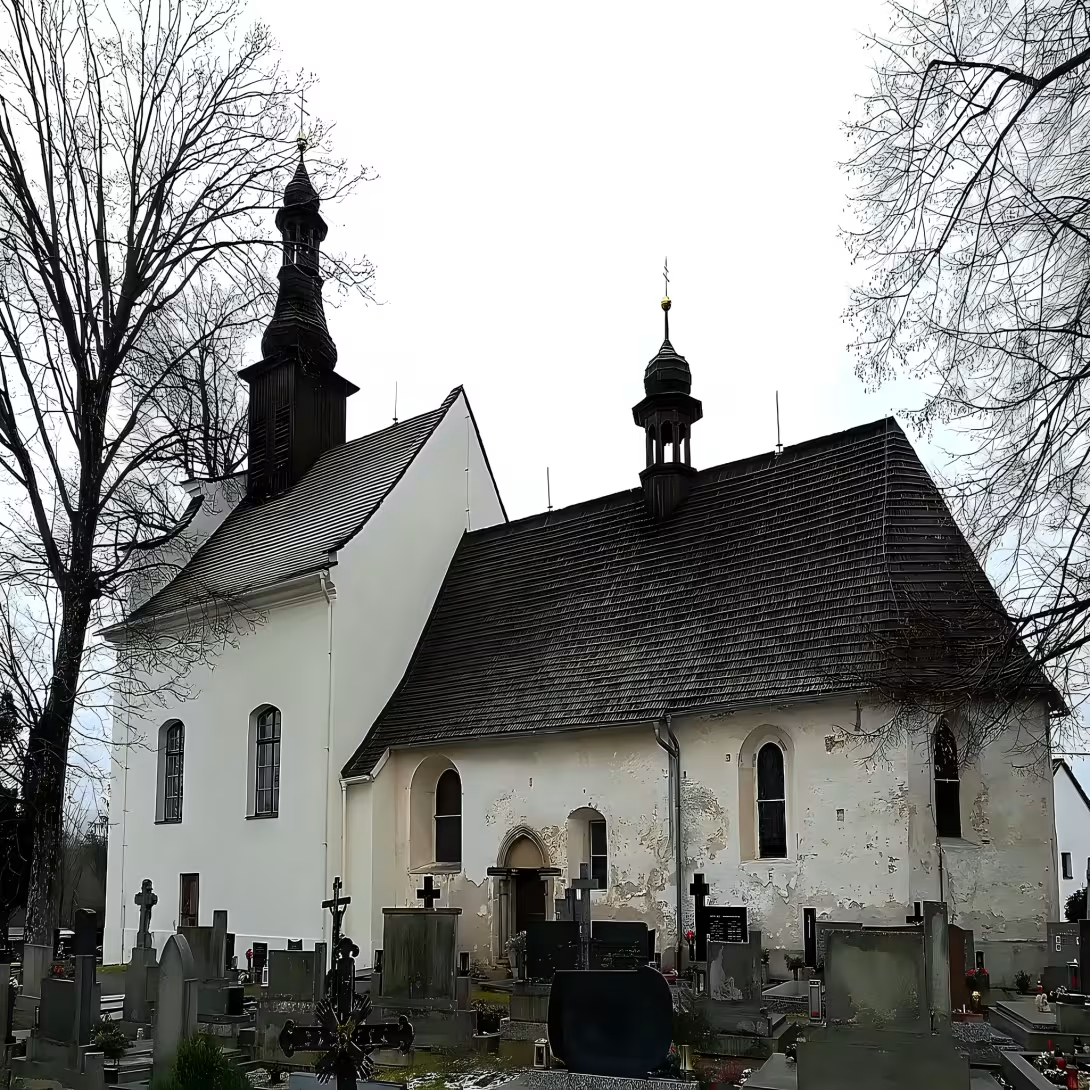
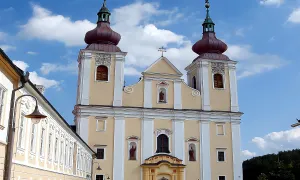
The Church of Saint Kunhuta in the Church stands as evidence of architectural evolution. It blends the origin of Romanesque with Gothic modifications and later classic expansion. This historic monument is located on a hill overlooking the river Jihlava and offers a wonderful view of medieval and classical architecture. The unique design church includes a five-sided Gothic chancel, a preserved winch Romanesque and a significant 19th century extension that highlights its architectural importance.
Originally built in the middle of the 13th century as a Romanesque structure on the site of an older wooden chapel, the Church of Saint Kunhuta was built at a time when Bohemia, part of the Holy Roman Empire, experienced considerable architectural development influenced by Romanesque styles. The original design represented the elongated end of the winch in a semi-circular apse and south portal. Gothic adaptations were introduced by the 15th century, including replacing the original apsy with a larger polygonal cannon decorated with oblique windows, alongside the sacristy construction on the north side.
The architectural journey continued until the 17th century when the ship received the vault of the barrel, thus increasing structural integrity and aesthetic attraction. A significant transformation occurred in 1803 under the guidance of architect Josef Dewez, which led to a significant expansion of the accommodation of 700 parishioners. This classic addition included the construction of a significant rectangular extension on the west side of the church, which included a new main entrance. Stonemason Johann Zeißl supervised his execution and completed it around 1805.
The church of St. Kunhuta shows a harmonious blend of styles. Its origin is evident in a preserved ship with its original southern portal, while the Gothic influences appear in a five-sided office and inclined windows. Classic expansion is characterized by a symmetrical facade of western addition, with pilasters and decorative shield. Inside, the church boasts elements such as the main altar from the end of the 18th century, the stone christening font from 1623 and the bell from 1546. Several tombstones from the beginning of the 17th century are located outside the southern portal.
Today, the church of St. Kunhuta stands on the west edge of Kostelka, surrounded by a cemetery enclosed by a wall. Jihlava River flows around this area, increasing its picturesque beauty and making it an attractive destination for visitors who are interested in history and architecture. Its status as a cultural monument underlines its importance and ensures its preservation for future generations.
Visiting St. Kunhuta Church offers a unique opportunity to explore a place that includes centuries of architectural evolution. Its mixture of Romanesque, Gothic and classical elements provides a rich tapestry of historical views, making it a target for anyone interested in the architectural heritage of the Czech Republic.
Then and now
Drag the slider to compare how the landmark may have looked when it was built with the view today.
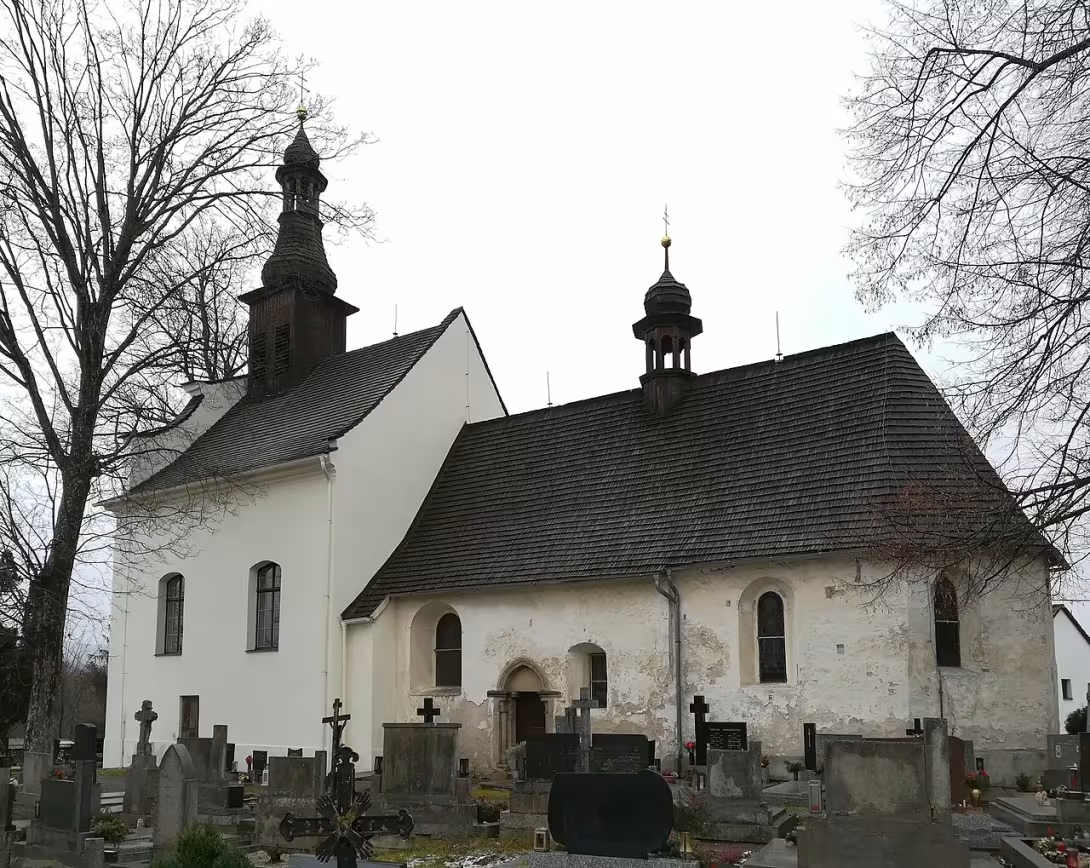

The historical appearance on the left is an AI-generated visualisation and serves as inspiration only.
Historical milestones
- mid- 13th century
- Construction of the original Romanesque church.
- 15th Century
- Gothic modifications including new pods and sacristy.
- 1803
- The main expansion with the new western boat the addition of Josef Dewez.
Architectural development
The Church of Saint Kunhuta began as a Romanesque structure in the mid-13th century. In the 15th century he underwent Gothic modifications, including extended polygonal office and sacristy. The 17th century saw an increase in the barrel arched into the ship. Significant classical expansion was created in 1803 with a new expansion of the western ship, which was designed by Josef Dewez.
Historical events
- mid- 13th century
- Construction of the original Romanesque church on the site of the older wooden chapel.
- 1803
- The main expansion led by architect Josef Dewez to increase capacity for 700 parishioners, including the addition of a new western ship.
Points of interest
- The Church of Saint Kunhuta is a unique five-sided Gothic chancel is a rare architectural feature that distinguishes it from other churches in the region and reflects the innovative spirit of Czech architecture of the 15th century.
- During its construction and subsequent modifications, the church was influenced by wider political and cultural shifts within the Holy Roman Empire, which included changes in artistic taste and technological progress in building techniques.
- Significant classical expansion in 1803 not only increased the capacity of the church, but also reflected the period of architectural revalalism, which sought to harmonise older styles with the newer classical elements, which at that time showed evolving aesthetic preferences.
- The bell placed in the church, occupied in 1546, is an interesting artifact from the Renaissance era, potentially used during major historical events or local festivals, adding layers of cultural history beyond its religious function.
- Located on the hill overlooking the Jihlava River, the church location was strategically selected for both defence purposes and providing commanding views, highlighting how geography played a role in planning medieval planting.
Guide
This guide is narrated by a synthetic voice generated by artificial intelligence.
Show guide text
This text was created by artificial intelligence and has not been editorially reviewed. It may contain inaccuracies.
The Church of Saint Kunhuta in Kostelci stands on a promontory surrounded by the Jihlava River, on the western edge of the village. In one structure it combines three styles: Romanesque nave, Gothic chancel, and Classical addition. It is protected as a cultural monument.
The brick Romanesque church was built in the mid-thirteenth century on the site of an older wooden chapel. It consisted of a rectangular nave with a flat ceiling, closed on the east by a semicircular apse. Entry was through a portal in the south wall of the nave.
In the mid-fifteenth century the apse was demolished. It was replaced by a larger polygonal chancel with pointed arch windows, and at the same time a sacristy was added on the north side. In roughly the second half of the seventeenth century the nave received a barrel vault. At that time or later the sacristy was torn down except for its west wall and replaced by a larger one. Even before this major reconstruction a storage room was added to it.
The decisive change came in eighteen hundred and three. The architect of the provincial building administration, Josef Dewez, then designed a reconstruction that was to enlarge the church to accommodate seven hundred parishioners. To the old nave a massive rectangular addition was attached to the west. The original west facade was torn down and the main entrance was moved to the facade of the new section. The construction was carried out by master builder Johann Zeißl and was completed probably in eighteen hundred and five. In eighteen hundred and twenty-four a wooden bell tower was built, and in eighteen hundred and ninety-eight a sanctus bell tower was added above the old part of the church.
Today the church is an oriented longitudinal structure. The five-sided Gothic chancel is followed by the original Romanesque nave at the same width, which retained its entrance portal on the south side. Behind it follows the wider Classical addition. The facades are smooth, only the west facade has a gable and is articulated by pilasters. The chancel is covered by a fan-ribbed vault, both naves and the sacristy have barrel vaults with pendentives. The sacristy is entered through a stone portal in the north wall of the chancel. In the western part stands a music gallery vaulted by a cross vault.
The furnishings are notable for the main altar from the second half of the eighteenth century and a stone baptismal font from sixteen hundred and twenty-three. The bell in the tower is dated to fifteen hundred and forty-six.
The church is surrounded by a cemetery with a surrounding wall and gate on the east side. Before the south portal, tombstones from the first half of the seventeenth century are laid in the ground. To the east near the chancel stands a stone shrine from seventeen hundred and fifty-two, which was moved here.
Tips for visitors
The best time to visit St. Kunhuta's church in Kostelka is at the end of spring or early autumn when the weather is pleasant, and the surrounding landscape is especially beautiful with flowering flowers or colorful leaves. These seasons offer a comfortable climate for exploring both the church and its picturesque surroundings, including nearby Jihlava River, which increases the charm of the area.
When planning your visit, consider bringing comfortable walking shoes as you wish to explore the area around the church, including its cemetery. To capture architectural beauty church and picturesque views along the river Jihlava is recommended camera. In addition, wearing a light jacket could be useful with respect to variable weather conditions.
For photographic enthusiasts, some of the best places include the western edge where the church stands, offering panoramic views of the surrounding landscape. Early morning or late afternoon provides soft lighting ideal for capturing complex details of architecture church and quiet river background.
Families with children will look forward to exploring nearby attractions within 30 minutes drive from Kostelce. The Jihlava River is ideal for a peaceful walk, offering opportunities to observe local wildlife and enjoy nature. The historical center Jihlava also provides various cultural experiences suitable for all ages.
Frequently asked questions
Can the monument be visited?
Religious buildings are usually open mainly during services; at other times a visit is normally arranged with the parish or the operator. We have not verified specific times.
Where is the monument?
Location: Kostelec, Kraj Vysočina. The map on this page shows the exact spot.
Why is the monument protected?
It is listed in the Central List of Cultural Monuments of the Czech Republic as a cultural monument (register no. 20578/7-4944).
Businesses nearby
Do you run a restaurant, accommodation, shop, museum, rental, wellness or other visitor service near this monument? Show yourself directly to the people heading to it — this is how they will see you in the app and on the web:
Nearby
the church is situated on the west edge of Kostelec, surrounded by a cemetery bounded by a wall. Jihlava river flows around this area, increasing its picturesque beauty.
Accommodation nearby
Trips and activities nearby
Guided tours, tickets and activities nearby from GetYourGuide
Affiliate link: if you buy from the partner, we may receive a commission. The price for you does not change.
Search tours and activities →Themed route
Thematic Travel Route: Church of St. Kunheluv Churches
1.Kostel svaté Kunhuty (Kostelec) - * Type: * Historical church - * Why is it worth a visit: * This baroque church, which is postulate at the beginning of the 18th century, is not only the spiritual centre of the village Kostelec, but also architectural pearls with rich history and artistic elements. It is of the opinion that these are beautiful goods and frescoes.
2. The cemetery at St. Kunherald's Church - * Type: * Historical cemetery - * Why is it worth visiting: * Border wall, this hrytov is a quiet bridge with historical possibilities and monuments that will go to smaller numbers. It's an ideal place to think and understand the days of the Church.
3. Zimbabwe creek - * Type: * Natural water - * Why is it worth visiting: * Tok islava, which surrounds the church and the glitter, transfers to the region a calm and pitresspire. Its sounds and views of water can provide relief from everyday life.
4. The rear district of Kostelce - * Type: * Urban products - * Why is it worth a visit: * Walk around the back of the village offers a view of the main architecture and nature of the landscape, which revives the flow of supralava. It is an ideal place to relax and design a rural project.
5. Church tank - * Type: * Open public space - * Why is it worth visiting: * The nation at the church offers a place to relax and reflect. It is so big that for a photographic church from different hives, it allows it to capture beauty in various world support.
This route offers on the basis of the possibility of obtaining the historical and cultural material of Kostelka while owning liquid products that are the subject of sale.
Seasonal recommendations
Spring: A visit to the Church of St. Kunhela in the spring period of the acquired one-way experience, when nature drifts and the church is enlightened by sunny goods. Flowers around the monument determine decomposition, which gives a vivid and colorful impression. The atmosphere is quiet with mild crowds, which from other provisions set up by ideal things for relaxing products. It is recommended to wear warm clothes that have a cool morning and evening, but the umbrella is also applicable during bright hours today. The best time for difficulty is at noon when the temperature rises and you can get demanding beauty without the risk of cold.
Summer: During the summer period, the Church of St. Kunhwed offers a live live with full quotas and green leaves, which relates to beautiful permits for photography. The sunny day makes bone architecture in the best light. I deter that it is historical details. In this season, the holidays may take place, especially during summer holidays, and it is advisable to arrive early before the trip to ensure a quieter piercing. The warm siege is supplied together with the sun courier and sun, which is designed to increase the mean speed.
Autumn: Autumn the conversion of the Church of St. Kunheran to a common common spectrum with leaves in various downtimes, orange and red. Sunshine enlightenment is valid for viewing the cube, but the length of the day is assessed, so it is better to arrive early at noon. The atmosphere is calmness with a minor element in the context with a light field, which allows in its activities based on and relaxing. The warm round is an important amount of cold morning and evening, while short gloves can be usable in late supported days.
Winter: In the country, the Church of St. Kunhewed is surrounded by quiet and peaceful profiles, where the lubricating air and snow present the romantic atmosphere. The sunny settlement of the extracted dramatic stalls at the church, which means architectural details. The warm round is persistent for the use of passing days and the legs are traffic if there is snow on the ground. The remaining amounts encourage liquid space without large crowds, which allows the soul to calm down and appreciate historical beauty in moderation.
Visualizations and artistic views


The visualisations are generated by artificial intelligence and serve as inspiration.
Photos from the area
Real photos taken near the monument


Zdroj a licence jsou uvedeny u každého snímku.
Tips from visitors
No tips yet. Be the first!
Log in and add your tip.
Sources and literature
Photos: RomanM82 / CC BY-SA 4.0, rozlišení zvýšeno umělou inteligencí — Wikimedia Commons. The author and licence also appear when you hover over the image.
Faktickým podkladem tohoto textu byl článek na Wikipedii, jehož autory jsou přispěvatelé Wikipedie. Článek je dostupný pod licencí CC BY-SA 4.0.
Location on the map


Příběhy a pověsti
Legendy, pověsti a příběhy spjaté s touto památkou
Příběh: Kostel svaté Kunhuty (Kostelec)
Bylo to v pondělí ráno, kdy Jakub zjistil, že jeho život je na pokraji propasti. Kostel svaté Kunhuty se rozprostíral jako monumentální obraz před ním — stře…
Číst příběh
Pověst: Kostel svaté Kunhuty (Kostelec)
Podle místní pověsti, jež se v Kostelci přenášela z pokolení na pokolení, nestál na návrší nad řekou Jihlavou od počátku žádný zděný kostel. Dávno před tím, …
Číst příběhFotografie návštěvníků
Zatím žádné fotografie. Buďte první, kdo přidá fotografii z návštěvy!
Log in a přidejte svou fotografii nebo hodnoťte.
Za ověřenou návštěvu v aplikaci získáte víc bodů — poznáme podle GPS, že jste na místě.
Reviews and comments