






kostel svaté Markéty (Dolní Bobrová) Church
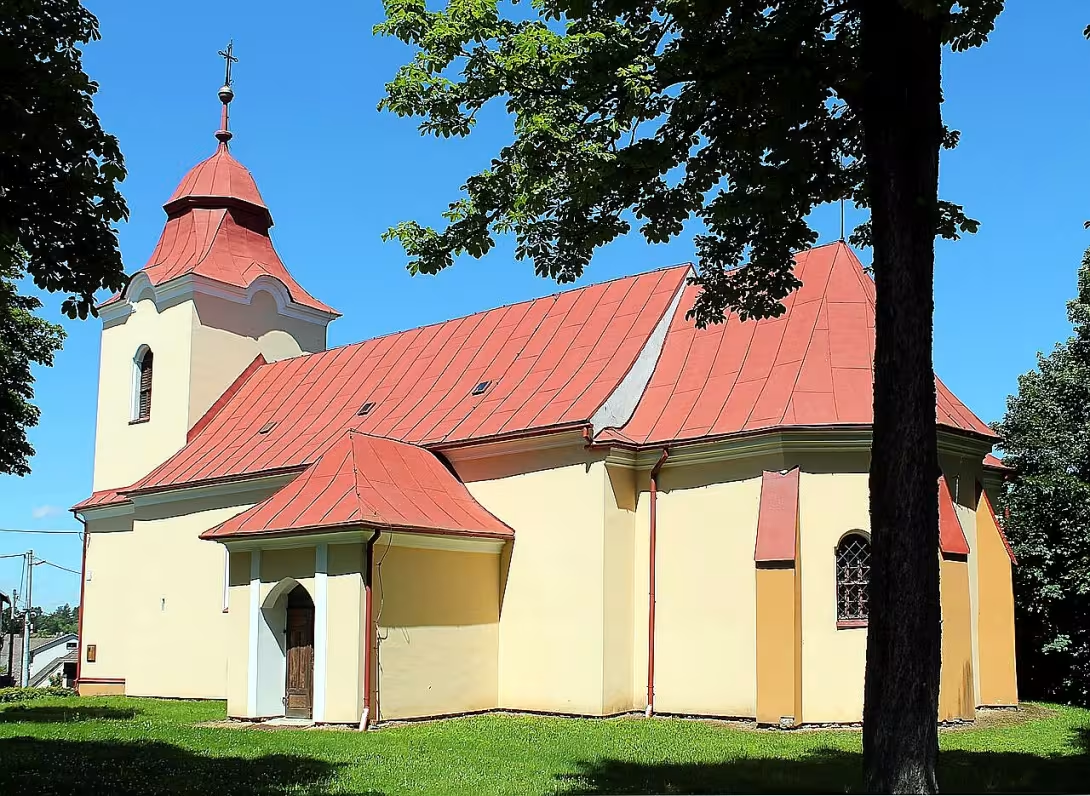
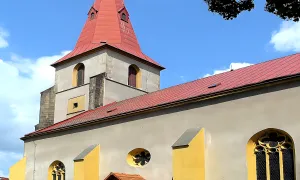
St. Margaret's Church is a philic church of the Roman Catholic parish Bobrová, located on the village square in its part Dolní Bobrová. It is a single-boat construction with a Gothic core, which is characterized by a polygonal conclusion supported by supporting pillars and a maple tower on its front. The construction is protected as a cultural monument of the Czech Republic.
The church was built in the late Middle Ages between 1250 and 1300 in the Gothic style. Its architecture is based on the building traditions of the period when goth firmly settled in Czech countries. The original building has until now preserved its fundamental character, thereby preserving the authenticity of its creation.
Over the centuries, the inside of the church has enriched itself with new elements. The church contains three altars: the main one is dedicated to its patron saint St. Margaret, while the two side altars are dedicated to St. John the Nepomuk and St. Anthony. These side altars were built in a later period, namely between 1880 and 1910, as evidenced by the interest of believers in gradually improving the sacral space.
Among the most valuable parts of the equipment are the statue of Saint Margaret, created by Ferdinand Lichta in 1803. This sculpture still adorns the church space. Fifteen years later, in 1818, an organ was taken into the church, which belonged to another important element of his equipment and certainly increased the ceremonies of liturgical ceremonies.
The church area was also evolving. Until 1860, the cemetery stood around the building, which was therefore part of the everyday life of the community and formed an integral whole with the church. Later, his function changed or he stopped being up to date.
In the recent past, in 2015, Pavel Štyl prepared a paper model church. This project shows a lasting interest in the memory and in the various ways in which we can preserve it and develop awareness of its historical value. So St. Margaret's Church is not only a place of religious will, but also a testament to the long history of Beaver and Central European sacral architecture.
Then and now
Drag the slider to compare how the landmark may have looked when it was built with the view today.
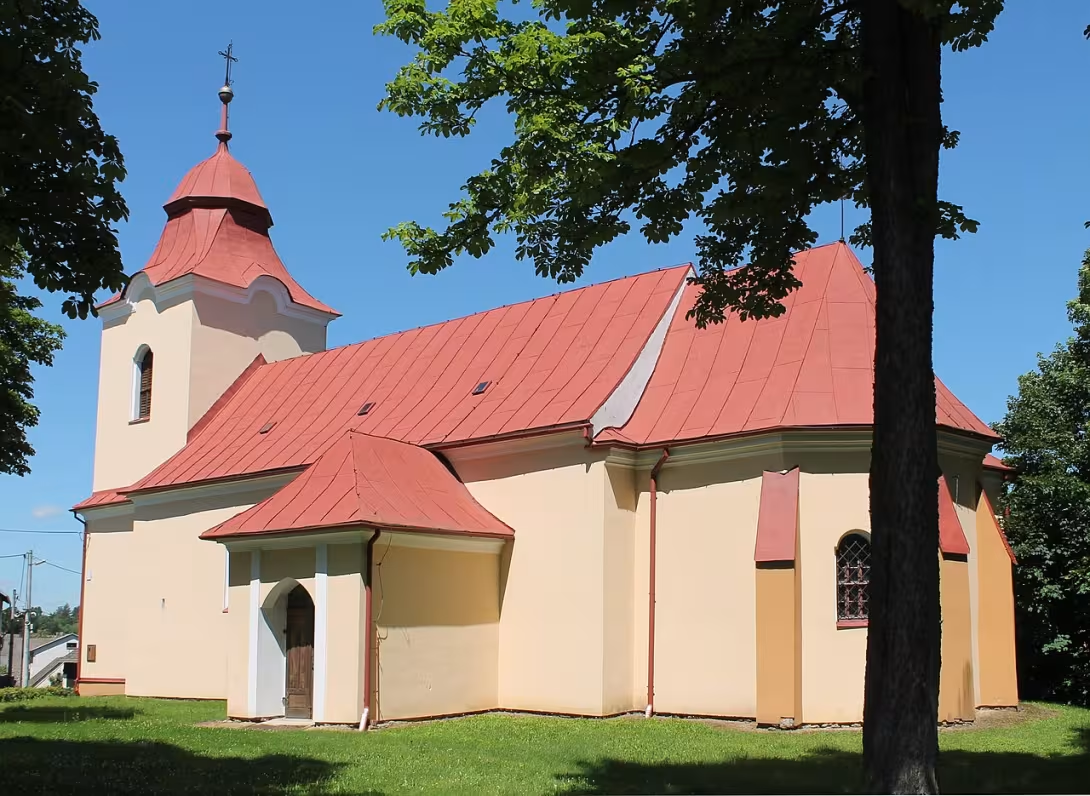

The historical appearance on the left is an AI-generated visualisation and serves as inspiration only.
Historical milestones
- 1250-1300
- formation of church in gothic style
- 1803
- acquisition of the statue of Saint Margaret by Ferdinand Licht
- 1818
- acquisition of organ
- 1860
- the destruction of the cemetery around the church
- 1880-1910
- building two side altars dedicated to Jan Nepomuk and Saint Anthony
- 2015
- a paper model of the church Pavel Štylem
Architectural development
The church was created as a Gothic one-boat building with a polygonal finish and a prism tower in the facade. In later periods, new altars and organ were installed in the interior. The tower is covered with a mansard helmet.
Historical events
The original Gothic church was built between 1250 and 1300. Until 1860, the church area was used as a cemetery.
Points of interest
- The church is a single-storey building with a Gothic core, a polygonal conclusion with supporting pillars and a moth tower. - The construction was built in the late Middle Ages between 1250 and 1300 in a Gothic style. - The side altars dedicated to St. John Nepomuk and St. Anthony were built between 1880 and 1910. - Among the most valuable equipment is the statue of Saint Margaret by Ferdinand Licht from 1803 and the organ acquired in 1818. There was a cemetery around the church until 1860.
Guide
This guide is narrated by a synthetic voice generated by artificial intelligence.
Show guide text
This text was created by artificial intelligence and has not been editorially reviewed. It may contain inaccuracies.
Welcome to Lower Beaver. You just stopped in front of one of the most important historical points in this area, in front of St. Margaret's Church. Before you take your first step towards his door, I suggest you stop for a moment, soak up the atmosphere of this place and just look at it. You're standing in front of a building that's not just a building made of stone and mortar, but it's a living witness for centuries that lasts here while the world around it keeps changing. Feel the calm that radiates this place, and realize that right now you're entering the space where medieval history meets with modern care for our heritage. This building is protected as a cultural monument of the Czech Republic, which clearly tells you how much value this monument has for our region and our history.
Let's look together at how this story began. If you look around now, you may not realize how deep your eyes go into the past. The foundations and the very core of this church come from the late Middle Ages, namely between 1250 and 1300. Imagine that time, an era of Gothic style, when buildings were built with an emphasis on height and spiritual nobility. Although the church changed and supplemented over hundreds of years, its Gothic character remained its most important foundation. This building stood here at a time when the entire destinies of the people of this landscape were forming, and although the times were changing, this Gothic core remained unwavering.
Now pay attention to the architecture surrounding you right now. Please look up to the main dominance of the entire building. There's a prism tower above your heads. Notice her appearance and how she dominates the whole neighborhood. Her profile ends with a segmentally serrated ledge and climax with a mansard helmet, which is closed with a tip. This tower serves as an orientation point not only for villagers, but also for every pilgrim who moved here. If the view is now transferred below to the physical nature of the church itself, you will see that it is a single-storey building. This means that internal space is uniform, without complex separation, which creates a sense of tonnage and unity.
Look at the back of the building, at the end. It's a polygonal conclusion, which means that instead of a flat wall, you'll find a polygonal shape here. In order for this structure to be stable and able to carry the weight of the roof, it is divided by supporting pillars. These pillars are not only functional elements that ensure the strength of the entire building, but also create interesting rhythm and shadows on the walls of the church. This combination of the Gothic nucleus and these architectural elements gives the church its unmistakable face.
Now that you're preparing to enter, allow me to prepare you for what awaits you inside. The interior of the church is rich in spiritual and artistic symbols. You'll see three altars that form the heart of this sacral space. Each one tells a different story and comes from a different period, which carries a beautiful contrast between the old and the new. Note also the historical organ that sounds here and which is an integral part of the overall experience of this place.
But the history of this place is closely linked to specific names. May you be interested in the character of Ferdinand Licht. It was in 1803 that he created a statue of St. Margaret, which is essential to this church. Imagine the effort and artistic talent that was needed to make this statue part of this sacred space. Another important moment was the acquisition of the organ in 1818, which brought to the interior a new dimension of sound beauty. And if you look at the side altars that were built later, between 1880 and 1910, you will see works dedicated to St. John Nepomuk and St. Anthony. These altars are proof that the church was a constantly living place that people have constantly improved and maintained over the centuries.
There is, however, one less visible, even a little mysterious aspect of this place. Maybe looking at the surrounding terrain, you're wondering where the cemetery should be. The fact is, the cemetery around the church died in 1860. This means that even though we see only the church today, people from surrounding generations once rested in this space. It is a reminder of the fleeting of life and also of how deeply the church is rooted in the history of local families. This invisible layer of history gives the place special weight and depth.
However, in order to remember that history is also made in our present time, we must also mention a modern connection with this monument. In 2015, the artist Pavel Štyl created a paper model of this church. This is an interesting way for modern people to try to understand and preserve the form of historical buildings. This model allows us to see the church from a different angle and on a different scale, which helps us better appreciate its architecture and complexity.
Now, I'm asking you to reconstruct your journey from the outside for an inside search. Step up to the door and enter the silence that awaits you. Look at the three altars I mentioned, pay attention to their details and try to see the atmosphere created by the historical organ and architecture itself. Let yourself be carried away by the feeling that you are part of something far greater than the moment you are in. Thank you for choosing this very monument. We wish you a beautiful and inspiring encounter with history at St. Margaret's Church.
Tips for visitors
The best time to visit St. Margaret's church in Lower Beaver is autumn or spring, when the landscape frame around the church is particularly charming and nature offers beautiful colors. This period also suits photography thanks to ideal light conditions.
Parking can be found near the church, but due to limited capacity we recommend using public transport. You can find the current connection using an online search engine or by contacting local transport services.
When visiting, bring shoes suitable for walking on more permanent surfaces, because the path to the church can be difficult in winter or rainy weather. A protective coat or jacket for possible cold and moist soil is also an additional element.
Photography of the church will offer several interesting perspectives. The best light is usually found in the early morning or in the evening when light is softer and shadow effects add the depth of the picture. The inner parts of the church also offer beautiful possibilities for detailed images.
There are several interesting places around Dolní Bobrová that can be visited within one day. These places include, for example, nature reserves or historical villages nearby. For families with children, a visit to local parks is an appropriate complement, where children can enjoy leisure time.
Frequently asked questions
Is kostel svaté Markéty (Dolní Bobrová) open to the public?
Yes, St. Margaret's Church is open to the public. The opening hours are from 9: 00 to 16: 00.
How do I get to the place by car / public transport?
St. Margaret's Church is located in the heart of the town of Bobrová. The car can be reached by road III / 0005, which leads from Lower Beaver to Upper Beaver. The public transport is available from a nearby city.
How much is the entrance fee and is it paid on the spot?
Payment is made directly at the entrance.
Is the tour suitable for children and seniors?
Yes, a tour of St. Margaret's Church is also suitable for families with children as well as for seniors. The church has accessible staircases and flat areas that allow easy walking.
How long does the tour take?
The tour of St. Margaret's Church takes approximately 30 minutes. However, you can also sit down and relax in a nearby park.
What are the opening times and booking is required?
The opening hours of St. Margaret's church are from 9: 00 to 16: 00. Reservation is not required, but we recommend previous contact information.
What's interesting in the immediate vicinity?
In the immediate vicinity of St. Margaret's Church there is a park with a playground and a spa. There are also several shops and restaurants nearby.
For kids
Imagine going back to the past. The town of Beaver was a small settlement where there were people who lived out of the country making clothes. St. Margaret's Church stood in the middle of the village and was a place where important events took place.
How did it look here? Who lived here? What happened here? The town was surrounded by forests and polems. People lived in small cottages and managed their land. The church was a place where weddings, funerals and other important events were held.
Businesses nearby
Do you run a restaurant, accommodation, shop, museum, rental, wellness or other visitor service near this monument? Show yourself directly to the people heading to it — this is how they will see you in the app and on the web:
Events nearby
Zdroj akcí: otevřená data měst a obcí ČR (Národní katalog otevřených dat) a kalendář akcí Národního památkového ústavu.
Nearby
The village of Beaver
Accommodation nearby
Themed route
1. Church of St. Margaret (sacral monument) - Explore the inner space and spiritual atmosphere of this historic building. 2. The reservoir of the church (area) - Take a walk in the immediate vicinity of the temple and look at its exterior. 3. Exposure in the church (exhibition) - Focus on tour of historical objects and works of art directly inside the building.
Seasonal recommendations
Spring: In the spring period the church of St. Margaret in Lower Bobrová is fertilized by bright sunlight, which emphasizes historical architecture. The green surroundings bring a calm atmosphere when early grass blooms and trees start to sprout. For the visit it is advisable to take a light coat or sweater, because the temperature can be medium to cold. The best time for a tour is in the morning or late afternoon, when the crowds are usually smaller.
Summer: Summer brings a living and warm character to St. Margaret's Church. The sun's rays highlight the colors of historical buildings, while the surrounding forests offer shade and escape from heat. In the main summer season it is recommended to come earlier morning or later in the evening to avoid flooding visitors. Hot clothes and sun protection are key; Do not underestimate the benefits of a hat or parasol.
Autumn: In autumn, St. Margaret's church is surrounded by silver and golden colours of leafy trees, adding melancholy beauty. Solar lighting is less intense, but still creates romantic moods against the background of shrinking days. The temperatures are usually mild, so bring a sweater or a light coat. The best time to visit is in the early afternoon, when the sun rays particularly highlight the colors of autumn.
Winter: Winter Dolní Bobrová offers the Church of St. Margaret a completely different look. Snow cover can add a magical atmosphere, while cold temperatures require solid clothing. The opening time of the monument may be shorter due to weather, so it is advisable to check before visiting. The best time to explore is on the day when the sun lights up the church and at the same time you can enjoy a quiet atmosphere without large crowds.
Visualizations and artistic views


The visualisations are generated by artificial intelligence and serve as inspiration.
Photos from the area
Real photos taken near the monument

Zdroj a licence jsou uvedeny u každého snímku.
Atmosphere of the place
This atmospheric visualisation of the place and period was generated by artificial intelligence. It is not real footage of the location.
Tips from visitors
No tips yet. Be the first!
Log in and add your tip.
Sources and literature
Fotografie: Harold / CC BY-SA 4.0 — Wikimedia Commons. The author and licence also appear when you hover over the image.
Faktickým podkladem tohoto textu byl článek na Wikipedii, jehož autory jsou přispěvatelé Wikipedie. Článek je dostupný pod licencí CC BY-SA 4.0.
Location on the map

Příběhy a pověsti
Legendy, pověsti a příběhy spjaté s touto památkou
Fotografie návštěvníků
Zatím žádné fotografie. Buďte první, kdo přidá fotografii z návštěvy!
Přihlaste se a přidejte svou fotografii nebo hodnoťte.
Za ověřenou návštěvu v aplikaci získáte víc bodů — poznáme podle GPS, že jste na místě.
Reviews and comments